
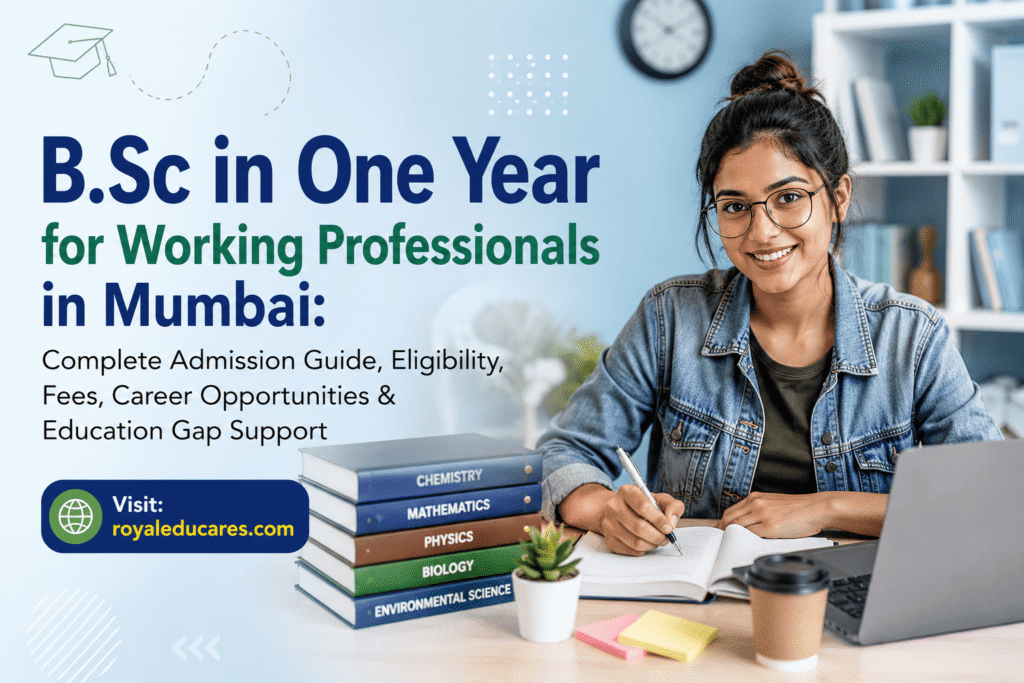
B.Sc in One Year for Working Professionals in Mumbai: Complete Admission Guide, Eligibility, Fees, Career Opportunities & Education Gap Support
Introduction
Many students cannot complete graduation because of work, financial constraints, family responsibilities, health concerns, relocation, or education gaps. B.Sc in One Year offers a practical pathway for eligible learners seeking academic advancement.
Accreditation & Approvals
UGC-DEB APPROVED
AICTE APPROVED
AIU APPROVED
NAAC +++ ACCREDITED

COBSE BOARDS
PHARMACY COUNCIL OF INDIA
BAR COUNCIL OF INDIA

WORLD EDUCATION SERVICES
MHRD

Get Free Career Counseling
Students exploring Graduation in One Year in Mumbai often search for flexible academic guidance that matches their educational background and career goals. Learn more about available options here: https://royaleducares.com/graduation-in-one-year-in-mumbai/
If you are specifically looking for B.Sc admission guidance in Mumbai, including eligibility, documentation, and academic counseling, you can also explore: https://royaleducares.com/b-sc-admission-in-mumbai/
For complete information about higher education, distance learning guidance, and various university admission services, visit: https://royaleducares.com/
What is B.Sc in One Year?
Bachelor of Science (B.Sc) is one of the most respected undergraduate degrees for students interested in science, technology, research, healthcare, education, information technology, environmental sciences, mathematics, and numerous other professional fields.
However, thousands of students across Mumbai are unable to complete their graduation because life often takes unexpected turns. Some begin working immediately after Class 12, while others discontinue studies because of financial issues, family responsibilities, relocation, medical reasons, or personal challenges.
Years later, these students often realize that graduation has become essential for career growth, promotions, government job eligibility, higher education, competitive examinations, or professional recognition.
This is where the concept of B.Sc in One Year guidance for eligible students becomes one of the most searched educational topics in Mumbai.
Rather than giving up on higher education, many learners now seek professional admission guidance to understand the academic pathways available according to university regulations and their previous educational qualifications.
The purpose is not simply obtaining a degree—it is completing unfinished education through the correct academic process applicable to the student’s eligibility.
Why is “B.Sc in One Year” Becoming Popular in Mumbai?
Mumbai is India’s financial capital and home to millions of working professionals.
Many individuals started earning immediately after school because supporting their families became more important than continuing college.
After several years, employers increasingly demand graduation for:
- Career promotions
- Better salary packages
- Government recruitment
- Private company eligibility
- Skill enhancement
- MBA admission
- MCA admission
- MSc admission
- Competitive examinations
- Professional certifications
As a result, search queries such as these have grown tremendously:
- B.Sc admission Mumbai
- B.Sc for working professionals
- Graduation after long gap
- Degree completion Mumbai
- B.Sc admission guidance
- Distance B.Sc Mumbai
- Online B.Sc admission
- Science graduation admission
- Graduation after job
- Graduation with work
These searches clearly indicate that learners want flexible educational guidance without compromising their professional responsibilities.
Who Should Consider B.Sc Admission Guidance?
Every student has a different educational journey.
Some have completed Class 12 with Science.
Some discontinued college after the first year.
Some left education because they needed to work.
Others shifted cities or states.
Many women discontinue education after marriage or childbirth.
Several professionals now wish to upgrade their qualifications for promotions.
Because every educational profile is different, admission guidance becomes extremely important before making any academic decision.
Generally, guidance is beneficial for:
Working Professionals
Employees working in:
- IT Companies
- Hospitals
- Laboratories
- Manufacturing Industries
- Pharmaceutical Companies
- Retail Organizations
- Banking Support Roles
- Logistics Companies
- Service Industries
often require graduation for future promotions.
Students with Education Gap
Education gaps are extremely common today.
A gap may occur because of:
- Family responsibilities
- Financial challenges
- Health issues
- Personal reasons
- Business commitments
- Competitive exam preparation
- Relocation
- Marriage
- Employment
Having an education gap does not automatically mean higher education opportunities are unavailable. The appropriate academic pathway depends on the individual’s qualifications and university policies.
Housewives Restarting Education
Many women pause higher education after marriage.
Years later they wish to:
- Build careers
- Become financially independent
- Apply for government jobs
- Prepare for teaching careers
- Pursue postgraduate education
Professional counseling helps them understand the options available based on their academic history.
Students Planning Government Jobs
Graduation is required for numerous competitive examinations.
Students preparing for opportunities in public sector organizations often first complete their graduation before applying.
Private Sector Employees
Many companies shortlist candidates only if they possess a bachelor’s degree.
Graduation improves:
- Resume strength
- Interview opportunities
- Internal promotions
- Salary negotiations
- Professional credibility
Why Completing Graduation Matters Today
A decade ago, many jobs accepted candidates with only Class 12 qualifications.
Today, the employment landscape has changed significantly.
Graduation has become a basic requirement across numerous industries.
A bachelor’s degree demonstrates:
- Academic commitment
- Learning ability
- Subject knowledge
- Communication skills
- Analytical thinking
- Professional readiness
This is one reason why searches for graduation-related admission guidance continue to increase every year.
Major Reasons Students Leave Graduation Incomplete
Understanding these reasons helps explain why educational guidance has become increasingly important.
1. Financial Problems
College fees, transportation, books, accommodation, and daily expenses often become difficult to manage.
Many students begin working to support themselves or their families.
2. Family Responsibilities
Some students become the primary earning member of the family.
Their education naturally gets postponed.
3. Medical Issues
Unexpected illnesses sometimes interrupt academic progress.
Recovery may take months or even years.
4. Relocation
Moving to another city or state can disrupt college education.
Many students never return to complete their degree.
5. Job Opportunities
Some students receive attractive employment opportunities before completing graduation.
Initially this seems beneficial, but later graduation becomes essential for career growth.
6. Competitive Exam Preparation
Many aspirants dedicate several years exclusively to examinations.
During this period, graduation remains incomplete.
7. Marriage
Especially among women, marriage often leads to discontinuation of college education.
Years later, many wish to restart their academic journey.
Why Working Professionals Need Graduation
Imagine two employees performing similar work.
One has completed graduation.
The other has not.
When promotion opportunities arise, companies frequently consider educational qualifications alongside work experience.
Graduation may improve eligibility for:
- Team Leader positions
- Supervisor roles
- Executive positions
- Administrative jobs
- Government recruitment
- Corporate management
- Overseas opportunities
This explains why searches like:
- Graduation for working professionals
- Degree completion after job
- Study while working
- Flexible graduation
continue to grow.
Advantages of Seeking Professional Admission Guidance
Every student’s case is unique.
Professional guidance helps learners understand:
- Eligibility requirements
- Available academic pathways
- Required documentation
- University processes
- Admission timelines
- Course selection
- Career planning
Instead of making assumptions based on internet rumors, students receive information relevant to their own educational profile.
Why B.Sc Remains One of the Most Valuable Degrees
Science graduates are required across multiple industries.
Depending on specialization, career opportunities may include:
- Healthcare
- Biotechnology
- Pharmaceuticals
- Environmental Science
- Information Technology
- Food Technology
- Clinical Research
- Agriculture
- Data Analysis
- Laboratory Sciences
- Teaching
- Research
- Quality Control
- Manufacturing
- Public Sector Organizations
Because science supports numerous industries, B.Sc continues to be among India’s most respected undergraduate qualifications.
Popular B.Sc Specializations Students Search For
Students frequently search for different B.Sc programs based on their career interests.
Some of the most popular include:
- B.Sc Computer Science
- B.Sc Information Technology
- B.Sc Biotechnology
- B.Sc Microbiology
- B.Sc Chemistry
- B.Sc Physics
- B.Sc Mathematics
- B.Sc Zoology
- B.Sc Botany
- B.Sc Environmental Science
- B.Sc Nursing
- B.Sc Agriculture
- B.Sc Food Technology
- B.Sc Data Science
- B.Sc Statistics
- B.Sc Animation
- B.Sc Multimedia
- B.Sc Psychology
- B.Sc Forensic Science
- B.Sc Artificial Intelligence
Each specialization offers different career opportunities, eligibility conditions, and future academic pathways.
High-Search Questions Students Ask Before Taking Admission
Before applying, students usually search for answers to questions like:
- Can I complete graduation after many years?
- Is an education gap acceptable?
- Can working professionals continue higher education?
- Which B.Sc specialization has the best career scope?
- Which B.Sc course has the highest salary?
- What documents are required for admission?
- Can I study while working full-time?
- Which science degree offers better career growth?
- Is graduation compulsory for government jobs?
- Can I pursue higher education after completing B.Sc?
These questions show that students are looking not only for admission but also for long-term career planning.
Why Students in Mumbai Need Proper Educational Counseling
Mumbai offers thousands of educational opportunities, but choosing the right one can be confusing.
Students often compare:
- Course duration
- Eligibility
- Career scope
- Fees
- Future studies
- Job opportunities
- University recognition
- Flexibility for working professionals
Without proper guidance, students may choose programs that do not align with their academic background or career objectives.
Educational counseling helps simplify the decision-making process by evaluating individual qualifications, career goals, and available academic options.
Continue Reading
The next section will explain eligibility criteria, admission process, required documents, fee considerations, university selection, and important factors every student should understand before applying for B.Sc admission guidance in Mumbai.
Eligibility Criteria for B.Sc Admission in Mumbai
One of the first questions every student asks is, “Am I eligible for B.Sc admission?” The answer depends on your educational background, previous qualifications, chosen specialization, and the admission policies applicable to the university or institution.
Since every student’s academic journey is different, eligibility should always be verified before starting the admission process.
Generally, eligibility assessment considers factors such as:
Previous educational qualifications
Science background (where applicable)
Academic records
Year of passing
Existing education gap
Required documents
Chosen specialization
Students should avoid assuming eligibility based solely on information available on social media or unofficial websites. Proper academic guidance helps determine the most suitable admission pathway.
Can Working Professionals Apply?
Yes. One of the biggest reasons students search for B.Sc admission for working professionals is because balancing education with a full-time job has become increasingly important.
Many professionals work in:
IT Companies
Healthcare
Laboratories
Pharmaceutical Industries
Manufacturing Units
Retail Chains
Customer Support
Logistics
Banking
Sales & Marketing
Research Organizations
For such individuals, flexible academic planning is often the preferred approach, allowing them to continue their professional responsibilities while pursuing higher education according to applicable university norms.
Is an Education Gap Accepted?
An education gap is one of the most searched topics among students planning to restart their studies.
Typical reasons include:
Financial difficulties
Employment
Family responsibilities
Health issues
Marriage
Relocation
Competitive exam preparation
Personal circumstances
Having a gap does not automatically prevent a student from pursuing higher education. The available options depend on the student’s educational history and the admission requirements of the institution.
This is why academic counseling is strongly recommended before making any decision.
Can Students Above 25 or 30 Years of Age Apply?
Age is another common concern.
Many students believe they have become “too old” to complete graduation.
In reality, thousands of learners return to education after several years because career requirements change over time.
People commonly restart their studies after:
5 years
8 years
10 years
15 years
Even longer gaps
Rather than focusing only on age, universities generally evaluate academic eligibility and documentation as per their policies.
Who Commonly Searches for B.Sc Admission?
Every year, students from different backgrounds search for:
B.Sc admission after 12th
B.Sc admission after long gap
B.Sc for working professionals
Graduation after job
Science graduation in Mumbai
Flexible graduation options
B.Sc admission guidance
Degree completion guidance
Career-oriented science courses
Graduation for private employees
These searches indicate that students are looking for solutions that fit their current stage of life rather than following a traditional academic path.
Step-by-Step Admission Process
Although procedures vary between universities, students generally follow a structured admission process.
Step 1: Academic Counseling
The first step is understanding your educational profile.
During counseling, factors such as previous education, career goals, specialization preferences, and eligibility are discussed.
This helps students avoid selecting an unsuitable course.
Step 2: Eligibility Verification
Academic documents are reviewed to determine whether the student satisfies the admission requirements.
Verification may include:
Previous qualifications
Mark sheets
Identity documents
Academic history
Step 3: Course Selection
Choosing the correct specialization is extremely important.
Students should consider:
Career interests
Job opportunities
Future education
Industry demand
Personal strengths
A well-chosen specialization can significantly influence long-term career growth.
Step 4: Document Submission
Students are generally required to submit academic and identification documents for verification.
Providing clear and accurate documents helps avoid delays in the admission process.
Step 5: Admission Confirmation
After successful verification and completion of the required formalities, eligible students receive confirmation according to the university’s admission process.
Students should always keep copies of submitted documents and official communication for future reference.
Documents Commonly Required
While requirements may differ, students are commonly asked to provide:
Class 10 Marksheet
Class 12 Marksheet
Previous College Documents (if applicable)
Leaving Certificate or Transfer Certificate
Aadhaar Card
Passport-size Photographs
Signature
Address Proof (where required)
Some universities may request additional documents depending on individual cases.
Submitting complete and accurate documents helps ensure a smoother admission experience.
Choosing the Right B.Sc Specialization
Selecting the right specialization is one of the most important decisions because it directly affects future career opportunities.
Instead of choosing a course simply because friends are enrolling, students should evaluate:
Personal interests
Academic strengths
Career goals
Industry demand
Higher education opportunities
A thoughtful decision today can open better opportunities tomorrow.
B.Sc Computer Science
One of the fastest-growing fields.
Students interested in technology often explore careers in:
Software Development
Programming
Web Development
Artificial Intelligence
Data Analytics
Cybersecurity
Cloud Computing
With increasing digital transformation, demand for technology professionals continues to rise.
B.Sc Information Technology
Suitable for students interested in:
Networking
Database Management
Software Support
IT Infrastructure
Cloud Technologies
Information Systems
IT professionals are employed across nearly every industry today.
B.Sc Biotechnology
Biotechnology combines biology with technology.
Career opportunities may include:
Pharmaceutical Companies
Research Laboratories
Clinical Research
Healthcare
Food Industries
Agricultural Research
The biotechnology sector continues to expand due to advancements in healthcare and life sciences.
B.Sc Microbiology
Microbiology focuses on microorganisms and their applications.
Career options include:
Diagnostic Laboratories
Pharmaceutical Industries
Food Safety
Research Institutes
Hospitals
Environmental Laboratories
Growing awareness of healthcare and disease control has increased demand for skilled microbiology professionals.
B.Sc Chemistry
Chemistry remains one of the most versatile science disciplines.
Graduates may pursue careers in:
Chemical Industries
Petrochemical Companies
Quality Control
Pharmaceuticals
Paint Manufacturing
Cosmetics
Research Organizations
Students can also continue with postgraduate studies for specialized career paths.
B.Sc Physics
Physics provides strong analytical and problem-solving skills.
Career possibilities include:
Research
Electronics
Space Science
Instrumentation
Renewable Energy
Teaching
Government Laboratories
The subject also forms a strong foundation for higher technical education.
B.Sc Mathematics
Students who enjoy numbers and logical thinking often choose mathematics.
Career opportunities include:
Banking
Data Science
Statistics
Financial Analysis
Insurance
Actuarial Science
Research
Teaching
The demand for mathematical skills continues to grow in data-driven industries.
B.Sc Environmental Science
As sustainability becomes a global priority, environmental science has emerged as an important career field.
Graduates may work in:
Environmental Consultancies
Pollution Control
Sustainability Projects
Government Agencies
NGOs
Research Organizations
B.Sc Data Science
Data has become one of the world’s most valuable resources.
Students interested in analytics often explore careers involving:
Machine Learning
Data Analysis
Business Intelligence
Predictive Analytics
Artificial Intelligence
Data science professionals are in demand across finance, healthcare, retail, technology, and manufacturing.
Factors to Consider Before Selecting a Course
Before making a final decision, students should ask themselves:
What subjects genuinely interest me?
Which industries are growing?
What skills do employers currently seek?
What are the future salary prospects?
Do I plan to pursue postgraduate education?
Am I interested in research?
Would I prefer government or private sector employment?
Answering these questions helps students choose a course aligned with long-term career goals.
Common Mistakes Students Should Avoid
Many students make avoidable mistakes during the admission process.
Some of the most common include:
Selecting a course without proper research
Ignoring future career opportunities
Choosing based only on friends’ recommendations
Not verifying eligibility
Submitting incomplete documents
Missing important deadlines
Depending on unofficial information available online
Avoiding these mistakes can save both time and effort.
Why Professional Admission Guidance Matters
Educational counseling offers several advantages:
Personalized course recommendations
Eligibility assessment
Documentation guidance
Admission process support
Career planning
Clarification of student queries
Assistance in choosing suitable specializations
Professional guidance helps students make informed decisions instead of relying on assumptions.
Frequently Searched Keywords Covered in This Section
Students searching online often use terms such as:
B.Sc admission in Mumbai
B.Sc admission process
B.Sc eligibility
B.Sc documents required
Science graduation admission
B.Sc for working professionals
Graduation after education gap
B.Sc career options
Best B.Sc specialization
Flexible graduation guidance
Understanding these topics helps students prepare better before applying.
What’s Next?
In the next section, we’ll explore career opportunities after B.Sc, government job options, private sector careers, salary prospects, higher education pathways, industry demand, future scope, and common myths associated with science graduation, helping students make informed career decisions.
Career Opportunities After B.Sc in Mumbai
Completing a Bachelor of Science degree is more than earning an academic qualification—it opens the door to diverse career opportunities across government organizations, private companies, healthcare, information technology, pharmaceuticals, research institutions, manufacturing industries, education, environmental science, biotechnology, and many other sectors.
Today, employers increasingly value graduates who possess analytical thinking, technical knowledge, communication skills, and the ability to solve real-world problems. A B.Sc degree provides a strong foundation for developing these essential skills.
Whether your goal is securing a better job, earning a higher salary, preparing for competitive examinations, or pursuing postgraduate education, a science degree can become an important step toward long-term professional growth.
Why Employers Prefer Graduates
Modern organizations seek candidates who can adapt to changing technologies and workplace requirements.
Graduation demonstrates that a candidate has developed:
Problem-solving ability
Scientific thinking
Communication skills
Teamwork
Research capability
Time management
Analytical skills
Professional discipline
Because of these qualities, many companies list graduation as a minimum eligibility requirement during recruitment.
Industries That Hire B.Sc Graduates
Science graduates are employed across numerous industries.
Some of the fastest-growing sectors include:
Information Technology
Technology companies recruit graduates for roles involving:
Technical Support
Software Testing
Data Analysis
System Administration
Cloud Operations
Cybersecurity
Database Management
The IT sector continues to expand rapidly, creating new employment opportunities every year.
Healthcare Industry
Healthcare remains one of India’s largest employment sectors.
Depending on specialization, graduates may explore opportunities in:
Hospitals
Diagnostic Laboratories
Healthcare Administration
Medical Research
Clinical Operations
Public Health Projects
Growing healthcare infrastructure has increased demand for qualified science professionals.
Pharmaceutical Industry
India is one of the world’s leading pharmaceutical producers.
Science graduates often find opportunities in:
Quality Assurance
Quality Control
Production
Drug Manufacturing
Clinical Research
Regulatory Affairs
Product Development
The pharmaceutical sector continues investing in innovation and research, creating long-term career opportunities.
Biotechnology Industry
Biotechnology combines scientific research with technological advancement.
Professionals may work in:
Research Laboratories
Vaccine Development
Agricultural Biotechnology
Medical Biotechnology
Genetic Research
Industrial Biotechnology
As biotechnology evolves, demand for skilled graduates is expected to remain strong.
Manufacturing Sector
Manufacturing companies require science graduates in departments such as:
Production
Process Improvement
Quality Management
Safety Compliance
Laboratory Operations
Product Testing
Science-based manufacturing continues supporting employment across multiple industries.
Environmental Organizations
Environmental awareness has created opportunities in:
Pollution Control
Sustainability Projects
Environmental Audits
Water Management
Waste Management
Environmental Monitoring
Graduates interested in protecting natural resources can build meaningful careers in this field.
Food Processing Industry
Food safety and quality standards have become increasingly important.
Graduates may contribute to:
Food Testing
Quality Assurance
Packaging
Production
Research
Product Development
The food industry continues adopting advanced scientific practices to improve quality and safety.
Education Sector
Many graduates choose careers in education.
Possible opportunities include:
Schools
Coaching Institutes
Educational Organizations
Academic Content Development
Science Training
Skill Development Programs
Students interested in teaching often pursue higher qualifications for expanded opportunities.
Government Job Opportunities After B.Sc
A bachelor’s degree is one of the most common eligibility requirements for numerous government recruitment examinations.
Science graduates often prepare for opportunities in:
Central Government Departments
State Government Departments
Public Sector Undertakings
Railways
Banking
Insurance Organizations
Municipal Bodies
Scientific Institutions
Public Research Organizations
Specific eligibility depends on the recruitment notification issued by the concerned authority.
Private Sector Career Opportunities
Private companies recruit graduates for various positions based on skills, specialization, and experience.
Popular roles include:
Laboratory Executive
Research Assistant
Technical Executive
Data Analyst
Quality Analyst
Production Executive
Customer Success Associate
Operations Executive
Technical Support Executive
Business Analyst
With experience and continuous skill development, professionals may progress into supervisory and managerial positions.
Can Working Professionals Improve Their Careers?
Yes.
Many employees complete graduation because they wish to:
Apply for internal promotions
Become eligible for managerial roles
Switch industries
Increase earning potential
Improve professional credibility
Meet minimum educational requirements
Graduation often strengthens a resume and expands career options.
Higher Education After B.Sc
Many students continue their academic journey after graduation.
Popular postgraduate options include:
M.Sc
Master of Science allows students to specialize further in their chosen subject.
It is commonly selected by students interested in:
Research
Teaching
Scientific Careers
Laboratory Work
Advanced Technical Roles
MBA
Students interested in management often pursue a Master of Business Administration.
MBA graduates work in:
Marketing
Human Resources
Finance
Operations
Business Development
Project Management
Combining science with management skills creates diverse career opportunities.
MCA
Students interested in technology may consider Master of Computer Applications.
This pathway supports careers in software development, programming, application development, and IT management.
Professional Certifications
Graduates also strengthen their careers through industry-recognized certifications in fields such as:
Data Analytics
Artificial Intelligence
Cybersecurity
Cloud Computing
Digital Marketing
Project Management
Business Analytics
Clinical Research
Continuous learning improves employability in competitive industries.
Career Scope in Mumbai
Mumbai remains one of India’s largest employment hubs.
Major industries include:
Information Technology
Healthcare
Pharmaceuticals
Banking
Financial Services
Media
Manufacturing
Logistics
Research
Education
Because of this diverse economy, science graduates have opportunities across multiple sectors.
Skills Employers Expect From Graduates
Academic qualifications are important, but employers also value practical skills.
Some of the most in-demand skills include:
Communication
Teamwork
Critical Thinking
Problem Solving
Time Management
Computer Literacy
Presentation Skills
Data Interpretation
Adaptability
Leadership
Students who continue improving these skills often enjoy better career growth.
Salary After B.Sc
Salary depends on multiple factors, including:
Specialization
Job Role
Industry
Employer
Skills
Experience
Location
Professionals who continuously upgrade their knowledge and gain practical experience generally experience better salary growth over time.
Instead of focusing only on the first salary, students should consider long-term career progression.
Future Scope of Science Graduates
Science continues influencing every major industry.
Emerging fields include:
Artificial Intelligence
Machine Learning
Biotechnology
Renewable Energy
Environmental Sustainability
Healthcare Technology
Data Science
Robotics
Space Technology
Clinical Innovation
These sectors are expected to create significant employment opportunities in the coming years.
Common Myths About B.Sc
Many students hesitate because of misconceptions.
Let’s address some of the most common myths.
Myth 1: B.Sc Has Limited Career Options
Reality:
Science graduates work across healthcare, technology, pharmaceuticals, research, education, manufacturing, finance, environmental science, and many other industries.
Myth 2: Only Doctors or Scientists Need Science Degrees
Reality:
A B.Sc degree supports careers in management, analytics, technology, education, administration, operations, quality assurance, and numerous corporate roles.
Myth 3: Government Jobs Are the Only Option
Reality:
Private industries, multinational companies, startups, research organizations, NGOs, and educational institutions also recruit science graduates.
Myth 4: Graduation Alone Guarantees a Job
Reality:
Graduation improves eligibility, but employers also evaluate skills, communication, experience, and practical knowledge.
Continuous learning remains essential.
Myth 5: Education Gap Ends Career Growth
Reality:
Many professionals successfully restart their education after several years and continue building rewarding careers.
The key is selecting the appropriate academic pathway based on eligibility.
Tips for Long-Term Career Success
Students should focus on more than just obtaining a degree.
Long-term success often comes from:
Building practical skills
Improving communication
Learning computer applications
Staying updated with industry trends
Developing professional networks
Pursuing internships where possible
Continuing higher education or certifications
Maintaining a strong resume
Career growth is a continuous journey rather than a one-time achievement.
Frequently Searched Career Questions
Students planning B.Sc admission commonly search for:
What can I do after B.Sc?
Which B.Sc specialization has the highest salary?
Is B.Sc good for government jobs?
Which B.Sc course has the best scope?
Can I pursue MBA after B.Sc?
Is M.Sc better than MBA?
Can I work while studying?
Which industries hire B.Sc graduates?
Is B.Sc useful after an education gap?
What are the career options after science graduation?
These questions highlight the importance of choosing a course that aligns with future career goals rather than focusing only on admission.
Building a Successful Career After Graduation
Completing graduation is only the beginning.
Students who combine their degree with practical skills, industry knowledge, certifications, and continuous learning often build stronger professional profiles.
Whether your goal is securing a government position, joining a multinational company, pursuing postgraduate education, or starting your own business, a well-planned academic journey creates a solid foundation for future success.
Continue Reading
The final section includes a comprehensive 50+ Frequently Asked Questions (FAQs) covering high-search student queries, admission-related concerns, eligibility, education gap, working professionals, fees, career scope, higher education, and a detailed conclusion to help readers make informed decisions.
B.Sc vs Other Undergraduate Courses: Which One Should You Choose?
One of the most common questions students ask before taking admission is whether B.Sc is the right choice compared to other bachelor’s degree programs. The answer depends on your academic background, career interests, and long-term goals.
Every undergraduate course offers different opportunities, so students should compare career scope, future studies, industry demand, and skill development before making a decision.
B.Sc vs BCA
Both B.Sc and BCA are popular choices among students interested in technology and science.
B.Sc
Strong scientific foundation
Multiple specialization options
Suitable for research-oriented careers
Excellent pathway toward M.Sc
Valuable for healthcare, laboratories, pharmaceuticals, biotechnology, environmental science, and research
BCA
Focuses primarily on computer applications
Programming-oriented curriculum
Suitable for software development careers
Popular pathway toward MCA
Students interested in science subjects often prefer B.Sc, while those focused specifically on software development may explore BCA.
B.Sc vs B.Com
B.Com is generally selected by students interested in commerce and finance, whereas B.Sc focuses on scientific education.
B.Com Careers
Accounting
Banking
Finance
Taxation
Auditing
Business Operations
B.Sc Careers
Healthcare
IT
Biotechnology
Research
Manufacturing
Environmental Science
Pharmaceuticals
The better option depends entirely on your interests.
B.Sc vs BA
Bachelor of Arts is another respected undergraduate degree.
BA generally prepares students for careers involving:
Journalism
Civil Services
Public Administration
Social Sciences
Languages
Education
Content Writing
B.Sc emphasizes scientific knowledge and technical understanding.
Neither course is “better.” The ideal choice depends on your career aspirations.
Most Popular B.Sc Specializations
Students frequently search for specializations before taking admission.
Below are some of the most searched B.Sc courses.
B.Sc Computer Science
Ideal for students interested in:
Programming
Software Development
Artificial Intelligence
Cybersecurity
Data Analytics
B.Sc Information Technology
Suitable for careers involving:
Networking
Cloud Computing
IT Support
Database Administration
Information Systems
B.Sc Biotechnology
Combines biology with technology.
Career fields include:
Healthcare
Pharmaceuticals
Research
Agriculture
Genetics
B.Sc Microbiology
Popular among students interested in:
Clinical Laboratories
Medical Research
Food Safety
Pharmaceutical Production
B.Sc Chemistry
Suitable for careers in:
Chemical Industries
Cosmetics
Paint Manufacturing
Petrochemicals
Pharmaceuticals
B.Sc Physics
Career opportunities include:
Electronics
Space Science
Renewable Energy
Scientific Research
Teaching
B.Sc Mathematics
Students interested in logical thinking often pursue careers in:
Banking
Statistics
Data Science
Finance
Insurance
B.Sc Environmental Science
Growing awareness of sustainability has increased demand for professionals working in:
Pollution Control
Waste Management
Environmental Consulting
Climate Studies
B.Sc Data Science
One of today’s fastest-growing career fields.
Professionals work in:
Artificial Intelligence
Machine Learning
Business Intelligence
Predictive Analytics
B.Sc Psychology
Students interested in human behavior often explore careers involving:
Counseling
Human Resources
Mental Health Services
Education
Skills Every B.Sc Student Should Develop
Graduation alone is no longer enough in today’s competitive job market.
Students should also improve practical and professional skills.
Important skills include:
English Communication
Presentation Skills
Computer Applications
Microsoft Office
Teamwork
Leadership
Time Management
Critical Thinking
Problem Solving
Research Skills
Employers value candidates who combine academic knowledge with workplace skills.
Technical Skills That Improve Career Growth
Depending on your specialization, consider learning:
Python
SQL
Excel
Power BI
Tableau
Data Analysis
Cloud Computing
Artificial Intelligence Basics
Cybersecurity Fundamentals
Digital Communication
Continuous learning significantly improves employability.
Mistakes Students Should Avoid During Admission
Many students delay their career because of avoidable mistakes.
Common mistakes include:
Choosing a course without career planning
Ignoring eligibility requirements
Relying only on social media information
Missing admission deadlines
Submitting incomplete documents
Not seeking proper counseling
Selecting a specialization only because friends selected it
Ignoring future industry demand
Not planning for higher education
Focusing only on short-term goals
Making informed decisions helps students build stronger careers.
Future Trends in Science Careers
Science and technology continue to transform every industry.
Emerging sectors include:
Artificial Intelligence
Machine Learning
Robotics
Renewable Energy
Environmental Sustainability
Healthcare Technology
Biotechnology
Precision Medicine
Data Science
Space Research
Students who continuously update their skills will benefit from these evolving opportunities.
Career Planning Tips for Students
A successful career requires planning.
Consider the following roadmap:
Year 1
Build strong subject knowledge.
Improve communication skills.
Learn computer applications.
Year 2
Develop technical skills.
Participate in workshops.
Build a professional resume.
Year 3
Explore internships.
Prepare for placements.
Decide between higher education and employment.
After Graduation
Pursue postgraduate education if required.
Obtain industry certifications.
Continue skill development.
Build professional networks.
Why Academic Guidance Matters
Every student’s educational journey is different.
Professional guidance can help students:
Understand eligibility.
Select the right specialization.
Plan future education.
Avoid admission mistakes.
Prepare documents correctly.
Make informed career decisions.
Taking guidance before admission often saves time and helps students choose the most appropriate academic pathway.
Final Conclusion
Education is one of the most valuable investments for long-term personal and professional growth. Whether you are a working professional, returning after an education gap, or planning your first undergraduate degree, completing graduation can strengthen your academic profile and open new career opportunities.
A B.Sc degree provides knowledge, analytical ability, and scientific thinking that remain valuable across industries. From healthcare and pharmaceuticals to information technology, biotechnology, environmental science, manufacturing, research, and education, science graduates continue to contribute to some of the world’s fastest-growing sectors.
Before applying, evaluate your educational background, career objectives, and future plans carefully. Choosing the right specialization and seeking professional admission guidance can help you make informed decisions that support your long-term goals.
If you are looking for guidance regarding Graduation in One Year in Mumbai, B.Sc Admission in Mumbai, or other higher education opportunities, consult experienced academic counselors who can assess your eligibility and recommend the most suitable academic pathway based on your individual profile.
Remember, completing graduation is not simply about earning a degree—it is about creating better opportunities, improving professional confidence, expanding career choices, and building a stronger future.
A well-informed decision today can become the foundation of lifelong learning, career advancement, and personal success.
B.Sc Salary by Industry in India
One of the most searched questions by students is, “What salary can I expect after completing B.Sc?” The answer depends on factors such as specialization, job role, employer, location, technical skills, certifications, and work experience.
Fresh graduates usually begin with entry-level positions and gradually move into senior technical, analytical, supervisory, or managerial roles. Professionals who continuously upgrade their skills generally experience faster salary growth.
Below are some of the industries that actively recruit B.Sc graduates.
Information Technology (IT)
Popular Job Roles:
Technical Support Executive
Software Tester
Junior Developer
System Administrator
Data Analyst
Approximate Salary Range:
Entry Level: ₹2.5–5 LPA
Experienced: ₹6–15+ LPA
Pharmaceutical Industry
Popular Job Roles:
Quality Control Executive
Production Officer
Regulatory Affairs Executive
Research Associate
Approximate Salary Range:
Entry Level: ₹2.8–5 LPA
Experienced: ₹6–12+ LPA
Biotechnology Industry
Popular Job Roles:
Research Assistant
Lab Executive
Biotechnology Associate
Approximate Salary Range:
Entry Level: ₹3–5 LPA
Experienced: ₹6–12+ LPA
Healthcare & Diagnostic Laboratories
Popular Job Roles:
Laboratory Technologist
Medical Laboratory Executive
Clinical Research Coordinator
Approximate Salary Range:
Entry Level: ₹2.5–4.5 LPA
Experienced: ₹5–10+ LPA
Data Science & Analytics
Popular Job Roles:
Data Analyst
Business Analyst
Junior Data Scientist
Approximate Salary Range:
Entry Level: ₹4–8 LPA
Experienced: ₹10–20+ LPA
Environmental Science
Popular Job Roles:
Environmental Consultant
Sustainability Executive
Pollution Control Officer
Approximate Salary Range:
Entry Level: ₹3–5 LPA
Experienced: ₹6–12+ LPA
Manufacturing Industry
Popular Job Roles:
Production Executive
Quality Assurance Executive
Process Executive
Approximate Salary Range:
Entry Level: ₹2.5–5 LPA
Experienced: ₹6–10+ LPA
Education Sector
Popular Job Roles:
Science Faculty
Academic Counselor
Content Developer
Laboratory Instructor
Approximate Salary Range:
Entry Level: ₹2.5–5 LPA
Experienced: ₹6–12+ LPA
Career Roadmap After B.Sc
Many students complete graduation without a clear plan. A structured roadmap can help you build a stronger career.
Stage 1: Complete Graduation Successfully
Focus on:
Strong academic performance
Practical knowledge
Communication skills
Computer proficiency
Stage 2: Develop Industry Skills
Depending on your specialization, learn skills such as:
Python
SQL
Excel
Power BI
Tableau
Artificial Intelligence
Machine Learning
Cloud Computing
Laboratory Techniques
Scientific Research Methods
Stage 3: Gain Practical Experience
Practical exposure can include:
Internships
Industrial Training
Laboratory Projects
Freelancing
Research Assistance
Hands-on experience improves confidence and employability.
Stage 4: Choose Your Career Path
After graduation, students generally choose one of the following directions:
Private Sector Job
Government Job Preparation
Postgraduate Education
Professional Certifications
Entrepreneurship
Research Career
Stage 5: Continue Learning
Industries evolve rapidly.
Professionals who keep learning through certifications, workshops, seminars, and higher education remain competitive in the job market.
Top Recruiters Hiring B.Sc Graduates
Science graduates find opportunities in organizations across healthcare, technology, manufacturing, research, pharmaceuticals, banking, and consulting.
Some well-known recruiters include:
Tata Consultancy Services (TCS)
Infosys
Wipro
Accenture
Cognizant
HCLTech
Tech Mahindra
Capgemini
Sun Pharmaceutical Industries
Dr. Reddy’s Laboratories
Cipla
Lupin
Biocon
Siemens
Larsen & Toubro (L&T)
Reliance Industries
Aditya Birla Group
ICICI Bank
HDFC Bank
Apollo Hospitals
Fortis Healthcare
Thyrocare
Metropolis Healthcare
Recruitment depends on the company’s hiring requirements, the candidate’s skills, and eligibility criteria.
State-Wise Career Opportunities After B.Sc
Science graduates are employed across India.
Maharashtra
Major sectors include:
IT
Pharmaceuticals
Healthcare
Manufacturing
Banking
Research
Cities:
Mumbai
Pune
Nashik
Nagpur
Karnataka
Popular industries:
Software
Artificial Intelligence
Biotechnology
Research
Major City:
Bengaluru
Telangana
Growing opportunities in:
IT
Pharmaceuticals
Healthcare
Biotechnology
Major City:
Hyderabad
Gujarat
Strong employment sectors include:
Chemical Industries
Pharmaceuticals
Manufacturing
Petrochemicals
Major Cities:
Ahmedabad
Vadodara
Surat
Tamil Nadu
Career opportunities in:
Automobile Industry
Electronics
Healthcare
Manufacturing
Research
Major Cities:
Chennai
Coimbatore
Delhi NCR
Students explore careers in:
Research Organizations
Government Offices
Corporate Companies
Healthcare
Consulting
Kerala
Popular sectors:
Healthcare
Education
Research
Biotechnology
Uttar Pradesh
Employment opportunities include:
Government Sector
Education
Healthcare
Manufacturing
High-Search Student Queries
Students frequently search the following questions before taking admission:
Which B.Sc specialization has the highest salary?
Is B.Sc good for future career growth?
Can I get a government job after B.Sc?
Which B.Sc course is best after Class 12 Science?
Is B.Sc better than BCA?
Which B.Sc specialization has the best scope in India?
Can I pursue MBA after B.Sc?
Which B.Sc course is best for girls?
Which B.Sc course has the highest demand?
Can I study while working full-time?
Is B.Sc useful after an education gap?
What is the eligibility for B.Sc admission in Mumbai?
Which industries hire B.Sc graduates?
Can I work abroad after B.Sc?
What are the best career options after B.Sc?
Which B.Sc specialization is best for IT jobs?
Is Data Science a good career after B.Sc?
Can I prepare for UPSC after B.Sc?
What is the average salary after B.Sc?
Which B.Sc course has the best future scope?
Answering these high-intent queries within your content improves topical relevance and helps search engines understand that the article comprehensively addresses user intent.
Final Conclusion
Choosing the right graduation pathway is one of the most important academic decisions a student can make. Whether you are a working professional, someone returning after an education gap, or a student planning to complete a science degree, understanding eligibility, admission guidance, career opportunities, and future scope is essential before taking the next step.
A B.Sc degree continues to be one of the most respected undergraduate qualifications because it creates opportunities across healthcare, information technology, biotechnology, pharmaceuticals, manufacturing, environmental science, research, education, banking, analytics, and many other industries. Combined with practical skills, certifications, and continuous learning, it can support long-term professional growth.
If you are looking for Graduation in One Year in Mumbai, B.Sc Admission in Mumbai, or guidance regarding science graduation after an education gap, working professionals can explore suitable academic options based on their educational profile and applicable university guidelines through Royal Educares.
Before applying, verify your eligibility, compare specializations, understand the admission process, prepare the required documents, and choose a career path that aligns with your future goals. A well-planned decision today can help create stronger employment opportunities, higher education prospects, and sustainable career success in the years ahead.
Graduation is more than earning a qualification—it is an investment in knowledge, confidence, career growth, and lifelong learning.
Frequently Asked Questions (FAQs)
1. What is B.Sc in One Year?
B.Sc in One Year generally refers to academic guidance for eligible students seeking suitable graduation completion pathways based on their educational background and applicable university regulations.
2. Who can apply for B.Sc admission in Mumbai?
Eligibility depends on previous qualifications, academic history, chosen specialization, and university admission requirements.
3. Is B.Sc suitable for working professionals?
Yes. Many working professionals pursue higher education to improve career prospects, promotions, and future opportunities.
4. Can I continue my job while pursuing graduation?
Many students look for flexible learning options that allow them to balance work and education, depending on the available academic pathway.
5. Is an education gap accepted?
An education gap does not automatically prevent higher education. Eligibility depends on individual academic records and university policies.
6. What documents are generally required?
Students are commonly asked to submit Class 10 and 12 marksheets, previous college documents (if applicable), Aadhaar Card, Leaving Certificate, passport-size photographs, and other required documents.
7. Which B.Sc specialization has the best career scope?
Popular options include Computer Science, Information Technology, Biotechnology, Microbiology, Mathematics, Physics, Chemistry, Environmental Science, Data Science, and Statistics.
8. Can I pursue M.Sc after B.Sc?
Students meeting the eligibility criteria of the respective institution may pursue M.Sc after completing graduation.
9. Is B.Sc better than other undergraduate courses?
The right course depends on career goals, interests, and future education plans.
10. Is B.Sc useful for government jobs?
Many government recruitment notifications require candidates to hold a bachelor’s degree, subject to the eligibility conditions of the recruiting authority.
11. Can I apply after a long education gap?
Many students restart higher education after several years. Eligibility should always be verified before applying.
12. What is the duration of B.Sc?
The duration depends on the academic pathway and university regulations.
13. Is B.Sc valuable in the private sector?
Yes. Science graduates are recruited across healthcare, IT, pharmaceuticals, manufacturing, research, education, and several other industries.
14. Which B.Sc course offers the highest salary?
Salary depends on specialization, skills, employer, experience, and industry demand.
15. Can science graduates work in IT companies?
Yes. Graduates from relevant specializations often explore careers in software support, data analysis, testing, networking, and technology-related roles.
16. Can I study after marriage?
Many students resume higher education after marriage to improve career opportunities.
17. Is graduation necessary for promotion?
Many organizations consider graduation an important qualification for career advancement.
18. Can I change my career after B.Sc?
Yes. Graduates often enter management, IT, banking, education, research, healthcare, and other sectors.
19. Is B.Sc suitable after Class 12 Science?
Students with the required educational background may apply according to the admission criteria.
20. Can I pursue MBA after B.Sc?
Yes, subject to the eligibility requirements of the institution offering the MBA program.
21. Which B.Sc specialization has the highest demand?
Demand varies by industry, but Computer Science, IT, Data Science, Biotechnology, and Environmental Science remain popular.
22. Can B.Sc graduates work abroad?
Employment opportunities abroad depend on qualifications, skills, experience, employer requirements, and local regulations.
23. Is B.Sc good for research careers?
Yes. Students interested in research often continue with postgraduate education.
24. Can I become a teacher after B.Sc?
Teaching opportunities depend on the role and required educational qualifications.
25. Is mathematics compulsory in every B.Sc course?
No. Requirements vary according to the chosen specialization.
26. What skills should B.Sc students develop?
Communication, analytical thinking, computer literacy, teamwork, research skills, and problem-solving abilities.
27. Which industries hire science graduates?
Healthcare, pharmaceuticals, biotechnology, education, manufacturing, IT, research, environmental science, and many more.
28. Can B.Sc graduates prepare for competitive exams?
Yes. Many graduates prepare for government and competitive examinations after completing their degree.
29. Does graduation improve employability?
Graduation often increases eligibility for many professional opportunities.
30. Can I pursue professional certifications after B.Sc?
Yes. Certifications in technology, analytics, management, cybersecurity, digital marketing, and other fields can strengthen a professional profile.
31. Is B.Sc suitable for career growth?
Yes. Combined with practical skills and continuous learning, it supports long-term career development.
32. Can I switch industries after graduation?
Many graduates successfully transition into different industries based on skills and experience.
33. Is B.Sc good for data science?
Relevant specializations and additional technical skills can support careers in data science.
34. Can B.Sc graduates work in laboratories?
Yes. Laboratory opportunities are available in healthcare, research, pharmaceuticals, and manufacturing.
35. Which B.Sc specialization is best for healthcare?
Biotechnology, Microbiology, Chemistry, and related disciplines are commonly associated with healthcare careers.
36. Is communication skill important after graduation?
Yes. Employers value communication alongside academic qualifications.
37. Can I pursue postgraduate education after an education gap?
Many institutions permit eligible students to continue higher education according to their admission criteria.
38. Why should students seek admission guidance?
Professional guidance helps students understand eligibility, documentation, specialization choices, and career planning.
39. Is practical knowledge important?
Yes. Practical skills often improve employability and workplace performance.
40. Can science graduates become entrepreneurs?
Yes. Many graduates establish businesses in healthcare, technology, education, consulting, laboratories, and research-related services.
41. Is B.Sc a professional degree?
B.Sc is an undergraduate degree that provides scientific knowledge and supports various professional careers.
42. Which city offers excellent career opportunities after B.Sc?
Mumbai remains one of India’s leading employment destinations across multiple industries.
43. Is networking important for career growth?
Professional networking can create learning opportunities, mentorship, and career advancement.
44. Can I improve my salary after graduation?
Career growth depends on skills, experience, industry demand, and continuous learning.
45. Should I pursue higher education immediately?
The decision depends on career goals, financial planning, and professional aspirations.
46. Is internship experience valuable?
Yes. Internships help students gain practical exposure and improve employability.
47. Can B.Sc graduates work in multinational companies?
Yes. Many multinational organizations recruit science graduates for technical and analytical roles.
48. Which soft skills are most important?
Communication, leadership, teamwork, adaptability, and problem-solving are highly valued.
49. Can science graduates build careers in emerging technologies?
Yes. Fields such as Artificial Intelligence, Data Science, Biotechnology, Environmental Sustainability, and Cloud Computing continue to expand.
50. How should I choose the right B.Sc specialization?
Consider your interests, academic strengths, career goals, future education plans, and industry demand before making a decision.
51. Is career counseling useful before admission?
Yes. Career counseling helps students select suitable academic pathways and avoid unnecessary mistakes.
52. Why is graduation important today?
Graduation improves eligibility for higher education, professional growth, competitive examinations, and numerous employment opportunities.
Final Thoughts
Completing graduation is one of the most valuable investments students can make for their future. Whether you are a working professional, someone returning after an education gap, or a student planning your next academic step, choosing the right guidance and understanding the admission process can make a significant difference.
A B.Sc degree not only strengthens academic credentials but also builds analytical thinking, scientific knowledge, and problem-solving abilities that are valued across industries. With growing demand in healthcare, information technology, pharmaceuticals, biotechnology, environmental science, manufacturing, research, and education, science graduates continue to enjoy diverse career opportunities.
Before making any admission decision, carefully evaluate your educational background, career objectives, and eligibility. Seeking professional academic guidance can help you select the most suitable pathway while avoiding common mistakes.
If you are looking for personalized guidance regarding Graduation in One Year, B.Sc admission in Mumbai, or other higher education opportunities, explore the resources available on Royal Educares to better understand the options that match your academic profile and future career goals.
A well-planned educational decision today can become the foundation for better career opportunities, higher studies, professional growth, and lifelong success.
Contact Royal Educares
Royal Educares
Education Guidance & Admission Support Across India
 Website:
https://royaleducares.com/
 Email:
info@royaleducares.com
 Phone:
+91 9819649369
 Address:
9/D-1, Office No. 005, Sangharsh Nagar, Chandivali, Powai, Mumbai, Maharashtra 400072, India
 GET DIRECTION
Google Map
Start your Admission Today!
Let Us Help You Choose the Right Course for Your Future.