
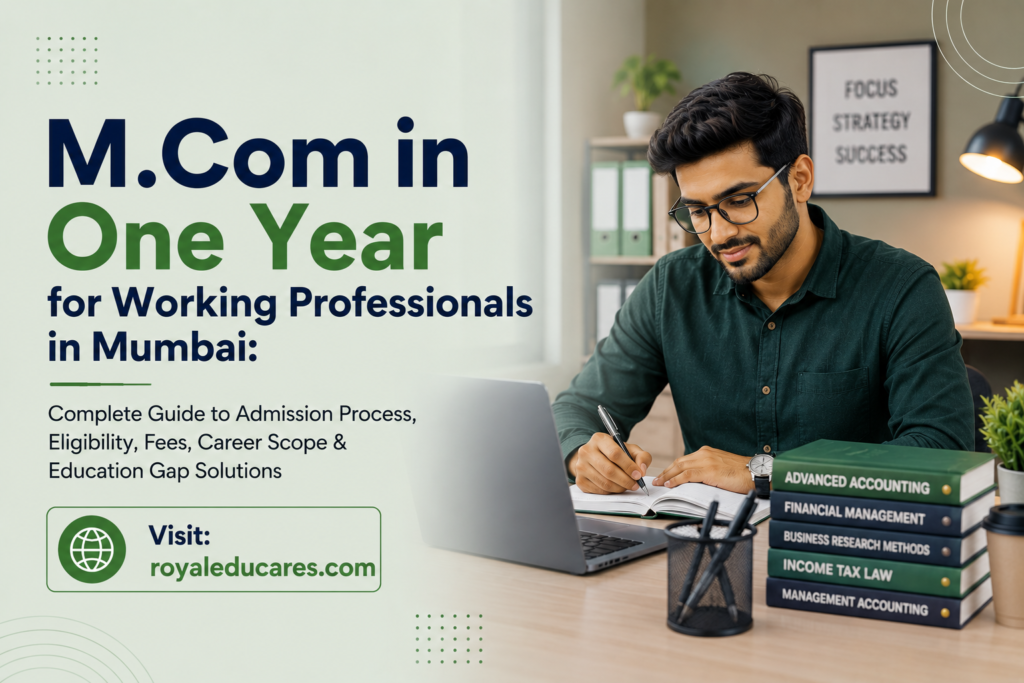
M.Com in One Year for Working Professionals in Mumbai: Complete Guide to Admission Process, Eligibility, Fees, Career Scope & Education Gap Solutions
Introduction
Advance your commerce career with flexible higher education pathways designed for working professionals, students with academic gaps, and ambitious learners seeking career growth opportunities in Mumbai.
Accreditation & Approvals
UGC-DEB APPROVED
AICTE APPROVED
AIU APPROVED
NAAC +++ ACCREDITED

COBSE BOARDS
PHARMACY COUNCIL OF INDIA
BAR COUNCIL OF INDIA

WORLD EDUCATION SERVICES

MHRD

Get Free Career Counseling
Students exploring flexible higher education opportunities often look for programs that align with their professional commitments and long-term career goals. Many learners first explore options such as Graduation in One Year in Mumbai available at https://royaleducares.com/graduation-in-one-year-in-mumbai/
to understand suitable pathways for completing or advancing their education efficiently.
For detailed educational guidance, course information, and career-focused academic support, learners can also explore the official Royal Educares platform at https://royaleducares.com/
,which provides information about various higher education opportunities for students and working professionals.
Why M.Com Remains One of the Most Valuable Commerce Degrees in India
The Master of Commerce (M.Com) continues to be among the most respected postgraduate qualifications for commerce graduates. Despite the emergence of numerous professional certifications and short-term programs, M.Com remains highly relevant because it provides comprehensive knowledge of finance, accounting, taxation, business management, economics, and corporate operations.
Organizations across industries require professionals who understand financial systems, business regulations, strategic management, and commercial operations. An M.Com qualification helps learners develop these competencies while strengthening their academic profile.
In today’s competitive job market, employers increasingly value candidates who possess both practical experience and advanced educational qualifications. This is one reason why many working professionals seek flexible pathways to continue their education while maintaining their careers.
Growing Demand for Commerce Professionals
India’s expanding economy has significantly increased the demand for qualified commerce professionals. Industries such as banking, insurance, taxation, auditing, consulting, e-commerce, fintech, logistics, manufacturing, healthcare administration, and retail management require skilled professionals who can manage financial and business operations effectively.
Several factors continue to drive demand:
Expansion of Financial Services
Banks, investment firms, insurance companies, and financial institutions require professionals with strong commerce backgrounds.
Rise of Digital Businesses
Modern businesses increasingly depend on professionals who understand financial planning, accounting systems, compliance requirements, and business analytics.
Increasing Regulatory Requirements
Taxation, GST compliance, auditing, and corporate governance have become more complex, creating opportunities for commerce graduates.
Growing Startup Ecosystem
Startups need finance professionals who can support budgeting, forecasting, fundraising, and strategic planning.
Because of these trends, M.Com remains a valuable qualification for individuals seeking stable and rewarding career opportunities.
What Is M.Com in One Year?
One of the most frequently searched questions online is:
“Can I complete M.Com in One Year?”
Many students and working professionals search for flexible educational pathways because they may have experienced an academic gap, career interruption, family responsibilities, or other circumstances that affected their educational journey.
The concept of M.Com in One Year is generally discussed by learners seeking guidance regarding accelerated educational pathways, academic progression opportunities, eligibility requirements, and educational gap solutions.
For working professionals, the primary objective is often to continue higher education without leaving employment. Similarly, students with educational gaps frequently seek options that help them reconnect with their academic goals and improve career prospects.
The growing interest in flexible education demonstrates the increasing need for educational guidance tailored to modern career realities.
Why Working Professionals Are Looking for Flexible M.Com Pathways
The modern workforce is significantly different from previous generations. Today’s professionals frequently balance:
- Full-time jobs
- Family responsibilities
- Career development goals
- Professional certifications
- Skill enhancement programs
- Financial commitments
As a result, many individuals cannot attend traditional full-time academic programs.
Flexible educational pathways provide an opportunity to pursue academic growth while continuing professional responsibilities.
Career Advancement Opportunities
Many professionals reach a stage where promotions require higher educational qualifications.
Examples include:
- Accounts Executive
- Finance Executive
- Tax Assistant
- Banking Associate
- Operations Executive
- Business Analyst
- Insurance Professional
- Office Administrator
A postgraduate qualification can strengthen promotion eligibility and improve long-term career prospects.
Better Salary Growth
Higher educational qualifications often contribute to stronger salary negotiation opportunities.
Employers frequently consider:
- Educational qualifications
- Work experience
- Technical skills
- Professional certifications
- Leadership capabilities
An advanced commerce qualification can strengthen a candidate’s overall profile.
Increased Professional Credibility
A postgraduate degree demonstrates commitment toward continuous learning and professional development.
Organizations often view academically qualified professionals as individuals who possess:
- Strong analytical skills
- Business understanding
- Financial knowledge
- Strategic thinking capabilities
- Problem-solving abilities
These qualities are highly valued across industries.
Why Students with Education Gaps Search for M.Com Opportunities
Educational gaps are increasingly common.
Many students experience interruptions due to:
- Financial challenges
- Family responsibilities
- Health-related issues
- Employment commitments
- Relocation
- Competitive exam preparation
- Personal circumstances
Fortunately, an educational gap does not define a student’s future potential.
Today, employers are often more interested in:
- Skills
- Knowledge
- Experience
- Professional attitude
- Academic progression
rather than focusing exclusively on past interruptions.
Rebuilding Academic Confidence
Students who return to education after a gap often gain renewed confidence and motivation.
Pursuing advanced studies can help:
- Improve self-confidence
- Enhance employability
- Strengthen academic credentials
- Create new career opportunities
- Support long-term professional growth
Expanding Career Possibilities
Without higher qualifications, some career paths may remain limited.
Advanced education can help learners pursue opportunities in:
- Accounting
- Finance
- Banking
- Insurance
- Taxation
- Corporate Administration
- Business Consulting
- Education and Training
- Entrepreneurship
These sectors continue to generate employment opportunities throughout India.
Why Mumbai Is an Ideal City for Commerce Education
Mumbai is widely recognized as India’s financial capital.
The city hosts:
- Major banks
- Financial institutions
- Corporate headquarters
- Insurance companies
- Investment firms
- Stock market operations
- Consulting organizations
- Multinational corporations
Because of this ecosystem, commerce education remains highly relevant in Mumbai.
Access to Diverse Industries
Students and professionals in Mumbai gain exposure to multiple sectors, including:
Banking
Banks require professionals with strong financial and analytical skills.
Finance
Financial services continue to offer significant growth opportunities.
Taxation
Businesses require experts who understand compliance and tax regulations.
Insurance
The insurance sector continues expanding across India.
Corporate Management
Organizations seek professionals who understand business operations and strategic management.
This broad industry exposure makes Mumbai an attractive destination for commerce-related career growth.
Key Advantages of Pursuing Advanced Commerce Education
Whether a learner is a recent graduate, experienced employee, entrepreneur, or returning student, advanced commerce education offers numerous benefits.
Strong Financial Knowledge
Commerce education develops understanding of:
- Financial management
- Investment planning
- Corporate finance
- Accounting principles
- Business economics
- Financial reporting
These skills remain valuable across industries.
Better Decision-Making Skills
Modern organizations require professionals who can:
- Analyze financial data
- Evaluate business risks
- Plan budgets
- Assess profitability
- Support strategic decisions
Advanced commerce education helps build these capabilities.
Enhanced Leadership Potential
Many leadership positions require understanding of:
- Organizational management
- Financial planning
- Business strategy
- Corporate governance
Commerce graduates often move into supervisory and managerial roles over time.
Greater Employment Flexibility
A commerce background allows professionals to work across multiple sectors rather than remaining limited to a single industry.
This flexibility can improve long-term career stability.
Who Should Consider M.Com Guidance in Mumbai?
The following categories of learners frequently explore M.Com opportunities:
B.Com Graduates
Individuals seeking advanced knowledge and stronger career prospects.
Working Professionals
Employees aiming for promotions and long-term career growth.
Students with Educational Gaps
Learners looking to resume academic progression.
Finance Professionals
Individuals working in accounting, auditing, taxation, and financial services.
Banking Employees
Professionals seeking academic advancement alongside employment.
Entrepreneurs
Business owners who want stronger financial and management knowledge.
Career Switchers
Individuals planning to move into commerce-related roles.
Common Goals of M.Com Aspirants
Most learners pursuing commerce education share several common objectives.
These include:
- Career advancement
- Promotion opportunities
- Higher earning potential
- Professional credibility
- Academic progression
- Improved business knowledge
- Better financial understanding
- Long-term career security
- Expanded employment opportunities
- Personal growth and confidence
Understanding these goals helps learners make informed educational decisions aligned with their future aspirations.
The Future of Commerce Careers in India
Commerce careers are expected to remain highly relevant due to:
- Economic growth
- Digital transformation
- Financial sector expansion
- Increasing compliance requirements
- Global business integration
- Startup ecosystem growth
- Demand for financial expertise
As businesses become more data-driven and financially focused, qualified commerce professionals are likely to remain valuable contributors across industries.
The combination of practical experience and advanced commerce education can help learners build strong foundations for long-term professional success.
Eligibility Criteria for M.Com in Mumbai
Before applying for M.Com, students and working professionals should understand the basic eligibility requirements. Eligibility can vary depending on the institution, academic background, and specific admission guidelines.
Most learners searching for M.Com admission in Mumbai want clear information regarding qualification requirements, educational background, and documentation.
Educational Qualification
Candidates generally seek admission after completing a bachelor’s degree in commerce or a related discipline. A strong academic foundation in subjects such as accounting, finance, taxation, economics, and business studies helps students understand advanced M.Com concepts more effectively.
Common undergraduate backgrounds include:
Bachelor of Commerce (B.Com)
Bachelor of Business Administration (BBA)
Bachelor of Management Studies (BMS)
Bachelor of Accounting and Finance (BAF)
Bachelor of Banking and Insurance (BBI)
Bachelor of Financial Markets (BFM)
Other commerce and management-related programs
Eligibility for Working Professionals
Working professionals from accounting, finance, banking, insurance, taxation, auditing, and corporate sectors often explore M.Com opportunities to strengthen their qualifications and improve career prospects.
Professional experience can complement academic learning by providing practical exposure to business operations and financial management.
Eligibility for Students with Educational Gaps
Many students worry that an educational gap may affect their future academic opportunities. However, learners who have experienced a break due to employment, financial challenges, family responsibilities, relocation, or personal circumstances frequently seek educational guidance to continue their higher education journey.
An education gap does not necessarily limit future academic growth when learners take the right steps toward completing their educational goals.
Why Eligibility Awareness Is Important
Many students begin the admission process without fully understanding eligibility requirements. This often leads to delays, confusion, or incomplete applications.
Understanding eligibility in advance helps applicants:
Prepare required documents
Plan their educational journey
Avoid unnecessary delays
Understand admission requirements
Make informed academic decisions
Proper planning creates a smoother admission experience and helps students focus on their long-term career objectives.
Admission Process for M.Com in Mumbai
One of the most searched queries among students is:
“How to get admission in M.Com in Mumbai?”
Understanding the admission process helps students prepare efficiently and avoid common mistakes.
Step 1: Educational Assessment
The first step involves reviewing academic qualifications, previous education, and career objectives.
Students should evaluate:
Academic background
Career goals
Professional experience
Long-term aspirations
Educational requirements
A clear understanding of personal goals helps learners choose suitable educational pathways.
Step 2: Course Selection
Students should carefully identify their academic interests before proceeding.
Common areas of interest include:
Accounting
Finance
Banking
Taxation
Insurance
Business Management
International Business
Economics
Choosing a field aligned with career objectives increases the long-term value of postgraduate education.
Step 3: Documentation Review
Documentation plays an important role during the admission process.
Applicants should ensure that all educational records and supporting documents are available and properly maintained.
Step 4: Application Submission
Students generally complete the application process after reviewing eligibility requirements and documentation requirements.
Accurate information should always be provided during the application stage.
Step 5: Verification Process
Verification helps ensure that academic details and supporting documents are properly reviewed before admission procedures are completed.
Step 6: Admission Confirmation
After successful completion of required procedures, students can proceed with the next stages of their educational journey.
Documents Commonly Required During Admission
Students frequently search:
“Which documents are required for M.Com admission?”
Proper documentation preparation helps simplify the admission process.
Commonly requested documents may include:
Academic Documents
Previous academic marksheets
Degree certificates
Educational records
Academic transcripts
Identity Documents
Aadhaar Card
PAN Card
Passport
Voter ID
Other government-approved identification documents
Address Proof
Aadhaar Card
Utility bills
Passport
Rental agreement
Other accepted address documents
Passport Size Photographs
Recent photographs are commonly required for educational documentation and admission formalities.
Additional Supporting Documents
Depending on individual circumstances, applicants may be asked to provide supporting educational or professional records.
Maintaining organized documentation can significantly improve the admission experience.
Understanding M.Com Fees in Mumbai
Another popular search query is:
“What are the fees for M.Com in Mumbai?”
Fee structures vary depending on multiple factors including institution type, facilities, academic resources, and support services.
Students should focus on overall educational value rather than considering fees as the only deciding factor.
Factors That Influence Fees
Several elements contribute to fee structures:
Academic Infrastructure
Educational institutions invest in faculty, academic support systems, learning resources, and administrative services.
Student Support Services
Career guidance, counseling, admission assistance, and academic support can influence educational costs.
Learning Resources
Libraries, digital learning tools, study materials, and academic platforms contribute to the overall educational experience.
Administrative Services
Documentation support, academic management, and student assistance services also form part of institutional operations.
How to Evaluate Educational Value Beyond Fees
Students often compare fees without considering long-term career benefits.
A better approach is to evaluate:
Career growth opportunities
Educational quality
Industry relevance
Academic support
Professional development potential
Future earning opportunities
An educational investment should be viewed from a long-term perspective rather than solely as an immediate expense.
Duration and Learning Flexibility
Modern learners require educational options that accommodate professional and personal commitments.
This is especially important for:
Full-time employees
Entrepreneurs
Family business owners
Parents
Career transition professionals
Students returning after an academic gap
Flexible learning pathways help individuals continue their education while managing existing responsibilities.
Why Flexibility Matters
The traditional classroom model may not suit every learner.
Many professionals work:
Fixed shifts
Rotational shifts
Extended office hours
Weekend schedules
Flexible academic planning helps these individuals continue learning without disrupting professional commitments.
Benefits of Pursuing M.Com While Working
Thousands of professionals seek postgraduate qualifications while continuing employment.
This approach offers several advantages.
Continuous Income
Professionals can continue earning while pursuing academic advancement.
Practical Application of Knowledge
Concepts learned during studies can often be applied directly within workplace environments.
Stronger Professional Profile
Employers frequently appreciate candidates who demonstrate commitment toward continuous learning and skill development.
Career Progression
Advanced qualifications may contribute to future promotion opportunities and leadership responsibilities.
Industries Where M.Com Graduates Are in Demand
Commerce professionals remain valuable across multiple industries.
Banking Sector
Banks require professionals skilled in:
Financial operations
Customer relationship management
Compliance procedures
Business development
Finance Industry
Finance organizations hire professionals for:
Financial analysis
Investment support
Corporate finance
Financial planning
Taxation and Compliance
Growing regulatory requirements create demand for taxation and compliance professionals.
Insurance Industry
Insurance companies continue expanding their workforce across various operational and management functions.
Corporate Sector
Businesses require commerce professionals for:
Accounting
Budgeting
Business operations
Financial reporting
Strategic planning
Common Mistakes Students Should Avoid During Admission
Many applicants unintentionally make errors that delay their educational plans.
Delaying Research
Students should begin researching educational options early rather than waiting until deadlines approach.
Ignoring Career Goals
Course selection should align with long-term career objectives.
Incomplete Documentation
Missing documents frequently cause admission delays.
Focusing Only on Fees
Quality, support, and career outcomes should also be considered.
Not Seeking Professional Guidance
Educational guidance can help students understand options and avoid common mistakes.
Why Planning Your M.Com Journey Early Matters
Early planning provides multiple benefits.
Students gain time to:
Organize documents
Review eligibility
Understand career goals
Explore specialization options
Prepare financially
Create an academic roadmap
A well-planned educational journey generally leads to better outcomes and greater confidence.
Building a Strong Career Foundation Through Commerce Education
Commerce education extends beyond classroom learning.
It develops skills in:
Financial analysis
Strategic thinking
Business communication
Decision making
Leadership
Problem solving
These competencies remain valuable across industries and career stages.
Whether a learner is a fresh graduate, working professional, entrepreneur, or student returning after an educational gap, advanced commerce education can contribute significantly to long-term professional development and career growth.
The next step is understanding which M.Com specializations align best with your interests, career goals, and industry aspirations. Choosing the right specialization can play a major role in shaping future employment opportunities and professional success.
Best M.Com Specializations and Career Opportunities in Mumbai
Choosing the right specialization is one of the most important decisions during your M.Com journey. While many students focus only on admission and eligibility, successful professionals understand that specialization selection can significantly influence future career opportunities, salary growth, and industry demand.
Mumbai, being India’s financial capital, offers opportunities across banking, finance, taxation, insurance, investment management, corporate accounting, consulting, and business administration. Therefore, selecting a specialization that aligns with career goals is essential.
A specialization helps students gain deeper knowledge in a specific area while developing industry-relevant skills that employers actively seek.
Why Choosing the Right M.Com Specialization Matters
A specialization can impact:
Career growth opportunities
Industry demand
Salary potential
Professional credibility
Future educational pathways
Job role eligibility
Long-term career stability
Students often choose a specialization based on current trends. However, a better approach is to evaluate personal interests, strengths, career objectives, and industry opportunities before making a decision.
M.Com in Accounting and Finance
Accounting and Finance remains one of the most popular M.Com specializations among commerce graduates and working professionals.
Modern businesses depend heavily on financial management, accounting systems, budgeting, auditing, compliance, and financial reporting. As a result, professionals with strong accounting and finance expertise continue to be in high demand.
Key Subjects Covered
Financial Accounting
Corporate Accounting
Financial Management
Cost Accounting
Auditing
Corporate Finance
Investment Analysis
Financial Reporting
Career Opportunities
Graduates often explore opportunities such as:
Accountant
Senior Accountant
Financial Analyst
Accounts Executive
Finance Executive
Audit Associate
Budget Analyst
Financial Controller
Industries Hiring Accounting and Finance Professionals
Banking
Insurance
Manufacturing
Retail
E-commerce
Consulting
Information Technology
Healthcare
Why This Specialization Is Popular
Every organization requires financial management. This creates consistent demand for qualified accounting and finance professionals across industries.
M.Com in Banking and Finance
The banking sector remains one of India’s largest employment generators.
With continuous growth in digital banking, financial inclusion initiatives, fintech innovation, and investment services, banking professionals are increasingly valuable.
Core Areas of Study
Banking Operations
Commercial Banking
Investment Banking
Financial Markets
Risk Management
Credit Management
Banking Regulations
Financial Services
Career Opportunities
Students often pursue careers as:
Banking Executive
Relationship Manager
Loan Officer
Credit Analyst
Investment Associate
Financial Services Executive
Wealth Management Associate
Banking Operations Officer
Advantages of Banking and Finance
This specialization offers opportunities in both public and private sector organizations.
Growing digital banking services continue creating employment opportunities for skilled professionals.
M.Com in Taxation
Taxation remains one of the most stable and respected commerce career paths.
Businesses, corporations, startups, professionals, and organizations require tax planning, compliance management, and regulatory support.
Major Subjects
Direct Taxation
Indirect Taxation
GST
Corporate Tax Planning
International Taxation
Tax Compliance
Tax Administration
Career Opportunities
Professionals may work as:
Tax Consultant
Tax Analyst
GST Executive
Tax Compliance Officer
Corporate Tax Associate
Tax Advisor
Finance and Tax Executive
Growing Demand for Tax Professionals
India’s evolving taxation framework continues generating opportunities for qualified taxation experts.
Organizations increasingly seek professionals who can manage compliance requirements effectively.
M.Com in Business Management
Business Management combines commerce knowledge with leadership and organizational skills.
This specialization is suitable for students interested in administration, operations, management, and entrepreneurship.
Key Subjects
Organizational Behavior
Strategic Management
Human Resource Management
Business Communication
Marketing Management
Business Economics
Operations Management
Career Opportunities
Graduates may pursue positions such as:
Business Executive
Operations Executive
Administrative Manager
Business Analyst
Project Coordinator
Management Trainee
Business Development Executive
Benefits of Business Management
This specialization develops leadership skills and prepares learners for managerial responsibilities.
Professionals interested in future leadership positions often find this specialization valuable.
M.Com in International Business
Globalization has transformed the business landscape.
Companies increasingly operate across international markets, creating demand for professionals who understand global trade and international business operations.
Subjects Commonly Covered
International Trade
Global Business Strategy
Export Management
Import Management
International Marketing
International Finance
Global Supply Chain Management
Career Opportunities
Graduates may work in:
Export Management
Import Operations
International Business Development
Global Logistics
Supply Chain Management
International Marketing
Trade Consulting
Why International Business Is Growing
As businesses expand globally, professionals with international business knowledge continue becoming more valuable.
M.Com in Financial Management
Financial Management focuses on investment planning, corporate finance, risk management, and wealth creation strategies.
This specialization attracts students interested in financial decision-making and corporate finance.
Important Subjects
Investment Management
Corporate Finance
Financial Markets
Portfolio Management
Risk Analysis
Financial Planning
Career Opportunities
Graduates may pursue careers as:
Financial Planner
Investment Analyst
Corporate Finance Executive
Wealth Advisor
Risk Analyst
Treasury Executive
Industry Demand
Financial planning and investment management remain rapidly growing sectors in India.
M.Com in Insurance Management
India’s insurance industry continues experiencing significant growth.
Both life and general insurance companies require qualified professionals to manage operations, customer relationships, compliance, and financial planning.
Areas of Study
Insurance Principles
Risk Management
Insurance Law
Insurance Operations
Claims Management
Career Opportunities
Insurance Advisor
Claims Executive
Insurance Operations Manager
Risk Management Executive
Insurance Consultant
Future Scope
Growing awareness of insurance products continues creating opportunities in this sector.
M.Com in Economics
Students interested in research, policy analysis, economic planning, and data interpretation often consider economics-related specialization areas.
Key Topics
Microeconomics
Macroeconomics
Economic Policy
Development Economics
Statistical Analysis
Career Opportunities
Economic Analyst
Research Associate
Policy Consultant
Market Research Executive
Business Economist
Long-Term Benefits
Economics provides strong analytical skills that are valuable across multiple industries.
How to Choose the Best M.Com Specialization
Selecting the right specialization requires careful evaluation.
Students should consider:
Personal Interests
Choose an area that genuinely interests you.
Long-term success often comes from working in a field you enjoy.
Career Goals
Your specialization should support your future professional objectives.
Industry Demand
Research employment opportunities before making a decision.
Existing Skills
Consider strengths and competencies that can support future growth.
Future Learning Plans
Some students plan to pursue professional certifications or additional qualifications after M.Com.
The chosen specialization should complement these plans.
Most Popular Career Paths After M.Com
Regardless of specialization, M.Com graduates frequently pursue opportunities in:
Accounting
Accountant
Senior Accountant
Accounts Manager
Finance
Finance Executive
Financial Analyst
Corporate Finance Associate
Banking
Banking Officer
Relationship Manager
Credit Analyst
Taxation
Tax Consultant
GST Executive
Tax Analyst
Corporate Sector
Business Executive
Operations Manager
Administrative Executive
Consulting
Business Consultant
Financial Consultant
Tax Consultant
Entrepreneurship
Many M.Com graduates also establish their own businesses or consulting practices.
Skills Employers Look for in M.Com Graduates
Employers increasingly prioritize practical skills alongside academic qualifications.
Important skills include:
Financial Analysis
Communication Skills
Problem Solving
Strategic Thinking
Leadership
Business Analysis
Data Interpretation
Time Management
Team Collaboration
Decision Making
Students who develop these skills alongside their academic qualifications often enjoy stronger career prospects.
Future Industry Trends Creating Opportunities for M.Com Graduates
Several trends continue increasing demand for commerce professionals.
Digital Transformation
Businesses require professionals who understand financial technology and digital business operations.
Growth of Fintech
Fintech companies continue hiring finance and commerce graduates.
Expansion of Financial Services
Banking, insurance, and investment sectors remain major employment generators.
Startup Ecosystem Growth
Startups require professionals with strong financial and business management knowledge.
Regulatory Compliance
Organizations need experts who can manage taxation, auditing, and compliance responsibilities.
Global Business Expansion
International trade and global business activities continue creating new opportunities.
The combination of industry growth and increasing demand for commerce expertise makes M.Com one of the most valuable postgraduate qualifications for students and working professionals seeking long-term career success in Mumbai and across India.
Career Opportunities After M.Com in Mumbai
One of the biggest reasons students and working professionals pursue M.Com is career growth. A postgraduate commerce qualification can strengthen professional credibility, improve employment prospects, and create opportunities across multiple industries.
Mumbai is home to thousands of companies, financial institutions, multinational corporations, banks, consulting firms, insurance organizations, startups, and investment companies. This diverse business environment creates strong demand for qualified commerce professionals.
The career opportunities available after M.Com depend on factors such as specialization, skills, industry knowledge, communication abilities, professional experience, and career goals.
Why Employers Value M.Com Graduates
Organizations require professionals who understand:
Accounting
Financial Management
Taxation
Auditing
Business Operations
Corporate Finance
Compliance
Strategic Planning
An M.Com qualification demonstrates advanced understanding of commerce-related subjects and helps candidates stand out in competitive job markets.
Employers often prefer candidates who combine academic qualifications with practical knowledge and problem-solving abilities.
Top Career Options After M.Com
M.Com graduates can explore opportunities across multiple industries rather than being restricted to a single career path.
Accountant
Accounting remains one of the most common and stable career choices for commerce graduates.
Accountants play a critical role in managing financial records and supporting business operations.
Responsibilities
Preparing financial statements
Managing accounts
Recording transactions
Financial reporting
Budget monitoring
Compliance support
Skills Required
Accounting knowledge
Attention to detail
Numerical ability
Analytical thinking
Industries Hiring Accountants
Manufacturing
Banking
Healthcare
Retail
Education
Technology
Hospitality
Senior Accountant
Professionals with experience often move into senior accounting positions.
Key Responsibilities
Managing accounting teams
Reviewing financial records
Monitoring compliance
Supporting audits
Financial planning
Career Growth Potential
Senior accountants frequently progress toward finance management and leadership roles.
Financial Analyst
Financial analysts help organizations make informed business decisions using financial data and market insights.
Responsibilities
Financial forecasting
Budget analysis
Investment evaluation
Performance assessment
Risk analysis
Why This Role Is Popular
Financial analysis combines business strategy with finance, making it attractive for ambitious professionals seeking career growth.
Finance Executive
Finance executives support organizational financial operations and planning activities.
Responsibilities
Managing financial transactions
Budget support
Reporting activities
Financial documentation
Internal financial coordination
Industries Hiring Finance Executives
Banking
Insurance
Manufacturing
E-commerce
Consulting
Tax Consultant
Taxation remains a high-demand career path.
Tax consultants assist businesses and individuals in understanding and managing tax-related responsibilities.
Responsibilities
Tax planning
Tax compliance
GST guidance
Tax documentation
Regulatory support
Benefits of This Career
Tax expertise remains valuable regardless of economic conditions because businesses continuously require compliance support.
GST Executive
The implementation of GST increased demand for taxation professionals.
Common Responsibilities
GST compliance
Return filing support
Documentation review
Tax calculations
Regulatory coordination
Industry Demand
Organizations across sectors require GST-related expertise.
Auditor
Auditors help organizations maintain financial accuracy and compliance.
Responsibilities
Reviewing financial records
Compliance verification
Risk identification
Process evaluation
Internal control assessment
Career Advantages
Auditing offers opportunities across public and private sectors.
Banking Professional
The banking industry continues to be one of India’s largest employers.
Banking Roles After M.Com
Banking Officer
Relationship Manager
Credit Analyst
Branch Operations Executive
Loan Processing Officer
Customer Relationship Executive
Why Banking Is Attractive
Banking offers structured career growth, professional development opportunities, and long-term stability.
Credit Analyst
Credit analysts evaluate financial information and assess lending-related risks.
Responsibilities
Credit assessment
Financial review
Risk evaluation
Loan recommendation support
Industry Demand
Banks and financial institutions actively seek professionals with analytical skills.
Investment Analyst
Investment analysts assist organizations and clients in making investment-related decisions.
Key Responsibilities
Market research
Financial evaluation
Investment assessment
Portfolio analysis
Suitable For
Students interested in financial markets, investments, and wealth management.
Business Analyst
Business analysts bridge the gap between business operations and strategic decision-making.
Responsibilities
Data analysis
Business process improvement
Reporting
Strategic recommendations
Growing Demand
Organizations increasingly rely on data-driven decisions, making business analysts highly valuable.
Corporate Finance Executive
Corporate finance professionals help organizations manage financial resources effectively.
Responsibilities
Capital planning
Financial strategy
Budget management
Performance analysis
Long-Term Career Scope
Corporate finance often leads to senior leadership opportunities.
Insurance Professional
The insurance industry continues expanding throughout India.
Career Opportunities
Insurance Advisor
Claims Executive
Operations Manager
Risk Assessment Associate
Why Insurance Offers Strong Potential
Growing awareness of financial protection products continues increasing industry demand.
Human Resource Executive
Commerce graduates interested in management and organizational development may pursue HR-related careers.
Responsibilities
Recruitment support
Employee management
Organizational coordination
Workforce planning
Benefits
HR roles offer opportunities to develop leadership and people-management skills.
Operations Manager
Operations management focuses on improving efficiency and organizational performance.
Key Responsibilities
Process management
Team coordination
Productivity improvement
Strategic implementation
Career Growth
Operations professionals often advance into senior management positions.
Business Development Executive
Business development professionals help organizations expand their customer base and market presence.
Responsibilities
Client acquisition
Market research
Relationship building
Revenue growth initiatives
Skills Needed
Communication
Negotiation
Strategic thinking
Government Job Opportunities After M.Com
Many students pursue M.Com to improve eligibility for government sector opportunities.
Government organizations regularly recruit commerce graduates for various positions.
Popular Government Sectors
Banking
Public Sector Undertakings (PSUs)
Tax Departments
Railways
State Government Departments
Central Government Departments
Insurance Organizations
Advantages of Government Careers
Job stability
Structured promotions
Retirement benefits
Professional growth opportunities
Private Sector Opportunities After M.Com
The private sector offers diverse opportunities across industries.
Major Hiring Industries
Banking
Financial Services
Insurance
Information Technology
Retail
Manufacturing
Consulting
Healthcare
Logistics
E-commerce
Private sector organizations often prioritize skills, performance, and professional growth potential.
Entrepreneurship Opportunities After M.Com
Many M.Com graduates choose entrepreneurship instead of traditional employment.
Commerce education provides valuable knowledge related to:
Business Planning
Financial Management
Budgeting
Taxation
Business Operations
Strategic Growth
Business Opportunities
Accounting Services
Tax Consultancy
Financial Advisory
Business Consulting
Insurance Services
Digital Business Ventures
Entrepreneurship allows professionals to build independent careers while applying commerce knowledge directly.
Salary Growth Potential After M.Com
Salary growth depends on multiple factors.
Influencing Factors
Skills
Experience
Industry
Specialization
Location
Professional Certifications
Communication Skills
Professionals who continuously upgrade their knowledge and skills generally experience stronger career progression.
Career Growth Roadmap After M.Com
A long-term career roadmap may involve progression through multiple stages.
Early Career Stage
Common roles include:
Accounts Executive
Finance Executive
Banking Associate
Tax Assistant
Mid-Level Career Stage
Professionals often move into:
Senior Accountant
Financial Analyst
Tax Consultant
Operations Manager
Senior Career Stage
Leadership opportunities may include:
Finance Manager
Senior Business Analyst
Corporate Manager
Department Head
Financial Controller
Executive-Level Opportunities
Experienced professionals may eventually reach positions such as:
Director
Vice President
Chief Financial Officer (CFO)
Business Head
Skills That Increase Career Growth
Many professionals focus only on educational qualifications. However, employers also value practical skills.
Important career-building skills include:
Communication
Leadership
Financial Analysis
Problem Solving
Strategic Thinking
Business Planning
Decision Making
Team Management
Presentation Skills
Technology Adaptability
Developing these skills alongside academic qualifications can significantly improve career prospects.
Future Scope of M.Com in India
The future remains promising for commerce professionals due to:
Economic growth
Digital business expansion
Financial sector development
Startup growth
Global trade opportunities
Increasing compliance requirements
Rising demand for financial expertise
Organizations continue seeking professionals who can manage finances, analyze business performance, support strategic decisions, and contribute to long-term growth.
As industries evolve, the combination of commerce knowledge, professional experience, and continuous learning will remain a powerful foundation for career success. M.Com graduates who stay updated with industry trends and develop practical skills can build rewarding careers across multiple sectors in Mumbai, India, and international markets.
M.Com vs MBA: Which Is Better for Career Growth?
One of the most common questions asked by commerce students and working professionals is whether they should pursue M.Com or MBA. Both qualifications offer valuable career opportunities, but the right choice depends on career goals, interests, professional experience, and future aspirations.
M.Com focuses primarily on commerce-related subjects such as accounting, finance, taxation, economics, auditing, and business management. MBA, on the other hand, emphasizes leadership, management, business strategy, marketing, operations, and organizational development.
Understanding the differences between these qualifications can help students make informed career decisions.
M.Com vs MBA: Key Differences
Academic Focus
M.Com
Accounting
Finance
Taxation
Economics
Auditing
Banking
MBA
Management
Leadership
Marketing
Operations
Human Resources
Business Strategy
Suitable Candidates
M.Com is suitable for:
Commerce graduates
Accounting professionals
Finance professionals
Banking professionals
Taxation enthusiasts
MBA is suitable for:
Future managers
Entrepreneurs
Business leaders
Professionals seeking management roles
Career Direction
M.Com generally supports specialization in commerce and finance-related fields, whereas MBA often prepares professionals for broader management responsibilities.
M.Com vs Professional Certifications
Many students compare M.Com with professional certifications before deciding on higher education.
Professional certifications may focus on specific technical skills, while M.Com provides broader academic and theoretical knowledge.
Benefits of M.Com
Strong academic foundation
Comprehensive commerce knowledge
Broader career opportunities
Postgraduate qualification
Long-term educational value
Benefits of Professional Certifications
Industry-specific skills
Specialized expertise
Practical applications
Technical knowledge enhancement
Why Many Professionals Combine Both
A common strategy among ambitious professionals is to combine postgraduate education with skill-based certifications to strengthen employability and career growth potential.
M.Com vs Distance Learning Options
Students frequently search for information regarding traditional learning and flexible learning pathways.
Several factors influence this decision:
Work Commitments
Working professionals often require flexibility.
Family Responsibilities
Many learners balance education with personal obligations.
Career Objectives
Professional goals influence learning preferences.
Location Constraints
Some students prefer educational options that reduce travel requirements.
The ideal choice depends on individual circumstances and long-term plans.
Advantages of Pursuing M.Com After B.Com
Commerce graduates often wonder whether pursuing postgraduate education is worth the investment of time and effort.
The answer depends largely on career objectives.
Benefits Include
Advanced subject knowledge
Stronger professional profile
Better career opportunities
Increased confidence
Academic progression
Competitive advantage
For many learners, M.Com serves as a logical next step after completing undergraduate commerce studies.
Higher Education Opportunities After M.Com
M.Com can serve as a foundation for further academic and professional growth.
Many graduates continue their educational journey through additional qualifications, research programs, management education, and professional development courses.
Advanced Commerce and Finance Studies
Students interested in academic excellence often pursue further specialization in finance, accounting, economics, taxation, or business-related disciplines.
Research Opportunities
Research-oriented students may explore opportunities involving:
Commerce research
Financial studies
Business research
Economic analysis
Academic writing
Research can open pathways toward teaching, consulting, and subject-matter expertise.
Management Education
Many professionals pursue management qualifications after gaining experience in commerce-related fields.
Management education can complement existing commerce knowledge and expand career opportunities.
How Working Professionals Can Balance Work and Higher Education
One of the biggest concerns among employed learners is time management.
Balancing work and education requires planning, discipline, and consistency.
Create a Study Schedule
A structured schedule helps learners manage responsibilities effectively.
Tips
Set realistic study goals
Allocate dedicated study hours
Maintain consistency
Avoid last-minute preparation
Focus on Long-Term Goals
Students often lose motivation when they focus only on short-term challenges.
Remembering long-term career objectives helps maintain momentum.
Examples include:
Promotion opportunities
Better salary prospects
Career advancement
Professional recognition
Personal growth
Develop Time Management Skills
Successful professionals often excel at managing priorities.
Important practices include:
Daily planning
Task prioritization
Goal tracking
Effective scheduling
How Students with Education Gaps Can Rebuild Their Academic Journey
Educational gaps are becoming increasingly common.
Students may pause their education due to:
Employment requirements
Financial challenges
Family obligations
Health concerns
Personal circumstances
Fortunately, educational interruptions do not determine future success.
Focus on Future Opportunities
Employers increasingly value:
Skills
Knowledge
Professionalism
Experience
Continuous learning
Students should focus on future achievements rather than past interruptions.
Build Confidence Through Learning
Returning to education can significantly improve confidence and career outlook.
Every completed academic milestone strengthens personal and professional development.
Stay Consistent
Consistency often matters more than speed.
Small but continuous progress can create significant long-term results.
Common Mistakes Students Should Avoid
Many students unintentionally make decisions that limit future opportunities.
Avoiding these mistakes can improve educational outcomes.
Choosing a Course Without Career Planning
Always connect educational decisions with long-term professional goals.
Ignoring Industry Trends
Students should understand which industries are growing and which skills are increasingly valuable.
Delaying Skill Development
Academic qualifications are important, but practical skills also influence employability.
Neglecting Communication Skills
Strong communication abilities often separate average professionals from high-performing professionals.
Avoiding Professional Networking
Building professional relationships can create future career opportunities.
Essential Skills Every M.Com Student Should Develop
Academic qualifications alone may not guarantee career success.
Students should focus on developing practical workplace skills.
Financial Analysis
Understanding financial information remains valuable across industries.
Business Communication
Clear communication improves professional effectiveness.
Leadership
Leadership skills support long-term career advancement.
Problem Solving
Organizations value professionals who can identify solutions and improve processes.
Analytical Thinking
Data-driven decision-making is increasingly important in modern workplaces.
Technology Awareness
Digital tools continue transforming commerce, finance, banking, and business operations.
Building a Successful Career After M.Com
A successful career typically involves continuous learning and professional growth.
Key elements include:
Strong Educational Foundation
Academic knowledge creates a solid starting point.
Industry Awareness
Understanding market trends improves decision-making.
Professional Skills
Skills enhance workplace performance.
Practical Experience
Experience strengthens professional credibility.
Continuous Improvement
Learning should continue throughout a career.
Why Commerce Careers Continue Growing in India
India’s economy continues expanding across multiple sectors.
Growth drivers include:
Banking expansion
Financial inclusion
Digital transformation
Startup ecosystem growth
E-commerce development
International trade
Regulatory requirements
These developments create ongoing demand for qualified commerce professionals.
Career Planning Roadmap for M.Com Students
Students should approach career development strategically.
Step 1
Define long-term career goals.
Step 2
Choose an appropriate specialization.
Step 3
Develop industry-relevant skills.
Step 4
Build practical experience.
Step 5
Strengthen communication and leadership abilities.
Step 6
Stay updated with industry developments.
Step 7
Continue learning throughout your career.
A structured approach increases the likelihood of long-term professional success.
Final Thoughts Before Choosing M.Com
M.Com remains one of the most respected postgraduate qualifications for commerce graduates, working professionals, and learners seeking academic progression after an educational gap.
The degree provides advanced knowledge in finance, accounting, taxation, economics, banking, and business management while supporting career growth across multiple industries.
Whether your goal is professional advancement, higher earning potential, improved qualifications, leadership opportunities, or personal development, M.Com can serve as a strong foundation for future success.
Making informed decisions, selecting the right specialization, developing practical skills, and maintaining a commitment to continuous learning can help transform educational achievements into long-term career growth and professional excellence.
Frequently Asked Questions (FAQs) About M.Com in One Year for Working Professionals in Mumbai
1. What is M.Com?
M.Com stands for Master of Commerce, a postgraduate degree focused on accounting, finance, taxation, economics, banking, auditing, and business management.
2. Who should pursue M.Com?
Commerce graduates, working professionals, banking employees, finance professionals, entrepreneurs, and students seeking advanced commerce knowledge can consider M.Com.
3. Is M.Com a good career option?
Yes, M.Com remains one of the most valuable postgraduate qualifications for commerce-related careers.
4. What are the benefits of M.Com?
M.Com helps improve subject knowledge, professional credibility, career opportunities, and long-term growth potential.
5. Can working professionals pursue M.Com?
Many working professionals pursue higher education to strengthen their qualifications and support career advancement.
6. Is M.Com useful for career growth?
Yes, advanced qualifications often help professionals improve their career prospects and competitiveness.
7. Can students with an education gap pursue M.Com?
Students with educational gaps frequently continue their higher education journey after receiving appropriate academic guidance.
8. Why is M.Com popular among commerce graduates?
It provides deeper knowledge of commerce-related subjects and opens diverse career opportunities.
9. What subjects are covered in M.Com?
Subjects may include accounting, finance, taxation, economics, auditing, banking, business management, and corporate finance.
10. Is M.Com better than stopping after B.Com?
Many students pursue M.Com to gain advanced knowledge and strengthen their professional profile.
11. What career opportunities are available after M.Com?
Career opportunities exist in accounting, finance, banking, taxation, insurance, consulting, and corporate management.
12. Can M.Com help in promotion opportunities?
Higher educational qualifications may contribute to professional advancement and leadership opportunities.
13. Is M.Com useful in the banking sector?
Yes, banking organizations frequently hire professionals with commerce and finance backgrounds.
14. Can M.Com graduates work in finance companies?
Finance companies often seek candidates with strong financial and analytical knowledge.
15. Is M.Com useful for accountants?
Yes, M.Com can enhance accounting knowledge and professional development.
16. Can M.Com graduates become financial analysts?
Financial analysis is one of the career paths frequently pursued by commerce professionals.
17. Does M.Com help in taxation careers?
Taxation remains one of the most popular career areas for commerce graduates.
18. Is GST knowledge important for commerce students?
GST knowledge is valuable because taxation and compliance play significant roles in modern business operations.
19. Can M.Com graduates work in multinational companies?
Many multinational organizations hire professionals with commerce and finance qualifications.
20. Is M.Com useful for entrepreneurship?
Yes, commerce education provides knowledge related to business operations, finance, and management.
21. Which specialization is best in M.Com?
The best specialization depends on career goals, interests, and industry preferences.
22. Is Accounting and Finance a good specialization?
Accounting and Finance remains among the most popular and widely recognized commerce specializations.
23. Is Banking and Finance a good specialization?
Yes, it supports careers within banking, financial services, and investment sectors.
24. Is Taxation a good specialization?
Taxation continues to offer strong long-term career opportunities.
25. Is Business Management useful after M.Com?
Business Management can support leadership and managerial career growth.
26. Is International Business a good specialization?
It is suitable for students interested in global business and international trade.
27. What skills should M.Com students develop?
Students should focus on communication, analytical thinking, financial knowledge, leadership, and problem-solving skills.
28. Is communication skill important after M.Com?
Yes, communication skills are highly valued across industries.
29. Can M.Com graduates work in the corporate sector?
Corporate organizations regularly hire commerce professionals for various roles.
30. Can M.Com graduates become managers?
Many professionals eventually progress into management positions through experience and skill development.
31. Is financial analysis a good career after M.Com?
Financial analysis remains a highly respected and growing career field.
32. Does M.Com help in developing leadership skills?
Higher education often contributes to broader business understanding and leadership development.
33. Is M.Com suitable for fresh graduates?
Yes, many students pursue M.Com immediately after completing their undergraduate studies.
34. Is M.Com suitable for experienced professionals?
Working professionals frequently pursue postgraduate qualifications to support career advancement.
35. Why do employers value M.Com graduates?
Employers appreciate candidates with advanced commerce knowledge and analytical abilities.
36. Can M.Com graduates work in consulting?
Consulting organizations often recruit professionals with commerce and finance expertise.
37. Is commerce a future-proof career field?
Commerce-related skills continue to remain valuable across multiple industries.
38. Does digital transformation create opportunities for commerce professionals?
Yes, digital business growth has increased demand for finance and commerce professionals.
39. Is fintech creating opportunities for M.Com graduates?
Fintech companies frequently seek professionals with finance and business knowledge.
40. Can M.Com graduates work in insurance companies?
Insurance organizations continue hiring commerce graduates for operational and management roles.
41. What industries hire M.Com graduates?
Banking, finance, insurance, consulting, retail, manufacturing, healthcare, logistics, and technology sectors hire commerce professionals.
42. Is auditing a good career option?
Auditing remains a respected and stable profession.
43. Can M.Com graduates become tax consultants?
Tax consulting is one of the most common career pathways within commerce.
44. Is M.Com beneficial for long-term career growth?
Many professionals consider M.Com valuable for long-term development.
45. Can M.Com graduates work in investment-related roles?
Investment firms often hire candidates with finance and commerce backgrounds.
46. Is business analysis a good career after M.Com?
Business analysis continues to be a growing field across industries.
47. Does M.Com help improve business knowledge?
Yes, M.Com provides advanced understanding of business operations and financial systems.
48. Is strategic thinking important for commerce professionals?
Strategic thinking supports better decision-making and leadership development.
49. Can M.Com graduates pursue further education?
Many students continue with additional academic and professional qualifications after M.Com.
50. Why is Mumbai a good city for commerce careers?
Mumbai offers opportunities across banking, finance, consulting, insurance, taxation, and corporate sectors.
51. Is M.Com relevant in today’s job market?
Yes, commerce qualifications remain highly relevant across industries.
52. Can M.Com help improve employability?
Advanced qualifications often strengthen professional profiles and employment opportunities.
53. Is networking important after M.Com?
Professional networking can support career growth and new opportunities.
54. Can M.Com graduates work internationally?
Commerce knowledge can be valuable in both domestic and international business environments.
55. Is continuous learning important after M.Com?
Yes, ongoing skill development and industry awareness remain important for long-term success.
Conclusion
M.Com continues to be one of the most respected postgraduate qualifications for commerce graduates, working professionals, and students seeking academic progression after an educational gap. The program supports the development of advanced knowledge in accounting, finance, taxation, banking, economics, auditing, and business management while creating opportunities across multiple industries.
For professionals looking to strengthen their qualifications, improve career prospects, enhance business knowledge, and build long-term career stability, M.Com remains a valuable educational pathway. With growing opportunities in banking, finance, taxation, consulting, insurance, fintech, corporate management, and entrepreneurship, commerce professionals continue to play a critical role in India’s evolving economy.
Success after M.Com depends not only on academic qualifications but also on practical skills, communication abilities, industry awareness, professional experience, leadership capabilities, and continuous learning. Students who combine education with skill development and strategic career planning are often better positioned for long-term growth.
Whether you are a recent commerce graduate, an experienced working professional, or a learner returning after an educational gap, investing in your education can open doors to new opportunities, professional advancement, and personal achievement. A well-planned academic journey today can contribute significantly to a stronger and more rewarding future tomorrow.
Contact Royal Educares
Royal Educares
Education Guidance & Admission Support Across India
 Website:
https://royaleducares.com/
 Email:
info@royaleducares.com
 Phone:
+91 9819649369
 Address:
9/D-1, Office No. 005, Sangharsh Nagar, Chandivali, Powai, Mumbai, Maharashtra 400072, India
 GET DIRECTION
Google Map
Start your Admission Today!
Let Us Help You Choose the Right Course for Your Future.