
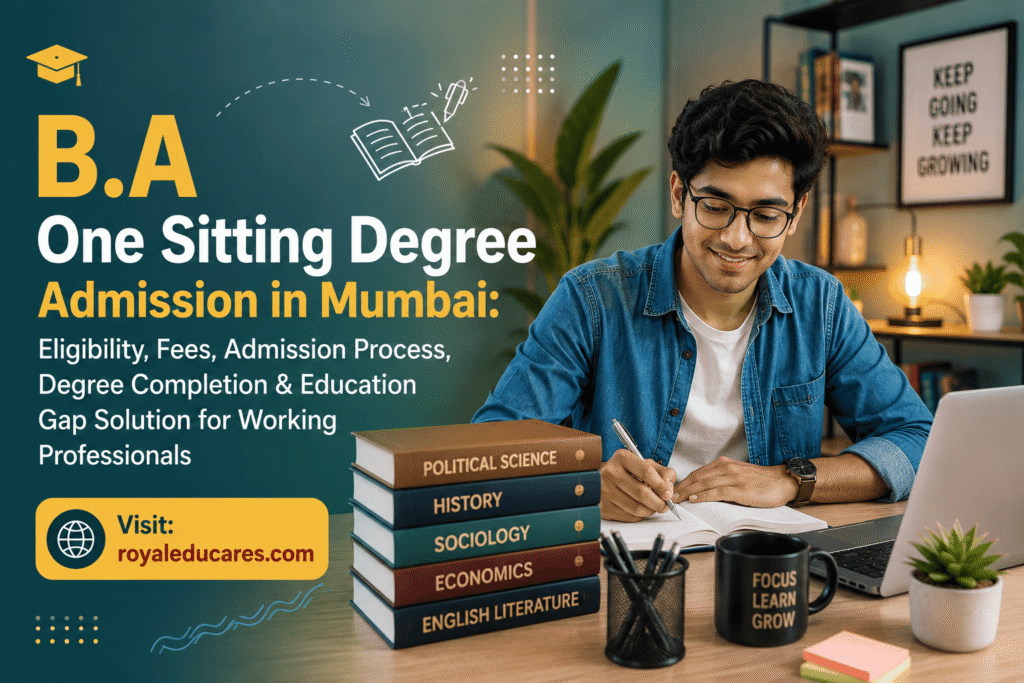
B.A One Sitting Degree Admission in Mumbai: Eligibility, Fees, Admission Process, Degree Completion & Education Gap Solution for Working Professionals
Introduction
Many students cannot complete graduation due to employment, finances, family responsibilities, health concerns, relocation, or educational gaps. B.A One Sitting Degree guidance helps eligible learners continue higher education confidently.
Accreditation & Approvals
UGC-DEB APPROVED
AICTE APPROVED
AIU APPROVED
NAAC +++ ACCREDITED

COBSE BOARDS
PHARMACY COUNCIL OF INDIA
BAR COUNCIL OF INDIA

WORLD EDUCATION SERVICES
MHRD

Get Free Career Counseling
Students looking for One Sitting Degree in Mumbai can explore comprehensive admission guidance through https://royaleducares.com/one-sitting-degree-in-mumbai/.
Those specifically interested in B.A Admission in Mumbai can find detailed information at https://royaleducares.com/b-a-admission-in-mumbai/.
For complete education guidance and professional admission support across various programs, visit https://royaleducares.com/.
B.A One Sitting Degree Admission in Mumbai
Choosing the right graduation path is one of the most important decisions for every student. Many individuals begin their higher education with enthusiasm but are unable to complete their degree because life takes unexpected turns. Career responsibilities, financial limitations, family commitments, health issues, relocation to another city, or full-time employment often interrupt academic journeys.
Fortunately, students looking for academic guidance now have opportunities to understand available degree completion pathways and admission options suitable for their educational background. Among the most searched options today is B.A One Sitting Degree Admission in Mumbai, especially among working professionals and students with an education gap.
Thousands of students search online every month using queries like:
- BA One Sitting Degree Admission Mumbai
- BA Degree Completion Mumbai
- One Sitting Graduation Mumbai
- BA Admission for Working Professionals
- Graduation After Long Gap
- BA Admission Without Regular College
- BA Degree Admission Process
- One Sitting Degree Eligibility
- BA Course Admission Mumbai
- Graduation Completion Guidance
This growing search trend clearly shows that students are actively seeking flexible educational guidance that helps them complete their graduation while balancing personal and professional responsibilities.
What Is B.A One Sitting Degree?
A Bachelor of Arts (B.A.) is one of India’s most popular undergraduate degree programs. It provides students with a strong academic foundation in humanities, social sciences, languages, history, political science, economics, sociology, psychology, public administration, geography, philosophy, and many other disciplines depending on the chosen specialization.
When students search for B.A One Sitting Degree, they are generally looking for educational guidance related to completing their graduation after an interruption in studies. Many learners are interested in understanding available admission pathways based on their previous academic qualifications and eligibility.
Rather than starting from the beginning without understanding their options, students often seek professional counselling to identify the most appropriate route for completing graduation according to university norms and eligibility criteria.
This is why educational counselling has become increasingly important for students who wish to resume their higher education after several years.
Why Is B.A One Sitting Degree Becoming Popular in Mumbai?
Mumbai is India’s financial capital and home to millions of working professionals, entrepreneurs, business owners, freelancers, healthcare workers, retail employees, hospitality staff, logistics professionals, corporate executives, government employees, and self-employed individuals.
Because of busy lifestyles, many students postpone graduation.
Some leave college after the first year.
Some discontinue after the second year.
Others complete higher secondary education but immediately begin working to support their families.
Several students even relocate due to career opportunities and never return to complete their graduation.
After a few years, they realize that a bachelor’s degree has become essential for career growth.
Today, many private companies prefer graduates during recruitment.
Government job notifications frequently specify graduation as a mandatory qualification.
Promotions within organizations often require a bachelor’s degree.
Higher education programs such as postgraduate courses also require graduation.
These factors have significantly increased online searches related to B.A admission and degree completion guidance.
Why Students Leave Graduation In Between
Understanding the reasons behind incomplete graduation helps explain why demand for educational guidance continues to grow.
Some of the most common reasons include:
Full-Time Employment
Many students receive employment opportunities immediately after completing Class 12.
Initially, earning an income appears more important than continuing education.
However, after several years, career growth becomes limited because graduation remains incomplete.
Financial Challenges
Higher education involves tuition fees, travel expenses, books, accommodation, examination charges, and other educational costs.
Many families prioritize immediate income instead of continuing studies.
Consequently, graduation gets postponed indefinitely.
Family Responsibilities
Some students become responsible for supporting parents, siblings, or their own families.
Managing household responsibilities alongside regular college becomes difficult.
As a result, education often takes a back seat.
Health Issues
Unexpected medical conditions can interrupt education for months or even years.
Once students recover, returning to regular college may not always be practical.
Marriage
Many students, especially women, discontinue higher education after marriage because of changing responsibilities.
Years later, they decide to complete graduation to improve career opportunities.
Relocation
Students frequently move to another city because of employment, family transfers, or business opportunities.
Changing colleges is not always possible.
Eventually, graduation remains incomplete.
Personal Circumstances
Every student’s educational journey is unique.
Unexpected personal situations may prevent someone from continuing regular education despite having excellent academic potential.
Who Should Consider B.A Admission Guidance?
Educational counselling is valuable for many categories of learners.
These include:
Working Professionals
Employees working in private companies often require graduation for promotions, salary growth, or better employment opportunities.
Business Owners
Entrepreneurs who discontinued education earlier may later wish to complete graduation to strengthen professional credentials.
Self-Employed Individuals
Freelancers, consultants, shop owners, and independent professionals often return to education after establishing financial stability.
Homemakers
Many women who paused education due to family responsibilities later decide to pursue graduation for personal development and future career opportunities.
Students With Education Gap
An education gap should never become the end of academic aspirations.
Professional guidance helps students understand available admission pathways based on their educational history.
Career Changers
Individuals planning to switch industries often realize that graduation significantly improves employment prospects.
Government Job Aspirants
Many competitive examinations require graduation as the minimum educational qualification.
Students therefore look for suitable guidance regarding degree completion opportunities.
Major Benefits of Completing Graduation
Graduation is not merely a certificate.
It represents academic achievement, discipline, learning ability, communication skills, and long-term commitment.
Some significant advantages include:
Better Career Opportunities
Most organizations shortlist graduate candidates before considering applicants without graduation.
Having a bachelor’s degree opens access to more employment opportunities.
Promotion Eligibility
Many companies require graduation before promoting employees to supervisory or managerial positions.
Higher Salary Potential
Graduates generally become eligible for broader job roles with improved salary packages compared to non-graduates.
Competitive Examination Eligibility
Graduation is essential for numerous recruitment examinations conducted across different sectors.
Without graduation, many opportunities remain inaccessible.
Postgraduate Education
Students planning to pursue postgraduate studies, professional certifications, or advanced academic programs generally require a bachelor’s degree.
Improved Confidence
Completing graduation increases self-confidence.
Many students feel proud after finishing an educational goal they had postponed for several years.
Professional Recognition
Graduation enhances professional credibility among employers, clients, colleagues, and business partners.
Why Working Professionals Prefer Flexible Educational Guidance
One of the fastest-growing search categories is:
- BA Admission for Working Professionals
- Graduation While Working
- Degree Completion for Employees
- Flexible Graduation Options
Working professionals usually cannot attend regular college every day because of:
- Office timings
- Rotational shifts
- Weekend work
- Business responsibilities
- Client meetings
- Travel schedules
- Family commitments
Therefore, they often search for educational counselling that helps them understand suitable admission options according to their eligibility and career goals.
Professional admission guidance also helps students understand documentation requirements, university procedures, timelines, and academic planning.
Why Mumbai Students Search Online Before Taking Admission
Today’s students make informed decisions.
Instead of immediately applying, they first research topics such as:
- Is B.A admission available in Mumbai?
- Which course should I choose?
- What are the eligibility criteria?
- How much are the fees?
- Which specialization offers better career opportunities?
- Can working professionals continue graduation?
- How can I complete graduation after a long gap?
- Which documents are required?
- What is the admission process?
- Which guidance centre should I contact?
Because these searches are highly specific, educational blogs play an important role in helping students understand their options before beginning the admission process.
Choosing the Right Academic Guidance Matters
Completing graduation is a significant educational milestone. Before proceeding with admission, students should carefully understand eligibility requirements, documentation, admission procedures, course structure, university guidelines, and future career opportunities.
Seeking guidance from experienced education counsellors can help students make informed decisions based on their academic background, career objectives, and long-term goals. Proper counselling also reduces confusion and allows students to select the most suitable path for completing their graduation.
Eligibility Criteria for B.A One Sitting Degree Admission in Mumbai
Before applying for any graduation-related admission process, students should first understand the eligibility requirements. Every student’s academic background is different, so eligibility may vary depending on previous qualifications, university regulations, and the admission pathway available.
Whether you are a working professional, have an education gap, or discontinued your studies years ago, the first step is to verify your eligibility through proper academic counselling.
Who Can Apply for B.A Admission in Mumbai?
Many students believe that once they leave college, they can never complete graduation. In reality, different students have different academic situations, and understanding your educational history is essential before proceeding.
Generally, guidance is commonly sought by:
- Students who have completed Class 12.
- Working professionals planning to continue higher education.
- Students with an education gap.
- Homemakers restarting their education.
- Self-employed individuals.
- Entrepreneurs.
- Private company employees.
- Government job aspirants.
- Students seeking graduation for career growth.
- Individuals planning higher education after completing graduation.
The first step is always an eligibility assessment based on your educational records.
Educational Qualification
For B.A admission, students are generally expected to have completed Higher Secondary (10+2) or an equivalent qualification from a recognized board, subject to the admission requirements of the institution or university.
Students who have previously enrolled in a bachelor’s program but could not complete it should discuss their academic history with an admission counsellor to understand the options available under applicable university rules.
Is There Any Age Limit?
One of the most common questions searched online is:
- Can I complete BA after 25 years?
- Can I do graduation after 30?
- Can I complete BA after 35?
- Is there an age limit for BA admission?
In many cases, higher education opportunities are available for adult learners as well. Rather than focusing on age, students should concentrate on meeting the academic eligibility criteria and selecting the appropriate admission pathway.
Whether someone is 22, 28, 35, or even older, many individuals return to education to improve their careers and personal growth.
Can Working Professionals Apply?
Yes. Working professionals are among the largest groups seeking B.A admission guidance.
Many employees begin working immediately after Class 12 because of financial responsibilities or family commitments. After gaining experience, they often discover that graduation has become essential for:
- Promotion opportunities.
- Salary increments.
- Internal company eligibility.
- Better job offers.
- Government recruitment.
- Professional certifications.
- Higher education.
Balancing work and education requires careful planning, which is why counselling becomes valuable during the admission process.
Can Students with an Education Gap Apply?
An education gap is one of the biggest concerns for students.
Common searches include:
- BA admission after long gap
- Graduation after 10 years
- Can I continue graduation after leaving college?
- How to complete graduation after a gap?
Having an education gap does not automatically prevent someone from pursuing higher education. The important factor is understanding your previous academic qualifications and discussing them with experienced admission counsellors who can guide you according to applicable university norms.
Can Homemakers Continue Their Graduation?
Yes. Many women discontinue education because of:
- Marriage
- Family responsibilities
- Childcare
- Relocation
- Financial priorities
Years later, they decide to restart their academic journey.
Completing graduation can help homemakers:
- Return to employment.
- Apply for teaching-related opportunities (where eligible and with required qualifications).
- Prepare for competitive examinations.
- Pursue postgraduate education.
- Build confidence and professional skills.
Can Business Owners Pursue Graduation?
Absolutely.
Entrepreneurs often focus on building their businesses at a young age and postpone higher education. Later, graduation becomes useful for:
- Business credibility.
- Loan applications.
- Corporate partnerships.
- Professional networking.
- Personal development.
- Future educational goals.
Many business owners now actively search for flexible graduation guidance.
Can Private Company Employees Continue Higher Education?
Private sector employees frequently require graduation because companies may use educational qualifications as one of several factors for recruitment, promotions, or role changes.
Industries where graduation is commonly valued include:
- Banking
- Retail
- Healthcare
- Hospitality
- Aviation
- Logistics
- Information Technology
- Sales and Marketing
- Customer Support
- Administration
- Human Resources
Completing graduation can broaden future career opportunities.
Documents Commonly Required During Admission
Although document requirements may vary, students are often asked to keep the following ready:
Academic Documents
- Class 10 Marksheet
- Class 12 Marksheet
- Previous college documents (if applicable)
- Transfer Certificate (where required)
- Leaving Certificate (if applicable)
Identity Documents
- Aadhaar Card
- PAN Card (if required)
- Passport (where applicable)
Address Proof
- Aadhaar Card
- Passport
- Driving Licence
- Voter ID
- Utility Bill (where accepted)
Photographs
Recent passport-size photographs may be required during the admission process.
Additional Documents
Depending on individual circumstances, students may also need to submit:
- Category certificate (if applicable)
- Name change documents (if applicable)
- Marriage certificate (if applicable)
- Migration certificate (where required)
- Gap declaration or other supporting documents, if requested by the institution.
Students should always verify the latest document checklist before applying.
Step-by-Step B.A Admission Process
Every institution follows its own procedures, but the admission journey generally includes the following stages.
Step 1 – Academic Counselling
The first step is understanding the student’s educational history.
Counsellors review:
- Previous qualifications.
- Educational gap.
- Career goals.
- Employment status.
- Preferred specialization.
- Future plans.
This helps identify the most suitable admission pathway.
Step 2 – Eligibility Verification
The student’s academic documents are reviewed to determine eligibility according to the applicable admission requirements.
Step 3 – Course Selection
Students choose a specialization that aligns with their interests and long-term career plans.
Popular B.A. subjects may include:
- English
- History
- Political Science
- Sociology
- Economics
- Psychology
- Public Administration
- Geography
- Philosophy
- Hindi
- Marathi
Availability depends on the institution.
Step 4 – Documentation
Students submit the required academic and identity documents for verification.
Step 5 – Application Submission
After document verification, the admission application is completed according to the institution’s process.
Step 6 – Confirmation
Once all formalities are completed and the application is accepted, students receive confirmation as per the institution’s admission procedures.
Why Students Need Professional Admission Guidance
Searching online provides general information, but every student’s academic journey is unique.
Professional counselling can help students:
- Understand eligibility.
- Choose the right course.
- Select an appropriate specialization.
- Prepare required documents.
- Avoid mistakes during admission.
- Understand academic timelines.
- Clarify future education options.
Good counselling helps students make informed decisions rather than relying on assumptions.
Common Mistakes Students Should Avoid
Many students unintentionally delay their admission because of avoidable errors.
Some common mistakes include:
Waiting Too Long
Students often postpone their admission for another year, which may delay career progression.
Not Checking Eligibility
Applying without understanding eligibility can lead to confusion.
Choosing a Course Without Career Planning
A degree should support long-term career goals, not just immediate admission.
Submitting Incorrect Documents
Incomplete or incorrect documentation can slow down the admission process.
Ignoring Academic Counselling
Professional guidance often saves time by helping students understand the correct process from the beginning.
Understanding Recognition and University Guidelines
Students frequently search:
- Is BA degree valid?
- Is graduation recognised?
- Can I apply for government jobs?
- Can I pursue a master’s degree after BA?
- Is BA accepted for private jobs?
The answers depend on factors such as the institution, applicable regulations, and the specific admission pathway. Students should always verify recognition, eligibility, and future applicability with the concerned university or institution before taking admission.
Choosing the Right B.A. Specialization
Selecting the right specialization is just as important as taking admission.
Students should consider:
- Personal interests.
- Career objectives.
- Future higher education plans.
- Government job aspirations.
- Competitive examination goals.
- Employment opportunities.
- Skill development.
A well-chosen specialization can support both professional growth and long-term academic success.
Why B.A. Remains One of the Most Popular Degrees
Despite the emergence of many new courses, the Bachelor of Arts continues to be one of the most widely chosen undergraduate programs because of its flexibility and broad career scope.
It provides a foundation for careers in education, administration, public service, media, content writing, journalism, civil services preparation, social work, human resources, customer relations, and many other fields. It also serves as a stepping stone for postgraduate programs and professional development.
By understanding the admission process, eligibility requirements, documentation, and career planning, students can make informed decisions and confidently move toward completing their graduation.
B.A One Sitting Degree Fees in Mumbai
One of the first questions students ask before taking admission is about the course fees. Online searches such as “B.A One Sitting Degree Fees in Mumbai,” “B.A Admission Fees,” “Graduation Fees,” and “Affordable B.A Admission in Mumbai” are among the most common.
However, it is important to understand that fees are not the same for every student or institution. The total cost may vary depending on several factors, including the university or institution, admission pathway, specialization, academic background, applicable university regulations, documentation requirements, and other administrative factors.
Therefore, students should always obtain the latest fee details directly from the admission counsellor before completing the admission process.
Factors That May Influence B.A Admission Fees
The overall fee structure may differ based on:
- University or institution
- Course specialization
- Academic qualification
- Previous educational history
- Admission category
- Documentation requirements
- Applicable university regulations
- Examination and administrative charges (where applicable)
Instead of comparing fees alone, students should focus on selecting the most suitable academic pathway based on eligibility and long-term career goals.
Is B.A an Affordable Graduation Option?
Compared with many professional degree programs, the Bachelor of Arts is generally considered one of the more affordable undergraduate courses. This is one reason why it remains popular among students from different educational and financial backgrounds.
Students often choose B.A. because it offers:
- Broad career opportunities
- Eligibility for many competitive examinations
- A foundation for postgraduate studies
- Flexibility in subject selection
- Opportunities in both government and private sectors
Why Students Invest in Completing Their Graduation
Graduation is more than an academic qualification—it is an investment in future career growth. Many individuals who postponed their studies later realize that completing a bachelor’s degree can expand their opportunities.
Graduation may help students:
- Become eligible for a wider range of jobs
- Improve promotion prospects
- Meet educational requirements for higher studies
- Build professional credibility
- Strengthen their résumé
- Increase long-term career options
Popular B.A. Specializations
Choosing the right specialization is an important decision. Students should consider their interests, career goals, and future study plans before selecting a subject.
Some commonly available B.A. specializations include:
B.A. in English
Suitable for students interested in literature, communication, teaching, writing, journalism, publishing, and content creation.
Career possibilities include:
- Content Writer
- Copywriter
- Editor
- Teacher (with required qualifications)
- Journalist
- Public Relations Executive
B.A. in Political Science
A preferred option for students preparing for civil services, public administration, governance, law, and public policy.
Career opportunities may include:
- Government services
- Research
- Political consultancy
- Policy analysis
- Civil services preparation
B.A. in History
Students interested in heritage, archaeology, museums, education, and research often choose History.
Possible career paths include:
- Historian
- Archivist
- Museum Professional
- Research Assistant
- Teacher (subject to required qualifications)
B.A. in Sociology
This specialization focuses on society, communities, and human behavior.
Career areas include:
- Social Work
- NGOs
- Community Development
- Human Resources
- Research Organizations
B.A. in Psychology
Psychology is increasingly popular among students interested in understanding human behavior.
It can provide a foundation for:
- Counselling
- Human Resources
- Behavioural Studies
- Higher Education
- Research
B.A. in Economics
Economics develops analytical and decision-making skills.
Graduates may explore careers in:
- Banking
- Financial Services
- Research
- Market Analysis
- Government Departments
B.A. in Public Administration
This specialization is suitable for students interested in governance, administration, and public service.
Career opportunities may include:
- Administrative roles
- Government departments
- Public sector organizations
- Research
- Civil services preparation
B.A. in Geography
Geography combines environmental, social, and geographical studies.
Potential career fields include:
- GIS
- Urban Planning
- Environmental Studies
- Research
- Government Departments
Which B.A. Specialization Is Best?
There is no single “best” specialization for every student.
The ideal choice depends on:
- Career objectives
- Personal interests
- Preferred industry
- Government job aspirations
- Future postgraduate plans
- Skill set
Students should select a specialization that aligns with their long-term goals rather than choosing solely based on popularity.
Career Opportunities After Completing B.A.
One of the biggest reasons students complete graduation is to improve their career prospects.
A Bachelor of Arts can open doors to opportunities across multiple industries, depending on the student’s skills, specialization, and experience.
Some sectors that recruit graduates include:
- Education
- Banking
- Insurance
- Media
- Journalism
- Digital Marketing
- E-commerce
- Customer Service
- Hospitality
- Tourism
- Retail
- Human Resources
- Administration
- Sales
- Government Departments
- NGOs
- Research Organizations
Government Job Opportunities After B.A.
Graduation is a basic eligibility requirement for many government recruitment examinations.
Depending on the specific recruitment notification and eligibility criteria, graduates may apply for various examinations conducted by central and state authorities.
Students commonly prepare for examinations conducted by organizations such as:
- UPSC
- SSC
- State Public Service Commissions
- Banking Recruitment Agencies
- Railways
- Insurance Organizations
- Defence Recruitment (where eligible)
- Municipal Bodies
- Public Sector Organizations
Candidates should always refer to the official notification for the latest eligibility requirements.
Private Sector Career Opportunities
The private sector offers a wide variety of opportunities for graduates.
Common job profiles include:
- Customer Relationship Executive
- HR Executive
- Administrative Assistant
- Operations Executive
- Business Development Executive
- Marketing Executive
- Sales Executive
- Office Administrator
- Recruiter
- Client Support Executive
- Digital Marketing Associate
- Content Executive
- Social Media Executive
Career growth typically depends on skills, experience, communication abilities, and job performance.
Can I Pursue Higher Education After B.A.?
Yes. Many students continue their education after completing a Bachelor of Arts.
Popular options include:
- M.A. (Master of Arts)
- MBA
- MSW
- LLB (subject to eligibility)
- B.Ed. (where eligible and as per current regulations)
- Professional Certification Courses
- Diploma Programs
- Skill Development Programs
Higher education can help students develop specialized knowledge and broaden career opportunities.
Expected Salary After B.A.
A common online search is:
- Salary after BA
- BA graduate salary in India
- Highest-paying jobs after BA
There is no fixed salary for B.A. graduates. Earnings depend on several factors, including:
- Skills
- Experience
- Industry
- Location
- Job role
- Employer
- Additional qualifications
Candidates who continuously improve their skills through certifications, internships, communication training, and practical experience often have stronger career prospects.
Skills That Improve Career Opportunities
Completing graduation is important, but employers also value practical skills.
Students can strengthen their profile by developing:
- Communication Skills
- English Proficiency
- Computer Literacy
- Microsoft Office Skills
- Presentation Skills
- Time Management
- Problem Solving
- Teamwork
- Leadership
- Critical Thinking
- Digital Skills
- Email Writing
- Interview Skills
These abilities can complement academic qualifications and improve employability.
Why Employers Value Graduates
Many organizations prefer graduates because a bachelor’s degree often reflects commitment, learning ability, and foundational knowledge. Combined with relevant skills and experience, graduation can enhance a candidate’s profile during recruitment and career progression.
Planning Your Career After Graduation
Students should think beyond obtaining a degree. A clear career plan helps maximize the value of graduation.
Consider:
- Which industry interests you?
- Do you want a government or private sector career?
- Will you pursue postgraduate studies?
- What skills should you develop alongside your degree?
- Which certifications can strengthen your profile?
- Where do you see yourself in the next five years?
Answering these questions early can help students make informed educational and career decisions.
Why Completing Graduation Should Not Be Delayed
Every year, many individuals postpone graduation because of work, financial responsibilities, or uncertainty about the admission process. Delaying further may postpone career advancement and future educational opportunities.
Understanding your eligibility, selecting the right specialization, and seeking proper academic guidance can help you take the next step toward completing your Bachelor of Arts and building a stronger foundation for long-term personal and professional growth.
Why Working Professionals Choose B.A. Admission in Mumbai
The demand for B.A. admission among working professionals has increased significantly in recent years. Many individuals start working immediately after completing Class 12 or after discontinuing college due to financial responsibilities, family commitments, or career opportunities. As their careers progress, they often realize that a bachelor’s degree is essential for long-term professional growth.
Today, employers across many industries value candidates with a graduation degree, making it an important qualification for promotions, better job opportunities, and higher studies.
B.A. Admission for Working Professionals
Working professionals often face challenges that make regular classroom education difficult. Common reasons include:
- Full-time office schedules
- Rotational shifts
- Weekend duties
- Frequent business travel
- Family responsibilities
- Limited study time
- Financial commitments
Because of these responsibilities, many employees search online for:
- BA Admission for Working Professionals
- Graduation While Working
- Degree Completion After Job
- Flexible BA Admission Mumbai
- Graduation After Employment
Academic guidance helps such students understand the available admission options according to their educational background and eligibility.
How Graduation Supports Career Growth
Many professionals reach a point where experience alone is not enough. Some organizations require graduation as one of the qualifications for promotions or certain job roles.
Completing graduation may help in:
- Applying for senior positions
- Becoming eligible for internal promotions
- Expanding career opportunities
- Meeting educational requirements for specific roles
- Pursuing postgraduate education
- Building long-term professional credibility
A bachelor’s degree also reflects commitment, discipline, and continuous learning.
Education Gap Should Not Stop Your Career
One of the most searched topics today is education gap.
Students often worry that a gap of several years will prevent them from completing graduation.
Common searches include:
- Graduation after 5 years
- Graduation after 10 years
- BA Admission after long gap
- Can I study after leaving college?
- How to complete graduation after a break?
An education gap can occur for many reasons:
- Financial difficulties
- Employment
- Family responsibilities
- Health-related issues
- Marriage
- Relocation
- Personal circumstances
An education gap does not define a student’s ability to succeed. Understanding the available admission pathways through proper counselling can help students continue their academic journey.
Graduation After a Long Career Break
Many students return to education after several years.
Some have worked for a decade.
Some have raised families.
Others have managed businesses.
Despite the gap, they decide to complete graduation because they understand its importance for future opportunities.
Returning to education requires determination, but thousands of adult learners successfully continue their academic journey every year.
B.A. Admission for Homemakers
Many women discontinue higher education because of family responsibilities, marriage, childcare, or relocation.
Years later, they often decide to resume their studies for personal growth and career development.
Completing graduation can help homemakers:
- Improve confidence
- Explore employment opportunities
- Prepare for competitive examinations
- Pursue higher education
- Develop professional skills
Education can be restarted at different stages of life with proper planning and guidance.
B.A. Admission for Business Owners
Entrepreneurs frequently prioritize business growth over education during their early years.
As businesses expand, many owners recognize the value of completing graduation.
A bachelor’s degree may support:
- Professional credibility
- Corporate communication
- Business networking
- Personal development
- Eligibility for future academic programs
Many business owners now seek graduation guidance while continuing to manage their enterprises.
B.A. Admission for Self-Employed Individuals
Freelancers and self-employed professionals also return to education for career advancement.
Examples include:
- Digital marketers
- Graphic designers
- Photographers
- Shop owners
- Consultants
- Traders
- Content creators
- Social media professionals
Completing graduation can strengthen professional profiles and create additional opportunities.
B.A. Admission for Government Job Aspirants
Graduation is one of the most common educational qualifications required for many government recruitment examinations.
Students preparing for competitive exams often complete their bachelor’s degree to meet eligibility requirements.
Popular examinations include those conducted by:
- UPSC
- SSC
- Banking recruitment agencies
- State Public Service Commissions
- Railways
- Insurance organizations
- Public sector institutions
Candidates should always verify eligibility through the official recruitment notification.
Why Students in Mumbai Prefer Career-Focused Guidance
Mumbai is one of India’s largest education and employment hubs.
Every year, students from different parts of Maharashtra and other states move to Mumbai for:
- Employment
- Business
- Professional training
- Skill development
- Higher education
Because of busy schedules, many learners prefer structured admission guidance that helps them understand eligibility, documentation, and suitable academic pathways.
B.A. vs Waiting Another Year
Many students postpone admission because they think they will start “next year.”
Unfortunately, one year often becomes several years.
Every additional delay may postpone:
- Career advancement
- Promotion opportunities
- Eligibility for higher studies
- Competitive examination plans
- Professional development
Starting the admission process after understanding eligibility can help students move closer to their long-term goals.
How to Balance Work and Graduation
Working professionals often worry about managing both career and education.
Effective planning can make the journey more manageable.
Useful strategies include:
Create a Weekly Study Schedule
Even a few consistent study sessions each week can help maintain progress.
Set Realistic Goals
Break larger objectives into smaller milestones to stay motivated.
Improve Time Management
Using calendars, planners, or reminders can help balance work, family, and study commitments.
Stay Consistent
Regular learning is often more effective than studying only occasionally.
Seek Academic Guidance
Understanding the admission process and course requirements early helps reduce confusion and saves time.
Common Challenges Faced by Adult Learners
Returning to education after several years may bring new challenges.
Some common concerns include:
- Fear of studying again
- Lack of confidence
- Time management
- Family responsibilities
- Work pressure
- Academic gap
- Technology adaptation
These challenges are common, and many students overcome them through planning, discipline, and support.
Benefits of Completing Graduation Later in Life
There is no fixed age for learning.
Adult learners often bring valuable life experience, maturity, and discipline to their educational journey.
Completing graduation later in life can provide:
- Greater self-confidence
- Enhanced career prospects
- Personal satisfaction
- Improved communication skills
- Stronger professional profile
- Better preparation for future educational goals
Education remains a lifelong investment.
Why Career Planning Is Important
Choosing a degree is only one step. Students should also think about where they want to be after graduation.
Questions worth considering include:
- Which career interests me?
- Do I want to work in the private or government sector?
- Should I pursue postgraduate education?
- What skills should I develop?
- Which certifications will complement my degree?
- How can I improve my employability?
A clear career plan helps students make better academic decisions.
Building Skills Alongside Graduation
Modern employers look beyond academic qualifications.
Students can improve their career prospects by learning additional skills such as:
- Spoken English
- Computer Applications
- Microsoft Office
- Digital Marketing
- Data Analysis
- Communication Skills
- Public Speaking
- Email Writing
- Presentation Skills
- Leadership
- Teamwork
- Problem Solving
Combining graduation with practical skills can strengthen a candidate’s profile in today’s competitive job market.
The Importance of Continuous Learning
The employment landscape continues to evolve with technology, automation, and changing industry requirements.
Graduation provides a strong academic foundation, but lifelong learning helps professionals remain competitive. Attending workshops, earning certifications, developing technical skills, and improving communication abilities can all contribute to long-term career success.
Students who invest in continuous learning are often better prepared to adapt to new opportunities and workplace expectations.
Take the First Step Toward Completing Your Graduation
Every successful educational journey begins with a single step. Whether you are a working professional, homemaker, entrepreneur, self-employed individual, or someone returning after an education gap, completing your Bachelor of Arts can become an important milestone in your personal and professional development.
Understanding your eligibility, selecting the right academic pathway, and planning your career carefully can help you move forward with greater confidence and achieve your long-term educational goals.
Why Mumbai Is One of the Best Cities for Higher Education
Mumbai is widely recognized as one of India’s leading educational and professional destinations. Every year, thousands of students choose Mumbai to pursue higher education because of its academic institutions, employment opportunities, diverse industries, and strong career ecosystem.
The city attracts:
- Working professionals
- Fresh Class 12 pass students
- Entrepreneurs
- Business owners
- Homemakers restarting education
- Students with an education gap
- Career changers
- Professionals seeking graduation for promotions
This growing demand has also increased online searches related to B.A. admission, degree completion guidance, and graduation opportunities in Mumbai.
Why Students Choose B.A. in Mumbai
A Bachelor of Arts remains one of the most versatile undergraduate programs because it provides opportunities across multiple industries and supports further education.
Students choose B.A. for different reasons, including:
- Career growth
- Government job preparation
- Private sector employment
- Higher education
- Skill development
- Personal achievement
- Career transition
Its flexibility makes it a preferred choice for learners from diverse educational backgrounds.
Step-by-Step Guide to Planning Your B.A. Admission
Before starting the admission process, students should follow a structured approach.
Step 1 – Understand Your Academic Background
Begin by reviewing your educational history.
Consider:
- Have you completed Class 12?
- Did you discontinue college?
- Do you have an education gap?
- Are you currently employed?
- Are you planning postgraduate studies later?
Understanding your academic background helps determine the most suitable admission pathway.
Step 2 – Collect Educational Documents
Keeping documents ready before applying can simplify the admission process.
Commonly required documents may include:
- Class 10 Marksheet
- Class 12 Marksheet
- Aadhaar Card
- Passport-size photographs
- Previous college documents (if applicable)
- Transfer or Leaving Certificate (where applicable)
- Other documents requested by the institution
Always verify the latest document requirements before applying.
Step 3 – Choose the Right Specialization
Students should select a specialization based on:
- Career interests
- Future goals
- Subject preferences
- Government job plans
- Higher education aspirations
- Individual strengths
Choosing a specialization carefully can support long-term career development.
Step 4 – Verify Eligibility
Eligibility verification is an important stage of the admission process.
Students should consult an admission counsellor to understand:
- Academic eligibility
- Documentation requirements
- Applicable university guidelines
- Admission procedures
Step 5 – Complete the Admission Process
Once eligibility and documentation are verified, students can proceed according to the institution’s admission process.
Mistakes Students Should Avoid Before Taking Admission
Many students unintentionally make decisions that delay their educational progress.
Avoid these common mistakes:
Choosing a Course Only Because Others Recommend It
Every student’s goals are different.
Select a program based on your interests and career plans rather than following friends or relatives.
Ignoring Career Planning
Graduation should support your long-term objectives.
Think about where you want to be five or ten years from now before choosing a specialization.
Delaying Admission
Waiting another year often becomes waiting several years.
If you are eligible and prepared, delaying your decision may postpone future opportunities.
Not Verifying Information
Always confirm admission procedures, eligibility, documentation, and recognition directly through the concerned institution or admission counsellor.
Avoid relying solely on unofficial online information.
Overlooking Skill Development
Academic qualifications are important, but employers also value practical skills.
Continue improving communication, computer literacy, and professional abilities throughout your educational journey.
Common Myths About B.A.
Many misconceptions prevent students from pursuing a Bachelor of Arts.
Let’s clarify some of the most common ones.
Myth 1: B.A. Has No Career Scope
Reality:
A B.A. graduate can build a career in education, administration, banking, media, digital marketing, customer service, human resources, public relations, journalism, NGOs, research, government services, and many other fields.
Career success depends on skills, experience, and continuous learning—not just the degree title.
Myth 2: Only Science or Commerce Students Get Good Jobs
Reality:
Employers recruit candidates from different educational backgrounds based on role requirements, skills, and experience.
Arts graduates continue to work successfully across both public and private sectors.
Myth 3: Graduation Is Not Necessary
Reality:
While some careers do not require a degree, many jobs, promotions, competitive examinations, and postgraduate programs specify graduation as a minimum qualification.
Completing graduation can expand future opportunities.
Myth 4: Education Gap Ends Career Opportunities
Reality:
Many professionals successfully resume education after several years.
An education gap does not automatically prevent academic or professional growth.
Myth 5: Graduation Alone Guarantees Success
Reality:
Graduation provides a strong academic foundation, but long-term success also depends on:
- Skills
- Communication
- Practical experience
- Professional attitude
- Continuous learning
Industries That Recruit B.A. Graduates
A Bachelor of Arts prepares students for opportunities across multiple sectors.
Examples include:
Education
- Academic Support
- Administration
- Training
- Educational Services
Banking and Finance
Graduates may explore customer service, operations, administration, and other entry-level roles, subject to employer requirements.
Digital Marketing
The digital economy has created demand for professionals in:
- SEO
- Content Writing
- Social Media
- Email Marketing
- Paid Advertising
- Analytics
Many B.A. graduates build successful careers in digital marketing by combining their degree with industry certifications.
Media and Journalism
Graduates interested in communication can explore:
- News Media
- Publishing
- Broadcasting
- Content Creation
- Editing
- Copywriting
Human Resources
HR departments recruit graduates for roles involving:
- Recruitment
- Employee Relations
- Documentation
- Administration
- Talent Acquisition
Customer Service
Many multinational companies recruit graduates for customer support and client relationship roles.
Sales and Marketing
Communication and interpersonal skills are valuable in sales, business development, and marketing positions.
Government Sector
Graduation serves as the educational foundation for many government recruitment examinations, subject to the eligibility criteria specified in official notifications.
Preparing for Success After Graduation
Completing a B.A. is only the beginning of a professional journey.
Students should also focus on:
- Building communication skills
- Learning computer applications
- Improving English proficiency
- Developing analytical thinking
- Gaining practical experience
- Earning industry certifications
- Networking professionally
These additional efforts can significantly improve career opportunities.
Soft Skills Every Graduate Should Develop
Employers increasingly value soft skills alongside academic qualifications.
Important soft skills include:
- Communication
- Teamwork
- Leadership
- Problem Solving
- Critical Thinking
- Adaptability
- Time Management
- Professional Ethics
- Decision Making
- Emotional Intelligence
Developing these skills can enhance workplace performance and career growth.
Creating a Long-Term Career Roadmap
Instead of focusing only on completing graduation, students should create a long-term roadmap.
Ask yourself:
- What industry do I want to work in?
- Should I pursue higher education?
- Which certifications can strengthen my profile?
- What technical skills should I learn?
- How can I improve my communication?
- What career opportunities match my interests?
Planning ahead helps students make informed educational and professional decisions.
The Value of Academic Guidance
Many students feel confused about eligibility, admission procedures, documentation, specialization selection, and future career planning.
Professional academic guidance can help by:
- Clarifying admission requirements
- Explaining eligibility criteria
- Assisting with document preparation
- Helping students choose suitable specializations
- Providing information about future educational opportunities
- Supporting informed decision-making
Seeking proper guidance early can save time and reduce unnecessary confusion.
Building a Strong Future Through Education
Education continues to play an important role in professional and personal development. Completing a Bachelor of Arts demonstrates commitment, perseverance, and a willingness to learn.
Whether your goal is career advancement, higher education, government employment, entrepreneurship, or personal achievement, graduation can become an important milestone that supports future growth.
By understanding your eligibility, planning carefully, developing practical skills, and staying committed to continuous learning, you can create a stronger foundation for long-term success.
B.A. vs B.Com – Which Degree Is Better?
Choosing the right undergraduate course is one of the most important academic decisions. Many students search online using queries like:
- B.A. vs B.Com
- Which is better, BA or BCom?
- Best graduation course after 12th
- BA or BCom for government jobs
- BA or BCom for private jobs
- Which graduation course has more career scope?
The answer depends on your interests, career goals, academic background, and future plans. There is no single degree that is best for everyone.
B.A. (Bachelor of Arts)
A Bachelor of Arts focuses on humanities, social sciences, languages, psychology, history, political science, sociology, economics, philosophy, geography, and related disciplines.
It is suitable for students interested in:
- Civil services
- Government jobs
- Education
- Journalism
- Content Writing
- Digital Marketing
- Public Administration
- Human Resources
- Social Work
- Research
B.Com (Bachelor of Commerce)
A Bachelor of Commerce focuses on:
- Accounting
- Finance
- Taxation
- Banking
- Business Studies
- Economics
- Auditing
- Corporate Finance
It is generally preferred by students interested in commerce-related careers.
Which One Should You Choose?
Choose B.A. if you enjoy:
- Reading and writing
- Social sciences
- Public policy
- Communication
- Languages
- Research
- Humanities
Choose B.Com if you prefer:
- Numbers
- Accounting
- Finance
- Taxation
- Banking
- Business Management
The best degree is the one that aligns with your long-term career objectives.
B.A. vs BBA
Another popular search is:
- BA vs BBA
- Which is better BA or BBA?
- Career after BA vs BBA
B.A.
Best suited for students planning careers in:
- Government sector
- Education
- Journalism
- Digital Marketing
- Public Relations
- Research
- Humanities
BBA
Primarily designed for students interested in:
- Business Management
- Marketing
- Human Resources
- Entrepreneurship
- Corporate Management
Neither degree is universally better. The right choice depends on your career aspirations.
B.A. vs Regular Graduation
Students often search:
- Regular BA vs Distance BA
- Regular graduation or flexible learning
- Which graduation option should I choose?
Regular classroom education is suitable for students who can attend classes consistently.
However, many learners cannot follow a regular schedule because of:
- Employment
- Business
- Family commitments
- Relocation
- Health-related issues
In such situations, students often seek academic counselling to understand the most appropriate educational pathway based on their eligibility and personal circumstances.
Why B.A. Is a Popular Choice for Competitive Exam Aspirants
Many students preparing for competitive examinations choose a Bachelor of Arts because subjects such as Political Science, History, Economics, Geography, Sociology, and Public Administration are closely related to the syllabus of several government examinations.
Common examinations include:
- UPSC Civil Services
- SSC
- State Public Service Commission Examinations
- Banking Recruitment
- Insurance Recruitment
- Railways
- Other government recruitment examinations
Candidates should always refer to the official notification for the latest eligibility and syllabus.
Can B.A. Graduates Build Successful Careers?
Absolutely.
Career success depends on much more than the name of the degree.
Successful professionals continuously improve their:
- Communication skills
- Technical knowledge
- Practical experience
- Professional attitude
- Industry certifications
- Leadership abilities
Graduation provides the academic foundation, while skills and experience support long-term career growth.
High-Demand Skills That Complement a B.A.
Employers increasingly look for candidates who combine academic qualifications with practical abilities.
Some valuable skills include:
Communication Skills
Strong verbal and written communication is useful in almost every profession.
Computer Skills
Knowledge of:
- MS Word
- Excel
- PowerPoint
- Email Communication
- Internet Research
can improve employability.
Digital Marketing
Digital Marketing continues to be one of the fastest-growing industries.
Useful skills include:
- Search Engine Optimization (SEO)
- Social Media Marketing
- Google Ads
- Content Marketing
- Email Marketing
- Web Analytics
Content Writing
Students with strong writing skills may explore careers in:
- Blogging
- Copywriting
- Website Content
- Technical Writing
- Academic Content
Public Speaking
Confidence in presentations and public communication is highly valued by employers.
Leadership
Leadership qualities can support career progression into supervisory and managerial positions.
Certifications That Can Enhance Career Opportunities
Alongside graduation, students may consider learning industry-relevant skills through certification programs such as:
- Digital Marketing
- Data Analytics
- Graphic Design
- UI/UX Basics
- Foreign Languages
- Computer Applications
- Tally
- Advanced Excel
- Content Writing
- Business Communication
The appropriate certification depends on individual career goals.
How to Improve Employability During Graduation
Students should not wait until graduation is complete before preparing for employment.
They can begin developing their profile by:
- Improving communication skills
- Participating in internships
- Building a professional résumé
- Creating a LinkedIn profile
- Learning computer applications
- Taking certification courses
- Practicing interview skills
- Reading industry-related books
- Staying updated with current affairs
These activities can make graduates more competitive in the job market.
Common Questions Students Ask Before Taking Admission
Students frequently have concerns before beginning their graduation journey.
Some of the most common questions include:
- Which graduation course should I choose?
- Is B.A. a good career option?
- Can I study while working?
- Will graduation help me get a better job?
- Which specialization has more career opportunities?
- Can I pursue higher education after B.A.?
- How long does the admission process take?
- Which documents are required?
- How do I verify my eligibility?
Seeking guidance from experienced admission counsellors can help answer these questions based on your individual circumstances.
Building a Professional Resume After B.A.
A degree alone is not enough to create a strong résumé.
Students should include:
- Academic qualifications
- Technical skills
- Certifications
- Internships
- Volunteer experience
- Projects
- Achievements
- Language proficiency
- Computer skills
A well-prepared résumé increases confidence during job applications.
Future Career Planning After Graduation
Career planning should begin before graduation is completed.
Students should identify:
- Preferred industries
- Career interests
- Higher education goals
- Skill gaps
- Certification requirements
- Long-term objectives
Having a structured plan helps students make better educational and professional decisions.
Why Continuous Learning Matters
Industries continue to evolve because of technology, automation, artificial intelligence, and changing business requirements.
Professionals who continuously update their knowledge remain better prepared for future opportunities.
Ways to continue learning include:
- Professional certifications
- Online courses
- Industry workshops
- Books
- Seminars
- Skill-development programs
- Networking events
Continuous learning supports long-term career growth.
Final Thoughts Before Taking Admission
Before making any admission decision, students should carefully evaluate their educational background, career goals, and future aspirations.
A Bachelor of Arts remains one of the most flexible and valuable undergraduate programs, offering opportunities across government services, private employment, higher education, research, digital industries, education, administration, and many other fields.
Choosing the right specialization, understanding eligibility, developing practical skills, and seeking professional academic guidance can help students complete their graduation with confidence and prepare for long-term personal and professional success.
Complete Guide to Choosing the Right B.A. Specialization
Selecting the right specialization is one of the most important decisions in your graduation journey. Many students focus only on admission, but choosing a subject that matches your interests and career goals can have a long-term impact on employment opportunities and higher education.
Before selecting a specialization, ask yourself:
- Which subjects do I enjoy studying?
- What type of career do I want?
- Am I preparing for government jobs?
- Do I want to pursue postgraduate education?
- Which industries interest me?
- What skills do I already have?
A thoughtful decision today can support your career for years to come.
How to Choose the Right Graduation Course
Students often search:
- Which graduation course is best?
- Best BA specialization
- Best graduation after 12th
- Which degree has more career scope?
- Which course is best for government jobs?
There is no single course that is perfect for everyone. The right course depends on:
- Career goals
- Academic interests
- Personal strengths
- Future education plans
- Employment aspirations
Instead of following trends, students should choose a course that aligns with their own ambitions.
Is B.A. a Good Career Choice in 2026 and Beyond?
Yes. A Bachelor of Arts continues to be a relevant undergraduate degree because it develops analytical thinking, communication, writing, research, and problem-solving skills.
Graduates can pursue opportunities in:
- Government Sector
- Private Companies
- Digital Marketing
- Education
- Banking
- Insurance
- Human Resources
- Media
- Journalism
- Administration
- Research
- Public Relations
- NGOs
- Customer Service
- Entrepreneurship
The degree also provides a strong foundation for postgraduate education.
Career Opportunities Across Different Industries
A B.A. graduate is not limited to one profession. Depending on specialization, experience, and skills, opportunities exist across multiple sectors.
Education
Graduates interested in teaching, academic administration, or educational services may continue their studies and pursue the required qualifications for their chosen field.
Human Resources
Organizations recruit graduates for roles involving recruitment, employee engagement, documentation, and talent management.
Media & Communication
Students with strong communication skills can explore careers in:
- Journalism
- Content Writing
- Editing
- Copywriting
- Public Relations
- Broadcasting
Digital Marketing
Digital Marketing has become one of the fastest-growing career fields.
Graduates can build expertise in:
- SEO
- Google Ads
- Social Media Marketing
- Content Marketing
- Email Marketing
- Analytics
With practical experience, career growth in this field can be significant.
Administration
Many organizations recruit graduates for administrative and operational roles that require communication, organization, and documentation skills.
Banking & Financial Services
Graduates may become eligible for various banking and financial sector opportunities, subject to recruitment requirements and examinations.
Customer Relations
Strong communication and interpersonal skills can help graduates build careers in customer success, client servicing, and relationship management.
Preparing for Competitive Examinations
Many students pursue graduation while preparing for competitive examinations.
Graduation is commonly required for several recruitment processes conducted by:
- UPSC
- SSC
- State Public Service Commissions
- Banking Recruitment
- Railways
- Insurance Organizations
- Public Sector Undertakings
Candidates should regularly follow official notifications for updated eligibility criteria and examination details.
Importance of Soft Skills
Academic qualifications alone are not enough in today’s competitive job market.
Employers also evaluate:
- Communication
- Leadership
- Professionalism
- Teamwork
- Adaptability
- Critical Thinking
- Time Management
- Problem Solving
- Decision Making
Developing these skills alongside graduation can improve employability.
Technical Skills That Add Value
Students should also focus on practical skills that complement their degree.
Examples include:
- Microsoft Office
- Google Workspace
- Advanced Excel
- Canva
- Digital Marketing
- Data Analysis
- Graphic Design
- AI Productivity Tools
- Basic Website Management
- Email Communication
Combining graduation with technical skills creates a stronger professional profile.
Building a Strong Professional Profile
Students can begin preparing for employment even before graduation by:
- Creating a professional résumé
- Building a LinkedIn profile
- Completing online certifications
- Participating in internships
- Developing communication skills
- Learning industry-specific software
- Practicing interview techniques
These efforts can improve confidence and job readiness.
Tips for Students Returning After an Education Gap
Returning to education after several years may feel challenging, but many students successfully restart their academic journey.
Helpful tips include:
Believe in Your Decision
Every educational journey is different. An education gap does not define your future potential.
Stay Organized
Keep your academic documents, identification records, and study materials well organized.
Set Achievable Goals
Break your graduation journey into smaller milestones instead of focusing only on the final outcome.
Continue Learning
Develop new skills alongside your degree to remain competitive in the job market.
Seek Professional Guidance
Academic counselling can help clarify eligibility, documentation, specialization choices, and admission procedures.
Why Career Planning Should Begin Today
Many students think about careers only after completing graduation.
A better approach is to start planning early.
Consider:
- Which industry interests you?
- What salary expectations do you have?
- Which skills should you develop?
- Do you want to pursue higher education?
- Are you interested in entrepreneurship?
- Which certifications will strengthen your profile?
Planning ahead allows students to make informed academic and professional decisions.
Long-Term Benefits of Completing Graduation
Completing a Bachelor of Arts can contribute to long-term personal and professional development.
Potential benefits include:
- Improved employment opportunities
- Better career progression
- Eligibility for postgraduate education
- Preparation for competitive examinations
- Increased confidence
- Stronger communication skills
- Enhanced professional credibility
- Broader career options
Graduation is often viewed as an important milestone that supports future learning and career advancement.
Final Advice for Students
If you have been postponing your graduation because of work, financial challenges, family responsibilities, relocation, health issues, or an education gap, remember that many students face similar circumstances.
The first step is to understand your eligibility, gather the required documents, choose the right specialization, and seek reliable academic guidance. Careful planning and consistent effort can help you complete your graduation and move closer to your educational and career goals.
Every successful career begins with a decision to move forward. Completing your Bachelor of Arts can be one of the most valuable investments you make in your future.
Conclusion
A B.A. One Sitting Degree Admission in Mumbai is a topic that attracts students looking for flexible pathways to continue their education after interruptions caused by employment, financial challenges, family responsibilities, health concerns, relocation, or other personal circumstances. Understanding eligibility, admission procedures, documentation, specialization options, career opportunities, and long-term educational planning is essential before making any decision.
Graduation is more than an academic qualification—it can strengthen your professional profile, improve career prospects, support higher education, and help you achieve personal goals. Whether you are a working professional, homemaker, entrepreneur, self-employed individual, or someone returning after an education gap, seeking proper academic guidance can help you identify the most suitable path based on your educational background and applicable university guidelines.
With the right planning, continuous skill development, and informed decision-making, completing your Bachelor of Arts can become a valuable step toward long-term career growth and lifelong learning.
Frequently Asked Questions (FAQs)
1. What is B.A. One Sitting Degree Admission in Mumbai?
Students commonly use this term while searching for guidance on completing their Bachelor of Arts after an education gap, discontinued studies, or while managing work and personal responsibilities. Eligibility and admission options depend on the student’s academic background and applicable university guidelines.
2. Who can apply for B.A. admission in Mumbai?
Students who meet the required academic eligibility criteria, such as completing Class 12 or having relevant previous educational qualifications, may explore admission opportunities. Eligibility should always be verified before applying.
3. Can working professionals apply for B.A. admission?
Yes. Many working professionals continue their graduation while managing their careers. Proper academic planning and admission guidance can help them understand the available options.
4. Can I complete my graduation after a long education gap?
Yes. Many students resume their studies after several years due to work, family responsibilities, health concerns, or financial challenges. Eligibility depends on individual academic records and applicable regulations.
5. Is there an age limit for B.A. admission?
Age requirements may vary depending on the institution and admission pathway. Students should confirm the latest eligibility requirements before applying.
6. Can homemakers pursue a B.A. degree?
Yes. Many homemakers restart their education to improve career opportunities, continue higher studies, or achieve personal academic goals.
7. Can business owners complete graduation?
Yes. Many entrepreneurs complete graduation to strengthen their educational qualifications and support long-term professional growth.
8. What documents are generally required for B.A. admission?
Commonly required documents may include Class 10 and 12 marksheets, Aadhaar Card, passport-size photographs, and previous academic records where applicable. Requirements can vary by institution.
9. What is the admission process for B.A.?
The process generally includes eligibility verification, document submission, counselling, application completion, and admission confirmation according to institutional procedures.
10. Can I pursue higher education after completing B.A.?
Yes. Subject to eligibility, graduates may pursue programs such as M.A., MBA, LL.B., B.Ed. (where applicable), diploma courses, or professional certification programs.
11. Is B.A. a good career option?
Yes. A Bachelor of Arts offers career opportunities across education, administration, media, digital marketing, banking, customer service, human resources, public relations, research, and many other industries.
12. Which B.A. specialization is best?
There is no universal answer. The ideal specialization depends on your interests, career goals, and future education plans.
13. Can B.A. graduates apply for government jobs?
Many government recruitment examinations require graduation as a minimum educational qualification. Candidates should always refer to official recruitment notifications for the latest eligibility criteria.
14. Can I prepare for UPSC after B.A.?
Yes. Many UPSC aspirants choose B.A. because several subjects align well with the Civil Services Examination syllabus.
15. Is B.A. useful for SSC examinations?
Graduation is one of the common educational requirements for many SSC recruitment examinations, subject to official eligibility conditions.
16. Can I get a private job after B.A.?
Yes. B.A. graduates can explore opportunities across various private-sector industries depending on their skills, experience, and specialization.
17. Which industries recruit B.A. graduates?
Education, media, digital marketing, banking, insurance, customer service, human resources, administration, NGOs, hospitality, retail, research, and public relations are among the sectors employing graduates.
18. What skills should I develop along with B.A.?
Communication, computer literacy, digital marketing, advanced Excel, presentation skills, leadership, English proficiency, and problem-solving are valuable additions to your academic qualification.
19. Is Digital Marketing a good career after B.A.?
Yes. Many B.A. graduates build successful careers in digital marketing after acquiring relevant practical skills and certifications.
20. Can I become a content writer after B.A.?
Yes. Graduates with strong writing and communication skills may pursue careers in content writing, copywriting, editing, and publishing.
21. Is B.A. better than B.Com.?
Neither is universally better. The right choice depends on your career interests, strengths, and long-term goals.
22. Is B.A. better than B.B.A.?
Both programs offer different career paths. Students should choose according to their preferred industry and professional objectives.
23. Can I pursue M.A. after B.A.?
Yes, subject to meeting the admission requirements of the institution offering the postgraduate program.
24. Can I pursue MBA after B.A.?
Yes. Many MBA programs accept graduates from different academic backgrounds, subject to their admission criteria.
25. Is graduation important for career growth?
In many industries, graduation can improve access to employment opportunities, promotions, higher education, and professional development.
26. Can I study while working full-time?
Many working professionals continue higher education while balancing employment. Good planning and time management are important.
27. How can I balance work and studies?
Create a realistic schedule, set weekly study goals, remain consistent, and seek academic guidance whenever needed.
28. Does an education gap affect admission?
An education gap does not automatically prevent admission. Eligibility depends on academic records and applicable institutional guidelines.
29. Can I continue graduation after marriage?
Yes. Many students resume higher education after marriage for career development and personal achievement.
30. Can self-employed professionals complete B.A.?
Yes. Freelancers, consultants, entrepreneurs, and self-employed individuals often continue graduation while managing their work.
31. Why is graduation important today?
Graduation remains an important qualification for many jobs, competitive examinations, postgraduate programs, and career advancement opportunities.
32. Can I switch careers after completing B.A.?
Yes. Many graduates transition into new industries after developing relevant technical and professional skills.
33. Does communication skill matter after graduation?
Yes. Strong communication skills are highly valued by employers across almost every industry.
34. Should I learn computer skills along with graduation?
Yes. Computer literacy and digital skills significantly improve employability.
35. Which certifications are useful after B.A.?
Popular options include Digital Marketing, Advanced Excel, Data Analytics, Graphic Design, Content Writing, Business Communication, and foreign language certifications.
36. Can I prepare for banking exams after B.A.?
Yes. Many banking recruitment examinations require graduation, subject to the eligibility conditions specified in official notifications.
37. Is B.A. suitable for civil services preparation?
Yes. Many students preparing for civil services choose B.A. because several subjects are relevant to the examination syllabus.
38. Can B.A. graduates work in Human Resources?
Yes. Human Resources is one of the career fields open to graduates, depending on employer requirements and skills.
39. Is B.A. useful for journalism?
Yes. Journalism, media, public relations, and content creation are common career options for graduates with strong communication abilities.
40. Can I work in administration after B.A.?
Yes. Administrative and operational roles are available across many organizations for qualified graduates.
41. Is English important after B.A.?
Good English communication skills can improve employment opportunities in many industries.
42. Can I build a career in education after B.A.?
Yes. Many students continue with additional qualifications required for teaching and education-related careers.
43. How can I improve my employability after graduation?
Develop technical skills, communication abilities, practical experience, certifications, and a professional résumé.
44. What are the benefits of completing graduation?
Graduation can support career advancement, higher education, competitive examination eligibility, personal growth, and professional credibility.
45. Should I seek admission counselling?
Yes. Professional counselling helps students understand eligibility, documentation, specialization options, and admission procedures.
46. Can I pursue graduation after relocating to another city?
Many students continue their education after relocation by exploring suitable admission options based on their eligibility.
47. Why should I choose the right specialization?
A suitable specialization should align with your interests, strengths, career goals, and future education plans.
48. Is continuous learning important after graduation?
Yes. Certifications, workshops, online courses, and practical skills help graduates remain competitive in today’s evolving job market.
49. Can graduation improve my confidence?
Completing an educational goal often enhances self-confidence and supports long-term personal and professional growth.
50. Where can I get guidance for B.A. admission in Mumbai?
Students seeking guidance regarding eligibility, admission procedures, documentation, and degree completion pathways can consult experienced education counsellors to understand the most suitable options according to their academic background.
Final Thoughts
Completing graduation is an important milestone that can open new academic and professional opportunities. Whether you are a working professional, student with an education gap, homemaker, entrepreneur, or self-employed individual, taking the right step today can contribute to a stronger future.
Before applying, carefully verify your eligibility, understand the admission process, prepare the required documents, choose the appropriate specialization, and seek reliable academic guidance. A well-informed decision today can help you move closer to your long-term career and education goals.
Contact Royal Educares
Royal Educares
Education Guidance & Admission Support Across India
 Website:
https://royaleducares.com/
 Email:
info@royaleducares.com
 Phone:
+91 9819649369
 Address:
9/D-1, Office No. 005, Sangharsh Nagar, Chandivali, Powai, Mumbai, Maharashtra 400072, India
 GET DIRECTION
Google Map
Start your Admission Today!
Let Us Help You Choose the Right Course for Your Future.