
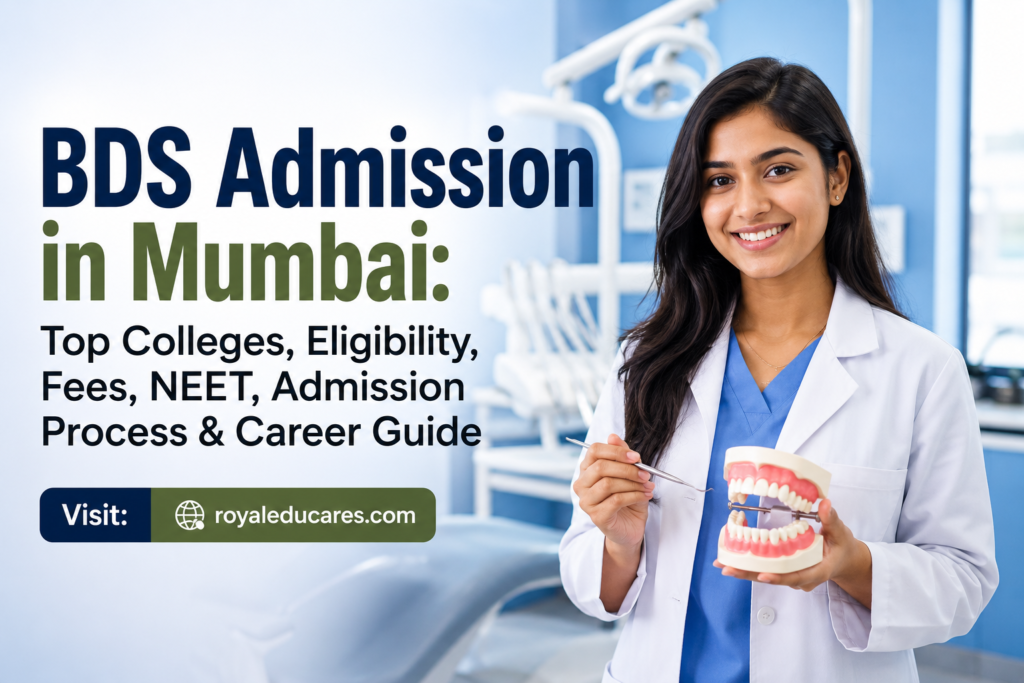
BDS Admission in Mumbai: Top Colleges, Eligibility, Fees, NEET, Admission Process & Career Guide
Introduction
BDS admission in Mumbai offers aspiring dental professionals quality education, excellent clinical exposure, recognized colleges, and rewarding career opportunities through a structured admission process with proper academic guidance.
Accreditation & Approvals
UGC-DEB APPROVED
AICTE APPROVED
AIU APPROVED
NAAC +++ ACCREDITED

COBSE BOARDS
PHARMACY COUNCIL OF INDIA
BAR COUNCIL OF INDIA

WORLD EDUCATION SERVICES
MHRD

Get Free Career Counseling
Students looking for complete information about Regular Medical Courses Admission in Mumbai can also explore: https://royaleducares.com/regular-medical-courses-admission-in-mumbai/
If your goal is specifically pursuing dentistry, you can find detailed guidance on BDS Admission in Mumbai here: https://royaleducares.com/bds-admission-in-mumbai/
For complete information about professional, medical, and higher education admissions, visit the Royal Educares homepage: https://royaleducares.com/
What is BDS?
Bachelor of Dental Surgery (BDS) is one of the most respected undergraduate professional medical courses in India. It prepares students to diagnose, prevent, and treat diseases related to teeth, gums, jaws, and oral health. The course combines classroom learning with practical clinical training, allowing students to gain hands-on experience before entering professional practice.
The BDS program is regulated by the relevant authorities in India and is offered by recognized dental colleges across the country. Students learn everything from basic human anatomy to advanced dental procedures, oral surgery, prosthodontics, orthodontics, periodontology, pediatric dentistry, and community dentistry.
For students who wish to become dental surgeons, oral healthcare professionals, or later pursue MDS specialization, BDS is the essential first step.
Why Choose BDS Admission in Mumbai?
Mumbai is one of India’s leading education hubs for medical and dental studies. Every year, thousands of students from Maharashtra and other states apply for BDS admission because the city offers excellent academic infrastructure, experienced faculty, advanced dental hospitals, and better clinical exposure.
Some of the major reasons students prefer BDS admission in Mumbai include:
- Access to reputed dental colleges
- Excellent patient flow for practical learning
- Modern dental laboratories
- Advanced diagnostic equipment
- Experienced faculty members
- Internship opportunities
- Better placement support
- Career guidance for higher education
- Opportunities to prepare for MDS and international licensing exams
Students also benefit from Mumbai’s healthcare ecosystem, where exposure to real-world clinical cases significantly improves practical knowledge and professional confidence.
Why is BDS Becoming a Popular Career Choice?
Healthcare continues to grow every year, and oral healthcare has become equally important. Increasing awareness about dental hygiene, cosmetic dentistry, smile correction, orthodontic treatments, dental implants, and preventive care has increased the demand for qualified dental professionals.
Today’s dentists do much more than treat cavities. They help patients with:
- Smile designing
- Dental implants
- Root canal treatment
- Cosmetic dentistry
- Gum disease treatment
- Oral cancer screening
- Orthodontic correction
- Pediatric dental care
- Preventive oral healthcare
As lifestyles change and awareness grows, patients increasingly seek professional dental treatment, making dentistry a promising career.
BDS Course Overview
| Particular | Details |
|---|---|
| Course Name | Bachelor of Dental Surgery (BDS) |
| Course Level | Undergraduate |
| Duration | 5 Years (Including Internship) |
| Admission Mode | Merit/Counselling as applicable |
| Eligibility | 10+2 with PCB |
| Entrance Requirement | NEET (as applicable) |
| Internship | Mandatory |
| Career Options | Dental Surgeon, Consultant, Lecturer, Researcher, Entrepreneur |
Who Should Choose BDS?
BDS is suitable for students who are interested in science, healthcare, and patient care. It is especially ideal for those who enjoy precision-based work and want a respected profession with long-term growth.
You should consider BDS if you:
- Enjoy Biology.
- Have good communication skills.
- Like helping people.
- Want a professional medical career.
- Prefer practical learning.
- Are interested in healthcare technology.
- Wish to start your own clinic in the future.
- Plan to pursue MDS or higher education.
Skills Required for a Successful Dentist
Academic knowledge alone is not enough to become a successful dentist. Professional skills play an equally important role.
Important skills include:
Communication Skills
Dentists interact with patients every day. Good communication helps explain treatment plans, reduce patient anxiety, and build trust.
Hand Dexterity
Dental procedures require precision and steady hand movements.
Observation Skills
Identifying oral diseases at an early stage requires careful examination and attention to detail.
Problem-Solving Ability
Every patient’s condition is different. Dentists must evaluate symptoms and recommend suitable treatment plans.
Patience
Many treatments require multiple appointments, making patience an essential quality.
Professional Ethics
Maintaining patient confidentiality, honesty, and ethical medical practice is fundamental to a successful dental career.
Scope of BDS in India
The demand for qualified dentists has steadily increased due to growing awareness about oral hygiene and preventive healthcare. Graduates can choose from clinical practice, hospitals, academic institutions, research organizations, corporate healthcare, and public health programs.
Some graduates establish private dental clinics, while others work with multispecialty hospitals or pursue postgraduate education to specialize in fields such as orthodontics, prosthodontics, oral surgery, pediatric dentistry, or endodontics.
With advancements in dental technology, opportunities in cosmetic dentistry, digital dentistry, implantology, and laser dentistry are also expanding.
Why Oral Healthcare Matters Today
Oral health is directly connected to overall health. Poor dental hygiene may contribute to gum disease, infections, difficulty eating, and other health concerns. Regular dental check-ups help detect issues early and improve long-term well-being.
Because of this increasing awareness, qualified dentists continue to play an important role in modern healthcare systems.
Advantages of Pursuing BDS
Choosing BDS offers several long-term professional advantages.
- Respected healthcare profession
- Opportunity to improve patients’ quality of life
- Hands-on clinical experience
- Diverse career pathways
- Scope for specialization
- Entrepreneurship opportunities
- Continuous learning with new technologies
- Growing awareness and demand for dental care
- Flexible career options in clinical and academic settings
Common Reasons Students Prefer Mumbai for Dental Education
Students choose Mumbai because of its educational ecosystem and exposure to advanced healthcare facilities. Access to experienced mentors, modern infrastructure, and diverse clinical cases helps students develop practical confidence throughout their education.
In addition, Mumbai provides opportunities to attend workshops, conferences, skill-development programs, and professional networking events that contribute to long-term career growth.
What’s Coming Next
The next section will explain BDS eligibility criteria, educational qualifications, NEET requirements, age limit, required documents, reservation policies, and important admission requirements that every aspiring student should understand before applying.
BDS Eligibility Criteria in Mumbai
Before applying for BDS admission, every student should understand the eligibility requirements. Meeting the prescribed criteria is essential for participating in the admission process and securing a seat in a recognized dental college.
Although specific requirements may vary depending on the admission authority or institution, the general eligibility conditions remain similar across most colleges.
Educational Qualification
Students must have successfully completed their 10+2 (Higher Secondary) or an equivalent examination from a recognized board.
The qualifying examination should include the following compulsory subjects:
Physics
Chemistry
Biology/Biotechnology
English
These subjects provide the academic foundation required for pursuing dental education.
Minimum Qualifying Marks
Candidates are generally expected to achieve the minimum qualifying percentage prescribed by the relevant admission authority.
The required percentage may vary depending on:
General Category
OBC Category
SC Category
ST Category
EWS Category
Other applicable reservation categories
Students should always verify the latest admission guidelines before applying.
Is NEET Mandatory for BDS Admission?
Yes, in most cases, NEET (National Eligibility cum Entrance Test) is required for admission to BDS courses in India as per the applicable admission regulations.
NEET evaluates a student’s understanding of:
Physics
Chemistry
Biology
A valid NEET score plays an important role during counselling and seat allocation.
Why is NEET Important for BDS?
NEET creates a standardized admission process for medical and dental courses across India.
Its benefits include:
Transparent admission procedure
Merit-based seat allocation
Uniform entrance examination
Equal opportunity for students
Simplified counselling process
Students preparing seriously for NEET improve their chances of securing admission in preferred colleges.
Age Limit for BDS Admission
Candidates are generally expected to satisfy the minimum age requirement prescribed for medical admissions.
Applicants should ensure they fulfill the age criteria mentioned in the official admission notification applicable for the academic session.
Nationality Criteria
Generally, the following candidates may be eligible depending on the applicable admission rules:
Indian Citizens
Overseas Citizen of India (OCI), where applicable
Other eligible categories as notified by the competent authorities
Eligibility may differ for different counselling authorities.
Required Documents for BDS Admission
Keeping documents ready in advance helps avoid delays during counselling and admission.
Commonly required documents include:
NEET Scorecard
NEET Admit Card
Class 10 Marksheet
Class 12 Marksheet
School Leaving Certificate
Transfer Certificate (if applicable)
Migration Certificate (if applicable)
Aadhaar Card or other valid ID
Passport-size Photographs
Category Certificate (if applicable)
EWS Certificate (if applicable)
Domicile Certificate (where required)
PwD Certificate (if applicable)
Students should keep both original documents and scanned copies ready.
Admission Process Overview
The admission process generally involves several stages.
Step 1: Qualify NEET
Students must appear for NEET and obtain the required qualifying score.
Step 2: Registration
Eligible candidates register for the relevant counselling process.
Step 3: Choice Filling
Students select their preferred colleges and course options.
Step 4: Seat Allotment
Seats are allotted according to merit, preferences, reservation policies, and seat availability.
Step 5: Document Verification
Original documents are verified by the concerned authority or institution.
Step 6: Fee Payment
Candidates complete admission by paying the applicable admission fee within the prescribed timeline.
Step 7: Reporting to College
Students report to the allotted college and complete the remaining admission formalities.
Government vs Private BDS Admission
Students often compare government and private dental colleges before making a decision.
Government Dental Colleges
Advantages include:
Lower tuition fees
Strong academic reputation
High patient inflow
Competitive admission
Affordable education
Private Dental Colleges
Advantages include:
Modern infrastructure
Advanced laboratories
Comfortable campus facilities
Multiple seat availability
Excellent clinical exposure in many institutions
Students should evaluate colleges based on academics, faculty, clinical training, infrastructure, internship opportunities, and overall learning environment rather than only considering fees.
Important Factors While Choosing a BDS College
Before finalizing admission, students should consider:
Recognition and approvals
Faculty experience
Hospital attachment
Clinical exposure
Infrastructure
Laboratory facilities
Patient inflow
Internship opportunities
Location
Hostel facilities
Safety
Alumni performance
Academic results
Choosing the right college can significantly influence future learning and career opportunities.
Common Mistakes Students Should Avoid
Many students make avoidable mistakes during the admission process.
Some of the most common ones include:
Waiting until the last date to apply
Keeping incomplete documents
Ignoring official admission notifications
Filling incorrect information in application forms
Not researching colleges properly
Choosing colleges based only on fees
Missing counselling deadlines
Failing to verify document requirements
Being organized and informed helps ensure a smoother admission experience.
Tips to Improve Your Chances of Admission
Students can strengthen their admission journey by following a few practical steps:
Prepare sincerely for NEET.
Keep all documents updated.
Track counselling schedules regularly.
Research colleges thoroughly.
Understand eligibility before applying.
Seek professional guidance if needed.
Keep multiple college preferences ready.
Complete every admission step within the specified deadline.
Planning ahead reduces stress and helps students make informed decisions.
Why Proper Admission Guidance Matters
Choosing a dental college is an important academic decision. Understanding eligibility, counselling, documentation, and college selection helps students avoid confusion and make confident choices.
Proper guidance also assists students in comparing institutions, understanding available options, and selecting a college aligned with their career goals.
What’s Coming Next
The next section covers the complete BDS admission process in Mumbai, including counselling, seat allotment, government and private admission procedures, management quota overview, college selection strategies, and practical guidance for aspiring dental students.
Complete BDS Admission Process in Mumbai
Understanding the admission process is one of the most important steps for students planning to pursue Bachelor of Dental Surgery (BDS). A clear understanding of each stage helps candidates complete formalities on time and improves their chances of securing admission in a preferred dental college.
Although counselling schedules and procedures may vary each academic year, the overall admission process generally follows a structured sequence.
Step 1: Prepare for NEET
The first and most important step is preparing for the National Eligibility cum Entrance Test (NEET). Since BDS admission is generally based on NEET, students should focus on building a strong foundation in:
Physics
Chemistry
Biology
Regular practice, mock tests, previous years’ question papers, and time management play an important role in NEET preparation.
Step 2: Appear for the NEET Examination
Candidates should appear for the NEET examination as per the official schedule. After the examination, results are declared along with the qualifying status and score.
Students should carefully download and preserve the following documents:
NEET Scorecard
Admit Card
Result Copy
These documents are required during counselling and admission.
Step 3: Register for Counselling
After qualifying NEET, eligible candidates must register for the appropriate counselling process applicable to their admission category.
During registration, students generally provide:
Personal details
Academic information
NEET details
Contact information
Required documents
Applicants should carefully review every detail before submitting the registration form.
Step 4: Document Verification
Document verification is one of the most important stages of the admission process.
Authorities verify the authenticity of submitted documents before allowing candidates to participate in seat allocation.
Documents commonly verified include:
Class 10 Marksheet
Class 12 Marksheet
NEET Scorecard
Identity Proof
Transfer Certificate
Leaving Certificate
Category Certificate (if applicable)
Domicile Certificate (where applicable)
Passport-size Photographs
Students should carry both original documents and photocopies whenever required.
Step 5: Choice Filling
Once verification is completed, candidates select their preferred colleges in order of priority.
This is a critical stage because the choices submitted influence the seat allotment outcome.
While selecting colleges, students should evaluate:
College reputation
Academic performance
Clinical exposure
Infrastructure
Faculty experience
Internship opportunities
Location
Hostel facilities
Overall learning environment
Submitting thoughtful preferences can improve satisfaction with the final allotted college.
Step 6: Seat Allotment
Seat allotment is generally based on several factors, including:
NEET rank
Merit
Reservation policies
Category
College preferences
Availability of seats
Students should regularly check counselling updates to know whether a seat has been allotted.
If allotted a seat, candidates must complete the next admission formalities within the prescribed timeline.
Step 7: Fee Payment
After seat allotment, students are required to pay the applicable admission fee according to the instructions of the counselling authority or allotted institution.
Timely payment confirms the candidate’s acceptance of the allotted seat.
Failure to complete this step within the specified period may affect the admission process.
Step 8: Reporting to the Allotted College
The final stage involves reporting to the allotted dental college.
Students generally complete:
Original document submission
Identity verification
Admission confirmation
Fee verification
Institutional formalities
After successful completion of these steps, students officially begin their BDS journey.
Government vs Private BDS Colleges in Mumbai
Many students compare government and private colleges before making a final decision.
Both options have their own advantages depending on a student’s academic profile, budget, and career goals.
Government Dental Colleges
Government colleges are known for their strong academic reputation and affordable education.
Advantages
Lower tuition fees
Experienced faculty
High patient inflow
Excellent clinical exposure
Strong academic environment
Good internship experience
Better affordability
Things to Consider
Highly competitive admission
Limited seat availability
Higher NEET competition
Students with strong NEET performance often prefer government colleges due to affordability and reputation.
Private Dental Colleges
Private colleges have significantly expanded dental education by offering quality infrastructure and modern teaching facilities.
Advantages
Modern campus
Advanced laboratories
Updated dental equipment
Comfortable classrooms
Multiple clinical departments
Good student support services
Many reputed private colleges also provide excellent clinical exposure through attached hospitals.
How to Choose the Right BDS College?
Choosing a dental college should never depend on just one factor.
Instead, students should evaluate multiple aspects before making a final decision.
Recognition
Always choose a college recognized by the appropriate regulatory authorities.
Academic Reputation
Look at the institution’s academic performance over several years.
Clinical Exposure
Clinical learning is one of the most important aspects of dental education.
A college with higher patient inflow allows students to gain more practical experience.
Faculty
Experienced professors and specialists improve learning quality and clinical understanding.
Infrastructure
Modern laboratories, simulation units, digital radiography, and updated dental equipment enhance practical education.
Internship
A structured internship provides real-world clinical exposure before entering professional practice.
Location
Many students prefer studying in cities that offer better healthcare exposure, transportation, and internship opportunities.
Common Admission Mistakes to Avoid
Every year, many deserving students face difficulties because of avoidable mistakes.
Some common mistakes include:
Waiting Until the Last Date
Late registration increases the risk of missing deadlines.
Incorrect Information
Always verify personal details before submitting any application.
Incomplete Documentation
Missing documents may delay verification or admission.
Ignoring Counselling Updates
Students should regularly monitor official counselling announcements.
Choosing Colleges Without Research
College selection should be based on academic quality rather than assumptions or popularity alone.
Focusing Only on Fees
Affordable education is important, but students should also evaluate teaching quality, clinical exposure, faculty, and infrastructure.
Practical Tips for BDS Aspirants
Students planning for BDS admission can improve their overall preparation by following these recommendations.
Begin NEET preparation early.
Create a realistic study timetable.
Practice mock tests regularly.
Strengthen Biology concepts.
Revise Physics formulas consistently.
Improve Chemistry fundamentals.
Stay updated with counselling announcements.
Organize documents before registration.
Research colleges thoroughly.
Seek professional admission guidance whenever required.
Why Students Choose Professional Admission Guidance
The admission process often involves multiple stages, counselling rounds, documentation, and college selection.
Professional guidance helps students:
Understand eligibility clearly
Compare college options
Complete documentation correctly
Avoid common admission mistakes
Receive counselling support
Make informed academic decisions
This structured approach reduces confusion and helps students navigate the admission process more confidently.
What You’ll Learn Next
The next section provides a detailed overview of the Top BDS Colleges in Mumbai, including important factors to compare, fee structure overview, infrastructure, clinical exposure, internship opportunities, and practical tips for selecting the right dental college according to your academic and career goals.
Top BDS Colleges in Mumbai
Choosing the right dental college is one of the most important decisions for every BDS aspirant. While admission depends on eligibility, NEET performance, counselling, and seat availability, students should also evaluate factors such as academic quality, clinical exposure, faculty, infrastructure, internship opportunities, and overall learning environment before making a final decision.
Mumbai is home to several reputed dental institutions that provide quality education and practical clinical training. Students from across India prefer Mumbai because of its healthcare ecosystem, experienced faculty, and exposure to diverse dental cases.
Factors to Consider Before Choosing a BDS College
Instead of selecting a college based only on popularity, students should compare multiple factors that influence their overall education and future career.
1. Recognition and Approval
Always ensure that the college is recognized by the appropriate regulatory authorities and follows the prescribed curriculum.
2. Academic Reputation
A college with consistent academic performance, experienced faculty, and structured teaching methods helps students build strong theoretical knowledge.
3. Clinical Exposure
Clinical training is one of the most important aspects of BDS.
Students should look for colleges that provide:
Regular patient interaction
Practical clinical sessions
Hands-on learning
Comprehensive dental departments
Higher patient inflow generally allows students to gain broader practical experience during training.
4. Faculty Experience
Qualified and experienced faculty members play a significant role in helping students understand clinical concepts, treatment planning, and professional ethics.
5. Infrastructure
Modern dental education benefits from advanced facilities such as:
Simulation laboratories
Digital radiography
Phantom head labs
Dental clinics
Research laboratories
Modern classrooms
Digital libraries
6. Internship Opportunities
A structured internship helps students apply classroom knowledge in real clinical settings and develop professional confidence before graduation.
7. Research and Academic Activities
Participation in:
Conferences
Scientific presentations
Workshops
Continuing Dental Education (CDE)
Research projects
helps students improve their academic profile and professional skills.
Popular BDS Colleges in Mumbai
Mumbai has several well-known dental institutions that attract students from different parts of India.
Some reputed institutions include:
Government Dental College & Hospital, Mumbai
Nair Hospital Dental College, Mumbai
Y.M.T. Dental College and Research Institute
Other recognized dental institutions participating in the applicable admission process.
Students should always verify the latest admission details and eligibility criteria before applying.
Government vs Private Dental Colleges
Both government and private colleges provide quality dental education, but students should understand the differences before making a decision.
| Factor | Government College | Private College |
|---|---|---|
| Tuition Fee | Generally Lower | Usually Higher |
| Competition | Very High | Varies |
| Infrastructure | Good | Often Modern |
| Patient Exposure | Usually High | Depends on Institution |
| Seat Availability | Limited | More Options |
Actual fees and seat availability vary by institution and academic year.
BDS Fee Structure in Mumbai
The total cost of pursuing BDS varies depending on several factors.
These include:
Type of institution
Tuition fee
Development fee
Hostel charges
Examination fees
Laboratory charges
Library charges
Miscellaneous institutional expenses
Government colleges generally have lower tuition fees, while private colleges may have higher fee structures depending on institutional policies. Official fee notifications are released by the concerned authorities for each academic year.
Hostel Facilities
Many dental colleges provide hostel accommodation for students coming from different cities and states.
Students should compare:
Hostel rooms
Security
Wi-Fi
Library access
Mess facilities
Medical support
Transportation
Campus environment
Comfortable accommodation contributes positively to academic performance.
Campus Life During BDS
Dental education involves much more than classroom lectures.
Students usually participate in:
Clinical practice
Laboratory sessions
Workshops
Seminars
Academic competitions
Cultural festivals
Sports activities
Community dental camps
These activities contribute to both academic and personality development.
Importance of Clinical Training
One of the biggest advantages of studying dentistry is practical learning.
Throughout the course, students gradually learn:
Patient examination
Diagnosis
Infection control
Treatment planning
Dental procedures
Clinical documentation
Professional communication
Strong clinical exposure helps students become confident professionals after graduation.
Modern Technologies Used in Dental Education
Dental education has evolved significantly with advancements in technology.
Many institutions now use:
Digital X-rays
Intraoral scanners
CAD/CAM technology
Dental simulation units
Laser dentistry equipment
Digital patient records
Exposure to modern technology prepares students for contemporary dental practice.
Internship Experience
The compulsory internship allows students to rotate through different departments and gain supervised clinical experience.
Interns generally develop practical understanding in areas such as:
Oral Diagnosis
Oral Surgery
Conservative Dentistry
Prosthodontics
Orthodontics
Periodontology
Pediatric Dentistry
Community Dentistry
The internship bridges the gap between academic learning and professional practice.
Student Support Services
Many institutions provide additional support through:
Academic mentoring
Career counselling
Personality development
Soft skill training
Placement assistance
Alumni interaction
Professional development workshops
Such initiatives help students prepare for future career opportunities.
Tips for Selecting the Best BDS College
Before confirming admission, students should compare colleges based on:
Recognition
Faculty quality
Clinical exposure
Patient inflow
Infrastructure
Laboratory facilities
Internship quality
Academic results
Research opportunities
Campus safety
Hostel facilities
Overall learning environment
Choosing a college after careful evaluation can contribute significantly to long-term academic and professional growth.
Common Questions Students Ask Before Choosing a College
Many aspirants have similar concerns before finalizing their admission.
Common questions include:
Which BDS college has better clinical exposure?
Which college offers experienced faculty?
How important is internship quality?
Are hostel facilities available?
What is the overall fee structure?
Does the college provide research opportunities?
Is campus placement available?
What is the student-to-faculty ratio?
How is the academic environment?
Which college best matches my career goals?
Answering these questions through proper research helps students make informed decisions.
What’s Coming Next
In the next section, you’ll learn about the complete BDS syllabus, year-wise subjects, practical training, laboratory work, internship structure, examination pattern, clinical departments, and the essential skills every dental student develops during the course.
BDS Syllabus, Subjects & Course Structure
The Bachelor of Dental Surgery (BDS) curriculum is designed to provide students with a strong foundation in medical sciences while developing advanced clinical and practical dental skills. Throughout the course, students gradually progress from basic science subjects to specialized dental disciplines, ensuring they are well-prepared for professional practice.
The BDS program typically spans five years, including a one-year compulsory rotatory internship, where students receive supervised clinical training in different dental specialties.
BDS Course Duration
The standard duration of the BDS course is:
Academic Study: 4 Years
Compulsory Rotatory Internship: 1 Year
During the academic years, students attend classroom lectures, laboratory sessions, pre-clinical training, and clinical postings. The internship provides hands-on experience in treating patients under the guidance of experienced faculty members.
Year-Wise BDS Subjects
The curriculum is divided into different academic years, with each year focusing on specific medical and dental sciences.
First Year BDS Subjects
The first year builds a strong understanding of human anatomy and basic medical sciences.
Major subjects generally include:
General Human Anatomy
Embryology
Histology
Human Physiology
Biochemistry
Dental Anatomy
Oral Histology
Oral Embryology
What Students Learn
Students develop knowledge about:
Human body structure
Organ systems
Tooth morphology
Cell structure
Basic physiology
Biochemical processes
Oral tissue development
This foundation supports all advanced dental subjects studied later.
Second Year BDS Subjects
The second year introduces students to disease processes and the fundamentals of dental treatment.
Common subjects include:
General Pathology
Microbiology
Pharmacology
Dental Materials
Preclinical Conservative Dentistry
Preclinical Prosthodontics
Practical Skills Developed
Students begin learning:
Identification of oral diseases
Infection control
Dental materials handling
Tooth preparation techniques
Basic restorative procedures
Prosthetic model preparation
This stage bridges theoretical knowledge with practical application.
Third Year BDS Subjects
Clinical learning becomes more significant during the third year.
Subjects commonly include:
General Medicine
General Surgery
Oral Pathology
Oral Microbiology
Students start interacting with patients while strengthening their diagnostic and clinical abilities.
Clinical Focus
Students gain experience in:
Patient examination
Medical history recording
Oral disease diagnosis
Radiographic interpretation
Infection prevention
Professional communication
Final Year BDS Subjects
The final academic year emphasizes advanced dental specialties and comprehensive patient management.
Major disciplines generally include:
Oral Medicine and Radiology
Oral and Maxillofacial Surgery
Conservative Dentistry and Endodontics
Prosthodontics
Orthodontics
Periodontology
Pediatric and Preventive Dentistry
Public Health Dentistry
Core Learning Areas
Students learn:
Root canal treatment principles
Tooth restoration
Gum disease management
Orthodontic concepts
Pediatric dental care
Oral surgery principles
Complete and partial dentures
Community oral healthcare
This phase prepares students for independent clinical responsibilities during the internship.
Practical Training in BDS
Practical learning is one of the strongest aspects of dental education.
Students gradually develop competence through:
Laboratory exercises
Simulation training
Pre-clinical practice
Clinical demonstrations
Supervised patient care
Case discussions
The emphasis on practical training helps students gain confidence before entering professional practice.
Clinical Departments in Dental Colleges
During clinical postings, students receive exposure to various specialized departments.
These typically include:
Oral Medicine and Radiology
Students learn:
Oral examination
Diagnosis
Radiographic interpretation
Treatment planning
Oral and Maxillofacial Surgery
Students observe and assist in:
Tooth extractions
Minor oral surgical procedures
Trauma management
Surgical case discussions
Conservative Dentistry and Endodontics
Training includes:
Dental restorations
Caries management
Root canal procedures
Esthetic restorations
Prosthodontics
Students understand:
Complete dentures
Partial dentures
Crowns
Bridges
Dental prostheses
Orthodontics
Students are introduced to:
Malocclusion
Braces
Bite correction
Growth assessment
Periodontology
Learning focuses on:
Gum diseases
Scaling
Root planing
Periodontal health
Preventive care
Pediatric and Preventive Dentistry
Students learn how to manage dental care for children, including preventive treatments and behavior management.
Public Health Dentistry
Community-based learning includes:
Oral health awareness
School dental programs
Preventive dentistry
Community surveys
Laboratory Training
Dental laboratories help students improve precision and technical skills.
Common laboratory activities include:
Tooth carving
Wax pattern fabrication
Cast preparation
Impression techniques
Crown and bridge models
Denture fabrication exercises
These practical sessions strengthen hand skills required in dentistry.
Clinical Skills Every BDS Student Develops
Throughout the course, students build important professional competencies such as:
Patient communication
Clinical examination
Diagnosis
Treatment planning
Infection control
Record maintenance
Professional ethics
Teamwork
Time management
Clinical decision-making
These skills are essential for becoming a competent dental professional.
Examination Pattern
BDS assessments generally consist of:
Internal assessments
Theory examinations
Practical examinations
Viva voce
Clinical evaluations
Record submissions
Students are evaluated on both theoretical understanding and practical competence.
Importance of the Internship
The compulsory internship is a crucial stage of the BDS program.
During this period, students rotate through different departments and gain supervised clinical experience by treating patients, maintaining records, and participating in routine dental procedures.
The internship helps students:
Improve clinical confidence
Strengthen diagnostic skills
Understand patient management
Enhance treatment planning
Develop professional responsibility
It also prepares graduates for independent practice or postgraduate education.
Tips for Success During BDS
Students can make the most of their dental education by following these practical tips:
Attend lectures regularly.
Focus equally on theory and practical sessions.
Practice manual skills consistently.
Maintain accurate clinical records.
Participate in workshops and seminars.
Learn from experienced faculty members.
Develop effective communication skills.
Stay updated with advancements in dentistry.
Follow professional ethics in every clinical interaction.
Revise subjects systematically before examinations.
Skills Employers Value in BDS Graduates
Healthcare institutions and dental clinics often look for graduates who possess:
Strong clinical knowledge
Practical competence
Professional communication
Ethical practice
Problem-solving ability
Attention to detail
Patient-centered approach
Willingness to learn
Teamwork
Adaptability to modern dental technologies
Developing these qualities during the course can improve future career opportunities.
What’s Coming Next
The next section explores career opportunities after BDS, including higher education options, MDS specializations, government jobs, private practice, hospital careers, salary prospects, opportunities abroad, and emerging fields in modern dentistry.
Career Opportunities After BDS
Completing a Bachelor of Dental Surgery (BDS) opens the door to a wide range of career opportunities in healthcare. Graduates can choose clinical practice, higher education, government services, research, academics, hospitals, corporate healthcare, or entrepreneurship based on their interests and long-term career goals.
With increasing awareness of oral healthcare and advancements in dental technology, skilled dentists continue to find opportunities in both India and abroad.
What Can You Do After BDS?
After completing BDS and the compulsory internship, graduates have several career paths available.
Popular options include:
Private Dental Practice
Government Dental Services
Multispecialty Hospitals
Dental Clinics
Higher Education (MDS)
Teaching and Academics
Research
Public Health Dentistry
Corporate Healthcare
Dental Product Companies
Healthcare Administration
Each career path offers different responsibilities, growth opportunities, and work environments.
Private Dental Practice
Many graduates aspire to establish their own dental clinic.
Private practice allows dentists to build long-term relationships with patients while offering a variety of dental treatments.
Common services include:
Dental Check-ups
Tooth Fillings
Root Canal Treatment
Teeth Cleaning
Dental Crowns
Dental Bridges
Teeth Whitening
Cosmetic Dentistry
Smile Designing
Preventive Dental Care
Building a successful clinic requires professional expertise, patient trust, ethical practice, and continuous learning.
Working in Hospitals
Hospitals employ dental professionals to provide oral healthcare services as part of multidisciplinary medical teams.
Hospital-based dentists may work alongside specialists in:
Oral Surgery
Maxillofacial Surgery
Emergency Care
Pediatric Care
Oncology
Trauma Management
Hospital experience helps dentists gain exposure to complex clinical cases.
Government Jobs After BDS
Government healthcare organizations periodically recruit qualified dental professionals through applicable recruitment processes.
Opportunities may exist in:
Government Hospitals
Community Health Centres
Primary Health Centres
Public Health Departments
Defence Services
Railways
Municipal Healthcare Institutions
Eligibility, vacancies, and selection procedures vary depending on the recruiting authority.
Teaching and Academic Careers
Graduates interested in education can pursue careers in teaching after obtaining the required qualifications.
Academic responsibilities may include:
Classroom Teaching
Practical Demonstrations
Clinical Supervision
Student Mentoring
Curriculum Development
Academic Research
Teaching offers opportunities to contribute to the education of future dental professionals.
Higher Education After BDS
Many students choose postgraduate education to develop advanced clinical expertise.
One of the most common options is pursuing Master of Dental Surgery (MDS).
Specialization allows dentists to focus on a specific branch of dentistry and enhance their professional skills.
Popular MDS Specializations
Students can choose from several dental specialties depending on their interests.
Popular MDS branches include:
Orthodontics
Prosthodontics
Conservative Dentistry and Endodontics
Oral and Maxillofacial Surgery
Oral Medicine and Radiology
Periodontology
Pediatric and Preventive Dentistry
Public Health Dentistry
Oral Pathology
Implantology (through advanced training)
Each specialization offers unique clinical and academic opportunities.
Career in Cosmetic Dentistry
Cosmetic dentistry has witnessed significant growth in recent years.
Dentists specializing in aesthetic procedures help patients improve the appearance of their smiles.
Popular cosmetic procedures include:
Teeth Whitening
Smile Designing
Veneers
Tooth-Colored Restorations
Cosmetic Bonding
Dental Laminates
Growing patient awareness has increased demand for aesthetic dental treatments.
Implant Dentistry
Dental implants have become an increasingly preferred solution for replacing missing teeth.
Dentists interested in implantology can pursue advanced training after graduation to develop expertise in:
Implant Placement
Treatment Planning
Bone Assessment
Prosthetic Rehabilitation
This field continues to evolve with advancements in digital dentistry.
Public Health Dentistry
Public health professionals focus on improving oral health at the community level.
Responsibilities may include:
Oral Health Awareness Programs
School Dental Health Initiatives
Preventive Care Campaigns
Community Screenings
Epidemiological Surveys
Rural Healthcare Services
This field emphasizes prevention and education.
Research Opportunities
Students interested in scientific advancement can contribute through research.
Research areas include:
Dental Biomaterials
Oral Diseases
Preventive Dentistry
Digital Dentistry
Oral Cancer
Regenerative Dentistry
Clinical Trials
Research plays an important role in improving dental treatments and patient care.
Opportunities in Corporate Healthcare
Several healthcare organizations employ dental professionals in non-clinical and clinical roles.
Career options may include:
Clinical Advisor
Medical Consultant
Healthcare Coordinator
Training Specialist
Clinical Support Executive
These roles combine dental knowledge with healthcare management.
Opportunities in Dental Product Companies
Dental equipment and pharmaceutical companies often recruit qualified dental graduates.
Possible roles include:
Product Specialist
Clinical Trainer
Technical Consultant
Scientific Advisor
Marketing Support Professional
Clinical knowledge helps graduates understand product applications and educate healthcare professionals.
Career Opportunities Abroad
Many BDS graduates explore international career opportunities after fulfilling the licensing requirements of the destination country.
Requirements vary depending on the country and may include:
Qualifying Examinations
Language Proficiency
Credential Evaluation
Registration with Regulatory Authorities
Clinical Assessment
Students should always verify the latest licensing regulations before planning an international career.
Emerging Fields in Dentistry
Modern dentistry continues to evolve with technological innovation.
Some growing areas include:
Digital Dentistry
CAD/CAM Dentistry
Laser Dentistry
3D Printing
Digital Smile Design
AI-Assisted Diagnostics
Preventive Dentistry
Geriatric Dentistry
Sports Dentistry
Forensic Odontology
These emerging fields offer exciting opportunities for future dental professionals.
Salary After BDS
Salary after BDS depends on several factors, including:
Skills and Clinical Competence
Experience
Location
Type of Employer
Specialization
Nature of Practice
Dentists working in private practice, hospitals, academic institutions, or specialized fields may have different earning potential. As professional experience and expertise increase, career growth and income opportunities generally improve.
Skills That Improve Career Growth
To build a successful career, dental professionals should continuously improve both clinical and interpersonal skills.
Important skills include:
Patient Communication
Clinical Decision-Making
Manual Dexterity
Diagnostic Ability
Professional Ethics
Time Management
Leadership
Team Collaboration
Continuous Learning
Adaptability to New Technologies
These skills contribute to long-term professional success.
Future Scope of Dentistry
The future of dentistry continues to evolve with advances in healthcare technology, digital treatment planning, preventive care, and patient awareness.
Increasing demand for:
Preventive Dental Care
Cosmetic Dentistry
Orthodontic Treatment
Dental Implants
Digital Dentistry
Pediatric Dental Care
Geriatric Oral Healthcare
indicates promising opportunities for qualified dental professionals.
Graduates who continue learning, upgrade their clinical skills, and adapt to modern technologies are well-positioned for sustained career growth.
What’s Coming Next
The final section covers scholarships, education loans, hostel facilities, student life, admission tips, common mistakes to avoid, a comprehensive conclusion, and 50+ frequently asked questions (FAQs) that address the most common BDS admission and career-related queries searched by students.
Scholarships for BDS Students
Financing a professional course is an important consideration for many students and families. Various scholarship schemes are offered by government bodies, private organizations, trusts, and educational institutions based on eligibility criteria such as academic performance, category, family income, or merit.
Students should always check the latest eligibility requirements and application deadlines before applying for any scholarship.
Some common types of scholarships include:
Merit-Based Scholarships
Need-Based Scholarships
Minority Scholarships
State Government Scholarships
Central Government Scholarship Schemes
Scholarships for Reserved Categories
Institutional Scholarships
Receiving financial assistance can help reduce the overall cost of education and allow students to focus on academics.
Education Loan for BDS
Many banks and financial institutions provide education loans for eligible students pursuing professional courses like BDS.
Loan approval and terms generally depend on factors such as:
Admission to an eligible institution
Course duration
Loan amount requested
Required documentation
Applicable banking policies
Students should compare interest rates, repayment options, moratorium periods, and eligibility before selecting an education loan.
Hostel and Student Life
For students relocating to Mumbai, hostel facilities can provide a safe and convenient living environment during the course.
When evaluating hostel accommodation, consider:
Campus security
Cleanliness
Study environment
Library access
Internet connectivity
Mess facilities
Transportation
Medical assistance
Recreational facilities
A balanced student life that combines academics, practical training, extracurricular activities, and adequate rest contributes to overall development.
Essential Tips Before Taking BDS Admission
Choosing the right dental college requires careful planning. Before confirming admission, students should keep the following points in mind:
Verify the recognition and approvals of the institution.
Compare multiple colleges before making a decision.
Understand the complete fee structure.
Check internship and clinical training opportunities.
Review hostel and campus facilities if relocating.
Keep all required documents ready before counselling.
Follow official admission schedules carefully.
Seek guidance whenever clarification is required.
Making an informed decision at the beginning of your academic journey can positively influence your future career.
Common Mistakes Students Should Avoid
Many admission-related issues occur because of avoidable mistakes.
Some common mistakes include:
Applying without checking eligibility.
Missing counselling or reporting deadlines.
Submitting incomplete documentation.
Selecting a college without proper research.
Depending on unofficial sources for admission updates.
Ignoring internship and clinical exposure while comparing colleges.
Focusing only on fees instead of overall academic quality.
Waiting until the last moment to complete admission formalities.
Avoiding these mistakes can make the admission process smoother and less stressful.
How to Prepare for a Successful BDS Journey
Success in BDS depends on consistent learning and practical experience.
Students should aim to:
Build strong fundamentals in basic sciences.
Attend lectures and practical sessions regularly.
Develop communication and patient management skills.
Participate in workshops and academic seminars.
Stay updated with advancements in dental technology.
Practice ethical and patient-centred care.
Maintain discipline throughout the course.
Continuous learning is one of the keys to becoming a competent dental professional.
Why Choose Royal Educares for BDS Admission Guidance in Mumbai?
Selecting the right college and understanding the admission process can sometimes feel overwhelming. Professional admission guidance helps students understand eligibility, documentation, counselling procedures, and available course options.
Royal Educares provides guidance to students seeking admission to professional medical and healthcare courses in Mumbai, helping them make informed academic decisions based on their career goals and eligibility.
Conclusion
BDS is a respected professional healthcare course that offers students the opportunity to build a rewarding career in dentistry. From understanding eligibility and the admission process to selecting the right college and exploring future career opportunities, careful planning plays an important role in achieving long-term success.
Mumbai continues to be one of the preferred destinations for dental education because of its reputed institutions, experienced faculty, modern infrastructure, and valuable clinical exposure. Students who prepare well, stay informed, and make thoughtful decisions can build a strong foundation for a successful career in oral healthcare.
Whether your goal is private practice, higher education, hospital employment, research, or public healthcare, a BDS degree can open the door to diverse professional opportunities.
Frequently Asked Questions (FAQs)
1. What is the duration of the BDS course?
The BDS course is generally completed in five years, including a one-year compulsory internship.
2. Is NEET required for BDS admission?
In most cases, a valid NEET qualification is required as per the applicable admission regulations.
3. What subjects are required in Class 12 for BDS?
Students generally need Physics, Chemistry, Biology, and English in their qualifying examination.
4. Can I pursue MDS after completing BDS?
Yes. Eligible graduates can pursue Master of Dental Surgery (MDS) in various specializations.
5. What are the career options after BDS?
Career opportunities include private practice, hospitals, higher education, academics, research, public health, and corporate healthcare.
6. Is BDS a good career option?
For students interested in healthcare and dentistry, BDS offers diverse professional opportunities and long-term career growth.
7. Does BDS include practical training?
Yes. Practical training and clinical exposure are integral parts of the curriculum.
8. Can I open my own dental clinic after BDS?
Subject to applicable registration and legal requirements, eligible graduates may establish their own dental practice.
9. Are hostel facilities available in dental colleges?
Many institutions provide hostel accommodation, although facilities vary by college.
10. How should I choose the right BDS college?
Compare recognition, faculty, infrastructure, clinical exposure, internship quality, fees, location, and student support services before making a decision.
Frequently Asked Questions (FAQs)
11. What is BDS?
BDS stands for Bachelor of Dental Surgery, an undergraduate professional degree in dentistry.
12. What is the duration of the BDS course?
The course generally takes five years, including a one-year compulsory internship.
13. Is BDS a medical course?
Yes. BDS is a professional healthcare course focused on oral health and dentistry.
14. Can I get BDS admission after 12th?
Yes, eligible students who have completed 10+2 with the required subjects can apply as per the applicable admission process.
15. Is NEET compulsory for BDS admission in Mumbai?
In most cases, NEET qualification is required according to the prevailing admission regulations.
16. What subjects are required in Class 12 for BDS?
Physics, Chemistry, Biology, and English are generally required.
17. What is the minimum age for BDS admission?
Candidates must satisfy the minimum age criteria prescribed by the relevant admission authority.
18. Can students from other states apply for BDS admission in Mumbai?
Yes, subject to the applicable eligibility and counselling rules.
19. Is Biology compulsory for BDS?
Yes, Biology is an essential qualifying subject.
20. How are BDS seats allotted?
Seats are generally allotted through the applicable counselling process based on merit, eligibility, and seat availability.
21. What documents are required for BDS admission?
Students typically require academic certificates, NEET documents, identity proof, photographs, and other applicable certificates.
22. Can I pursue MDS after BDS?
Yes, eligible graduates can pursue Master of Dental Surgery (MDS).
23. Which specialization is best after BDS?
The ideal specialization depends on your interests and career goals.
24. Can I become a dentist after completing BDS?
Yes, after completing the course, internship, and fulfilling applicable registration requirements.
25. Is internship compulsory in BDS?
Yes, the internship is an essential part of the course.
26. Can I open my own dental clinic after BDS?
Eligible graduates may establish a dental practice after meeting the applicable legal and professional requirements.
27. Is BDS better than other healthcare courses?
The right course depends on your interests, aptitude, and career aspirations.
28. Does BDS include practical training?
Yes, practical and clinical learning are core components of the curriculum.
29. Are there government and private dental colleges in Mumbai?
Yes, Mumbai has both government and private dental institutions.
30. How do I choose the best BDS college?
Compare recognition, faculty, infrastructure, clinical exposure, internship quality, and student support.
31. Does BDS have good career opportunities?
Yes, graduates can pursue careers in clinical practice, hospitals, academics, research, and public health.
32. Can I work abroad after BDS?
Yes, after fulfilling the licensing requirements of the destination country.
33. What is cosmetic dentistry?
It focuses on improving the appearance of teeth and smiles through aesthetic dental procedures.
34. What is implant dentistry?
It involves replacing missing teeth with dental implants and related restorative treatments.
35. Can I work in hospitals after BDS?
Yes, many hospitals recruit qualified dental professionals.
36. Is BDS suitable for students interested in healthcare?
Yes, it is an excellent option for students interested in oral healthcare and patient care.
37. Does BDS involve surgery?
Students receive training in oral and maxillofacial surgical procedures appropriate to the curriculum.
38. What skills are important for a dentist?
Communication, clinical knowledge, precision, ethics, patience, and problem-solving are important.
39. Can BDS graduates become lecturers?
Yes, after meeting the required academic qualifications.
40. Is research a career option after BDS?
Yes, graduates can pursue research in various areas of dentistry.
41. Does BDS include community health programs?
Yes, community dentistry is an important part of dental education.
42. Are scholarships available for BDS students?
Various scholarships may be available depending on eligibility and applicable schemes.
43. Can I get an education loan for BDS?
Many financial institutions offer education loans subject to their eligibility criteria.
44. Is hostel accommodation available?
Many dental colleges provide hostel facilities for students.
45. How important is clinical exposure during BDS?
Clinical exposure is essential for developing practical competence and confidence.
46. What is the role of the internship?
It provides supervised hands-on experience in different dental specialties.
47. What are the emerging fields in dentistry?
Digital dentistry, laser dentistry, implantology, and preventive dentistry are among the growing fields.
48. Can BDS graduates work in corporate healthcare?
Yes, opportunities exist in healthcare companies and dental product organizations.
49. Is communication important for dentists?
Yes, effective communication improves patient understanding and trust.
50. What is preventive dentistry?
It focuses on maintaining oral health and preventing dental diseases.
51. Is regular practical practice important during BDS?
Yes, continuous practical training helps improve clinical skills.
52. What should students consider before taking admission?
Evaluate eligibility, college recognition, faculty, infrastructure, clinical exposure, internship opportunities, and fees before making a decision.
53. Why do students prefer BDS admission in Mumbai?
Mumbai offers reputed dental colleges, experienced faculty, advanced healthcare infrastructure, and valuable clinical exposure.
54. How can students prepare for successful BDS admission?
Prepare well for NEET, keep documents ready, follow official counselling updates, and research colleges before applying.
55. Where can students get guidance for BDS admission in Mumbai?
Students seeking guidance on eligibility, admission procedures, and available options can explore Regular Medical Courses Admission in Mumbai and BDS Admission in Mumbai through Royal Educares for detailed information and professional admission support.
Final Thoughts
A BDS degree offers a strong foundation for a rewarding career in dentistry. By understanding the admission process, meeting eligibility requirements, selecting the right college, and making the most of academic and clinical training, students can build a successful future in oral healthcare. Careful planning, continuous learning, and informed decision-making are key to achieving long-term professional growth.
Contact Royal Educares
Royal Educares
Education Guidance & Admission Support Across India
 Website:
https://royaleducares.com/
 Email:
info@royaleducares.com
 Phone:
+91 9819649369
 Address:
9/D-1, Office No. 005, Sangharsh Nagar, Chandivali, Powai, Mumbai, Maharashtra 400072, India
 GET DIRECTION
Google Map
Start your Admission Today!
Let Us Help You Choose the Right Course for Your Future.