
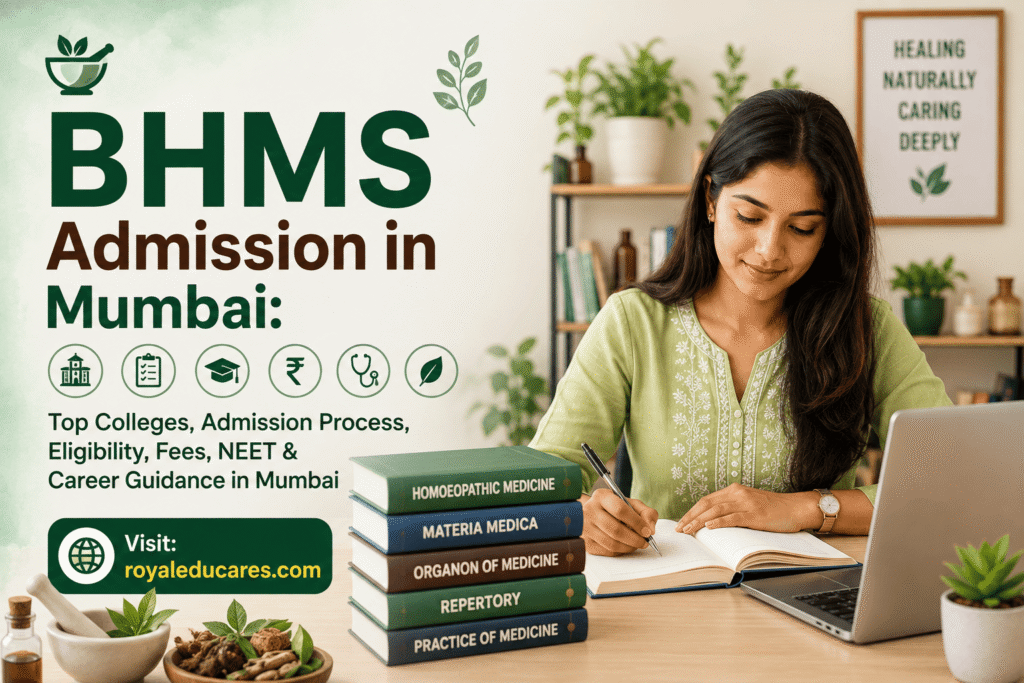
BHMS Admission in Mumbai: Top Colleges, Admission Process, Eligibility, Fees, NEET & Career Guidance in Mumbai
Introduction
BHMS admission in Mumbai offers students a structured pathway into homoeopathic medicine, combining foundational medical sciences, clinical education, compulsory internship, and diverse healthcare career opportunities for aspiring healthcare professionals today.
Recognitions, Approvals & Accreditations
Applicable recognitions and approvals vary by course, programme and university.
UGC-DEB APPROVED
AICTE APPROVED
AIU APPROVED
NAAC +++ ACCREDITED

COBSE BOARDS
PHARMACY COUNCIL OF INDIA
BAR COUNCIL OF INDIA

WORLD EDUCATION SERVICES
MHRD

Get Free Career Counseling
Students exploring Regular Medical Courses Admission in Mumbai can compare different medical and healthcare pathways before selecting a course that matches their academic background, interests, budget, and long-term career plans.
For students specifically interested in homoeopathy, BHMS Admission in Mumbai provides a more focused overview of the course, admission requirements, academic structure, and career possibilities.
Students and parents looking for broader admission counselling and educational assistance can also explore Royal Educares for guidance related to medical and healthcare education options.
What Is BHMS?
BHMS stands for Bachelor of Homoeopathic Medicine and Surgery. It is an undergraduate degree programme for students who want to build a professional career in homoeopathic medicine and healthcare.
For many students, BHMS is considered an alternative undergraduate medical pathway alongside courses such as MBBS, BDS, BAMS, and other healthcare programmes. The course combines subjects related to human anatomy, physiology, pathology, medicine, community health, homoeopathic pharmacy, materia medica, organon of medicine, clinical training, and patient care.
The programme is not simply limited to learning about homoeopathic medicines. Students also study important medical and clinical subjects that help them understand the human body, diseases, diagnosis, patient history, and healthcare practice.
Under the National Commission for Homoeopathy regulations, the BHMS programme extends over five years and six months, including the academic phases and a 12-month compulsory rotatory internship.
This makes BHMS an important option for students who want to enter the healthcare profession through homoeopathy while receiving structured academic and clinical training.
Why Are Students Choosing BHMS in Mumbai?
Mumbai is one of India’s major education and healthcare centres. The city offers access to colleges, hospitals, clinics, diagnostic facilities, professional networks, and a large healthcare ecosystem.
For a student, studying BHMS in Mumbai can provide several practical advantages. The city exposes students to a diverse population and different healthcare requirements, while its large professional ecosystem can be useful when students begin looking for internships, clinical experience, employment, or future specialization.
Another reason students search for BHMS admission in Mumbai is the combination of education and career exposure available in a metropolitan city.
However, choosing a course only because it is located in Mumbai is not enough. Students should also evaluate the college’s recognition status, admission route, academic facilities, clinical exposure, fee structure, location, internship arrangements, and future career opportunities.
A suitable college should be evaluated carefully rather than selected only because it appears in a search result or is described as a “top college.”
Is BHMS a Medical Degree?
BHMS is an undergraduate professional degree in homoeopathic medicine. Students completing the prescribed programme and compulsory internship can proceed according to the applicable registration and professional requirements.
The National Commission for Homoeopathy’s regulations specify the BHMS degree structure and the compulsory rotatory internship required for completion of the programme.
Students should understand the difference between a recognized professional BHMS programme and unrelated short-term courses that may use words such as “homeopathy,” “alternative medicine,” or “medical training” in their advertising.
The recognition status of the institution and programme is therefore extremely important.
BHMS Admission in Mumbai: Understanding the Basic Admission Route
One of the most important questions students ask is:
How can I get admission in BHMS in Mumbai?
For the regular undergraduate BHMS route, admission is linked to applicable eligibility conditions and the NEET-UG based admission and counselling system. The Ayush Admissions Central Counseling Committee lists BHMS among the undergraduate courses covered through its counselling framework for applicable All India Quota and other participating institutions.
This means students should not assume that simply completing Class 12 automatically guarantees a BHMS seat.
The admission journey generally involves several stages:
- Completing the required school-level education.
- Meeting the applicable eligibility requirements.
- Appearing for and qualifying NEET-UG as required.
- Registering for the applicable counselling process.
- Filling college and course preferences.
- Receiving a seat allotment according to the applicable merit and counselling rules.
- Completing document verification and college admission formalities.
The exact counselling authority can differ depending on the type of seat, institution, quota, and applicable rules. Students should therefore check the current official counselling notification for the admission year.
Is NEET Required for BHMS Admission?
This is one of the most searched questions among students:
“Is NEET compulsory for BHMS?”
For the regular undergraduate BHMS admission pathway, NEET-UG qualification is an important requirement. The official AACCC framework specifically covers NEET-qualified candidates seeking admission to undergraduate BHMS seats under its counselling process.
Students should therefore be cautious about advertisements claiming that they can obtain a regular recognized BHMS medical seat without following the applicable entrance examination and counselling requirements.
Admission rules can change, and different categories of seats may follow different procedures. For this reason, students should verify the latest official notification before paying any admission-related amount.
Who Should Consider BHMS?
BHMS can be considered by students who have a genuine interest in healthcare and want to build their career in homoeopathic medicine.
The course may be suitable for students who:
- Have an interest in biology and healthcare.
- Want a professional undergraduate medical pathway.
- Are interested in patient care and clinical practice.
- Want to study homoeopathic medicine in depth.
- Are prepared for a multi-year professional degree.
- Are interested in developing a healthcare career beyond graduation.
- Want to explore clinical practice, government opportunities, wellness-related roles, education, research, or higher studies, subject to applicable requirements.
At the same time, students should understand what BHMS actually involves before choosing it.
A student who wants to become an allopathic MBBS doctor, for example, should not select BHMS simply because admission appears more accessible. Career goals should come first.
What Do Students Study in BHMS?
BHMS has a broad academic structure. Students study both foundational medical sciences and subjects specific to homoeopathy.
Common areas of study include:
Human Anatomy
Anatomy helps students understand the structure of the human body, including organs, tissues, systems, and their relationships.
Understanding anatomy is essential for any healthcare student because clinical practice requires knowledge of the normal structure of the body before disease processes can be understood.
Human Physiology
Physiology focuses on how the human body functions.
Students learn about systems such as the cardiovascular system, respiratory system, digestive system, nervous system, endocrine system, renal system, and reproductive system.
Biochemistry
Biochemistry introduces students to the chemical processes occurring within living organisms.
Students learn about biochemical reactions, metabolism, enzymes, proteins, carbohydrates, lipids, and other fundamental concepts relevant to human health.
Pathology
Pathology focuses on disease processes and the changes that occur in tissues and organs because of disease.
It helps students develop an understanding of how diseases affect the human body.
Microbiology
Microbiology introduces students to microorganisms and their relationship with human health and disease.
Depending on the curriculum, this can include areas related to bacteria, viruses, fungi, parasites, infection, and laboratory concepts.
Organon of Medicine
Organon of Medicine is one of the major subjects associated with homoeopathic education.
Students study the principles and philosophical framework relevant to homoeopathic practice as prescribed by the curriculum.
Homoeopathic Materia Medica
Materia Medica is another central component of BHMS education.
Students study the characteristics, indications, and application of homoeopathic medicines as taught within the professional curriculum.
Homoeopathic Pharmacy
Homoeopathic Pharmacy introduces students to the preparation, handling, storage, and related pharmaceutical concepts associated with homoeopathic medicines.
Practice of Medicine
Practice of Medicine introduces students to clinical medicine and patient-oriented healthcare.
It plays an important role in connecting theoretical learning with clinical understanding.
Community Medicine
Community Medicine focuses on healthcare beyond individual patients and introduces concepts related to public health, prevention, health education, and community-level healthcare.
Obstetrics and Gynaecology
Students are introduced to women’s health, pregnancy, childbirth, and related clinical areas within the prescribed curriculum.
Paediatrics
Paediatrics focuses on healthcare related to infants, children, and adolescents.
Forensic Medicine
Forensic Medicine introduces medical concepts relevant to law, medico-legal cases, injury, identification, and related professional responsibilities.
The Royal Educares BHMS programme overview also lists subjects such as Organon of Medicine, Materia Medica, Anatomy, Physiology, Pathology, Microbiology, Pharmacy, Community Medicine, Practice of Medicine, Pediatrics, Obstetrics and Gynecology, Forensic Medicine, Psychiatry, and clinical training.
BHMS Course Duration
How many years is BHMS?
The BHMS programme has a total duration of 5.5 years, including the compulsory internship.
The regulatory structure consists of four professional academic phases followed by the required internship. The National Commission for Homoeopathy regulations specify:
- First Professional BHMS – 18 months
- Second Professional BHMS – 12 months
- Third Professional BHMS – 12 months
- Fourth/Final Professional BHMS – 12 months
- Compulsory Rotatory Internship – 12 months
Therefore, students should plan BHMS as a long-term professional education programme rather than a short-duration undergraduate course.
BHMS Internship: Why It Matters
The internship is an important part of professional medical education.
Students do not complete the academic portion of BHMS and immediately become fully independent professionals. The compulsory internship provides practical exposure under the structure prescribed by the programme.
The regulatory framework includes a 12-month compulsory rotatory internship as part of BHMS completion.
During training, students can encounter areas related to medicine, paediatrics, obstetrics and gynaecology, ENT, ophthalmology, homoeopathic outpatient and inpatient services, community health, pharmacy-related training, case taking, and repertorization, depending on the institutional curriculum and internship structure.
This practical component is valuable because professional healthcare education is not limited to classroom theory.
BHMS Admission in Mumbai for Students After 12th
One of the biggest search queries among students is:
“BHMS after 12th”
Students who have completed or are completing Class 12 with the relevant science subjects can explore BHMS, subject to the eligibility requirements applicable to the admission year.
For medical and AYUSH undergraduate admissions, students should carefully check the required subjects, qualifying examination criteria, minimum marks, age requirements, NEET qualification, category rules, and counselling requirements.
Rather than relying on social media posts or unofficial admission claims, students should verify the requirements published by the relevant authorities.
This is particularly important because admission requirements can be updated from one academic session to another.
BHMS vs MBBS: A Basic Comparison
Students frequently search:
“BHMS or MBBS which is better?”
There is no universal answer because the two courses lead toward different professional pathways.
MBBS is focused on allopathic medicine, while BHMS is a professional degree in homoeopathic medicine.
The better option depends on the student’s career objective, academic interests, entrance performance, budget, preferred healthcare system, and long-term professional plans.
A student who specifically wants to practise within the homoeopathic healthcare pathway may consider BHMS.
A student whose goal is to become an MBBS doctor should focus on the MBBS admission pathway instead.
Choosing a course based purely on perceived difficulty, fees, or the availability of seats can create problems later. The decision should be based on a clear understanding of the profession.
Why College Selection Matters for BHMS
Getting admission is only one part of the process.
The college a student chooses can influence academic experience, clinical exposure, infrastructure, faculty interaction, internship environment, location, professional networking, and overall student life.
Before confirming admission, students should check:
Recognition and Regulatory Status
Always verify whether the college and programme have the necessary recognition and approval applicable to the admission year.
University Affiliation
Check the university affiliation and understand which university framework governs the academic programme.
Clinical Exposure
Students should find out what kind of practical and clinical exposure is available.
Internship Structure
Ask where and how the compulsory internship is conducted.
Total Fee
Do not look only at the headline tuition fee. Students should understand the complete cost, including applicable institutional charges, examination fees, hostel expenses, transportation, books, uniforms, and other expenses.
Location
Mumbai is a large city, so daily travel can significantly affect a student’s schedule. A college that is academically suitable but extremely difficult to reach every day may not be the most practical choice.
Future Opportunities
Students should evaluate how the programme supports their future plans for clinical practice, higher studies, public-sector opportunities, research, teaching, or other professional directions.
BHMS in Mumbai: What Students Should Understand Before Applying
A common mistake is to search only for:
“Best BHMS college in Mumbai.”
A better approach is to search and compare multiple factors:
BHMS colleges in Mumbai + fees + eligibility + NEET + admission process + cutoff + counselling + recognition + internship + career scope.
This creates a much more realistic picture of the available options.
Students also commonly search for phrases such as:
“BHMS admission near me,” “BHMS colleges near Mumbai,” “BHMS fees in Mumbai,” “BHMS admission without NEET,” “BHMS eligibility after 12th,” “BHMS course duration,” “BHMS career scope,” “BHMS salary,” and “top BHMS colleges in Maharashtra.”
These searches reflect the actual questions students and parents ask while planning admission.
A good admission decision should answer all of these questions before money is paid or a seat is confirmed.
The Growing Importance of Proper Admission Guidance
Medical and healthcare admissions can involve multiple stages, deadlines, documents, counselling registrations, preference filling, seat allotment, reporting, and verification.
For this reason, students often seek professional admission guidance instead of handling every stage without support.
The objective of proper counselling should not simply be to secure admission quickly. It should be to help students understand the course, compare realistic options, verify eligibility, organize documentation, understand counselling procedures, and make an informed decision.
The medical admission guidance information published by Royal Educares covers areas such as college selection, counselling procedures, admission requirements, documentation, and medical course options including MBBS, BDS, BAMS, BHMS, BNYS, and B.Sc Nursing.
For a student considering BHMS in Mumbai, this broader perspective can be useful because BHMS should be evaluated alongside the student’s complete set of medical and healthcare education options.
Final Takeaway
BHMS can be a meaningful undergraduate healthcare pathway for students who genuinely want to study homoeopathic medicine and build a professional career in the field.
The course involves several years of structured academic education followed by compulsory internship, making it important for students to understand the commitment before applying.
For students considering BHMS admission in Mumbai, the most important starting points are eligibility, NEET requirements, counselling, college recognition, course structure, total fees, clinical exposure, internship, and long-term career plans.
The right college is not necessarily the one with the most attractive advertisement. It is the one that fits the student’s eligibility, academic goals, financial planning, professional expectations, and future career direction.
BHMS Eligibility in Mumbai: Who Can Apply?
One of the first questions students ask before applying for BHMS admission is:
“Am I eligible for BHMS after 12th?”
For the regular BHMS undergraduate pathway, students need to satisfy the applicable academic, age, entrance examination, and counselling requirements. The National Commission for Homoeopathy’s BHMS regulations prescribe eligibility conditions, while NEET-UG is the common entrance route for BHMS admissions.
Students should understand that eligibility and admission are two different things. A candidate may meet the basic eligibility requirements but still need to qualify in NEET, participate in the applicable counselling process, satisfy merit requirements, and complete all admission formalities before securing a seat.
BHMS Eligibility After 12th
Students generally explore BHMS after completing their higher secondary education with the required science subjects.
The academic eligibility framework includes study of Physics, Chemistry and Biology/Biotechnology, along with English as applicable under the prescribed regulations. The required qualifying marks can vary by category, so students should always verify the rules applicable to their admission year and category.
The important point is that students should not judge eligibility only by their overall Class 12 percentage.
For BHMS admission, the relevant subjects and qualifying criteria matter.
A student searching for:
“BHMS eligibility criteria after 12th”
should therefore check:
Required Class 12 subjects
Minimum qualifying marks
Category-specific eligibility
NEET-UG qualification
Age requirements
Counselling eligibility
State or institutional requirements, where applicable
Minimum Marks Required for BHMS
The minimum marks requirement is one of the most common admission queries.
Under the BHMS regulations, the qualifying examination criteria include prescribed minimum marks in the relevant subjects. The regulations provide category-specific thresholds, including provisions for candidates belonging to reserved categories and candidates covered by applicable disability provisions.
Because admission rules and implementation can be amended, students should check the regulations and official admission notification applicable to the academic session in which they are applying.
A candidate should not rely on an old admission blog, social-media post, or counselling information from a previous year when making an admission decision.
Is NEET Compulsory for BHMS?
Yes, NEET-UG is applicable for regular undergraduate BHMS admission.
The National Testing Agency states that NEET-UG is applicable to admission to BHMS under the National Commission for Homoeopathy framework.
The current NEET-UG information published by NTA also explicitly identifies BHMS among the undergraduate programmes for which NEET is applicable.
This makes NEET one of the most important steps for students planning BHMS admission in Mumbai.
Students should therefore be careful with claims such as:
“BHMS admission without NEET”
or
“Direct BHMS admission without entrance exam.”
A student should always verify whether such a claim actually relates to a recognized regular BHMS undergraduate seat and whether it complies with the applicable regulations and counselling requirements.
BHMS Admission Process in Mumbai
The BHMS admission process can look complicated to first-time applicants, but it becomes easier when divided into stages.
Step 1: Complete Class 12
The student should complete the required qualifying examination with the relevant subjects.
Before applying, it is sensible to verify whether the student’s subjects and marks satisfy the current eligibility criteria.
Step 2: Appear for NEET-UG
Students seeking regular BHMS admission should appear for NEET-UG and obtain the required qualification.
For the 2026 admission cycle, the official NTA NEET portal confirms that NEET-UG is the common entrance examination applicable to BHMS as well.
Step 3: Check the Counselling Authority
Qualifying NEET does not automatically mean that a student has been admitted to a college.
Students must identify the counselling authority relevant to their desired seat.
AACCC conducts counselling for specified All India Quota and other categories of AYUSH undergraduate seats, including BHMS. Its published framework includes 15% All India Quota UG seats in government and government-aided ASU & H institutions and specified BHMS seats in central institutions and deemed universities.
State-level counselling can apply to other categories of seats.
Therefore, a student looking for BHMS admission in Mumbai needs to understand whether the desired college and seat are being filled through AACCC counselling, the relevant state counselling authority, or another officially prescribed route.
Step 4: Register for Counselling
After NEET results, eligible candidates need to register for the applicable counselling process within the announced schedule.
Students should enter their personal details exactly as they appear in official documents and carefully review all information before submitting the application.
Step 5: Fill College Preferences
Preference filling is one of the most important parts of the counselling process.
Students may be required to select colleges and courses according to the available choices.
This should not be done randomly.
A sensible preference list can consider:
College recognition
Location
Fees
Clinical facilities
Hospital attachment
Internship environment
Accommodation
Travel convenience
Academic reputation
Future plans
Step 6: Seat Allotment
Seats are allotted according to the applicable counselling rules, merit, category, availability, preferences, and other relevant factors.
Students should understand the difference between qualifying NEET and getting a BHMS seat.
A NEET qualification allows a candidate to participate in the relevant admission process, but final admission depends on the applicable counselling and seat-allocation rules.
Step 7: Document Verification
After allotment, students generally need to complete document verification and other admission formalities.
Documents must be accurate and valid.
Step 8: Pay the Required Admission Fee
Once the student accepts the allotted seat and completes the required formalities, the applicable fee must be paid according to the institution’s instructions and deadlines.
Step 9: Report to the College
The final step is reporting to the allotted institution within the prescribed timeline.
Missing a reporting deadline can create serious problems, so students should carefully read the official allotment and reporting instructions.
Documents Required for BHMS Admission
The exact document list can differ according to the counselling authority, college, state, quota, and candidate category.
However, students are commonly asked to keep documents such as the following ready:
Academic Documents
Class 10 certificate or marksheet and Class 12 marksheet or equivalent qualifying examination documents are generally important for admission verification.
NEET Documents
The NEET application details, admit card, scorecard, rank information, or other counselling-related NEET documents may be required.
Identity Proof
A valid government-approved identity document may be required.
Passport-Size Photographs
Students should keep recent passport-size photographs that meet the specifications given by the counselling authority or institution.
Category Certificate
Students applying under a reserved category should have the appropriate valid certificate in the prescribed format, wherever applicable.
Domicile or State Documents
For seats where state-specific eligibility applies, students may be required to submit domicile or other state-related documents.
Medical Fitness Documents
Where requested, candidates may need to provide medical fitness documentation.
Migration or Transfer Documents
Depending on the educational background and institution, migration, transfer, or leaving-related documents may also be required.
The safest approach is to prepare both original documents and multiple clear copies, while also maintaining digital scans in a secure folder.
BHMS Admission for Maharashtra Students
Students from Mumbai and other parts of Maharashtra should pay particular attention to the distinction between All India Quota and state-level counselling.
The counselling authority depends on the type of seat and institution.
AACCC’s official framework covers specified AIQ and other UG AYUSH seats, including BHMS, while state authorities conduct counselling for applicable state-level categories.
Therefore, students should not assume that one counselling registration automatically covers every BHMS seat available in Mumbai or Maharashtra.
A student can save time and reduce errors by determining the category of seat before starting the counselling process.
What Is BHMS Counselling?
BHMS counselling is the process through which eligible candidates compete for and are allotted available seats.
Students normally participate by:
Registering on the relevant counselling portal.
Providing required information.
Uploading or verifying documents.
Selecting preferred colleges.
Locking or submitting choices according to the rules.
Waiting for the seat-allotment result.
Accepting, upgrading, or reporting according to the applicable instructions.
Completing admission at the allotted college.
The exact number of rounds and procedures can change from one admission cycle to another.
For this reason, students should follow the official counselling schedule instead of relying on old screenshots or previous-year dates.
Can I Get BHMS with a Low NEET Score?
Another major student search is:
“Can I get BHMS with a low NEET score?”
The answer depends on several factors.
There is no single NEET score that guarantees a BHMS seat across all colleges and categories.
Seat availability, candidate merit, category, counselling round, college, seat type, and the year’s competition can all affect the outcome.
A candidate with a comparatively lower score may have different opportunities in different counselling rounds or categories, while another student with the same score may have fewer options depending on the available seats.
Therefore, instead of focusing only on one cutoff number, students should evaluate the complete counselling landscape.
BHMS Cutoff in Mumbai
Students frequently search:
“BHMS cutoff Mumbai”
“BHMS cutoff 2026”
“BHMS NEET cutoff”
and
“BHMS college cutoff in Maharashtra.”
A cutoff should be understood carefully.
The closing rank or score can differ according to:
College
Category
Seat type
Counselling authority
Admission year
Round of counselling
Availability of seats
Candidate preference patterns
Previous-year cutoff information can be useful for estimating competition, but it should not be treated as a guaranteed cutoff for the next admission cycle.
For the most reliable information, students should refer to the official counselling results and seat matrices published for the relevant year.
BHMS Fees in Mumbai
“What is the BHMS fee in Mumbai?” is another high-intent search query.
There is no single fee applicable to every BHMS college.
The total educational cost can vary depending on whether the institution is government, aided, private, or deemed, as well as the applicable category and fee structure.
Students should calculate the total cost of education, not just the annual tuition fee.
Possible expenses may include:
Tuition fees
Admission fees
University fees
Examination fees
Hostel fees
Library charges
Laboratory charges
Books and study materials
Uniforms
Transportation
Food and living expenses
Internship-related personal expenses
Before accepting admission, students should request a complete written fee structure from the college or authorized counselling source.
How Much Does It Cost to Study BHMS?
The answer depends heavily on the institution.
Government and aided institutions may have significantly different fee structures from private institutions.
Similarly, deemed universities may have their own fee structures applicable to their respective seat categories and counselling process.
Students should also remember that a lower tuition fee does not automatically mean a lower total cost.
A college located far from home, for example, may create substantial accommodation and transportation expenses.
When comparing two colleges, the correct comparison is often:
Total education cost + living cost + travel cost + academic facilities + clinical exposure + future value.
Can BHMS Admission Be Taken Directly From a College?
This is an important question because students often hear about “direct admission.”
Students should distinguish between:
college-level information and official seat allotment.
For seats subject to centralized counselling, admission must follow the applicable official counselling and regulatory framework.
AACCC publishes counselling information for specified BHMS seats, while state authorities handle applicable state-level counselling categories.
Therefore, students should not pay a large amount to an unknown intermediary simply because someone promises a “guaranteed BHMS seat.”
Before making any payment, students should verify:
Which college is offering the seat
Whether the college is permitted for the relevant academic year
Which quota the seat belongs to
Which counselling authority governs it
Whether NEET qualification is required
Whether the payment is officially receipted
Whether the fee matches the official fee structure
How to Choose the Right BHMS College in Mumbai
The phrase “top BHMS college” can mean different things to different students.
A student from South Mumbai may prioritize location.
A student from another city may prioritize hostel facilities.
Another student may focus heavily on fees.
Someone else may prioritize hospital exposure and clinical training.
A practical college comparison should therefore consider multiple factors.
Recognition
Verify the institution’s current regulatory and permission status through the relevant official authorities.
The National Commission for Homoeopathy currently publishes regulations covering BHMS education, recognition, minimum essential standards for homoeopathic colleges and attached hospitals, and related institutional requirements.
Hospital and Clinical Facilities
Clinical education is an important part of a professional healthcare degree.
Students should understand what facilities are available and how much practical exposure is provided.
Faculty and Academic Support
Qualified faculty, structured teaching, practical sessions, and academic support can have a meaningful impact on student learning.
Location and Transportation
For a Mumbai student, daily travel can be a major consideration.
A manageable commute can make it easier to maintain attendance, study time, practical training, and personal responsibilities.
Fee Transparency
Students should understand the complete payable amount before admission.
Internship Environment
Because internship is an integral component of BHMS training, students should understand how the institution structures internship and practical exposure.
Common Mistakes Students Make During BHMS Admission
A large number of admission problems arise not because the student is academically weak, but because important administrative details are missed.
Mistake 1: Choosing a College Only by Name
A popular name does not automatically mean that the college is the best fit for every student.
Mistake 2: Ignoring Recognition
Students sometimes focus on fees, location, or social-media popularity and forget to verify regulatory status.
Mistake 3: Waiting Until the Last Date
Counselling registrations and reporting deadlines are time-sensitive.
Leaving everything until the final day can lead to avoidable mistakes.
Mistake 4: Entering Incorrect Information
Incorrect personal, academic, category, or document information can create verification problems.
Mistake 5: Assuming NEET Qualification Guarantees Admission
NEET is an essential part of the admission pathway, but qualification alone does not guarantee a seat.
Mistake 6: Not Checking the Counselling Authority
Students sometimes register only for one counselling process without determining whether their desired seats are handled elsewhere.
Mistake 7: Paying Unofficial Agents
Students should be extremely cautious about anyone promising guaranteed admission without clearly explaining the official seat and counselling route.
Mistake 8: Comparing Tuition Fees Only
The cheapest college on paper may not be the cheapest option after adding hostel, transportation, books, and living expenses.
Is BHMS Good for a Career?
This question should be approached differently.
Instead of asking only:
“Is BHMS good?”
students should ask:
“Is BHMS suitable for my career goals?”
A professional healthcare degree requires commitment, study, practical exposure, internship, and continuous learning.
A student who is genuinely interested in homoeopathic medicine may build a career through clinical practice, further studies, teaching, research, healthcare organizations, wellness-related fields, or other opportunities available within the applicable professional framework.
The long-term value of the course depends not only on the qualification but also on the student’s skills, professional development, experience, communication ability, academic performance, and career choices.
Final Admission Checklist for BHMS Students
Before confirming BHMS admission in Mumbai, a student should be able to answer all of these questions clearly:
Have I completed the required Class 12 subjects?
Do I meet the current eligibility criteria?
Have I qualified NEET-UG?
Which counselling authority handles my desired seat?
Is the college currently permitted and recognized for the relevant admission year?
What is the complete fee structure?
What additional expenses should I budget for?
What hospital and clinical facilities are available?
How is the internship structured?
Where is the college located?
Can I manage the daily travel or hostel arrangement?
What are my realistic options based on my NEET performance and category?
Answering these questions before admission can help students make a far more informed decision.
The most important principle is simple: do not select a BHMS college only because a seat is available. Select it after understanding the course, college, counselling route, total cost, practical training, and your long-term career objective.
BHMS Colleges in Mumbai: Fees, Course Structure, Syllabus, Training & Student Life
Top BHMS Colleges in Mumbai and Maharashtra
Students searching for “best BHMS colleges in Mumbai” should avoid relying on a single ranking or advertisement. The better approach is to compare institutions based on recognition, academic facilities, hospital exposure, internship arrangements, location, fee structure, and the applicable admission route.
Mumbai and the surrounding Maharashtra region offer students different types of institutions and admission possibilities. The exact availability of seats can change from one academic year to another, so students should verify the current official seat matrix and counselling information before selecting a college.
A student should ideally create a comparison table before filling counselling preferences.
| Factor | What Students Should Check |
|---|---|
| Recognition | Current regulatory status |
| University | Affiliation and academic framework |
| Admission | Applicable NEET and counselling route |
| Fees | Complete annual and total charges |
| Hospital | Attached or associated clinical facility |
| Internship | Training structure and practical exposure |
| Location | Daily travel and accessibility |
| Hostel | Availability and cost |
| Infrastructure | Classrooms, laboratories and library |
| Career Support | Academic and professional guidance |
The term “top BHMS college” should therefore be interpreted according to the student’s requirements rather than simply by popularity.
Government vs Private BHMS Colleges
One of the most important decisions students face is whether to choose a government, aided, or private institution.
Government BHMS Colleges
Government institutions can be attractive to students because of comparatively affordable fee structures in applicable categories and the opportunity to study within a public healthcare education environment.
However, admission competition may be stronger, and eligibility, reservation, merit, counselling, and seat availability all play an important role.
Students should check the current official fee schedule and seat matrix rather than assuming that every government institution has the same fee.
Private BHMS Colleges
Private institutions may offer different infrastructure, facilities, locations, accommodation arrangements, and fee structures.
Before choosing a private BHMS college, students should carefully calculate the entire cost of education.
A college with a higher annual fee may also involve different facilities or additional services, while another institution may have lower tuition but higher commuting or accommodation expenses.
Deemed and Other Institutions
Certain institutions can have separate admission and fee frameworks subject to the applicable regulations and counselling process.
Students should always identify the exact seat category before comparing fees or admission conditions.
BHMS Course Structure
BHMS is a professional undergraduate programme with a structured academic progression.
The current regulatory framework divides the academic programme into four professional phases followed by a compulsory rotatory internship. The National Commission for Homoeopathy specifies the duration as 18 months for the First Professional and 12 months each for the Second, Third, and Fourth Professional phases, followed by a 12-month internship. (nch.org.in)
This structure allows students to progress gradually from foundational medical sciences to clinical and professional subjects.
BHMS First Year Subjects
Students entering BHMS initially build their understanding of the human body and the fundamental principles underlying medical education.
The early stage generally includes subjects and learning areas connected with:
- Anatomy
- Physiology
- Biochemistry
- Homoeopathic Pharmacy
- Organon of Medicine
- Homoeopathic Materia Medica
- Related practical and introductory clinical components
Students should understand that the first stage is not limited to homoeopathic theory.
A strong foundation in anatomy, physiology, biochemistry, and related medical sciences becomes important for understanding later clinical subjects.
Anatomy in BHMS
Anatomy is one of the foundational subjects in BHMS.
Students study the structure of the human body and learn about organs, tissues, muscles, bones, nerves, blood vessels, and various body systems.
The subject can initially appear theoretical, but it becomes increasingly relevant as students move toward clinical learning.
Understanding normal anatomy helps students understand what changes when disease or injury occurs.
Physiology in BHMS
Physiology focuses on the normal functioning of the human body.
Students study how different organ systems work individually and together.
Topics can include:
- Cardiovascular function
- Respiratory function
- Digestive processes
- Nervous system function
- Renal function
- Endocrine regulation
- Reproductive physiology
- Blood and circulation
- Homeostatic mechanisms
This subject provides the foundation for understanding abnormal physiology and disease processes later in the course.
Biochemistry in BHMS
Biochemistry explains the chemical processes operating inside the human body.
Students may study carbohydrates, proteins, lipids, enzymes, vitamins, minerals, metabolism, biochemical pathways, and related concepts.
Although students often search for the “BHMS syllabus PDF”, the actual curriculum should be checked from the current regulatory and university sources because subject details can be updated.
Organon of Medicine
Organon of Medicine is a defining subject of homoeopathic education.
Students study the principles and conceptual framework used within homoeopathic medical education.
As the course progresses, students are expected to develop a deeper understanding of the principles included in the professional curriculum and how they are applied within the educational and clinical framework.
Homoeopathic Materia Medica
Materia Medica is another central BHMS subject.
It deals with the study of homoeopathic medicines and their characteristics as taught within the curriculum.
Students progressively learn to connect medicine-related information with the case-taking and repertorization concepts introduced during their education.
Homoeopathic Pharmacy
Homoeopathic Pharmacy introduces students to the pharmaceutical aspects of homoeopathic medicines.
Students study concepts related to preparation, dispensing, storage, and other relevant pharmaceutical principles prescribed by the curriculum.
The subject gives students an understanding of the technical side of handling homoeopathic preparations.
BHMS Second Year
The second professional phase moves students further into subjects connected with disease, diagnosis, microbiology, pathology, and clinical understanding.
Depending on the applicable curriculum and university structure, students encounter subjects and practical training associated with areas such as:
- Pathology
- Microbiology
- Forensic Medicine
- Community Medicine
- Organon of Medicine
- Materia Medica
- Pharmacy
- Other professional learning components
This stage gradually connects the basic sciences taught earlier with clinical concepts.
Pathology in BHMS
Pathology helps students understand how disease affects tissues and organs.
Students learn about various pathological processes and how abnormalities can be identified and interpreted.
Pathology is an important bridge between basic sciences and clinical medicine.
Understanding the disease process helps students make sense of symptoms, investigations, and clinical findings later in their education.
Microbiology in BHMS
Microbiology introduces students to microorganisms and infectious disease concepts.
Students can study areas such as bacteria, viruses, fungi, parasites, infection, immunity, sterilization, and laboratory principles according to the prescribed curriculum.
This subject supports students in understanding communicable diseases and the role of microorganisms in human health.
Forensic Medicine in BHMS
Forensic Medicine provides students with knowledge of medical concepts connected with law and medico-legal matters.
The subject can include topics related to injuries, poisoning, identification, death, legal documentation, and professional responsibilities.
Although some students may consider it a specialized topic, forensic knowledge contributes to a healthcare professional’s broader understanding of medical practice.
Community Medicine in BHMS
Community Medicine shifts the focus from individual patient care to population-level health.
Students learn about:
- Disease prevention
- Health promotion
- Sanitation
- Nutrition
- Public health programmes
- Epidemiology
- Community health
- Health education
- Primary healthcare
This area is particularly relevant for students interested in public health and community-oriented healthcare.
BHMS Third Year
The third professional phase moves increasingly toward clinical medicine and patient care.
Students may study areas including:
- Practice of Medicine
- Surgery-related principles
- Obstetrics and Gynaecology
- Materia Medica
- Organon of Medicine
- Repertory
- Other clinical components
The objective of this stage is to strengthen the student’s ability to understand patient presentations and integrate theoretical knowledge with clinical learning.
Practice of Medicine in BHMS
Practice of Medicine is one of the major clinical subjects.
Students learn about the presentation and management framework of diseases within the curriculum.
Clinical education includes understanding patient history, symptoms, examination, investigations, differential considerations, and appropriate referral or management within the professional scope.
This stage can be a major transition because students move away from purely classroom-based subjects and begin thinking more like healthcare professionals.
Obstetrics and Gynaecology in BHMS
Obstetrics and Gynaecology introduces students to women’s reproductive health and related clinical topics.
Students learn about pregnancy, antenatal care, childbirth, common gynaecological conditions, reproductive health, and other subjects prescribed by the programme.
Practical exposure becomes particularly important because healthcare students benefit from observing real clinical environments under supervision.
Paediatrics in BHMS
Paediatrics focuses on healthcare related to children.
Students learn about growth, development, common childhood conditions, nutrition, preventive healthcare, and other areas relevant to child health.
Clinical training allows students to understand how healthcare considerations can differ between children and adults.
Surgery and Clinical Training
Students can encounter surgery-related academic content and clinical exposure as part of the BHMS curriculum and associated training structure.
This does not mean that a BHMS degree is equivalent to an MBBS surgical specialization.
Students must understand the exact professional scope of their qualification and work within the applicable legal, regulatory, institutional, and professional framework.
BHMS Fourth Year
The final academic phase is focused heavily on advanced professional and clinical learning.
Students consolidate knowledge from earlier years and continue studying major clinical and homoeopathic subjects.
The objective is to prepare the student for internship and eventual professional responsibilities.
The exact subject distribution should always be checked against the current regulatory and university curriculum because individual institutions may structure teaching schedules differently.
BHMS Internship After Final Year
The compulsory internship is an important part of BHMS education.
The National Commission for Homoeopathy regulations require a 12-month compulsory rotatory internship for BHMS students. (nch.org.in)
Internship provides structured practical exposure and helps students transition from academic learning toward professional healthcare work.
The internship phase can include exposure to different departments and patient-care environments according to the prescribed institutional schedule.
Students should ask a college:
Where is the internship conducted?
Which departments are included?
How is attendance managed?
What practical responsibilities are assigned?
What clinical exposure is available?
These questions can help students evaluate the practical quality of the programme.
BHMS Syllabus: How Difficult Is It?
Students often ask:
“Is BHMS easy or difficult?”
There is no objective answer because difficulty depends on the student’s academic background, study habits, interest, and consistency.
However, BHMS should not be considered an easy alternative simply because it is different from MBBS.
Students still need to study medical subjects, understand anatomy and physiology, learn pathology and clinical concepts, complete practical requirements, attend classes, prepare for examinations, and undertake internship.
The course requires serious academic commitment.
How to Study BHMS Effectively
Students can improve their academic performance by creating a consistent study system.
Build Strong Basics
Anatomy, physiology, biochemistry, pathology, and microbiology provide essential foundations.
Weak fundamentals can make later clinical subjects more difficult.
Use Case-Based Learning
Clinical subjects become easier to understand when students connect concepts with patient scenarios.
Revise Regularly
Professional medical courses contain a large volume of information. Regular revision is generally more effective than last-minute study.
Maintain Practical Notes
Students should maintain organized notes from practical sessions and clinical postings.
Understand Rather Than Memorize
Memorization has a role in medical education, but conceptual understanding helps students retain information and apply it appropriately.
BHMS Attendance and Academic Commitment
Professional medical courses involve classroom teaching, practical work, clinical exposure, examinations, and internship.
Students should therefore plan for regular attendance rather than treating BHMS as a programme that can be completed through occasional visits.
Before admission, students who have jobs, businesses, family responsibilities, or long commuting requirements should realistically assess whether they can meet the programme’s academic and attendance expectations.
BHMS Hostel Facilities in Mumbai
Students coming from outside Mumbai often search:
“BHMS college with hostel in Mumbai.”
Hostel availability can vary significantly between institutions.
Some colleges may provide on-campus accommodation, while others may have limited hostel capacity or recommend nearby private accommodation.
Students should ask:
- Is hostel accommodation available?
- Is it compulsory for certain students?
- What is the annual hostel fee?
- What is included in the hostel fee?
- Are meals provided?
- How far is the hostel from the college?
- What are the room-sharing arrangements?
- What are the hostel rules?
- Is separate accommodation available for male and female students?
The cost of living in Mumbai should also be included in the student’s overall financial planning.
Cost of Living for BHMS Students in Mumbai
The total cost of studying BHMS in Mumbai does not consist only of tuition fees.
Students may also spend money on:
- Rent or hostel
- Food
- Local transport
- Books
- Stationery
- Mobile and internet
- Medical supplies where applicable
- Personal expenses
- Examination-related travel
- Professional clothing or equipment
Students from outside Mumbai should calculate these expenses before choosing a college.
For some students, a slightly farther college with a practical hostel arrangement may be more affordable overall than an institution where private accommodation is expensive.
Daily Commute for Medical Students in Mumbai
Mumbai’s transport network can make travelling between suburbs and educational institutions possible, but long daily journeys can still be exhausting.
A student should not underestimate the effect of a two- or three-hour daily commute.
Healthcare education can involve:
- Morning lectures
- Practical classes
- Clinical postings
- Internal assessments
- Assignments
- Hospital duties
- Examination preparation
A manageable commute can help students maintain academic consistency.
Therefore, when comparing BHMS colleges in Mumbai, location should be considered a serious academic factor rather than only a convenience issue.
BHMS Admission Through Counselling: How Choice Filling Works
Choice filling can be one of the most stressful stages for first-time applicants.
Students often make either of two mistakes:
They select only one college.
Or:
They fill a very large list without understanding the order.
A more thoughtful strategy is to organize choices into categories.
Dream Choices
These are colleges the student strongly prefers but may be more competitive.
Realistic Choices
These are colleges that align reasonably well with the student’s expected rank, category, and previous admission trends.
Backup Choices
These provide additional options if preferred seats are unavailable.
This approach can reduce the risk of ending the counselling process without a suitable option.
How to Decide College Preference Order
Students should consider the following in order of importance:
1. Recognition and regulatory status
2. Admission eligibility
3. Course availability
4. Clinical facilities
5. Total cost
6. Location
7. Hostel
8. Academic environment
9. Internship
10. Personal career goals
The order can change according to individual circumstances.
For example, a student with a strict budget may place fee affordability much higher, while a student from another city may place hostel availability near the top.
BHMS Seat Allotment
Once preferences are submitted, counselling authorities process candidates according to the applicable rules.
The result can depend on:
- NEET merit
- Category
- Seat availability
- Preference order
- Counselling rules
- Quota
- Round
- Candidate eligibility
Receiving a seat in an early round does not always mean that the student must immediately stop considering alternatives. Depending on the counselling rules, candidates may have options related to acceptance, upgradation, or subsequent rounds.
Students must follow the exact instructions published by the relevant counselling authority.
What Happens After BHMS Seat Allotment?
After a seat is allotted, the student should carefully read the allotment letter and admission instructions.
The candidate may need to:
- Download the allotment result.
- Follow reporting instructions.
- Present original documents.
- Complete verification.
- Pay the applicable fees.
- Submit required declarations.
- Complete college registration.
- Begin academic attendance.
Students should maintain copies of every receipt, application, allotment document, fee payment, and important communication.
What if I Do Not Get My Preferred BHMS College?
Not getting the first-choice college does not necessarily mean that the admission journey is over.
Depending on the counselling rules, additional rounds may take place.
Students may also reassess:
- Other BHMS colleges
- Different locations
- Other eligible AYUSH courses
- Subsequent counselling rounds
- Upgrade possibilities
The right response is to review the options objectively rather than making an emotional decision.
BHMS Admission After NEET Result
Once NEET results are released, students should immediately organize the next stage of their admission plan.
A useful checklist includes:
NEET score and rank
Category
State eligibility
Counselling authority
Registration dates
Document preparation
College shortlist
Expected fee budget
Hostel requirement
Preference order
This preparation can make the counselling process significantly smoother.
Can Students From Outside Mumbai Apply for BHMS in Mumbai?
Students from other cities or states may be able to apply for applicable seats depending on the counselling category and eligibility conditions.
However, domicile, quota, category, and seat type can influence the admission route.
Therefore, an applicant from Gujarat, Delhi, Karnataka, Uttar Pradesh, Rajasthan, Madhya Pradesh, or another state should not assume that the process is identical to that of a Maharashtra-domicile candidate.
The correct counselling authority and seat category must be verified before preference filling.
BHMS for NEET Repeaters
Students who have taken NEET more than once may also consider BHMS as one of their professional healthcare options.
A NEET repeater should not select BHMS purely because MBBS admission was not achieved.
Instead, the student should ask:
Do I genuinely want to build my career in homoeopathic medicine?
If the answer is yes, BHMS can be evaluated seriously.
If the student’s only goal is MBBS, then selecting BHMS without understanding the profession can result in dissatisfaction later.
BHMS as an Alternative to MBBS and BDS
BHMS is one of several professional healthcare education options available after Class 12.
Students may compare:
- MBBS
- BDS
- BAMS
- BHMS
- BNYS
- B.Sc Nursing
- BPT
- Other allied healthcare programmes
The right course depends on the student’s interest, eligibility, NEET performance, financial capacity, and professional goals.
The objective should not be to identify the course with the easiest admission.
The objective should be to identify the course in which the student can realistically build a satisfying and sustainable career.
How BHMS Compares With BAMS
Students commonly ask:
“BHMS or BAMS?”
The fundamental difference is the medical system and professional curriculum.
BHMS focuses on homoeopathic medicine.
BAMS focuses on Ayurveda.
Both are professional healthcare degrees with their own academic structures, regulatory frameworks, and professional pathways.
A student interested in Ayurveda should investigate BAMS, while a student specifically interested in homoeopathic medicine may consider BHMS.
Comparing them only on salary or admission difficulty gives an incomplete picture.
How BHMS Compares With BDS
BDS focuses on dentistry and oral healthcare.
BHMS focuses on homoeopathic medicine.
The day-to-day professional environment, patient population, procedures, clinical training, and career pathways are therefore different.
A student who enjoys dentistry and oral surgery may prefer BDS.
A student interested in homoeopathic medicine may find BHMS more aligned with their goals.
Is BHMS a Good Option for Female Students?
BHMS can be considered by both male and female students who meet the applicable eligibility and admission requirements.
Female students may explore the same professional pathways after graduation, subject to applicable registration and career rules.
Students should evaluate college safety, hostel arrangements, transportation, campus environment, and clinical facilities alongside academic considerations.
For students relocating to Mumbai, safe accommodation and practical travel arrangements should be considered before admission.
Is BHMS Suitable for Students From Science Background?
BHMS is designed for students with the relevant science background and required qualifying subjects.
Students who genuinely enjoy biology and healthcare sciences may find the academic structure more suitable than students who dislike science-related study.
A strong interest in biology can be particularly helpful during the early years of the course.
What Skills Help a BHMS Student Succeed?
Academic knowledge is only one component of professional development.
Students can benefit from developing:
Communication Skills
Healthcare professionals need to communicate clearly and respectfully with patients.
Clinical Observation
Students should learn to pay attention to patient history, symptoms, behaviour, examination findings, and clinical context.
Documentation Skills
Accurate patient records are an important component of healthcare practice.
Time Management
BHMS combines lectures, practical work, clinical exposure, examinations, and internship.
Professional Ethics
Students should understand the importance of patient privacy, responsible communication, informed decision-making, and professional conduct.
Continuous Learning
Healthcare education does not end at graduation.
Professionals need to continue learning and updating their knowledge throughout their careers.
Planning Your BHMS Budget
Before taking admission, students should create a five-part budget:
College fee
Hostel or accommodation
Food
Transport
Academic and personal expenses
This makes financial planning more realistic.
Parents and students should also ask whether the fee is payable annually, semester-wise, or according to another schedule.
The written fee structure should always be retained.
Questions to Ask a BHMS College Before Admission
Students can save themselves considerable confusion by asking the college direct questions before paying fees.
Is the BHMS programme currently recognized and permitted?
Which university is the college affiliated with?
What is the complete fee structure?
Are there additional institutional charges?
Is hostel accommodation available?
What hospital is attached or associated with the institution?
How is clinical training conducted?
Where is the compulsory internship completed?
What documents are required?
What is the refund policy?
What are the reporting and attendance requirements?
These questions can help identify important differences between colleges.
Why Students Should Verify Information Before Paying Fees
Medical and healthcare education involves significant time and financial investment.
Students should therefore verify every major admission claim from reliable sources.
Information found on:
- YouTube
- Telegram
- Facebook groups
- Unofficial websites
- Private agents
can sometimes be outdated or incomplete.
A professional admission decision should be based on current official counselling information, institutional documents, regulatory information, and clearly documented fee structures.
Building a Realistic BHMS College Shortlist
A good shortlist should contain more than one institution.
For example, a student may prepare:
3 high-preference colleges
5 realistic options
3 backup options
The exact number depends on the counselling system and available choices.
The important part is having a strategy.
Students should then rank each college based on:
Academic quality + clinical exposure + total cost + location + internship + personal preference.
This is usually more useful than simply searching for a “number one BHMS college.”
What Students Should Expect From BHMS Life
BHMS student life combines academics with practical learning.
A typical week may involve:
- Lectures
- Practical sessions
- Laboratory classes
- Clinical postings
- Case discussions
- Assignments
- Internal assessments
- Examination preparation
The exact schedule varies by institution.
Students should be prepared for a professional academic environment rather than expecting a simple conventional college timetable.
Is BHMS Stressful?
Like any professional healthcare course, BHMS can become demanding during examinations, practical assessments, and clinical training.
Students who maintain a regular study routine generally find it easier to manage than students who postpone preparation.
The most challenging periods are often associated with:
- Large syllabus volume
- Professional examinations
- Practical assessments
- Clinical postings
- Internship
Strong time management can make a significant difference.
BHMS and Long-Term Career Planning
Students should not wait until the final year to think about their career.
By the middle of the programme, students can begin identifying their preferred direction.
Potential areas to investigate include:
- Clinical practice
- Higher education
- Teaching
- Research
- Public health
- Healthcare organizations
- Wellness-related roles
- Administrative opportunities
- Entrepreneurship
The availability and professional requirements for particular roles depend on the relevant regulations and employer requirements.
Higher Studies After BHMS
Some students choose to continue their education after completing BHMS.
Higher education can help students develop deeper knowledge in a particular area and may support careers in teaching, research, or specialized professional pathways.
Students interested in postgraduate study should investigate the eligibility, entrance requirements, recognized institutions, and current regulatory framework applicable to their intended programme.
Can BHMS Graduates Open a Clinic?
A frequently searched question is:
“Can a BHMS doctor open a clinic?”
Professional practice is governed by applicable laws, registration requirements, professional regulations, and the rules of the relevant jurisdiction.
A graduate must satisfy the applicable registration and professional requirements before independently practising.
Students should therefore distinguish between:
completing the academic degree
and
meeting the legal requirements for professional practice.
This is another reason why choosing a properly recognized course is essential.
Why Recognition Matters More Than Advertising
A student may encounter impressive claims such as:
“100% placement.”
“Guaranteed medical career.”
“Direct admission.”
“No NEET required.”
“Best college in Mumbai.”
Such statements should never be accepted automatically.
Students should ask for documentary evidence and verify important claims through the appropriate official sources.
For BHMS, the regulatory framework and official admission system matter far more than promotional language.
A Practical BHMS Admission Strategy for Students
Students planning BHMS admission in Mumbai can follow a straightforward process.
First, identify whether BHMS genuinely matches the student’s career objective.
Second, confirm Class 12 eligibility and relevant science subjects.
Third, prepare seriously for NEET-UG.
Fourth, identify the correct counselling authorities.
Fifth, shortlist recognized institutions.
Sixth, compare fees and total living costs.
Seventh, prepare documents in advance.
Eighth, create a well-researched preference order.
Ninth, track counselling deadlines carefully.
Finally, verify the allotment and complete admission only through the applicable official process.
This approach can reduce confusion and help students make decisions based on evidence rather than pressure.
BHMS Admission in Mumbai: The Most Important Factors at a Glance
For students who want a simple framework, BHMS admission can be evaluated through six major questions:
Am I academically eligible?
Have I met the NEET requirement?
Am I participating in the correct counselling process?
Is the college recognized and suitable?
Can my family comfortably manage the complete cost?
Does BHMS actually match my long-term career goal?
When all six answers are positive, the student is in a much stronger position to proceed with admission.
Conclusion: Choosing BHMS With the Right Information
BHMS admission in Mumbai is a significant educational decision. The course involves a substantial academic commitment, professional subjects, clinical exposure, compulsory internship, examinations, and long-term career planning.
Students should therefore evaluate more than the college name or annual fee.
The most important areas to examine are eligibility, NEET, counselling, recognition, curriculum, fees, clinical exposure, internship, location, accommodation, and career goals.
A well-informed student is better positioned to select the right institution and avoid common admission mistakes.
For students comparing regular medical education options in Mumbai, the decision should begin with accurate information and a clear understanding of what each course actually offers.
The next stage is to examine the career scope after BHMS, expected professional pathways, higher studies, salary-related questions, government and private opportunities, and how students can plan their career after graduation.
BHMS Career Scope, Salary, Jobs, Higher Studies & Future Opportunities
Career Scope After BHMS
Completing BHMS is the beginning of a professional journey, not the end of education.
Students often search:
“What can I do after BHMS?”
“What is the scope of BHMS?”
“What are the career options after BHMS?”
The answer depends on the student’s interests, professional registration, skills, additional qualifications, and the type of career they want to build.
After completing the degree and fulfilling the applicable internship and registration requirements, graduates can explore different professional directions within the healthcare and homoeopathy sector.
Some students prefer clinical practice, while others continue their education. Some explore teaching, research, healthcare organizations, public-sector opportunities, wellness-related work, or entrepreneurship.
The most important point is that there is no single career path for every BHMS graduate.
What Can I Do After BHMS?
A BHMS graduate can explore several broad career directions, subject to applicable professional and regulatory requirements.
Clinical Practice
One of the most direct options is professional clinical practice.
A graduate who satisfies the applicable registration requirements can explore practice within the permitted scope of homoeopathic medicine.
This can include working in an established clinic, healthcare setting, or eventually developing an independent practice.
Clinical success generally depends on more than the degree itself.
Communication skills, patient interaction, case understanding, ethical practice, professional reputation, experience, and continuous learning can all influence long-term development.
Working in a Homoeopathic Hospital
Graduates can explore opportunities in hospitals and other healthcare institutions where homoeopathic services are provided.
Working in an institutional environment can be useful for graduates who want to gain experience before considering independent practice.
It can also expose students to structured patient care, professional teamwork, documentation, and different clinical situations.
Private Clinics
Another option is to work with an established practitioner.
For a newly graduated student, this can provide practical exposure and help develop professional confidence.
Rather than immediately attempting to establish a large independent practice, some graduates prefer to first understand the practical side of patient management and clinic administration.
Government Healthcare Opportunities
Government healthcare organizations can provide opportunities for qualified professionals when positions are officially advertised and the candidate satisfies the relevant eligibility and registration requirements.
Students searching for:
“BHMS government jobs”
or
“government jobs after BHMS”
should understand that vacancies, eligibility requirements, examination rules, age criteria, reservation provisions, and salary structures depend on the specific recruitment notification.
Government employment should therefore be evaluated vacancy by vacancy rather than assumed to be guaranteed after graduation.
BHMS Government Jobs
Government recruitment can be an attractive career direction for students who prefer structured employment.
Depending on the organization and notification, opportunities may arise in areas associated with:
- Government hospitals
- Homoeopathic dispensaries
- AYUSH departments
- Public health services
- Research institutions
- Government-supported healthcare programmes
- Teaching institutions
- Administrative healthcare roles
However, students should always check the exact recruitment notification.
A BHMS qualification alone does not guarantee a government position.
The candidate may also need:
- Valid professional registration
- Specific experience
- Age eligibility
- Required documentation
- Recruitment examination qualification
- State or central eligibility
- Additional qualifications where specified
BHMS Jobs in Private Sector
Private-sector opportunities can include clinical and healthcare-related roles.
Graduates may explore positions in:
- Homoeopathic hospitals
- Private clinics
- Healthcare organizations
- Wellness centres
- Patient-care support environments
- Education and training institutions
- Research-related organizations
- Healthcare administration
The nature of a job depends heavily on the employer and the qualification requirements mentioned in the job advertisement.
Students should carefully distinguish between professional healthcare roles and general administrative or sales positions in companies operating in the healthcare sector.
BHMS Salary in India
“What is the salary after BHMS?” is one of the most common searches made by students.
There is no single fixed salary for every BHMS graduate.
Income can vary substantially depending on:
- Location
- Experience
- Employer
- Job role
- Professional reputation
- Clinical skills
- Additional qualifications
- Type of practice
- Patient volume
- Business model
A newly graduated professional working in an entry-level position may earn very differently from an experienced practitioner who has developed an established patient base.
Similarly, a government position follows the relevant official pay structure, while private-sector compensation depends on the employer.
Therefore, students should be cautious about websites that promise a specific salary to every BHMS graduate.
BHMS Salary for Freshers
Fresh graduates commonly start by gaining experience.
Their initial income can depend on whether they join:
- A private clinic
- A hospital
- A healthcare organization
- A research institution
- A teaching-related role
- Another eligible professional position
Instead of focusing only on the first salary, students should consider how the opportunity contributes to their long-term professional development.
An entry-level role that provides meaningful clinical exposure may sometimes be more valuable for a new graduate than a slightly higher-paying position with limited learning opportunities.
BHMS Salary With Experience
Professional earnings can change considerably as experience increases.
Experienced practitioners may develop:
- Better patient communication
- Stronger clinical confidence
- A broader professional network
- Better understanding of clinic management
- More referrals
- Greater professional visibility
These factors can influence earning potential, particularly for professionals who eventually develop their own practice.
However, individual income varies widely, so no universal salary figure should be treated as guaranteed.
Can BHMS Doctors Practice Independently?
Graduates may explore independent professional practice after completing the required course, internship, and applicable registration requirements.
However, independent practice must operate within the scope permitted by the applicable laws, regulations, and professional registration framework.
Students considering opening a clinic should understand:
- Registration requirements
- Local regulatory requirements
- Clinic documentation
- Professional ethics
- Patient records
- Applicable advertising restrictions
- Facility requirements
- Local municipal requirements
- Tax and business obligations where applicable
The exact requirements can vary according to location and type of practice.
How to Start a BHMS Clinic
Students frequently search:
“How to open a BHMS clinic?”
Starting a clinic is both a professional and business decision.
A graduate should first establish that they meet all requirements for lawful professional practice.
The next stage involves planning the clinic.
Location
The location can influence visibility, accessibility, rent, local competition, and the type of patient population served.
Clinic Infrastructure
A professional environment should provide appropriate consultation space, patient privacy, seating, record-keeping arrangements, and other facilities required by applicable rules.
Documentation
Proper documentation and patient records are important aspects of responsible practice.
Professional Conduct
Patient communication should remain ethical, respectful, and transparent.
Financial Planning
The graduate should estimate:
- Rent
- Furniture
- Equipment
- Staff
- Electricity
- Internet
- Registration costs
- Software
- Marketing
- Ongoing operating expenses
Starting with a sustainable setup can be more practical than spending heavily on unnecessary infrastructure.
Is BHMS a Good Career for the Future?
Students frequently ask:
“Is BHMS a good career in the future?”
The answer depends on individual goals.
BHMS can be a suitable career pathway for someone who has a genuine interest in homoeopathic medicine and is prepared to develop professionally over time.
A healthcare career is usually not built solely through the degree certificate.
Professional success may involve:
- Practical experience
- Lifelong learning
- Communication
- Ethical practice
- Professional networking
- Appropriate specialization or higher education
- Patient trust
- Strong clinical discipline
Students should therefore think about BHMS as a long-term professional pathway rather than a short-term job qualification.
Is BHMS Better Than Other Medical Courses?
There is no universally “best” medical course.
A course becomes better or worse depending on the student’s objective.
For example:
| Career Interest | Course to Explore |
|---|---|
| Allopathic medicine | MBBS |
| Dentistry | BDS |
| Ayurveda | BAMS |
| Homoeopathy | BHMS |
| Nursing | B.Sc Nursing |
| Physiotherapy | BPT |
| Other healthcare fields | Relevant allied-health programmes |
The decision should be based on genuine interest, eligibility, admission opportunities, financial planning, and future career goals.
BHMS vs MBBS: Career Difference
Students should understand the professional distinction clearly.
MBBS is the undergraduate qualification for modern/allopathic medicine.
BHMS is the undergraduate qualification in homoeopathic medicine.
The education, clinical framework, professional pathways, and applicable legal scope are different.
A student should not choose BHMS with the expectation that it is simply another route to becoming an MBBS doctor.
Instead, students should select BHMS because they are interested in its own healthcare system and professional pathway.
BHMS vs BAMS: Which Is Better?
BHMS and BAMS are both professional healthcare degrees, but they are based on different systems of medicine.
BHMS focuses on homoeopathy.
BAMS focuses on Ayurveda.
Students should compare:
- Curriculum
- Professional interests
- Clinical exposure
- Higher education opportunities
- Career preferences
- Institution
- Fees
- Location
Choosing one simply because a friend selected it is not a sound admission strategy.
Higher Studies After BHMS
Students interested in academic and professional advancement can explore postgraduate education after BHMS, subject to the eligibility requirements applicable to the programme and admission year.
Higher studies can help graduates develop deeper knowledge in a chosen area and may support careers in:
- Teaching
- Research
- Specialized clinical practice
- Academic institutions
- Healthcare organizations
Students should verify current postgraduate eligibility rules and entrance requirements before deciding on a specific programme.
MD in Homoeopathy After BHMS
One of the common postgraduate pathways associated with BHMS is a postgraduate degree in homoeopathy.
Students interested in postgraduate education should investigate:
- Available specializations
- Entrance examination requirements
- Recognized institutions
- Seat availability
- Counselling
- Fees
- Career outcomes
The exact structure and admission conditions can change, so current official notifications should be consulted for the relevant academic year.
Research Opportunities After BHMS
Students who enjoy scientific inquiry may consider research-oriented careers.
Research can involve:
- Clinical studies
- Public health
- Homoeopathic medicine
- Healthcare education
- Data collection
- Academic research
- Institutional research programmes
Research-oriented students can benefit from developing skills in:
- Scientific reading
- Research methodology
- Data interpretation
- Academic writing
- Statistics
- Presentation
Students interested in this pathway should consider postgraduate education and research training.
Teaching Career After BHMS
Some graduates develop an interest in academic careers.
Teaching may be available in appropriate educational institutions when the candidate meets the prescribed qualification and experience requirements.
Students interested in becoming educators can strengthen their profile through:
- Higher qualifications
- Subject expertise
- Clinical experience
- Academic writing
- Teaching skills
- Research experience
Academic careers often require additional qualifications beyond an undergraduate degree.
BHMS in Public Health
Public health is another area students may explore.
The broader healthcare ecosystem requires professionals who understand community needs, health education, disease prevention, and healthcare delivery.
A BHMS graduate interested in public-health work can investigate roles and higher-education pathways that align with their qualifications.
Public-health careers may involve additional education, recruitment examinations, or specific organizational requirements.
BHMS and Healthcare Administration
Some graduates move toward administrative and organizational roles.
Healthcare administration can involve areas such as:
- Hospital operations
- Patient services
- Healthcare coordination
- Documentation
- Quality-related processes
- Healthcare management
Graduates interested in this field may benefit from additional management or healthcare-administration qualifications.
MBA After BHMS
“Can I do MBA after BHMS?”
Students often consider management education after completing a healthcare degree.
In many cases, graduates with a recognized bachelor’s degree can explore MBA programmes subject to the eligibility requirements of the institution and programme.
An MBA can be particularly relevant for students interested in:
- Hospital management
- Healthcare management
- Marketing
- Operations
- Finance
- Entrepreneurship
- Business development
However, students should choose the specialization according to the career direction they want to pursue.
MPH After BHMS
Students interested in public health may investigate a Master of Public Health or related programmes, subject to the eligibility criteria of the specific institution.
Public-health education can be useful for students interested in:
- Epidemiology
- Health programmes
- Community health
- Healthcare policy
- Research
- Public-health organizations
Students should review the specific university eligibility conditions before applying.
Career Growth Through Additional Skills
A professional degree provides the academic foundation, but practical skills can improve career development.
BHMS students can benefit from developing:
Communication
Strong communication helps when interacting with patients and colleagues.
Digital Skills
Modern healthcare practices increasingly involve digital records, online communication, scheduling, and practice-management systems.
Professional Writing
Clear documentation is valuable in clinical and administrative settings.
Research Skills
Research literacy can help students evaluate information more critically.
Public Speaking
This can support teaching, seminars, presentations, and professional networking.
Business Skills
Students considering independent practice can benefit from understanding basic financial planning, operations, and ethical marketing.
Can BHMS Graduates Work Abroad?
Students sometimes search:
“BHMS abroad scope”
or
“Can BHMS doctors work abroad?”
This question does not have a single worldwide answer.
Healthcare professions are regulated differently by different countries.
A BHMS degree from India does not automatically provide professional practice rights in another country.
Before planning an international career, graduates should investigate:
- Degree recognition
- Professional registration
- Licensing examination
- Immigration requirements
- Additional education
- Language requirements
- Local healthcare regulations
Some countries may have limited or different recognition of homoeopathic qualifications.
Therefore, students should research the specific destination country rather than assuming that an Indian professional qualification automatically transfers.
BHMS in the Gulf Countries
Students may also search for opportunities in countries such as:
- UAE
- Saudi Arabia
- Qatar
- Oman
- Bahrain
However, licensing rules can differ significantly between jurisdictions.
A graduate should verify the relevant health authority’s current requirements before assuming eligibility.
The existence of a vacancy does not necessarily mean that an Indian BHMS degree automatically qualifies the candidate for professional practice.
BHMS in the United Kingdom
The professional status of homoeopathy differs from that of mainstream medical practice in the UK.
A student considering the UK should distinguish between:
working as a licensed mainstream medical doctor
and
participating in a complementary or alternative medicine-related sector.
The registration pathway for doctors is not the same as the pathway for someone holding a BHMS qualification.
Students should check the latest UK regulatory and employer requirements before making plans.
BHMS and Entrepreneurship
Entrepreneurship can be another long-term direction.
Graduates may explore healthcare-related businesses within the applicable legal and professional framework.
Possible areas can include:
- Clinic operations
- Healthcare education
- Wellness services
- Healthcare consulting
- Health-focused content businesses
- Healthcare technology projects
- Homoeopathic product-related businesses, subject to applicable regulations
Entrepreneurship requires business knowledge in addition to clinical education.
Starting a Healthcare Business After BHMS
Students planning entrepreneurship should learn about:
- Business registration
- Accounting
- Taxation
- Compliance
- Branding
- Ethical marketing
- Customer service
- Operations
- Record management
Healthcare marketing should be particularly careful about professional ethics and applicable advertising rules.
Claims about curing diseases, guaranteed results, or impossible outcomes should never be used simply to attract patients.
Building a Personal Brand as a BHMS Professional
The healthcare industry increasingly involves digital communication.
A professional may choose to build a responsible online presence through:
- An informational website
- Educational articles
- Social media
- Patient education content
- Professional networking
- Health awareness videos
However, professional communication should remain accurate, ethical, and consistent with applicable regulations.
The purpose should be to educate and establish credibility rather than make exaggerated promises.
BHMS and Digital Healthcare
Healthcare is increasingly influenced by digital technologies.
Students may encounter:
- Electronic records
- Appointment platforms
- Teleconsultation systems
- Digital documentation
- Online education
- Healthcare analytics
Technology skills can therefore be useful for modern healthcare professionals.
However, digital healthcare must also comply with professional and legal requirements regarding confidentiality, patient information, consent, and appropriate practice.
Is There Demand for BHMS Professionals?
Demand can vary by location, institution, healthcare system, patient preference, employer, and broader market conditions.
There is no responsible way to guarantee a specific level of demand for every graduate.
Students should therefore evaluate actual employment opportunities, local professional ecosystems, institutional reputation, and their own ability to build professional expertise.
One important principle is that the degree creates an opportunity, but professional development determines how effectively that opportunity is used.
How to Build a Strong BHMS Career
A successful long-term career can be approached in stages.
Stage 1: Build Academic Foundations
Take the undergraduate programme seriously.
Stage 2: Develop Clinical Confidence
Use practical training and internship to understand real-world professional environments.
Stage 3: Complete Registration Requirements
Ensure all applicable professional registration procedures are completed.
Stage 4: Gain Experience
Work with an institution, clinic, hospital, or other suitable organization.
Stage 5: Identify a Direction
Decide whether the preferred direction is clinical practice, higher education, research, teaching, government service, management, or entrepreneurship.
Stage 6: Continue Learning
Healthcare professionals should continue improving their knowledge and professional skills.
BHMS Career Mistakes to Avoid
Students can avoid many future problems by thinking carefully during the early stages of their career.
Expecting Instant High Income
A professional career usually develops over time.
Comparing Only Salaries
Salary is important, but learning opportunities, experience, work environment, professional growth, and long-term potential also matter.
Ignoring Registration
Professional practice requires compliance with applicable registration and regulatory requirements.
Choosing a Postgraduate Course Randomly
Higher education should support a clear career objective.
Copying Another Doctor’s Career
Every professional has a different location, patient base, experience level, and specialization.
Making Unethical Claims
Healthcare professionals should communicate responsibly and avoid unsupported guarantees.
BHMS Career for Students Who Want Their Own Clinic
Students with entrepreneurial ambitions can start planning early.
During the undergraduate years, they can develop:
- Communication
- Professional etiquette
- Patient documentation
- Basic accounting
- Digital skills
- Business awareness
- Ethical marketing
- Time management
The objective is not to become a business expert during BHMS.
The objective is to understand the additional skills required if independent practice becomes the long-term goal.
BHMS Career and Work-Life Balance
Healthcare careers can become demanding, particularly during the early stages.
Students should consider:
- Working hours
- Clinical responsibilities
- Patient management
- Administrative work
- Continuing education
- Personal commitments
Self-employment can offer flexibility but also carries financial and operational responsibility.
Employment can offer greater structure but may provide less control over schedules.
The ideal choice depends on the individual’s circumstances and career objectives.
How Parents Can Support a BHMS Student
Parents often play a major role in medical education decisions.
Instead of focusing only on:
“How much will my child earn?”
parents should also consider:
“Does my child genuinely want this profession?”
A student who is interested in the course is more likely to remain motivated throughout the demanding academic years.
Parents can support students by helping with:
- College selection
- Financial planning
- Accommodation
- Transportation
- Counselling decisions
- Study environment
- Long-term career planning
BHMS Career Planning From First Year
Students do not need to wait until final year to think about their future.
First Year
Focus on strong academic foundations.
Second Year
Understand clinical subjects and observe different healthcare areas.
Third Year
Start identifying professional interests.
Final Year
Research postgraduate programmes and career options.
Internship
Develop professional confidence and practical understanding.
After Graduation
Choose between employment, practice, higher studies, research, teaching, management, or another suitable pathway.
Early planning can make the transition after graduation easier.
Is BHMS Worth It?
The answer depends on the individual.
BHMS can be worth considering for a student who:
- Is genuinely interested in homoeopathic medicine
- Wants a professional healthcare degree
- Is prepared for the 5.5-year educational commitment
- Understands the importance of internship
- Is willing to build professional skills
- Has realistic career expectations
It may be a poor choice for someone who chooses it solely because they could not obtain another course and have no interest in homoeopathy.
The best course is not necessarily the course with the highest salary claim.
The best course is the one that aligns with the student’s interests, abilities, financial situation, and long-term professional goals.
Final Career Perspective
BHMS offers several possible professional directions, but students should approach the degree with realistic expectations.
Clinical practice, hospitals, government opportunities, private employment, teaching, research, higher studies, healthcare administration, entrepreneurship, and other pathways may be explored depending on qualification, registration, employer requirements, and applicable regulations.
The strongest BHMS career strategy is therefore not to depend on a single job title.
Instead, students can build a combination of:
Professional education + clinical exposure + communication + practical experience + additional skills + ethical practice + continuous learning.
For students planning BHMS admission in Mumbai, understanding the career pathway before joining the course can make the admission decision much more meaningful.
A student should know not only how to get admission, but also what the next five to ten years could look like after entering the profession.
The final stage of this comprehensive guide will address the questions students and parents search most frequently, including BHMS admission, eligibility, NEET, fees, cutoff, colleges, syllabus, duration, salary, career scope, government jobs, higher studies, counselling, internship, and other practical concerns through an extensive FAQ section.
BHMS Admission in Mumbai: Complete Guide for Students and Parents
Choosing a professional healthcare course after Class 12 is a major decision. For students interested in homoeopathic medicine, BHMS admission in Mumbai can be an important step toward building a long-term healthcare career.
However, students should not make the decision based on one factor alone. Admission eligibility, NEET qualification, counselling, college selection, fees, clinical exposure, internship, career plans, and personal interest all need to be considered together.
This section answers many of the practical questions students usually have before applying.
How to Apply for BHMS Admission in Mumbai
The first step is to understand the admission pathway applicable to the college and seat category being considered.
A student should generally begin with academic eligibility and NEET-UG, followed by the relevant counselling process.
The process can be broadly understood as:
Class 12 eligibility → NEET-UG → counselling registration → college choice filling → seat allotment → document verification → fee payment → college reporting
Students should not assume that the process is identical for every BHMS college.
The relevant counselling authority, seat quota, institution type, domicile requirements, and admission rules can affect the process.
What Is the Best Time to Start BHMS Admission Preparation?
Students should ideally begin preparation well before counselling starts.
A practical timeline can include:
Before NEET
Focus on the qualifying examination and NEET preparation while researching BHMS as a career option.
After NEET
Check the score, rank, category, and realistic college possibilities.
Before Counselling
Prepare documents, research colleges, compare fees, and understand the applicable counselling authority.
During Counselling
Register on time, fill choices carefully, monitor allotment results, and follow reporting deadlines.
Starting early reduces unnecessary stress.
How to Select the Best BHMS College in Mumbai
Students should not select a college simply because it appears first on a Google search.
A proper comparison should include:
Recognition and regulatory status
University affiliation
Clinical exposure
Hospital facilities
Internship arrangements
Fee structure
Hostel facilities
Location
Academic environment
Student support
Future career suitability
For one student, the best college may be the institution closest to home.
For another, it may be the institution with better accommodation and clinical facilities.
Therefore, “best BHMS college” is ultimately a student-specific decision.
BHMS Colleges Near Me
“BHMS colleges near me” is a common local-intent search.
For Mumbai students, proximity can be important because the course includes regular academic and practical commitments.
Before choosing a nearby college, however, students should still verify the institution’s current status and overall suitability.
A nearby college is useful only when the academic and professional requirements are also satisfactory.
BHMS College in Mumbai vs BHMS College Outside Mumbai
Students sometimes assume Mumbai is automatically better because it is a major metropolitan city.
That is not necessarily true for every student.
A college outside Mumbai could sometimes provide:
- Lower living expenses
- Lower accommodation costs
- Shorter travel
- A different campus environment
- Different clinical exposure
On the other hand, studying in Mumbai can offer access to a large metropolitan healthcare ecosystem.
The correct decision depends on the student’s circumstances.
BHMS Admission for Students From Mumbai
Students already living in Mumbai may have an advantage in terms of familiarity with the city and transportation.
They can consider:
- Daily travel time
- Local train or metro access
- Bus connectivity
- College timings
- Practical class schedules
- Hospital location
- Overall monthly expenses
A shorter commute can leave more time for study, revision, practical preparation, and rest.
BHMS Admission for Students From Other States
Students coming from outside Maharashtra should carefully understand the applicable seat category and counselling rules.
They should not assume that being eligible for NEET automatically gives access to every state-level seat.
The exact eligibility can depend on the relevant counselling rules.
Students should therefore verify the applicable:
State quota rules
All India Quota rules
Domicile requirements
Category requirements
College-specific conditions
before filling preferences.
BHMS Admission Through All India Quota
Some undergraduate AYUSH seats are filled through All India Quota counselling conducted through the applicable central counselling framework.
AACCC’s counselling framework covers specified undergraduate AYUSH seats, including applicable BHMS seats. (aaccc.gov.in)
Students should identify the specific category of seat before assuming that a particular college will be available through a particular counselling portal.
BHMS State Counselling
State counselling may cover seats under applicable state-level categories.
For students targeting colleges in Maharashtra, it is important to monitor the current official state counselling information and not depend on an old admission schedule.
Dates, procedures, seat matrices, and registration requirements can change.
BHMS Choice Filling Strategy
Choice filling should be based on realistic planning.
Students can organize colleges according to:
High Preference
Colleges they strongly want to join.
Moderate Preference
Colleges that fit their score, category, budget, and location reasonably well.
Backup Preference
Additional options that may remain realistic if higher choices are unavailable.
Students should avoid filling choices randomly.
The order can directly affect the outcome of counselling when the system considers candidate preferences.
What Should I Do After a BHMS Seat Is Allotted?
Once a seat is allotted, students should immediately read the official instructions.
They should check:
- Reporting date
- Reporting location
- Required documents
- Fee payment deadline
- Verification procedure
- Upgrade or further-round rules
- Admission confirmation requirements
Students should never assume that receiving an allotment automatically completes admission.
The seat generally needs to be accepted and the prescribed formalities completed within the specified timeline.
Can I Upgrade My BHMS College?
Depending on the applicable counselling rules, students may have an opportunity to participate in subsequent rounds or seek an upgrade.
However, students should understand the exact rules before making a decision.
An upgrade strategy should consider:
Current allotted college
Desired college
Probability of improvement
Reporting requirements
Rules regarding retaining or surrendering the current seat
Students should always follow the instructions published for the relevant counselling cycle.
What Happens if I Miss the Counselling Deadline?
Missing a counselling deadline can seriously affect a student’s admission options.
Depending on the stage of the process, missing a registration, choice filling, fee payment, or reporting deadline can result in loss of the opportunity.
Students should therefore maintain a personal admission calendar.
Important dates should be recorded for:
- NEET result
- Counselling registration
- Choice filling
- Choice locking
- Seat allotment
- Fee payment
- Reporting
- Subsequent counselling rounds
Can BHMS Admission Be Taken Without Class 12 Biology?
For regular BHMS admission, the required science subjects are a fundamental part of eligibility.
Students who have not studied the prescribed subjects should not assume that they are eligible simply because they have completed Class 12.
The exact current eligibility conditions should always be verified from the applicable BHMS regulations and admission notification.
Can Commerce or Arts Students Take BHMS?
Students from Commerce or Arts backgrounds generally cannot treat BHMS as a normal undergraduate option simply because they completed Class 12.
The programme has prescribed science-subject requirements.
A student without the required subjects should first determine whether they meet the current eligibility rules rather than applying based on assumptions.
BHMS Admission After PCB
For students who have studied Physics, Chemistry and Biology/Biotechnology, BHMS can be an option to investigate after meeting all applicable admission requirements.
These students can compare BHMS with other healthcare pathways based on their interests.
The important point is to understand the professional outcome of each course before choosing.
BHMS After NEET: What Options Should Students Compare?
After receiving their NEET result, students may find themselves comparing multiple healthcare courses.
A student may search:
“BHMS vs MBBS”
“BHMS vs BAMS”
“BHMS vs BDS”
“BHMS vs BPT”
“Best medical course after NEET”
These are useful searches because they encourage students to compare alternatives.
The comparison should include:
| Factor | What to Compare |
|---|---|
| Course Duration | Total academic and internship period |
| Entrance | Applicable entrance requirements |
| Fees | Total education cost |
| Curriculum | Subjects and clinical training |
| Profession | Nature of future work |
| Higher Studies | Available postgraduate pathways |
| Career | Employment and practice possibilities |
| Location | College and living arrangements |
Which Is Better: BHMS or BAMS?
Students interested in alternative systems of medicine frequently compare these two courses.
BHMS is focused on homoeopathic medicine.
BAMS is focused on Ayurveda.
Neither should automatically be considered better.
A student interested in homoeopathy should investigate BHMS seriously, while a student interested in Ayurvedic medicine should research BAMS.
The decision should be based on professional interest rather than social pressure.
Which Is Better: BHMS or BDS?
BDS is a dental degree focused on oral healthcare.
BHMS is focused on homoeopathic medicine.
Students should ask themselves:
Do I want to work primarily with oral and dental healthcare?
Or:
Do I want to pursue homoeopathic medicine?
The answer can make the choice much clearer.
Which Is Better: BHMS or BPT?
BPT is focused on physiotherapy and rehabilitation.
BHMS is focused on homoeopathic medicine.
The daily professional environment can therefore be very different.
Students interested in exercise therapy, physical rehabilitation, movement science, and physiotherapy may prefer BPT.
Students interested in homoeopathic medicine may prefer BHMS.
BHMS Admission and Family Budget Planning
Medical education is a long-term financial commitment.
Families should calculate the complete cost before admission.
A useful calculation includes:
Tuition + examination + accommodation + food + transportation + books + other educational expenses
Students should also consider the total duration of the course.
The objective is to make sure that the family can comfortably support the student throughout the entire programme rather than only paying the first year’s fees.
How Much Money Should I Keep for BHMS?
There is no universal amount because fee structures differ substantially among institutions.
Students should obtain an official written fee structure from the relevant college or authority.
For students moving to Mumbai, accommodation and living costs should be added separately.
A realistic financial plan should include an emergency reserve as well.
BHMS Fee Payment: What Students Should Verify
Before making payment, students should confirm:
Who is receiving the payment?
Is the payment made through an official channel?
Is an official receipt issued?
What exactly does the fee cover?
Are additional charges payable later?
What is the refund or cancellation policy?
This is especially important when admission is facilitated through a third party.
Avoiding BHMS Admission Scams
Students searching for medical admissions online can encounter misleading claims.
Common red flags include:
Guaranteed seat regardless of merit
Guaranteed admission without NEET
Immediate admission without counselling
Requests for large unofficial cash payments
No official fee receipt
Refusal to disclose the college or seat category
Pressure to pay immediately
A genuine admission process should be transparent about the institution, seat category, applicable eligibility, fee, and official procedure.
Why Admission Counselling Can Help
Students may find the admission process confusing because several pieces of information have to be understood simultaneously.
Professional counselling can help students organize:
- Eligibility
- College options
- Documents
- Counselling registration
- Choice filling
- Fee comparisons
- Admission timelines
- Course comparisons
However, students should still verify final admission details through the relevant official authority.
Good counselling should improve decision-making rather than replace verification.
What Parents Should Ask Before Paying for BHMS
Parents can use a simple checklist.
Is the college recognized for the relevant academic year?
Which university is affiliated with the college?
What is the full fee?
What additional charges exist?
What hospital facilities are available?
How is internship conducted?
What is the student accommodation arrangement?
What is the refund policy?
What is the exact admission route?
Is every payment officially receipted?
These questions can prevent many avoidable problems.
What Students Should Carry on Admission Day
Students should prepare a dedicated admission folder containing:
- Original academic documents
- Photocopies
- Identity proof
- NEET documents
- Category documents where applicable
- Passport-size photographs
- Counselling allotment documents
- Fee-payment proof
- Medical or fitness documents where requested
- Other documents specified by the college
Keeping a digital backup is also useful.
How to Prepare for BHMS Before College Starts
Students can use the period before college to build basic academic habits.
Useful preparation includes:
Revise Biology
Review basic human physiology and biological terminology.
Improve English Communication
Medical education involves textbooks, lectures, documentation, and professional communication.
Learn Basic Medical Terminology
Understanding common terms can make the first semester easier.
Develop Study Discipline
A regular study routine is more valuable than last-minute preparation.
Organize Digital Notes
A structured note-taking system can become extremely useful as the syllabus expands.
Is BHMS Difficult for Average Students?
An “average” student can pursue BHMS if they are willing to work consistently.
The programme requires sustained effort but does not require every student to have extraordinary academic ability.
Students should focus on:
Consistency
Revision
Understanding concepts
Practical learning
Exam preparation
The course becomes significantly more manageable when students avoid accumulating large study backlogs.
How Many Hours Should a BHMS Student Study?
There is no fixed number of hours that works for everyone.
The required study time depends on:
- Academic year
- Upcoming examinations
- Personal learning speed
- Practical workload
- Clinical postings
- University assessment schedule
Quality of study is generally more important than simply counting hours.
A consistent daily routine is usually more sustainable than studying intensely only before exams.
BHMS Exams and Practical Assessments
Students should expect a combination of theoretical and practical learning.
Depending on the curriculum and university, assessment can include:
- Written examinations
- Practical examinations
- Viva
- Internal assessments
- Clinical performance
- Assignments
Students should therefore prepare throughout the academic year instead of relying entirely on final-exam preparation.
How to Score Well in BHMS
Students who want strong academic performance can develop a systematic approach.
Understand the Syllabus
Know exactly what each subject covers.
Attend Classes
Lectures can provide context that is difficult to obtain from textbooks alone.
Make Revision Notes
Short, organized notes can reduce revision time.
Practice Previous Questions
Past papers can help students understand question patterns where appropriate.
Prepare for Viva
Do not focus only on written examinations.
Take Practical Training Seriously
Clinical and practical knowledge should not be treated as secondary.
BHMS Internship Experience
The internship is one of the most important stages of professional education.
Students should approach internship as a learning opportunity rather than simply a requirement to complete.
The internship can help graduates improve:
- Patient communication
- Case documentation
- Clinical observation
- Professional confidence
- Teamwork
- Understanding of healthcare environments
The quality of learning depends significantly on how actively the student participates.
BHMS Career After Internship
After completing the academic requirements and internship, students can evaluate several directions.
They may consider:
Employment
Private clinical work
Independent practice
Government opportunities
Higher studies
Research
Teaching
Healthcare management
The most appropriate path depends on the individual’s interests and eligibility.
What Should a BHMS Student Do During Internship?
Students should use internship to understand how healthcare institutions operate.
They can focus on:
- Professional communication
- Case documentation
- Department workflow
- Patient interaction
- Clinical observation
- Team coordination
- Ethical responsibilities
Students should also maintain proper records of internship activities wherever required.
BHMS and Patient Communication
Communication is often underestimated.
A student may have strong theoretical knowledge but still struggle if they cannot communicate clearly with patients.
Professional communication includes:
- Listening carefully
- Asking appropriate questions
- Explaining information clearly
- Maintaining patient privacy
- Showing empathy
- Avoiding unnecessary technical language
- Remaining professional
These skills can become extremely valuable later in clinical practice.
BHMS and Professional Ethics
Healthcare professionals carry significant responsibility.
Students should understand the importance of:
Patient confidentiality
Accurate documentation
Respectful communication
Professional boundaries
Honest representation of qualifications
Responsible health communication
Evidence-aware decision-making
Ethical practice contributes to long-term professional credibility.
Common BHMS Search Queries Students Use
Students researching the course often search dozens of related queries.
These include:
BHMS admission in Mumbai
BHMS colleges in Mumbai
best BHMS college in Mumbai
BHMS admission after 12th
BHMS eligibility
BHMS eligibility after 12th
BHMS NEET requirement
is NEET compulsory for BHMS
BHMS fees in Mumbai
BHMS course duration
BHMS syllabus
BHMS subjects
BHMS cutoff
BHMS cutoff in Maharashtra
BHMS admission process
BHMS counselling
BHMS college fees
BHMS hostel
BHMS career scope
salary after BHMS
BHMS government jobs
jobs after BHMS
higher studies after BHMS
MD after BHMS
can BHMS doctors open a clinic
BHMS vs MBBS
BHMS vs BAMS
BHMS vs BDS
BHMS after NEET
BHMS admission near me
These searches represent different stages of the student’s decision-making journey.
Some show informational intent, while others show commercial or admission intent.
A strong BHMS information resource should address both.
Informational Search Intent vs Admission Search Intent
Not every student searching for BHMS is ready to apply immediately.
Informational Intent
Examples include:
What is BHMS?
How long is BHMS?
What subjects are in BHMS?
Is BHMS difficult?
These searches usually indicate early research.
Comparison Intent
Examples include:
BHMS or BAMS
BHMS or MBBS
BHMS or BDS
These indicate that the student is comparing career options.
Transactional or Admission Intent
Examples include:
BHMS admission in Mumbai
BHMS fees
BHMS colleges near me
BHMS counselling
These suggest stronger admission intent.
A useful educational guide should address the complete journey instead of targeting only one keyword.
How Parents Search for BHMS
Parents often use slightly different search queries from students.
They may search:
BHMS college fees
best BHMS college
BHMS job scope
BHMS government job
BHMS salary
BHMS college recognition
BHMS hostel
BHMS admission process
BHMS future scope
These searches are often focused on safety, cost, recognition, career stability, and long-term value.
How Students Search Differently
Students may search more conversational queries such as:
Can I get BHMS with my NEET score?
BHMS after 12th science?
Is BHMS good?
How many years is BHMS?
What jobs can I get after BHMS?
Can I become a doctor after BHMS?
What is BHMS salary?
These natural-language searches should also be considered when researching educational content.
Voice Search and Question-Based BHMS Searches
Search engines increasingly handle conversational queries.
Students may ask:
“Is NEET compulsory for BHMS admission in Mumbai?”
“How much does BHMS cost in Mumbai?”
“Which BHMS college is best after NEET?”
“What can I do after completing BHMS?”
“Can I open my own clinic after BHMS?”
Question-based content is useful because it matches how students naturally search.
Why a Long-Form BHMS Guide Is Useful
A comprehensive guide can help a student move through the entire decision process:
Course discovery → Eligibility → NEET → College search → Fees → Counselling → Admission → Internship → Career
This is more useful than a short article discussing only one aspect of BHMS.
Students and parents often have multiple questions at different stages, so a detailed resource can become a practical reference during admission planning.
What Makes a Good BHMS Admission Guide?
A professional guide should be:
Accurate
Information should be carefully verified.
Current
Admission rules can change.
Transparent
Fees, eligibility, and procedures should not be presented misleadingly.
Student-focused
The content should answer practical questions.
Organized
Clear headings make a large amount of information easier to use.
Balanced
The article should explain both advantages and limitations.
Action-oriented
Students should understand what they need to do next.
Why Students Should Not Choose BHMS Only for “Doctor” Status
Some students select healthcare courses mainly because they want to be called a doctor.
This is not a strong enough reason to choose a professional degree.
A better question is:
“Do I genuinely want to study and practise within this healthcare system?”
BHMS requires years of study, practical training, internship, and continuing professional development.
Students should understand the actual profession before committing.
Can BHMS Be a Good Option for NEET Aspirants?
For students who want a healthcare career and are considering AYUSH options, BHMS can be one course to evaluate after NEET.
However, students should understand the profession clearly.
The decision should not be:
“I could not get MBBS, so I will automatically take BHMS.”
Instead, it should be:
“I understand what BHMS involves, and it matches my interests and career plans.”
This mindset can lead to a much better long-term decision.
Final Guidance Before Choosing BHMS in Mumbai
Before applying, students should create a complete personal profile containing:
NEET score
NEET rank
Category
Class 12 marks
Budget
Preferred location
Hostel requirement
Career objective
Preferred counselling route
This profile can then be used to create a realistic college shortlist.
The Most Important Rule for BHMS Admission
The most important rule is simple:
Never choose a BHMS college only because admission is available.
Choose it after verifying:
Course + Recognition + Counselling + College + Fees + Clinical Exposure + Internship + Career Goal
A seat is not the final objective.
The objective is to enter a professional programme that the student can successfully complete and use as a foundation for a meaningful career.
Preparing for the Next Step
Students who understand the complete admission process are in a stronger position to handle counselling, college selection, fee discussions, and documentation.
They can also have more productive conversations with parents and admission counsellors because they know exactly what questions to ask.
For students exploring BHMS admission in Mumbai, the next major step is to evaluate the most frequently searched questions around eligibility, NEET, fees, colleges, cutoff, counselling, course duration, career, salary, internship, government jobs, higher studies, and professional practice.
A comprehensive FAQ can make these answers easier to access in one place and help both students and parents make a more informed decision.
Frequently Asked Questions About BHMS Admission in Mumbai
1. What is BHMS?
BHMS stands for Bachelor of Homoeopathic Medicine and Surgery. It is an undergraduate professional degree programme in homoeopathic medicine that includes academic study, practical training, clinical education, and compulsory internship.
2. How long is the BHMS course?
The BHMS programme is 5.5 years, including the academic programme and a 12-month compulsory rotatory internship. The current regulatory structure specifies four professional phases followed by the internship.
3. Is BHMS a medical degree?
BHMS is a professional undergraduate degree in homoeopathic medicine. Students must complete the prescribed academic programme and internship and satisfy applicable professional registration requirements.
4. Is NEET compulsory for BHMS admission?
Yes. NEET-UG is the applicable entrance examination for regular undergraduate BHMS admission. NTA identifies BHMS among the undergraduate programmes covered by NEET-UG.
5. Can I get BHMS admission without NEET?
Students should be cautious about claims of regular recognized BHMS admission without NEET. The applicable admission framework requires NEET-UG for undergraduate BHMS admission, so students should verify any exception claim directly through the relevant official authority.
6. Can I do BHMS after 12th?
Yes, students who satisfy the required academic and admission conditions can pursue BHMS after Class 12.
7. Which subjects are required for BHMS?
The applicable BHMS eligibility framework includes the relevant science subjects, including Physics, Chemistry and Biology/Biotechnology, along with English requirements prescribed by the regulations.
8. Can PCB students apply for BHMS?
Yes. Students with the required Physics, Chemistry and Biology/Biotechnology background can explore BHMS, provided they meet all other eligibility and NEET requirements.
9. Can a Commerce student do BHMS?
A Commerce student generally cannot directly enter the regular BHMS programme without the prescribed science-subject eligibility. Students should check the current regulations rather than relying on admission advertisements.
10. Can an Arts student apply for BHMS?
BHMS has prescribed science-subject requirements. An Arts student should first determine whether they satisfy the current eligibility conditions before considering admission.
11. What are the minimum marks required for BHMS?
The applicable regulations prescribe minimum qualifying criteria in the relevant subjects, with category-specific provisions. Students should check the current admission notification for the academic year in which they are applying.
12. What is the BHMS admission process in Mumbai?
The process generally involves completing the required Class 12 qualification, appearing for NEET-UG, registering for the appropriate counselling, filling college choices, receiving seat allotment, completing document verification, paying the applicable fees, and reporting to the college.
13. Where is BHMS counselling conducted?
The counselling authority depends on the seat category and institution. AACCC conducts counselling for specified All India Quota and other eligible AYUSH undergraduate seats, including applicable BHMS seats, while applicable state-level counselling is handled through the relevant state authority.
14. What is AACCC counselling for BHMS?
AACCC stands for Ayush Admissions Central Counseling Committee. It conducts counselling for specified undergraduate AYUSH seats, including applicable BHMS seats under its counselling framework.
15. Can students from another state apply for BHMS in Mumbai?
Depending on the seat category and counselling rules, students from outside Maharashtra may be eligible for applicable seats. They should verify domicile, quota, category, and counselling requirements before applying.
16. What is the BHMS cutoff in Mumbai?
There is no single fixed BHMS cutoff for every college. Closing scores or ranks can vary according to college, category, seat type, counselling round, availability, and competition in a particular admission year.
17. What NEET score is required for BHMS?
There is no universal NEET score that guarantees a BHMS seat. The required score can vary considerably depending on the college, category, quota, counselling round, and competition.
18. Can I get BHMS with a low NEET score?
Possibly, depending on the admission year, seat availability, category, college, and counselling round. Students should evaluate actual counselling possibilities rather than assuming that a particular score guarantees admission.
19. Is BHMS easier to get than MBBS?
Admission competition can differ between courses, colleges, categories, and years. BHMS should not be selected merely because it may appear more accessible than MBBS.
20. How much are BHMS fees in Mumbai?
BHMS fees vary by institution, seat category, and college type. Students should request the official current fee structure and calculate tuition together with hostel, food, transportation, examination, books, and other expenses.
21. Is government BHMS cheaper than private BHMS?
Government or aided institutions may have different fee structures from private institutions, but students should verify the actual current fees rather than assuming a fixed difference.
22. Are there private BHMS colleges in Mumbai?
Students can find different types of institutions and admission options in Mumbai and Maharashtra. The exact availability and admission status should be verified for the relevant academic year.
23. What are the best BHMS colleges in Mumbai?
There is no universally applicable “best” college. Students should compare current recognition, academic facilities, clinical exposure, hospital arrangements, internship, fees, location, and overall suitability.
24. How do I choose a BHMS college in Mumbai?
Compare the college’s regulatory status, university affiliation, hospital exposure, internship structure, fees, hostel, location, academic environment, and future career suitability.
25. Is college recognition important for BHMS?
Yes. Students should verify that the institution and programme have the required recognition and permissions applicable to the relevant academic year. The National Commission for Homoeopathy publishes regulations governing BHMS education and institutional standards.
26. What subjects are taught in BHMS?
The programme includes foundational medical sciences and homoeopathic subjects such as Anatomy, Physiology, Biochemistry, Pathology, Microbiology, Organon of Medicine, Materia Medica, Homoeopathic Pharmacy, Practice of Medicine, Community Medicine, Paediatrics, Obstetrics and Gynaecology, and other prescribed subjects.
27. Is BHMS difficult?
BHMS requires consistent academic work, practical learning, examinations, clinical training, and internship. Its difficulty depends on the student’s academic foundation, study habits, interest, and consistency.
28. What is taught in the first year of BHMS?
The early professional phase builds foundations in subjects such as Anatomy, Physiology, Biochemistry, Homoeopathic Pharmacy, Organon of Medicine, and Materia Medica, along with associated practical learning.
29. Is Anatomy taught in BHMS?
Yes. Anatomy is one of the foundational subjects of BHMS and helps students understand the structure of the human body.
30. Is Physiology taught in BHMS?
Yes. Physiology helps students understand how the different systems of the human body function.
31. Does BHMS include Pathology?
Yes. Pathology is part of the professional curriculum and helps students understand disease processes and changes occurring in tissues and organs.
32. Does BHMS include Microbiology?
Yes. Microbiology forms part of the medical-science education associated with BHMS and introduces students to microorganisms and infectious disease concepts.
33. Is surgery included in BHMS?
BHMS students receive education involving surgery-related and clinical subjects within the prescribed curriculum, but BHMS should not be treated as equivalent to an MBBS surgical qualification. Students must work within the applicable professional scope.
34. Does BHMS include Obstetrics and Gynaecology?
Yes. Obstetrics and Gynaecology is included in the BHMS curriculum.
35. Is Paediatrics taught in BHMS?
Yes. Paediatrics is included as part of the professional curriculum and focuses on healthcare related to children.
36. Does BHMS have clinical training?
Yes. Clinical training is an important component of the programme and connects classroom education with patient-oriented learning.
37. Is internship compulsory in BHMS?
Yes. The current BHMS regulations specify a 12-month compulsory rotatory internship.
38. What happens during BHMS internship?
Internship provides structured practical exposure in relevant healthcare departments and clinical settings according to the applicable curriculum and institutional schedule.
39. Can BHMS graduates open a clinic?
A graduate may pursue professional practice after completing the prescribed qualification, internship, and applicable registration requirements. Independent practice must comply with the laws, regulations, and professional rules applicable in the relevant jurisdiction.
40. What is the salary after BHMS?
There is no fixed salary for every BHMS graduate. Income can depend on experience, location, employer, role, additional qualifications, professional reputation, and whether the person is employed or running an independent practice.
41. What is the salary of a BHMS fresher?
Entry-level compensation varies by employer, city, role, and experience. Students should not rely on a single advertised salary figure as a guaranteed starting income.
42. Are there government jobs after BHMS?
Government opportunities can arise when relevant departments and institutions advertise suitable vacancies. Eligibility, registration, examinations, age limits, experience, and other conditions depend on the particular recruitment notification.
43. Can I get a government job immediately after BHMS?
Not automatically. A BHMS degree does not guarantee government employment. Candidates must meet the requirements of individual recruitment notifications.
44. What jobs are available after BHMS?
Depending on qualifications and applicable requirements, graduates can explore clinical practice, hospitals, private clinics, government opportunities, research, teaching, healthcare organizations, and other relevant professional pathways.
45. Can I do MD after BHMS?
Students can explore recognized postgraduate education in homoeopathy after BHMS, subject to the eligibility and admission requirements applicable to the postgraduate programme and academic year.
46. Can I do MBA after BHMS?
Graduates can explore MBA programmes where the university’s eligibility requirements accept their bachelor’s qualification. Healthcare management, hospital management, operations, marketing, and entrepreneurship can be relevant areas for some students.
47. Can I do MPH after BHMS?
Some public-health postgraduate programmes may accept BHMS graduates, but eligibility differs by institution. Students should check the current admission requirements of the specific programme.
48. Can BHMS graduates work in research?
Yes, research can be a potential career direction, particularly for graduates who pursue appropriate higher education and research training.
49. Can BHMS graduates become teachers?
Teaching opportunities may be available where the candidate satisfies the required educational, professional, and experience criteria for a particular institution or position.
50. Can BHMS graduates work abroad?
International practice depends on the destination country’s recognition and licensing rules. An Indian BHMS qualification does not automatically provide professional practice rights in another country.
51. Can BHMS graduates work in Dubai or the UAE?
Students interested in the UAE should check the current requirements of the relevant health authority and employer. Professional licensing depends on the specific jurisdiction, qualification, experience, and regulatory conditions.
52. Is BHMS recognized abroad?
Recognition varies between countries. Students should check the specific country’s professional licensing and education-recognition framework before making international career plans.
53. Is BHMS a good career?
BHMS can be a suitable career pathway for students who genuinely want to study and work within homoeopathic medicine and are willing to develop professionally over the long term.
54. Is BHMS a good option after NEET?
For NEET-qualified students interested in homoeopathic medicine, BHMS can be one healthcare pathway to evaluate alongside other eligible courses.
55. Is BHMS better than BAMS?
Neither is universally better. BHMS and BAMS are different professional courses based on different systems of medicine. The appropriate choice depends on the student’s professional interest and goals.
56. Is BHMS better than BDS?
BDS focuses on dentistry, while BHMS focuses on homoeopathic medicine. The better choice depends on which professional field the student actually wants to pursue.
57. Is BHMS better than BPT?
BPT focuses on physiotherapy and rehabilitation, while BHMS focuses on homoeopathic medicine. Students should compare the daily work, academic content, and career pathway before selecting.
58. Can I study BHMS in Mumbai while living outside the city?
Yes, where admission eligibility permits, students can relocate to Mumbai for education. They should plan accommodation, travel, food, and living costs carefully.
59. Does BHMS college provide hostel facilities?
Hostel availability varies by institution. Students should verify room availability, fees, food arrangements, distance from campus, and hostel rules directly with the college.
60. Is Mumbai a good city for BHMS students?
Mumbai can offer access to a large healthcare and education ecosystem, but the suitability of the city depends on the student’s budget, college location, commute, accommodation, and personal preferences.
61. How much does it cost to live in Mumbai as a student?
Living expenses vary significantly according to accommodation, area, food, transport, and lifestyle. Students should calculate living costs separately from college tuition.
62. Is daily travel practical for BHMS in Mumbai?
It can be, but students should consider the actual travel time and course schedule. Very long daily commutes can reduce time available for study and rest.
63. What documents are required for BHMS admission?
The exact list varies, but students should generally prepare academic documents, identity proof, NEET-related documents, photographs, applicable category or domicile documents, counselling allotment documents, and any additional documents requested by the authority or institution.
64. Do I need original documents for BHMS admission?
Students should generally keep original documents available for verification along with photocopies and secure digital backups. The exact requirement should be checked in the official admission instructions.
65. Can I change my BHMS college after admission?
College-change possibilities depend on the applicable counselling, university, and regulatory rules. Students should never assume that transfer is automatically permitted.
66. Can I participate in another counselling round after getting a BHMS seat?
Possibilities such as upgradation or participation in subsequent rounds depend on the rules of the relevant counselling authority and the action taken on the currently allotted seat.
67. What if I do not get my first-choice BHMS college?
Students can evaluate subsequent counselling rounds and other available colleges, depending on the rules and seat availability. A well-prepared backup preference list can be useful.
68. Should I fill many BHMS college choices?
Students should fill choices strategically rather than randomly. A broader but well-researched preference list can provide more possibilities, provided every selected college is genuinely acceptable to the student.
69. Is direct admission in BHMS possible?
Students should determine whether the particular seat is subject to centralized counselling or another officially prescribed admission mechanism. Claims of guaranteed direct admission should always be verified.
70. How can I avoid fake BHMS admission offers?
Verify the college, seat category, counselling route, official fee structure, recognition status, and payment channel. Do not make large unofficial payments based solely on verbal promises.
71. Can I get BHMS admission with a gap after 12th?
A gap does not automatically answer the question of eligibility. Students should check the current age, academic, NEET, and counselling requirements applicable to their admission year.
72. Can repeat NEET students take BHMS?
Yes, NEET repeaters can evaluate BHMS as a possible professional course, provided they meet the admission requirements and genuinely want to pursue homoeopathic medicine.
73. Can a student who did not get MBBS choose BHMS?
Yes, but the decision should be based on genuine interest in homoeopathic medicine rather than simply using BHMS as a substitute for MBBS.
74. What should I check before paying BHMS fees?
Check recognition, college details, admission route, seat category, official fee structure, refund rules, payment method, receipt, hostel expenses, and other applicable charges.
75. How should I prepare for BHMS counselling?
Know your NEET score and rank, category, budget, preferred locations, eligible colleges, counselling authority, important dates, and required documents before choice filling begins.
76. Why is college recognition more important than advertisements?
A marketing claim does not establish regulatory status. Students should verify important information through appropriate official authorities and institutional documentation.
77. Is BHMS suitable for students who want to start their own practice?
It can be considered by students who genuinely want a career in homoeopathic medicine and understand the professional and regulatory requirements associated with practice.
78. Can BHMS graduates earn more through private practice?
Income from private practice can vary widely. It depends on location, experience, patient volume, professional reputation, operating costs, and many other factors. No income level should be treated as guaranteed.
79. Is higher study necessary after BHMS?
Not necessarily for every career path. Some graduates may begin professional work after meeting the required registration conditions, while others pursue postgraduate education or additional qualifications.
80. What is the best career option after BHMS?
There is no single best option. Clinical practice, employment, government opportunities, higher studies, research, teaching, healthcare management, and entrepreneurship can suit different individuals.
81. Should I choose BHMS based only on salary?
No. Salary is only one factor. Course interest, professional suitability, education quality, career opportunities, financial investment, and long-term goals should also be considered.
82. Is BHMS suitable for female students?
Yes. Female students who meet the applicable admission requirements can pursue BHMS. College safety, accommodation, transportation, and academic environment should be considered when selecting an institution.
83. Is BHMS suitable for an average student?
Students with an average academic background can pursue BHMS if they are consistent and willing to study. Regular preparation is more important than expecting the course to be effortless.
84. How should I prepare before starting BHMS?
Students can revise biology and basic human physiology, improve study habits, develop communication skills, and become familiar with basic medical terminology.
85. How can I score well in BHMS?
Regular attendance, understanding concepts, maintaining revision notes, practising questions, preparing for practicals, and avoiding last-minute study can help improve academic performance.
86. Is BHMS only about homoeopathic medicines?
No. The programme also involves foundational medical sciences, pathology, microbiology, clinical subjects, community medicine, practical learning, and internship alongside homoeopathic subjects.
87. Does BHMS include patient care training?
Yes. Clinical education and practical exposure are important components of the programme.
88. Does BHMS include community medicine?
Yes. Community Medicine forms part of the professional curriculum and introduces students to public-health concepts and community healthcare.
89. Is internship important after BHMS?
Yes. The compulsory internship is designed to provide practical exposure and serves as an important transition between academic education and professional practice.
90. What is the biggest mistake students make when choosing BHMS?
One major mistake is choosing the course only because another course was unavailable, without understanding what BHMS actually involves.
91. Should I choose a BHMS college only because it is near my home?
Location is important, but it should be considered alongside recognition, clinical facilities, fees, internship, academic environment, and career suitability.
92. Should I compare total cost or only tuition fees?
Students should compare total education cost, including tuition, examination expenses, accommodation, food, transport, books, and other relevant costs.
93. What is more important: NEET score or college preference?
Both matter. NEET merit influences the admission opportunity, while preference determines which available options are prioritized within the counselling system.
94. Can I rely on previous-year BHMS cutoff?
Previous-year cutoffs can provide a reference point, but they should not be treated as a guarantee for the current admission year because competition and seat availability can change.
95. Can BHMS students pursue careers in healthcare management?
Students can explore healthcare management after BHMS, particularly with additional management education where appropriate.
96. Can BHMS graduates work in healthcare administration?
Yes, some graduates may explore healthcare administration and related organizational positions depending on employer requirements and additional qualifications.
97. Can BHMS graduates work in research institutions?
Research is a possible direction, especially for graduates who pursue suitable postgraduate education and research training.
98. Can BHMS graduates become entrepreneurs?
Yes, entrepreneurship can be explored through professional practice and other healthcare-related ventures, provided all applicable professional, legal, and regulatory requirements are followed.
99. Where can I get reliable information about BHMS admission?
Students should prioritize official regulatory bodies, official counselling authorities, NTA information, university notices, and the institution’s official admission communications.
100. How can I make the right BHMS admission decision?
Start by confirming eligibility and NEET requirements, identify the correct counselling route, shortlist suitable colleges, verify recognition, compare total costs, evaluate clinical and internship facilities, and make sure BHMS genuinely matches your long-term career goals.
Final Conclusion: BHMS Admission in Mumbai
Choosing BHMS is a major academic and professional decision. Students should look beyond the admission date, headline fee, or college advertisement and understand the entire journey from Class 12 eligibility and NEET to counselling, college education, clinical training, internship, registration, and career development.
For students considering BHMS admission in Mumbai, the strongest approach is to combine accurate information with realistic personal planning.
Before taking admission, verify the latest eligibility requirements, NEET rules, counselling process, seat availability, college recognition, fee structure, and institutional information applicable to the relevant academic year.
BHMS can be a meaningful professional pathway for students who genuinely want to study homoeopathic medicine and are prepared for the academic and clinical commitment involved.
The right decision is not simply about getting a seat. It is about choosing a recognized programme, suitable college, manageable financial plan, and career direction that aligns with the student’s long-term goals.
Students and parents who are comparing regular healthcare courses in Mumbai should evaluate all available options carefully and select the programme that best matches their academic profile, professional interests, budget, and future plans.
For personalized admission planning, students can begin by reviewing the available regular medical course admission options in Mumbai, then compare BHMS with other suitable healthcare programmes before finalizing their counselling preferences.
Contact Royal Educares
Royal Educares
Education Guidance & Admission Support Across India
 Website:
https://royaleducares.com/
 Email:
info@royaleducares.com
 Phone:
+91 9819649369
 Address:
9/D-1, Office No. 005, Sangharsh Nagar, Chandivali, Powai, Mumbai, Maharashtra 400072, India
 GET DIRECTION
Google Map
Start your Admission Today!
Let Us Help You Choose the Right Course for Your Future.