
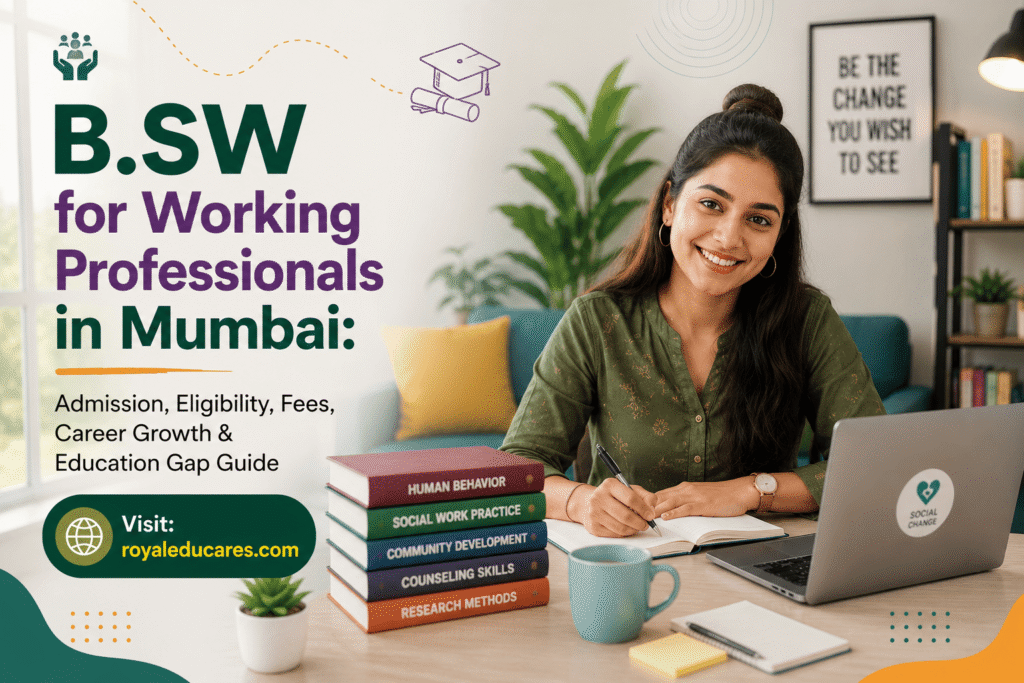
B.SW for Working Professionals in Mumbai: Admission, Eligibility, Fees, Career Growth & Education Gap Guide
Introduction
Many students cannot complete graduation because of employment, financial challenges, family responsibilities, health issues, relocation, or personal commitments. B.SW offers opportunities to continue higher education with proper guidance.
Accreditation & Approvals
UGC-DEB APPROVED
AICTE APPROVED
AIU APPROVED
NAAC +++ ACCREDITED

COBSE BOARDS
PHARMACY COUNCIL OF INDIA
BAR COUNCIL OF INDIA

WORLD EDUCATION SERVICES
MHRD

Get Free Career Counseling
If you are looking for Distance Graduation in Mumbai, explore our complete admission guidance here:
https://royaleducares.com/distance-graduation-in-mumbai/
Students specifically interested in B.SW Admission in Mumbai can learn more here:
https://royaleducares.com/b-sw-admission-in-mumbai/
To explore all available graduation admission guidance and educational services, visit:
https://royaleducares.com/
What is B.SW?
Bachelor of Social Work (B.SW) is an undergraduate degree program that focuses on social welfare, community development, human behavior, social justice, counseling fundamentals, and public welfare. It prepares students with knowledge and practical understanding to work with individuals, families, communities, non-government organizations (NGOs), healthcare institutions, educational organizations, and government welfare departments.
Today, B.SW is becoming one of the fastest-growing graduation choices among students who want to build meaningful careers while contributing to society. It is especially popular among students interested in psychology, community development, healthcare support, child welfare, women empowerment, rural development, disability services, and public administration.
Why is B.SW Becoming Popular in Mumbai?
Searches like “BSW Admission Mumbai,” “Bachelor of Social Work Course,” “BSW Colleges in Mumbai,” “Distance BSW Admission,” and “BSW for Working Professionals” have increased significantly in recent years.
Mumbai is one of India’s largest metropolitan cities with numerous hospitals, NGOs, rehabilitation centers, educational institutions, charitable organizations, and corporate social responsibility (CSR) initiatives. This creates growing opportunities for trained social work professionals.
Students increasingly choose B.SW because it combines academic knowledge with practical social impact and opens career opportunities across multiple sectors.
Why Working Professionals Choose B.SW
Many working professionals begin earning immediately after completing school or after partially completing graduation. Over time, career growth often requires completing a bachelor’s degree, but balancing work and education becomes challenging.
Common reasons professionals return to higher education include:
- Career advancement
- Promotion opportunities
- Better job prospects
- Personal development
- Government job eligibility
- Higher education planning
- Professional credibility
- Long-term career security
B.SW provides an excellent option for individuals interested in developing professional knowledge related to social welfare, human services, and community engagement.
Who Should Pursue a B.SW Degree?
Bachelor of Social Work is suitable for students from diverse backgrounds.
It is commonly considered by:
- Working professionals
- Fresh Class 12 graduates
- Students returning after an education gap
- NGO volunteers
- Healthcare workers
- Community workers
- Teachers
- Social activists
- Entrepreneurs involved in social initiatives
- Women restarting their careers
- Individuals preparing for government services
Students interested in improving society while building a stable professional career often find B.SW a rewarding academic choice.
Why Students Search for B.SW Admission
Every month, thousands of students search online using keywords such as:
- BSW Admission in Mumbai
- Bachelor of Social Work Course
- Distance BSW Admission
- BSW Eligibility
- BSW Fees
- BSW Course Details
- BSW Career Scope
- BSW Government Jobs
- BSW Salary
- Best BSW Course in Mumbai
- BSW After 12th
- BSW for Working Professionals
- Social Work Degree
These searches show increasing awareness about professional opportunities in the social work sector.
What Makes B.SW Different from Other Graduation Programs?
Unlike many traditional undergraduate degrees, B.SW combines classroom learning with an understanding of real-life social challenges.
Students study topics related to:
- Human behavior
- Community organization
- Family welfare
- Social policies
- Child development
- Women empowerment
- Mental health awareness
- Rural and urban development
- Public health
- Social legislation
- Counseling basics
- Community outreach
The interdisciplinary nature of the course helps students understand social systems while developing practical problem-solving skills.
Major Benefits of Pursuing B.SW
Students choose B.SW for many reasons.
Some of the major advantages include:
Strong Career Opportunities
Graduates may explore opportunities in NGOs, hospitals, educational institutions, CSR departments, rehabilitation centers, social welfare organizations, and government-supported projects.
Personal Growth
The program encourages empathy, communication, leadership, teamwork, and ethical decision-making.
Professional Development
Students develop valuable interpersonal and organizational skills that are useful across multiple industries.
Foundation for Higher Education
B.SW graduates often continue with postgraduate studies such as Master of Social Work (MSW), MBA, Public Administration, Psychology, Counseling, or related disciplines, depending on eligibility requirements.
Contribution to Society
One of the biggest attractions of social work is the opportunity to create positive social change while building a meaningful career.
Why Mumbai is an Ideal City for B.SW Aspirants
Mumbai offers a dynamic environment for students interested in social work because it has:
- Large healthcare networks
- Numerous NGOs
- Educational institutions
- Community welfare organizations
- Rehabilitation centers
- Child protection organizations
- Women development programs
- Senior citizen welfare initiatives
- CSR activities by corporate organizations
Exposure to diverse communities provides valuable learning opportunities for aspiring social work professionals.
B.SW for Students with an Education Gap
Many students worry that an education gap will affect their future studies.
Common searches include:
- BSW after education gap
- Graduation after 5 years
- Graduation after job
- Degree after career break
- Continue graduation after gap
- BSW after long break
Education gaps can occur because of:
- Employment
- Financial responsibilities
- Marriage
- Family commitments
- Health issues
- Relocation
- Personal circumstances
Students should not assume that an education gap automatically prevents further education. Instead, they should verify eligibility according to the applicable admission requirements.
Can Working Professionals Study B.SW?
Yes. Many working professionals choose B.SW because they want to strengthen their educational qualifications while continuing their careers.
Professionals from many sectors explore this degree, including:
- Healthcare
- Education
- Customer Service
- Banking
- Retail
- Hospitality
- Security Services
- NGOs
- Corporate Organizations
- Government Support Services
The course appeals to individuals who wish to combine practical work experience with academic learning.
Important Skills Developed During B.SW
Beyond academic knowledge, students gradually build skills that are valuable in professional environments.
These include:
- Communication Skills
- Leadership
- Problem Solving
- Critical Thinking
- Counseling Basics
- Teamwork
- Community Engagement
- Public Speaking
- Report Writing
- Time Management
- Organizational Skills
- Ethical Decision-Making
These competencies are valuable in both social work and many other professional fields.
Why B.SW is a Future-Oriented Degree
As awareness about healthcare, mental health, education, child welfare, women empowerment, disability inclusion, elderly care, and community development continues to increase, the demand for qualified social work professionals is also growing.
Organizations increasingly seek individuals who understand social challenges, can communicate effectively with diverse communities, and contribute to sustainable development initiatives.
For students seeking a graduation program that combines career opportunities with meaningful social impact, Bachelor of Social Work continues to be an excellent choice.
Planning Your Career Before Choosing B.SW
Before applying, students should think carefully about their long-term objectives.
Consider questions such as:
- Do I enjoy helping people?
- Am I interested in community development?
- Would I like to work with NGOs or healthcare organizations?
- Do I plan to pursue MSW or another postgraduate degree?
- Am I interested in government welfare services?
- Do I enjoy communication and teamwork?
- Do I want a career that combines professional growth with social responsibility?
Answering these questions helps students determine whether B.SW aligns with their interests and future career aspirations.
B.SW Eligibility Criteria for Working Professionals in Mumbai
Before applying for a Bachelor of Social Work (B.SW) program, students should understand the eligibility requirements. Every applicant has a unique educational background, so eligibility may vary depending on previous qualifications, university regulations, and the admission pathway.
Whether you are a fresh Class 12 student, a working professional, or someone returning after an education gap, understanding the admission requirements is the first step toward completing your graduation.
Who Can Apply for B.SW Admission?
One of the most searched questions is:
Who is eligible for BSW?
Can I apply for BSW after 12th?
BSW admission eligibility
Bachelor of Social Work eligibility
BSW for working professionals
Distance BSW admission eligibility
Generally, B.SW admission guidance is suitable for:
Class 12 pass students
Working professionals
Business owners
Self-employed individuals
Homemakers planning to continue education
Students with an education gap
Individuals preparing for government careers
NGO volunteers
Community workers
Students interested in healthcare and social services
Students should always confirm eligibility according to the applicable admission guidelines before proceeding.
Educational Qualification for B.SW
Bachelor of Social Work is an undergraduate degree program.
Students commonly search:
Can I do BSW after 12th?
Which stream is best for BSW?
BSW after Commerce
BSW after Science
BSW after Arts
Students from different educational backgrounds may explore B.SW admission, including:
Arts (Humanities)
Commerce
Science
Vocational streams
Other equivalent qualifications, subject to applicable eligibility requirements
This flexibility makes B.SW an attractive graduation option for students from diverse academic streams.
Is There Any Age Limit for B.SW Admission?
Many students search online:
Age limit for BSW
Can I do BSW after 25?
BSW after 30
Graduation after long gap
Can working professionals pursue BSW?
Age requirements may vary depending on institutional policies and admission guidelines.
Many learners continue their graduation after several years due to work, family responsibilities, or other personal commitments. Students should verify the latest eligibility requirements before applying.
B.SW for Students with an Education Gap
One of the biggest concerns among students is an education gap.
Common searches include:
BSW after 5 years
Graduation after 10 years
Continue studies after long gap
Degree after career break
BSW after employment
Education gaps commonly occur because of:
Full-time employment
Financial challenges
Marriage
Family responsibilities
Medical reasons
Relocation
Personal commitments
Having an education gap does not automatically prevent students from continuing their graduation. Students should seek proper admission guidance and verify their eligibility according to current academic requirements.
Can Working Professionals Pursue B.SW?
Yes. B.SW is increasingly popular among working professionals who wish to complete their graduation while enhancing their knowledge and career prospects.
Professionals from various sectors consider B.SW, including:
Healthcare
Education
Retail
Banking
Hospitality
Customer Support
Social Welfare Organizations
Government Support Services
Corporate CSR Departments
Non-Government Organizations (NGOs)
Many professionals choose B.SW because it supports both personal development and long-term career planning.
B.SW for Homemakers
Many homemakers decide to continue their education after taking a break due to family responsibilities.
A B.SW degree can help them:
Restart their academic journey
Build professional confidence
Prepare for employment opportunities
Develop communication and leadership skills
Pursue higher education in the future
Returning to education can open new possibilities for personal and professional growth.
B.SW for NGO Volunteers and Community Workers
Individuals already involved in community service often pursue B.SW to strengthen their knowledge and practical understanding of social work.
The program helps students gain insights into:
Community development
Social welfare policies
Child protection
Women empowerment
Public health
Human rights
Counseling fundamentals
Community outreach
Formal education can complement practical experience in the social sector.
Documents Generally Required for B.SW Admission
Document requirements may vary depending on the institution. Students are generally advised to keep the following documents ready.
Academic Documents
Class 10 Marksheet
Class 12 Marksheet
Transfer Certificate or Leaving Certificate (where applicable)
Previous academic documents (if required)
Identity Proof
Aadhaar Card
PAN Card (if applicable)
Passport (where applicable)
Address Proof
Aadhaar Card
Passport
Voter ID
Driving Licence
Other accepted address proof
Passport-Size Photographs
Recent passport-size photographs may be required during the admission process.
Additional Supporting Documents
Depending on individual circumstances, students may also need:
Name change documents (if applicable)
Category certificate (where applicable)
Experience certificate (if applicable)
Employment proof (where applicable)
Other documents requested during admission
Students should always verify the latest document checklist before applying.
Step-by-Step B.SW Admission Process
Understanding the admission process helps students prepare in advance.
Step 1 – Academic Counselling
Students receive guidance based on their educational background, career objectives, and future plans.
Step 2 – Eligibility Verification
Academic qualifications are reviewed to determine whether the student meets the admission requirements.
Step 3 – Course Guidance
Students receive information about the B.SW program, its curriculum, career scope, and future opportunities.
Step 4 – Document Verification
Required academic and identity documents are reviewed.
Step 5 – Application Submission
The admission application is completed according to institutional procedures.
Step 6 – Admission Confirmation
After successful verification and completion of the required formalities, admission is confirmed as per the applicable process.
Recognition and Future Opportunities
Students frequently ask:
Is BSW a recognised degree?
Can BSW graduates apply for government jobs?
Can I pursue higher education after BSW?
Is BSW valid for employment?
The answers depend on institutional recognition, applicable regulations, and specific recruitment or academic requirements. Students should always verify these details with the concerned institution before taking admission.
Why Professional Admission Guidance Is Important
Many students make mistakes because they apply without understanding the admission process.
Professional guidance helps students:
Understand eligibility requirements
Prepare necessary documents
Learn about career opportunities
Choose suitable academic pathways
Plan future higher education
Avoid common admission mistakes
Proper counselling enables students to make informed educational decisions.
Common Mistakes Students Should Avoid
Students often delay or complicate their admission because of avoidable mistakes.
Some of the most common include:
Not Checking Eligibility
Always verify eligibility before beginning the admission process.
Submitting Incomplete Documents
Missing documents may delay admission.
Delaying Graduation
Many students postpone completing their degree for several years, which may delay future career plans.
Ignoring Career Planning
Students should understand how a B.SW degree aligns with their long-term professional goals before applying.
Depending Only on Internet Information
Admission requirements and institutional guidelines may change over time. Students should always seek updated guidance from the concerned admission authority.
Preparing for a Successful Academic Journey
Completing graduation is an important milestone in professional development.
Before starting your B.SW journey, ask yourself:
What are my career goals?
Am I interested in social welfare and community development?
Do I plan to pursue higher education after graduation?
Which sector would I like to work in?
How will this degree support my long-term career?
Clear planning and informed decision-making can help students maximize the value of their Bachelor of Social Work degree while preparing for future academic and professional success.
B.SW Course Duration, Fees, Subjects & Curriculum
Before taking admission, most students want to understand what they will study during the Bachelor of Social Work (B.SW) program. Searches such as “BSW Course Details,” “BSW Subjects,” “BSW Duration,” “BSW Syllabus,” “BSW Fees in Mumbai,” and “Bachelor of Social Work Curriculum” are among the most common search queries.
Understanding the course structure helps students make informed decisions and prepare for their future academic and professional journey.
What is the Duration of a B.SW Course?
One of the most frequently asked questions is:
How many years is BSW?
BSW course duration
Bachelor of Social Work duration
Graduation duration after 12th
The duration of a B.SW program depends on the applicable academic structure and university regulations.
Students should always verify the latest academic schedule, examination pattern, and admission guidelines before enrolling.
B.SW Fees in Mumbai
Another important concern for students is the course fee.
Popular searches include:
BSW fees in Mumbai
Bachelor of Social Work course fees
Distance BSW fees
Affordable BSW admission
BSW admission cost
The total fee may vary depending on several factors, including:
University or institution
Admission pathway
Academic regulations
Examination fees
Administrative charges
Documentation requirements
Other applicable institutional fees
Students should always obtain the latest fee details from the concerned admission counsellor before completing the admission process.
Is B.SW Worth the Investment?
Students often ask:
Is BSW a good course?
Is Bachelor of Social Work worth it?
Does BSW have career scope?
Should I pursue BSW?
For many students, B.SW is more than just a graduation degree. It develops knowledge, practical skills, communication abilities, leadership qualities, and an understanding of social systems that can be useful in multiple career paths.
The long-term value of the degree depends on continuous learning, professional development, and practical experience.
What Subjects Are Studied in B.SW?
Although the exact syllabus may differ according to institutional guidelines, students generally study topics related to social work, human behavior, community welfare, and social development.
Common subject areas include:
Introduction to Social Work
Human Growth and Development
Sociology
Psychology
Community Organization
Social Welfare Administration
Social Case Work
Social Group Work
Family and Child Welfare
Rural Development
Urban Community Development
Public Health
Social Policy
Human Rights
Women’s Studies
Counseling Basics
Environmental Studies
Research Methods
Communication Skills
These subjects provide a balanced understanding of both theory and practical social work concepts.
Understanding the B.SW Curriculum
The B.SW curriculum is designed to help students understand individuals, families, communities, and society.
Students gradually learn about:
Social issues
Community participation
Public welfare programs
Social legislation
Child protection
Women’s empowerment
Healthcare awareness
Disability inclusion
Elderly care
Mental health awareness
Rehabilitation services
The curriculum encourages students to think critically while developing practical problem-solving skills.
Practical Learning in B.SW
One of the strengths of a Bachelor of Social Work program is its practical orientation.
Students gain exposure to real-world situations through learning activities that may include:
Community observation
Field-based learning
Case discussions
Group activities
Social awareness programs
Community interaction
Project work
Research assignments
Practical learning helps students understand how theoretical concepts relate to everyday social challenges.
Skills Developed During the B.SW Program
A B.SW degree focuses on both academic knowledge and professional skill development.
Important skills include:
Communication Skills
Effective communication helps professionals interact with individuals, families, communities, and organizations.
Leadership Skills
Students learn how to guide teams, organize community initiatives, and support social development programs.
Problem-Solving Ability
Social work often involves understanding challenges and identifying practical solutions.
Critical Thinking
Students learn to evaluate social situations from multiple perspectives before making decisions.
Teamwork
Many social welfare initiatives require collaboration with multidisciplinary teams.
Counseling Fundamentals
Students gain a basic understanding of listening, empathy, and supportive communication.
Organizational Skills
Planning, documentation, and coordination become valuable professional competencies.
Ethical Decision-Making
Professional ethics play an important role in responsible social work practice.
Why Communication Skills Are Important in Social Work
Communication is one of the most valuable skills for B.SW graduates.
Professionals frequently communicate with:
Children
Families
Senior citizens
Community members
Healthcare professionals
Teachers
Government officials
NGOs
Corporate representatives
Strong communication improves trust, teamwork, and effective service delivery.
Leadership Development Through B.SW
Leadership is not limited to corporate organizations.
Social work professionals often lead:
Community awareness campaigns
Health education programs
Youth development initiatives
Women’s empowerment projects
Child welfare activities
Disaster relief coordination
Volunteer management
Developing leadership qualities helps graduates contribute effectively in professional and community settings.
Research and Analytical Skills
Modern social work increasingly relies on research and evidence-based decision-making.
Students gradually develop the ability to:
Collect information
Analyze community needs
Interpret findings
Prepare reports
Evaluate social programs
Recommend improvements
These analytical skills are valuable across many industries beyond social work.
Technology in Modern Social Work
Technology has become an important part of community development and social service delivery.
Professionals increasingly use digital tools for:
Documentation
Online communication
Data collection
Case management
Awareness campaigns
Report preparation
Presentation of findings
Students who develop digital skills alongside their B.SW education are often better prepared for modern workplaces.
Why Students Choose B.SW Instead of Other Graduation Courses
Every student has different career goals.
Many students choose B.SW because they are interested in:
Helping people
Community service
Social justice
Healthcare support
Child development
Women’s welfare
Public health
Human rights
Rural development
Community leadership
The degree offers opportunities to combine academic learning with meaningful social contribution.
Preparing for Higher Education After B.SW
Many graduates continue their studies after completing a Bachelor of Social Work.
Depending on eligibility requirements and career interests, students may consider postgraduate education in areas such as:
Master of Social Work (MSW)
Master of Business Administration (MBA)
Public Administration
Psychology
Counseling
Rural Development
Social Policy
Human Resource Management
Planning for higher education early helps students build a stronger long-term career path.
Building a Strong Foundation for the Future
A Bachelor of Social Work is more than an undergraduate qualification. It provides students with knowledge of society, human behavior, welfare systems, communication, leadership, ethics, and community development.
When combined with practical experience, continuous learning, and professional skill development, B.SW can serve as a strong foundation for careers in social welfare, healthcare, education, community development, public service, and many other sectors.
Students who remain committed to learning and professional growth can maximize the value of their graduation and prepare themselves for a wide range of future opportunities.
Career Opportunities After B.SW in Mumbai
One of the biggest reasons students choose a Bachelor of Social Work (B.SW) is the wide range of career opportunities available after graduation. Every year, thousands of students search online using keywords such as “Career After BSW,” “BSW Jobs,” “Government Jobs After BSW,” “NGO Jobs,” “Social Worker Career,” “BSW Salary,” and “Future Scope of BSW.”
A B.SW degree prepares graduates with knowledge, communication skills, leadership abilities, and an understanding of community welfare, making them suitable for opportunities across government, private, healthcare, educational, and non-profit sectors.
Career Scope After B.SW
The demand for qualified social work professionals continues to grow because organizations increasingly focus on healthcare, education, child protection, women empowerment, mental health, disability inclusion, community development, and corporate social responsibility.
B.S.W graduates may explore opportunities in:
Non-Government Organizations (NGOs)
Hospitals
Educational Institutions
Rehabilitation Centres
Government Welfare Departments
Child Welfare Organizations
Women Development Organizations
Community Development Projects
Healthcare Institutions
Mental Health Support Organizations
Corporate CSR Departments
Rural Development Projects
International Development Organizations
Disaster Management Programs
The career scope continues to expand as awareness about social welfare and public health increases.
NGO Career Opportunities After B.S.W
NGOs are among the largest employers of social work graduates.
Students may work in organizations focusing on:
Child Protection
Women’s Empowerment
Education
Rural Development
Healthcare Awareness
Disability Support
Environmental Protection
Youth Development
Poverty Alleviation
Community Welfare
Common job roles include:
Social Worker
Community Coordinator
Program Assistant
Project Officer
Field Coordinator
Community Mobilizer
Welfare Officer
Outreach Worker
NGOs provide opportunities to work directly with communities and contribute to meaningful social change.
Government Jobs After B.S.W
Many students ask:
Can BSW graduates apply for government jobs?
Government jobs after Bachelor of Social Work
Social Welfare Department jobs
Government career after BSW
B.S.W graduates may become eligible to apply for various government recruitment opportunities where they meet the prescribed educational qualifications.
Employment opportunities may exist in:
Social Welfare Departments
Women and Child Development Departments
Health Departments
Rural Development Departments
Municipal Corporations
Public Health Projects
Government Hospitals
Rehabilitation Services
Candidates should always refer to official recruitment notifications for the latest eligibility requirements.
Healthcare Career After B.S.W
Healthcare is one of the fastest-growing employment sectors for social work graduates.
Hospitals and healthcare organizations often require professionals to support patients and families through counselling, coordination, and community outreach.
Possible roles include:
Medical Social Worker
Patient Counsellor
Community Health Coordinator
Hospital Welfare Officer
Public Health Assistant
Rehabilitation Coordinator
Healthcare professionals with social work knowledge play an important role in improving patient support services.
Child Welfare Career Opportunities
Child welfare organizations work to improve the lives of children through education, protection, rehabilitation, and community support.
Graduates may contribute to:
Child Protection Programs
Adoption Support Services
Juvenile Welfare Initiatives
Educational Outreach
Child Development Projects
Nutrition Awareness Campaigns
Professionals in this field work closely with children, families, schools, and welfare agencies.
Women Empowerment and Gender Development Careers
Women empowerment initiatives continue to expand across India.
B.S.W graduates may contribute to programs involving:
Women’s Education
Skill Development
Self-Help Groups
Community Awareness
Legal Awareness
Health Education
Financial Literacy
Social Inclusion
Organizations working in gender development often require professionals with strong communication and community engagement skills.
Community Development Careers
Community development focuses on improving the quality of life within communities through education, healthcare, employment support, sanitation, awareness, and welfare initiatives.
Career opportunities include:
Community Development Officer
Community Organizer
Project Coordinator
Rural Development Executive
Urban Development Coordinator
Social Development Professional
These roles involve working directly with communities to identify needs and implement development programs.
Corporate Social Responsibility (CSR) Careers
Corporate Social Responsibility (CSR) has become an important function within many organizations.
Companies invest in projects related to:
Education
Healthcare
Environment
Skill Development
Community Welfare
Rural Development
Sustainability
B.S.W graduates may work as:
CSR Executive
CSR Coordinator
Community Relations Officer
Social Impact Associate
CSR Project Officer
CSR careers combine corporate management with community development.
Educational Sector Careers
Educational institutions also recruit social work professionals.
Possible roles include:
Student Counsellor
Welfare Coordinator
Community Outreach Officer
School Social Worker
Student Support Executive
Professionals help improve student well-being, communication, and community engagement.
Rehabilitation and Disability Services
Rehabilitation organizations support individuals recovering from illness, injury, disability, or addiction.
Career opportunities include:
Rehabilitation Assistant
Disability Support Coordinator
Community Rehabilitation Worker
Social Welfare Officer
Case Coordinator
These roles involve collaboration with healthcare professionals and community organizations.
Public Health Career Opportunities
Public health initiatives require trained professionals to educate communities and improve awareness.
Programs may involve:
Vaccination Awareness
Nutrition Campaigns
Maternal Health
Child Health
Mental Health Awareness
Sanitation Projects
Disease Prevention Programs
Graduates contribute to community education and public welfare initiatives.
International Organizations and Development Agencies
Some graduates aspire to work with international organizations involved in humanitarian assistance, education, healthcare, community development, disaster management, and sustainable development.
Such organizations value professionals with strong communication, cultural awareness, leadership, and project management skills.
Entrepreneurship After B.S.W
Many graduates choose to build careers independently by starting organizations or initiatives related to social welfare.
Examples include:
Community Training Centres
Counselling Services
Skill Development Programs
Educational Support Services
NGO Consultancy
Social Enterprises
Entrepreneurship allows graduates to combine professional growth with social impact.
Salary After B.S.W
One of the most searched questions is:
BSW salary in India
Salary after Bachelor of Social Work
Highest salary after BSW
NGO salary after BSW
There is no fixed salary applicable to all graduates.
Income depends on factors such as:
Employer
Industry
Experience
Skills
Location
Responsibilities
Professional performance
Graduates who continue improving their qualifications and practical skills often strengthen their long-term career prospects.
Skills That Improve Career Opportunities
Graduation alone is not enough in today’s competitive job market.
Students should continue developing:
Communication Skills
Leadership
Report Writing
Public Speaking
Counseling Skills
Computer Skills
Microsoft Excel
Documentation
Project Management
Problem Solving
Team Management
Community Engagement
These skills improve employability across multiple sectors.
Why B.S.W Has Strong Future Scope
The need for trained social work professionals continues to grow because governments, healthcare institutions, NGOs, educational organizations, and corporate companies increasingly invest in social development and community welfare initiatives.
Professionals who combine academic qualifications with practical experience, communication skills, and continuous learning are better positioned to build rewarding careers.
Whether your goal is government service, healthcare, community development, NGO leadership, CSR, education, or entrepreneurship, a Bachelor of Social Work provides a strong academic foundation for long-term professional growth.
Salary After B.SW, Higher Education & Career Growth
One of the most common questions students ask before choosing a Bachelor of Social Work (B.S.W.) is, “What can I do after BSW?” Searches such as “BSW Salary,” “Career Growth After BSW,” “Courses After BSW,” “Higher Education After BSW,” and “Future Scope of Bachelor of Social Work” are among the highest-volume search queries.
A B.S.W. degree provides a strong academic foundation for students interested in social welfare, healthcare, counselling, education, community development, public administration, and management. Career growth depends on education, practical experience, professional skills, and continuous learning.
Salary After B.S.W. in India
Many students search:
BSW salary in India
Bachelor of Social Work salary
Fresher salary after BSW
Highest salary after BSW
Government salary after BSW
There is no fixed salary for every graduate.
Salary generally depends on:
Employer
Industry
Job Role
Experience
Location
Skills
Professional Performance
Additional Qualifications
Professionals who continuously improve their knowledge and practical abilities often create stronger long-term career opportunities.
Factors That Influence Salary After B.S.W.
Several factors affect career progression and salary growth.
These include:
Educational Qualifications
Students who continue learning and upgrade their qualifications often become eligible for broader career opportunities.
Practical Experience
Hands-on experience improves professional confidence and workplace readiness.
Communication Skills
Strong communication remains one of the most valuable skills across healthcare, education, NGOs, and corporate organizations.
Leadership Ability
Professionals capable of managing teams and coordinating projects often progress into higher responsibilities.
Technical Skills
Computer proficiency, documentation, Microsoft Office, reporting, and digital communication strengthen employability.
Professional Certifications
Industry-relevant certifications complement graduation and demonstrate commitment to continuous learning.
Higher Education After B.S.W.
Many graduates continue their education after completing a Bachelor of Social Work.
Popular searches include:
Best course after BSW
Higher education after BSW
Masters after BSW
Postgraduate courses after BSW
Further education allows students to specialize and expand career opportunities.
Master of Social Work (MSW)
MSW is one of the most preferred postgraduate programs after B.S.W.
Students deepen their knowledge in areas such as:
Community Development
Medical Social Work
Family Welfare
Child Welfare
Mental Health
Human Rights
Social Policy
Rural Development
MSW prepares graduates for advanced professional responsibilities in social welfare organizations and institutions.
MBA After B.S.W.
Many students search:
Can I do MBA after BSW?
MBA after Bachelor of Social Work
Best MBA specialization after BSW
Graduates interested in management careers may consider MBA, subject to meeting the applicable eligibility requirements.
Popular MBA specializations include:
Human Resource Management
Marketing
Healthcare Management
Operations Management
Finance
Business Analytics
An MBA can complement social work knowledge with business and leadership skills.
Psychology and Counselling
Students interested in human behaviour and mental well-being may consider further studies in:
Psychology
Counselling
Mental Health
Behavioural Sciences
These fields can support careers in education, healthcare, rehabilitation, and counselling services.
Public Administration
Public Administration is another option for graduates interested in governance, public policy, administration, and government systems.
The field focuses on:
Policy Implementation
Public Services
Administration
Governance
Community Development
Human Resource Management
Graduates who enjoy working with people may pursue higher education related to Human Resource Management.
Possible career areas include:
Recruitment
Employee Relations
Training and Development
Talent Management
Organizational Development
Strong interpersonal skills developed during B.S.W. can be valuable in HR roles.
Preparing for Competitive Examinations
Many students plan to appear for competitive examinations after graduation.
Graduates should always verify the eligibility criteria specified in official recruitment notifications before applying.
Proper planning, continuous preparation, and updated knowledge improve examination readiness.
Entrepreneurship After B.S.W.
Some graduates choose to build independent careers.
Possible ideas include:
NGO Consultancy
Community Welfare Projects
Counselling Services
Educational Support Programs
Skill Development Centres
Social Enterprises
Youth Development Initiatives
Entrepreneurship enables professionals to combine business ideas with community service.
Career Growth in the NGO Sector
NGOs offer multiple career progression opportunities.
Professionals may advance from entry-level roles to positions such as:
Project Coordinator
Program Officer
Team Leader
Project Manager
Regional Coordinator
Program Director
Career advancement depends on experience, leadership, and project management skills.
Career Growth in Healthcare
Healthcare organizations continue to recruit professionals with social work knowledge.
Career progression may involve responsibilities related to:
Patient Support
Medical Counselling
Community Health
Rehabilitation
Public Health Awareness
Hospital Administration Support
Experience and additional qualifications often contribute to long-term growth.
Career Growth in Corporate CSR
Corporate Social Responsibility (CSR) departments increasingly require professionals capable of planning and implementing community development initiatives.
Career progression may include:
CSR Executive
CSR Coordinator
CSR Manager
Community Relations Specialist
Social Impact Consultant
CSR combines corporate management with sustainable social development.
Building a Strong Professional Profile
Students should focus on developing a balanced professional profile during and after graduation.
Areas to improve include:
Communication Skills
Leadership
Computer Knowledge
Microsoft Excel
Documentation
Public Speaking
Project Management
Report Writing
Teamwork
Problem Solving
Professional growth is often influenced by continuous skill development.
Professional Certifications That Complement B.S.W.
Students can strengthen their profile through certifications in areas such as:
Digital Marketing
Advanced Microsoft Excel
Project Management
Counselling Skills
Child Protection
Community Development
Disaster Management
Public Health
Communication Skills
Leadership Development
Choosing certifications relevant to career goals improves employability.
Resume Building Tips for B.S.W. Graduates
A strong resume highlights both academic achievements and practical abilities.
Students should include:
Educational Qualifications
Internship Experience
Volunteer Work
Community Projects
Certifications
Technical Skills
Leadership Activities
Language Skills
Professional Achievements
A well-prepared resume creates a positive first impression during recruitment.
Interview Preparation Tips
Interview success depends on preparation.
Students should practice:
Professional Communication
Self-Introduction
Problem-Solving Questions
Teamwork Examples
Community Project Discussions
Leadership Experiences
Career Goal Explanation
Confidence improves through regular practice and continuous learning.
Long-Term Career Planning After B.S.W.
Every student should develop a clear career roadmap.
Important questions include:
Do I want to pursue higher education?
Which industry interests me most?
Should I prepare for government careers?
Am I interested in healthcare or NGOs?
Do I want to become an entrepreneur?
Which skills should I improve?
Clear career planning supports better educational and professional decisions.
Why Continuous Learning Matters
The fields of healthcare, education, public welfare, community development, and corporate social responsibility continue to evolve.
Professionals who regularly update their knowledge through certifications, workshops, seminars, practical experience, and higher education remain better prepared for future opportunities.
A Bachelor of Social Work provides a strong academic foundation, but lifelong learning is the key to sustained career success and professional growth.
B.SW for Working Professionals: Time Management, Career Change & Education Gap Guide
For many students, completing graduation while managing work, family responsibilities, or a business can feel challenging. This is why searches such as “BSW for Working Professionals,” “Complete Graduation While Working,” “Graduation After Long Gap,” “Career Change After Graduation,” and “Education Gap Solutions” continue to increase.
A Bachelor of Social Work (B.S.W.) can be an excellent choice for individuals who want to complete their graduation while building a meaningful and stable career. With proper planning, discipline, and academic guidance, many students successfully balance education with their personal and professional responsibilities.
Why Working Professionals Choose B.S.W.
Many people begin working immediately after completing Class 12 because of financial responsibilities or family commitments. Others start a business or take up full-time employment before completing graduation.
After a few years, they often realize that having a bachelor’s degree can support:
Career advancement
Promotion opportunities
Better employment prospects
Higher education
Professional credibility
Government job eligibility
Personal growth
Long-term career security
As a result, B.S.W. has become a preferred graduation option for many working professionals.
B.S.W. After an Education Gap
One of the biggest concerns among students is whether they can continue their education after several years.
Common online searches include:
Graduation after 5 years
Graduation after 10 years
BSW after education gap
Continue graduation after job
Degree after career break
Can I study after a long gap?
An education gap may occur due to:
Full-time employment
Financial challenges
Marriage
Family responsibilities
Health issues
Relocation
Personal commitments
An education gap does not automatically prevent a student from continuing higher education. Students should always verify eligibility according to the applicable admission guidelines.
Can Homemakers Pursue B.S.W.?
Yes. Many homemakers decide to resume their education after focusing on family responsibilities for several years.
A Bachelor of Social Work can help them:
Complete graduation
Improve professional confidence
Prepare for employment
Build communication skills
Explore higher education opportunities
Contribute to community development
Returning to education is an important step toward personal and professional growth.
B.S.W. for Business Owners
Business owners often believe that social work is limited to NGOs, but the skills learned during a B.S.W. program are valuable in many professional settings.
Entrepreneurs can benefit by developing:
Leadership
Communication
Team Management
Problem Solving
Community Engagement
Ethical Decision-Making
Organizational Skills
These abilities can strengthen both business operations and community relationships.
B.S.W. for NGO Volunteers
Individuals who already participate in community service or volunteer work often pursue B.S.W. to gain structured academic knowledge.
The degree enhances understanding of:
Community organization
Public welfare
Human rights
Child protection
Women empowerment
Public health
Rural development
Social legislation
Combining practical experience with academic learning helps build a stronger professional profile.
Time Management Tips for Working Professionals
Managing education along with work requires planning.
The following strategies can help students stay consistent.
Create a Weekly Study Schedule
Set aside dedicated hours each week for studying and revision.
Set Small Learning Goals
Breaking large tasks into smaller milestones makes learning more manageable.
Prioritize Important Activities
Focus first on assignments, examinations, and essential learning objectives.
Maintain Consistency
Studying regularly is often more effective than studying only before examinations.
Use Technology Wisely
Digital calendars, reminders, and productivity tools can help students organize their schedules more efficiently.
Balancing Work, Family and Education
Working professionals often manage multiple responsibilities at the same time.
These may include:
Office work
Business operations
Household responsibilities
Family commitments
Travel
Academic preparation
Maintaining a balanced routine improves productivity and reduces unnecessary stress.
Career Change After B.S.W.
Some students choose B.S.W. because they wish to move into a new professional field.
Possible career transitions include:
NGO Sector
Healthcare
Education
Community Development
Rehabilitation Services
Corporate Social Responsibility (CSR)
Public Welfare
Counselling Support
Changing careers requires planning, skill development, and continuous learning.
Common Challenges Faced by Working Professionals
Returning to education after several years presents certain challenges.
Common concerns include:
Lack of study routine
Limited time
Family responsibilities
Office workload
Travel commitments
Confidence after an education gap
Balancing examinations and work
Most of these challenges can be addressed through proper planning and disciplined time management.
Essential Skills Every B.S.W. Student Should Develop
Academic knowledge should be supported by professional skills.
Students should continue improving:
Communication Skills
Leadership
Public Speaking
Teamwork
Report Writing
Microsoft Office
Computer Literacy
Documentation
Project Coordination
Problem Solving
Critical Thinking
Ethical Decision-Making
These skills improve career opportunities across different sectors.
Digital Skills for Modern Social Work Professionals
Technology has become increasingly important in community development and welfare organizations.
Useful digital skills include:
Microsoft Word
Microsoft Excel
Microsoft PowerPoint
Google Workspace
Online Documentation
Email Communication
Digital Reporting
Virtual Meeting Platforms
Data Entry
Basic Presentation Design
Professionals who combine social work knowledge with digital skills are often better prepared for modern workplaces.
Professional Networking
Networking plays an important role in long-term career growth.
Students should actively participate in:
Community Programs
Workshops
Social Welfare Events
Professional Seminars
NGO Conferences
Healthcare Awareness Programs
LinkedIn Networking
Alumni Associations
Professional relationships often create future learning and employment opportunities.
Common Mistakes Students Should Avoid
Many students unknowingly delay their professional growth by making avoidable mistakes.
Some common examples include:
Delaying Graduation
Postponing graduation for several years may delay future educational and career opportunities.
Ignoring Skill Development
Graduation should be combined with communication, leadership, computer knowledge, and practical experience.
Depending Only on Academic Marks
Employers also value teamwork, adaptability, ethics, and interpersonal skills.
Lack of Career Planning
Students should identify their long-term goals before selecting a career path.
Not Seeking Professional Guidance
Proper admission counselling helps students understand eligibility, documentation, and future opportunities.
Building a Successful Career After B.S.W.
A successful career requires continuous improvement beyond graduation.
Students should focus on:
Higher Education
Professional Certifications
Internship Experience
Volunteer Activities
Community Projects
Leadership Development
Communication Skills
Technology Skills
Every new skill adds value to a student’s professional profile.
Why B.S.W. Is a Future-Oriented Degree
Healthcare, education, community welfare, rehabilitation, public health, and CSR continue to expand across India.
Organizations increasingly seek professionals who can:
Communicate effectively
Work with diverse communities
Coordinate welfare programs
Manage projects
Support vulnerable populations
Build strong community relationships
A Bachelor of Social Work prepares students with the academic knowledge and practical skills needed to contribute meaningfully in these growing sectors.
Planning Your Future After Graduation
Completing graduation is only the beginning of your professional journey.
Students should regularly evaluate:
Career goals
Higher education plans
Professional certifications
Leadership development
Technical skill improvement
Industry trends
Employment opportunities
By combining a B.S.W. degree with continuous learning, practical experience, and thoughtful career planning, students can build rewarding careers while making a positive impact on society.
Future Scope of B.S.W. in India
Bachelor of Social Work (B.S.W.) is becoming one of the fastest-growing undergraduate programs because the demand for trained social work professionals continues to increase across healthcare, education, community development, rehabilitation, government welfare schemes, and corporate organizations.
Students frequently search:
Future scope of BSW
Is BSW a good career?
Demand for BSW graduates
Best career after BSW
BSW jobs in India
BSW career opportunities
The future scope of B.S.W. is expanding as organizations increasingly focus on social welfare, public health, education, child protection, women empowerment, disability inclusion, mental health, and sustainable community development.
Why the Demand for Social Work Professionals Is Increasing
India continues to invest in welfare programs that require trained professionals who understand community needs and social development.
Growing demand is driven by areas such as:
Public Health
Child Welfare
Women Empowerment
Community Development
Education
Rural Development
Urban Development
Rehabilitation Services
Mental Health Awareness
Corporate Social Responsibility (CSR)
Disaster Management
Senior Citizen Welfare
This increasing focus creates opportunities for graduates with knowledge of social work and community engagement.
Industries That Recruit B.S.W. Graduates
A Bachelor of Social Work can open doors to employment in a variety of sectors.
Some of the major industries include:
Healthcare
Hospitals, rehabilitation centres, mental health institutions, and healthcare organizations require professionals who can support patients, families, and communities.
Education
Schools, colleges, educational trusts, and skill development organizations recruit professionals for counselling, welfare coordination, and community outreach.
Non-Government Organizations (NGOs)
NGOs remain one of the largest employers of social work graduates.
They work in areas including:
Education
Healthcare
Human Rights
Women’s Development
Child Protection
Community Welfare
Environmental Sustainability
Government Departments
Government organizations recruit professionals for welfare-related projects, public health initiatives, rehabilitation services, rural development, and community support programs, subject to the prescribed eligibility criteria.
Corporate Social Responsibility (CSR)
Many private companies implement CSR initiatives focused on education, healthcare, environmental sustainability, and community development.
Professionals with social work knowledge contribute to planning and implementing these initiatives.
International Development Organizations
Some graduates aspire to work with organizations involved in humanitarian assistance, sustainable development, education, healthcare, and disaster relief.
Strong communication, project management, and community engagement skills are valuable in these environments.
Skills Employers Look for in B.S.W. Graduates
Academic qualifications alone are not enough in today’s job market.
Employers also value professionals who demonstrate:
Communication Skills
Effective communication helps professionals interact with individuals, communities, healthcare teams, and government agencies.
Leadership Skills
Leadership is important for coordinating projects, managing volunteers, and guiding community initiatives.
Teamwork
Social work often requires collaboration with multidisciplinary teams.
Problem-Solving Ability
Organizations appreciate professionals who can identify challenges and recommend practical solutions.
Critical Thinking
Analysing social situations and making informed decisions are essential parts of professional social work.
Documentation Skills
Preparing reports, maintaining records, and documenting community activities are valuable workplace competencies.
Digital Literacy
Computer knowledge and digital communication have become increasingly important in modern organizations.
Professional Ethics
Ethical decision-making builds trust with communities, organizations, and stakeholders.
Technology and Modern Social Work
Technology has transformed the way social welfare organizations operate.
Professionals increasingly use digital tools for:
Case Documentation
Data Collection
Community Surveys
Online Meetings
Awareness Campaigns
Report Preparation
Communication
Project Monitoring
Students who develop technology skills alongside their graduation become better prepared for modern workplaces.
Resume Tips for B.S.W. Graduates
A professional resume should present academic achievements together with practical experience.
Students should include:
Educational Qualifications
Community Projects
Internship Experience
Volunteer Work
Technical Skills
Communication Skills
Leadership Activities
Certifications
Language Proficiency
Professional Achievements
A clear and well-organized resume improves employability.
Interview Preparation for B.S.W. Graduates
Interview preparation is essential for career success.
Students should practice:
Professional Self-Introduction
Communication Skills
Community Project Discussions
Leadership Examples
Problem-Solving Questions
Teamwork Experiences
Career Goals
Ethical Decision-Making Scenarios
Preparation helps candidates perform more confidently during recruitment.
Importance of Professional Networking
Professional networking supports long-term career development.
Students should participate in:
NGO Events
Healthcare Conferences
Community Programs
Professional Workshops
Skill Development Sessions
Alumni Networks
LinkedIn Communities
Social Welfare Campaigns
Building professional relationships can create valuable learning and employment opportunities.
Why Continuous Learning Is Important
The social work profession continues to evolve because of changing social needs, technology, healthcare systems, and government welfare initiatives.
Students should continue learning through:
Professional Certifications
Workshops
Seminars
Research Activities
Community Projects
Practical Experience
Online Learning Programs
Continuous learning strengthens professional competence and career growth.
Common Mistakes Students Should Avoid
Students often make mistakes that limit future opportunities.
Some common examples include:
Choosing a Course Without Career Planning
Students should understand their long-term goals before selecting a graduation program.
Ignoring Practical Experience
Volunteer work, internships, and community participation improve professional readiness.
Weak Communication Skills
Communication remains one of the most important competencies in social work.
Delaying Skill Development
Students should begin improving computer skills, documentation, public speaking, and leadership abilities during graduation.
Not Planning for Higher Education
Graduates interested in specialization should plan postgraduate studies early.
Long-Term Benefits of a B.S.W. Degree
A Bachelor of Social Work offers more than academic knowledge.
Long-term benefits include:
Strong communication skills
Leadership development
Community engagement experience
Professional confidence
Career flexibility
Foundation for postgraduate education
Opportunities across multiple sectors
Personal growth through meaningful social contribution
Graduates who continue learning and gaining practical experience often build rewarding professional careers.
Conclusion
Bachelor of Social Work is an excellent graduation choice for students, working professionals, homemakers, NGO volunteers, and individuals returning after an education gap. The program combines academic learning with practical knowledge of community development, healthcare, public welfare, child protection, women empowerment, and social responsibility.
As the demand for qualified social work professionals continues to grow across government departments, NGOs, healthcare institutions, educational organizations, and corporate CSR initiatives, B.S.W. graduates can explore diverse career opportunities while contributing positively to society.
Success after graduation depends on continuous learning, professional ethics, communication skills, leadership development, practical experience, and thoughtful career planning. Students who remain committed to lifelong learning can maximize the value of their B.S.W. degree and build meaningful, impactful, and sustainable careers.
Frequently Asked Questions (FAQs)
1. What is B.S.W.?
Bachelor of Social Work (B.S.W.) is an undergraduate degree focused on community development, social welfare, human behaviour, public health, counselling fundamentals, and social service.
2. Who can apply for B.S.W.?
Students who meet the applicable educational eligibility requirements can explore B.S.W. admission guidance.
3. Can I pursue B.S.W. after Class 12?
Yes, subject to meeting the prescribed admission eligibility requirements.
4. Can working professionals pursue B.S.W.?
Yes. Many working professionals choose B.S.W. to complete their graduation while continuing their careers.
5. Can I pursue B.S.W. after an education gap?
Students with an education gap should verify their eligibility according to the applicable admission guidelines.
6. Is there an age limit for B.S.W. admission?
Age criteria depend on institutional policies and admission requirements.
7. Is B.S.W. a recognised degree?
Recognition depends on the institution and applicable educational regulations. Students should always verify before taking admission.
8. Is B.S.W. good for career growth?
Yes. B.S.W. develops communication, leadership, and community development skills that support long-term career growth.
9. What is the duration of a B.S.W. course?
The duration depends on the academic structure and applicable university regulations.
10. What documents are generally required for B.S.W. admission?
Common documents include Class 10 and 12 marksheets, identity proof, address proof, passport-size photographs, and other documents required by the institution.
11. Can I pursue B.S.W. after Commerce?
Yes, subject to meeting the prescribed eligibility criteria.
12. Can I pursue B.S.W. after Science?
Yes. Students from different academic streams may explore B.S.W. admission.
13. Can I pursue B.S.W. after Arts?
Yes. Arts students commonly choose B.S.W. as a graduation program.
14. Is B.S.W. suitable for homemakers?
Yes. Many homemakers continue their education through B.S.W. after a career or family break.
15. Is B.S.W. suitable for NGO volunteers?
Yes. It provides structured academic knowledge that complements practical community service experience.
16. Can B.S.W. graduates apply for government jobs?
Graduates may apply for government positions where they meet the prescribed eligibility criteria mentioned in official recruitment notifications.
17. What are the career opportunities after B.S.W.?
Career opportunities exist in NGOs, hospitals, healthcare, education, CSR, rehabilitation centres, and community development organizations.
18. Can B.S.W. graduates work in hospitals?
Yes. Hospitals often recruit professionals for patient support, counselling assistance, and community outreach.
19. Can B.S.W. graduates work in NGOs?
Yes. NGOs are among the largest employers of social work graduates.
20. Is B.S.W. suitable for CSR careers?
Yes. Corporate Social Responsibility departments recruit professionals for community welfare initiatives.
21. What skills are developed during B.S.W.?
Communication, leadership, teamwork, problem-solving, counselling fundamentals, documentation, ethics, and community engagement.
22. Does B.S.W. include practical learning?
Many B.S.W. programs include practical learning activities according to institutional guidelines.
23. Is communication skill important in B.S.W.?
Yes. Communication is one of the most important professional skills for social work.
24. Can B.S.W. graduates pursue higher education?
Yes. Graduates may explore postgraduate studies based on applicable eligibility requirements.
25. Can I pursue MSW after B.S.W.?
Many graduates choose Master of Social Work (MSW) for advanced specialization.
26. Can I pursue MBA after B.S.W.?
Yes, subject to meeting the prescribed eligibility requirements.
27. Can B.S.W. graduates study Psychology?
Depending on eligibility requirements, graduates may explore higher education in Psychology and related fields.
28. Is B.S.W. useful for public welfare careers?
Yes. The degree focuses on community development and public welfare.
29. Is B.S.W. suitable for healthcare careers?
Yes. Healthcare organizations recruit professionals with social work knowledge.
30. Can B.S.W. graduates become counsellors?
Career opportunities depend on the specific role, qualifications, and any additional requirements that may apply.
31. What is the future scope of B.S.W.?
The demand for social work professionals continues to grow across multiple sectors.
32. Does B.S.W. help in leadership development?
Yes. Leadership is one of the important competencies developed during the program.
33. Is teamwork important in social work?
Yes. Social work professionals frequently collaborate with multidisciplinary teams.
34. Can B.S.W. graduates become entrepreneurs?
Yes. Some graduates establish NGOs, community projects, counselling services, or social enterprises.
35. Is digital knowledge useful for B.S.W. graduates?
Yes. Computer skills and digital communication are valuable in modern workplaces.
36. Should B.S.W. students pursue certifications?
Industry-relevant certifications can strengthen professional profiles and career opportunities.
37. Can B.S.W. graduates work internationally?
Employment opportunities depend on employer requirements, qualifications, experience, and local regulations.
38. Is volunteer experience valuable?
Yes. Volunteer work strengthens practical knowledge and professional confidence.
39. Can B.S.W. graduates prepare for competitive examinations?
Yes, provided they meet the eligibility requirements specified in the relevant official notifications.
40. Is resume preparation important?
Yes. A professional resume improves employment opportunities.
41. Why is networking important?
Professional networking supports learning, collaboration, and future career growth.
42. What industries recruit B.S.W. graduates?
Healthcare, NGOs, education, rehabilitation, CSR, government welfare departments, and community development organizations.
43. Is B.S.W. suitable for women returning to education?
Yes. Many women continue their graduation after family responsibilities or career breaks.
44. Can self-employed individuals pursue B.S.W.?
Yes. Business owners and self-employed professionals often pursue graduation for long-term growth.
45. Is community development an important part of B.S.W.?
Yes. Community development is one of the core areas of study.
46. Does B.S.W. improve communication skills?
Yes. Students develop professional communication throughout the program.
47. Why should I seek admission guidance?
Professional guidance helps students understand eligibility, documentation, admission procedures, and future academic planning.
48. How can I prepare before starting B.S.W.?
Organize your documents, understand your career goals, improve communication skills, and seek proper academic counselling.
49. Why is Mumbai a good place to study B.S.W.?
Mumbai offers opportunities in healthcare, NGOs, educational institutions, community welfare organizations, and corporate CSR initiatives.
50. Why should I choose B.S.W.?
B.S.W. combines academic learning with practical social work knowledge and prepares students for meaningful careers across multiple sectors.
51. Can B.S.W. graduates work in child welfare organizations?
Yes. Child welfare is one of the important career areas for qualified social work graduates.
52. Is B.S.W. a good choice for working professionals in Mumbai?
Yes. It is a popular option for individuals who wish to complete their graduation while building a career and expanding future opportunities.
Final Conclusion
Bachelor of Social Work (B.S.W.) is an excellent graduation choice for students, working professionals, homemakers, entrepreneurs, NGO volunteers, and individuals returning after an education gap. The program provides a strong foundation in social welfare, community development, communication, leadership, public health, counselling, and human behaviour while opening career opportunities across government departments, healthcare institutions, educational organizations, NGOs, rehabilitation centres, and Corporate Social Responsibility (CSR) initiatives.
If you are planning to complete your graduation in Mumbai, understanding your eligibility, admission process, required documents, career opportunities, and future education options is essential before making a decision.
For expert admission guidance, explore Distance Graduation in Mumbai, learn more about B.S.W. Admission in Mumbai, and visit Royal Educares to discover graduation options that match your educational background and long-term career goals.
Contact Royal Educares
Royal Educares
Education Guidance & Admission Support Across India
 Website:
https://royaleducares.com/
 Email:
info@royaleducares.com
 Phone:
+91 9819649369
 Address:
9/D-1, Office No. 005, Sangharsh Nagar, Chandivali, Powai, Mumbai, Maharashtra 400072, India
 GET DIRECTION
Google Map
Start your Admission Today!
Let Us Help You Choose the Right Course for Your Future.