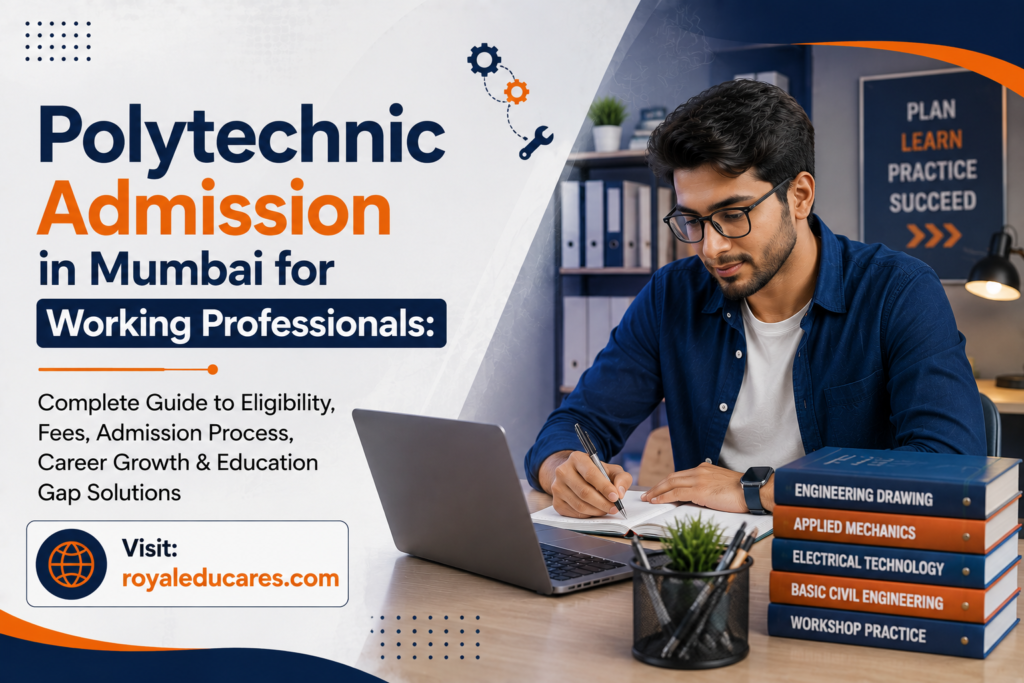
Polytechnic Admission in Mumbai for Working Professionals: Complete Guide to Eligibility, Fees, Admission Process, Career Growth & Education Gap Solutions
Introduction
Build a successful technical career through the right Polytechnic admission guidance. Explore eligibility, admission process, fees, career opportunities, and education gap solutions designed for ambitious students and professionals.
Accreditation & Approvals
UGC-DEB APPROVED
AICTE APPROVED
AIU APPROVED
NAAC +++ ACCREDITED

COBSE BOARDS
PHARMACY COUNCIL OF INDIA
BAR COUNCIL OF INDIA
WORLD EDUCATION SERVICES
MHRD

Get Free Career Counseling
Students looking for Distance Graduation in Mumbai and flexible educational guidance can explore available academic options, eligibility details, and admission support through https://royaleducares.com/distance-graduation-in-mumbai/.
If you are interested in technical diploma programs, you can learn more about the admission process and available guidance by visiting https://royaleducares.com/polytechnic-admission-in-mumbai/.
For complete admission assistance, educational counselling, and information about undergraduate, diploma, postgraduate, and professional programs, visit the official website at https://royaleducares.com/.
Polytechnic Admission in Mumbai: A Smart Path to Technical Career Success
India’s industrial, manufacturing, construction, automation, and technology sectors continue to create opportunities for skilled professionals. Companies increasingly seek candidates with practical technical knowledge, industry-relevant skills, and recognized educational qualifications.
A Polytechnic diploma has become one of the most popular technical education choices for students who want to develop job-ready skills in engineering, technology, design, electronics, civil engineering, mechanical engineering, computer engineering, electrical engineering, and other technical fields.
Many students and working professionals search online for Polytechnic Admission in Mumbai, Polytechnic for Working Professionals, Distance Polytechnic Guidance, Diploma Admission, and Education Gap Solutions because they want to continue their education while balancing personal and professional responsibilities.
This guide explains everything students commonly search before taking admission, including eligibility, admission process, fees, documents, branches, career opportunities, salary potential, technical skills, and future educational options.
Why Polytechnic Education Is Becoming More Popular
Technical education has gained significant importance due to the growing demand for skilled professionals across industries.
Every month, students search for topics such as:
- Polytechnic Admission Mumbai
- Polytechnic Course
- Polytechnic Diploma
- Polytechnic Fees
- Polytechnic Admission Process
- Polytechnic Eligibility
- Diploma Course After 10th
- Diploma Course After 12th
- Best Polytechnic Course
- Polytechnic for Working Professionals
- Technical Diploma Mumbai
- Engineering Diploma
- Polytechnic Career Scope
- Polytechnic Salary
- Diploma Admission After Education Gap
These searches reflect the increasing interest in career-oriented technical education.
Why Students Choose Polytechnic Courses
Unlike many traditional academic programs, Polytechnic education emphasizes both theoretical understanding and practical learning.
Students receive exposure to:
- Technical Concepts
- Laboratory Training
- Workshop Practice
- Industrial Applications
- Engineering Fundamentals
- Problem Solving
- Practical Projects
- Technical Communication
This practical approach helps students prepare for industry requirements from an early stage.
Who Should Read This Guide?
This guide is designed for anyone searching for reliable information about Polytechnic admission in Mumbai.
It is especially useful for:
- Students after Class 10
- Students after Class 12
- Working professionals
- Technical job seekers
- Students with an education gap
- Individuals planning skill development
- Engineering aspirants
- Diploma candidates
- Career changers
- Professionals seeking technical qualifications
Whether you are beginning your educational journey or planning to continue after several years, understanding your available options is an important first step.
Why Working Professionals Consider Polytechnic Education
Many professionals begin working immediately after school or college due to financial responsibilities or family commitments.
Later, they realize that upgrading their technical qualifications may support:
- Career advancement
- Promotion opportunities
- Technical expertise
- Better employment prospects
- Professional confidence
- Skill enhancement
This is one reason why searches for Polytechnic for Working Professionals continue to increase.
Education Gap Should Not Stop Your Learning Journey
One of the most common concerns among students is whether an education gap affects future learning opportunities.
Students often ask:
- Can I pursue Polytechnic after a long gap?
- Is an education gap accepted?
- Can working professionals continue technical education?
- Can I study while working?
The answer depends on the student’s educational background, previous qualifications, eligibility, and applicable academic guidelines—not simply the duration of the gap.
Many students return to education after taking breaks because of:
- Employment
- Family responsibilities
- Business commitments
- Financial challenges
- Medical reasons
- Relocation
- Competitive examination preparation
Understanding your eligibility through proper educational guidance is always the best approach.
Benefits of Polytechnic Education
Polytechnic programs are designed to help students develop practical technical abilities that are useful across multiple industries.
Some important benefits include:
Practical Learning
Students gain exposure to workshops, laboratories, industrial training, technical projects, and practical applications.
Industry-Oriented Skills
Polytechnic courses focus on developing job-ready technical competencies required by employers.
Career Opportunities
Technical diploma holders may explore opportunities in manufacturing, infrastructure, electrical systems, software support, automation, telecommunications, and many other industries.
Higher Education Options
After completing a Polytechnic diploma, eligible students may explore higher education opportunities according to applicable admission requirements.
Skill Development
Students strengthen technical, analytical, and problem-solving skills that remain valuable throughout their careers.
Why Technical Skills Matter Today
Modern industries depend heavily on technology and skilled professionals.
Employers increasingly value candidates who understand:
- Technical Drawing
- Engineering Principles
- Industrial Safety
- Quality Control
- Machine Operations
- Computer Applications
- Technical Documentation
- Equipment Maintenance
- Automation
- Digital Technologies
Developing these skills improves employability across different sectors.
Popular Polytechnic Branches
Students frequently search for the best Polytechnic branch before applying.
Popular branches include:
- Mechanical Engineering
- Civil Engineering
- Electrical Engineering
- Computer Engineering
- Electronics Engineering
- Automobile Engineering
- Information Technology
- Artificial Intelligence
- Robotics
- Mechatronics
- Chemical Engineering
- Architecture Assistantship
The most suitable branch depends on your interests, strengths, and long-term career goals.
Why Polytechnic Is a Good Career Choice
A Polytechnic diploma combines classroom learning with practical industry exposure.
Students benefit from:
- Technical knowledge
- Practical skills
- Workshop experience
- Industrial exposure
- Project-based learning
- Problem-solving ability
- Team collaboration
- Professional development
These qualities are valued in both private industries and public sector organizations.
Common Questions Students Search Before Polytechnic Admission
Before beginning the admission process, students frequently search:
- Which Polytechnic course is best?
- Can I join Polytechnic after 10th?
- Can I join Polytechnic after 12th?
- Is Polytechnic good for jobs?
- What are Polytechnic course fees?
- Which Polytechnic branch has the best scope?
- Can working professionals pursue Polytechnic?
- Can I study after an education gap?
- What documents are required for Polytechnic admission?
- What are the career opportunities after Polytechnic?
Understanding these questions helps students make informed educational decisions instead of relying on incomplete or unofficial information.
The following sections of this guide will explain eligibility, admission process, required documents, fees, branches, syllabus, technical skills, career opportunities, salary prospects, higher education options, and frequently asked questions in detail to help students confidently plan their Polytechnic education.
Eligibility for Polytechnic Admission in Mumbai
Before applying for any Polytechnic program, students should understand the eligibility requirements, admission process, documentation, and available academic pathways. Every year, thousands of students search for Polytechnic Admission in Mumbai, Diploma Admission, Polytechnic for Working Professionals, and Distance Graduation in Mumbai to continue their education and build technical skills.
Understanding your eligibility before applying helps you choose the right course according to your educational background and career goals.
Who Can Apply for Polytechnic Admission?
Polytechnic programs are designed for students who want practical technical education and industry-oriented skills. Depending on the course and admission requirements, Polytechnic education may be suitable for:
Students after Class 10
Students after Class 12
Working professionals
Technical job seekers
Individuals with an education gap
Candidates interested in engineering and technology
Professionals planning to upgrade their technical knowledge
Students preparing for higher technical education
Eligibility requirements may vary depending on the institution and academic guidelines, so students should always verify the latest admission criteria.
Can You Pursue Polytechnic After an Education Gap?
One of the most searched questions is:
Can I take Polytechnic admission after a long education gap?
Is Polytechnic available for working professionals?
Can I continue technical education after several years?
Does an education gap affect Polytechnic admission?
An education gap alone does not automatically decide eligibility. Admission depends on your previous educational qualifications, supporting documents, and the applicable academic requirements.
Many students return to education after a gap because of:
Employment
Family responsibilities
Business commitments
Financial challenges
Medical reasons
Relocation
Competitive examination preparation
Students should seek proper educational counselling before making admission decisions.
Why Working Professionals Choose Polytechnic
Technical industries continue to evolve with automation, digital manufacturing, artificial intelligence, robotics, and smart technologies.
Many working professionals choose Polytechnic education to:
Improve technical knowledge
Upgrade practical skills
Enhance career opportunities
Prepare for promotions
Increase industry knowledge
Build confidence for technical roles
Continuous learning helps professionals remain competitive in today’s rapidly changing job market.
Educational Background Assessment
Before beginning the admission process, students should understand how their educational profile aligns with the available academic options.
During counselling, guidance generally includes reviewing:
Previous educational qualifications
Academic records
Education gap (if applicable)
Career objectives
Eligibility requirements
Preferred Polytechnic branch
A proper assessment helps students choose a suitable technical pathway.
Documents Commonly Required for Polytechnic Admission
Document requirements may vary depending on the admission process and institutional guidelines. However, students are generally advised to prepare the following documents in advance.
Academic Documents
Class 10 Mark Sheet
Class 12 Mark Sheet (if applicable)
School Leaving Certificate
Transfer Certificate (if required)
Migration Certificate (where applicable)
Previous academic records
Identity Proof
Students may be required to submit:
Aadhaar Card
PAN Card (where applicable)
Passport
Driving Licence
Voter ID
Address Proof
Common address proof documents include:
Aadhaar Card
Passport
Electricity Bill
Driving Licence
Voter ID
Passport-Size Photographs
Recent passport-size photographs are generally required during the admission process.
Step-by-Step Polytechnic Admission Process
Students frequently search online for:
How to apply for Polytechnic in Mumbai?
Polytechnic admission process
Diploma admission guide
Polytechnic admission for working professionals
Although the process may vary depending on the institution and course, the general admission process usually includes the following stages.
Step 1: Educational Counselling
The first step is understanding the student’s educational history and career objectives.
Counselling generally covers:
Academic background
Career goals
Preferred branch
Education gap
Eligibility requirements
Step 2: Eligibility Verification
After reviewing the student’s educational qualifications, eligibility is assessed according to the applicable academic guidelines.
This helps students understand the most suitable admission pathway before proceeding further.
Step 3: Document Verification
Students submit the necessary academic and identity documents for verification.
Providing accurate and complete documentation helps ensure a smoother admission process.
Step 4: Admission Guidance
After verification, students receive guidance regarding:
Admission formalities
Documentation
Course structure
Branch selection
Academic process
Future educational planning
Step 5: Complete Admission Formalities
Eligible candidates can proceed with the admission process after completing all required documentation and institutional formalities.
Why Choosing the Right Polytechnic Branch Matters
One of the most important decisions during admission is selecting the right branch.
Students should consider:
Personal interests
Technical aptitude
Future career goals
Industry demand
Higher education plans
Employment opportunities
Choosing a branch based on long-term goals often leads to better career satisfaction.
Popular Polytechnic Branches
Students searching for best Polytechnic course commonly explore the following options:
Mechanical Engineering
Civil Engineering
Electrical Engineering
Computer Engineering
Information Technology
Electronics Engineering
Automobile Engineering
Robotics
Artificial Intelligence
Mechatronics
Chemical Engineering
Architecture Assistantship
Each branch develops different technical skills suited to specific industries.
Benefits of Polytechnic Education
Technical diploma programs provide several long-term advantages.
Practical Training
Students receive exposure to laboratories, workshops, industrial visits, and project-based learning.
Industry-Relevant Skills
The curriculum focuses on practical competencies required by employers.
Career Readiness
Students develop technical knowledge that supports entry into various engineering and industrial sectors.
Foundation for Higher Education
Eligible diploma holders may pursue further technical education according to applicable admission requirements.
Skills Developed During Polytechnic
Polytechnic education focuses on building practical and professional competencies such as:
Technical Problem Solving
Engineering Drawing
Machine Operations
Computer Applications
Workshop Practice
Industrial Safety
Technical Documentation
Equipment Maintenance
Teamwork
Communication Skills
These skills remain valuable across manufacturing, infrastructure, technology, and service industries.
Common Mistakes Students Should Avoid Before Admission
Students can improve their admission experience by avoiding common mistakes such as:
Applying without checking eligibility
Choosing a branch without career planning
Ignoring required documents
Depending on unofficial information
Delaying admission decisions
Not seeking educational counselling
Proper planning helps students make informed academic choices.
What You Will Learn in the Next Section
The next section explains Polytechnic course duration, fees, syllabus, practical training, major engineering branches, laboratory work, technical subjects, industrial exposure, and the essential skills students develop throughout their Polytechnic education.
Polytechnic Course Details: Fees, Duration, Syllabus, Engineering Branches & Practical Skills
Before taking admission, students should understand how a Polytechnic program is structured, what subjects they will study, the practical skills they will develop, and the career opportunities each engineering branch offers.
Many students search for Polytechnic Admission in Mumbai, Polytechnic Course Details, Polytechnic Fees, Diploma Course Duration, Best Polytechnic Branch, and Polytechnic Syllabus before making their final decision. Understanding these topics helps students choose a course that aligns with their interests and future career goals.
Polytechnic Course Duration
One of the most searched questions is:
How many years is a Polytechnic course?
What is the duration of a Polytechnic diploma?
Can working professionals pursue Polytechnic?
Can I continue Polytechnic after an education gap?
The duration depends on the specific course, entry qualification, admission pathway, and applicable academic guidelines. Students should always verify the latest course structure and eligibility criteria before applying.
Proper planning helps students balance education, skill development, and career goals effectively.
Understanding the Polytechnic Curriculum
Polytechnic education focuses on developing practical technical knowledge alongside theoretical concepts.
Unlike programs that emphasize classroom learning alone, Polytechnic courses generally combine:
Classroom lectures
Laboratory sessions
Workshop training
Technical assignments
Industrial exposure
Practical projects
Skill-based learning
This balanced approach helps students understand how engineering concepts are applied in real-world industries.
Core Engineering Subjects
Although subjects vary according to the selected branch, most Polytechnic programs include foundational engineering topics.
Engineering Mathematics
Engineering Mathematics develops logical thinking and analytical abilities used in technical problem-solving.
Students commonly study:
Algebra
Trigonometry
Calculus
Statistics
Applied Mathematics
These concepts support higher-level engineering subjects.
Engineering Physics
Physics helps students understand scientific principles used in mechanical systems, electronics, electrical engineering, and industrial technology.
Topics often include:
Mechanics
Heat
Electricity
Optics
Modern Physics
Engineering Chemistry
Engineering Chemistry introduces materials, industrial chemicals, corrosion prevention, and quality control concepts that are useful across engineering industries.
Engineering Drawing
Engineering Drawing is one of the most important technical subjects.
Students learn:
Technical Drawing
Dimensioning
Orthographic Projection
Isometric Views
Engineering Graphics
This subject improves visualization and design interpretation skills.
Workshop Practice
Workshop sessions provide practical exposure to engineering tools and equipment.
Students may gain experience in:
Welding
Fitting
Carpentry
Machine Operations
Sheet Metal Work
Electrical Workshop
Safety Procedures
Hands-on learning helps build confidence before entering industry.
Popular Polytechnic Engineering Branches
Choosing the right branch is one of the most important decisions during admission.
Below are some of the most popular Polytechnic specializations.
Mechanical Engineering
Mechanical Engineering remains one of the most sought-after Polytechnic branches.
Students learn about:
Manufacturing Processes
Machine Design
Thermodynamics
Industrial Production
Maintenance Engineering
CAD Basics
Career opportunities exist in manufacturing, automotive, heavy engineering, and production industries.
Civil Engineering
Civil Engineering focuses on infrastructure development.
Subjects commonly include:
Building Construction
Surveying
Structural Engineering
Estimation
Concrete Technology
Transportation Engineering
Graduates may work in construction companies, infrastructure projects, consulting firms, and government departments.
Electrical Engineering
Electrical Engineering prepares students for careers involving electrical systems and power distribution.
Students study:
Electrical Machines
Power Systems
Wiring
Control Systems
Electrical Measurements
Industrial Automation
This branch offers opportunities in manufacturing, energy, maintenance, and utilities.
Computer Engineering
Computer Engineering is among the highest searched Polytechnic courses due to increasing demand in the IT sector.
Students generally learn:
Programming
Computer Hardware
Networking
Database Basics
Operating Systems
Software Fundamentals
This branch provides a foundation for careers in information technology and software support.
Information Technology
Information Technology focuses on modern computing and digital technologies.
Topics often include:
Programming Languages
Database Management
Web Development
Networking
Cybersecurity Basics
Cloud Computing Fundamentals
IT graduates may pursue careers in software companies, support services, and digital businesses.
Electronics Engineering
Electronics Engineering develops knowledge of electronic circuits and communication systems.
Students study:
Electronic Devices
Digital Electronics
Microprocessors
Embedded Systems
Communication Technology
Career opportunities exist in electronics manufacturing, automation, telecommunications, and consumer electronics.
Automobile Engineering
Automobile Engineering focuses on vehicle technology and maintenance.
Subjects include:
Engine Systems
Automobile Design
Vehicle Maintenance
Transmission Systems
Automotive Electronics
Graduates often work in automobile manufacturing and service industries.
Practical Laboratory Training
One of the biggest advantages of Polytechnic education is practical exposure.
Students regularly participate in:
Engineering Laboratories
Computer Labs
Electrical Labs
Mechanical Workshops
Electronics Labs
CAD Laboratories
Programming Labs
Practical learning strengthens technical understanding and industry readiness.
Industrial Visits and Practical Exposure
Many Polytechnic programs include industrial exposure to help students understand professional work environments.
Industrial learning may involve:
Factory Visits
Manufacturing Plants
Construction Sites
Power Stations
Software Companies
Industrial Workshops
These experiences connect classroom knowledge with real-world engineering practices.
Technical Skills Students Develop
Throughout their Polytechnic education, students build a variety of technical competencies.
Important skills include:
Technical Problem Solving
Engineering Drawing
Equipment Handling
Machine Operations
Programming Basics
Computer Applications
Industrial Safety
Technical Documentation
Quality Control
Team Collaboration
These practical skills remain valuable across engineering and industrial sectors.
Software and Technical Tools
Depending on the branch, students may become familiar with tools such as:
AutoCAD
SolidWorks
CATIA
MATLAB
PLC Basics
Tally (for certain technical administration roles)
MS Excel
Programming IDEs
Computer-Aided Design Software
Learning industry-standard tools can improve technical proficiency and employability.
Project-Based Learning
Project work helps students apply engineering concepts to practical situations.
Examples of Polytechnic projects include:
Mini Engineering Projects
Machine Design Models
Smart Home Systems
Robotics Projects
Electrical Circuits
Website Development
Mobile Applications
IoT-Based Solutions
Automation Models
Projects also strengthen problem-solving, teamwork, and presentation skills.
Why Practical Skills Matter More Than Theory
Employers increasingly value candidates who can apply technical knowledge in real work environments.
Students should continuously improve:
Practical workshop skills
Technical communication
Project documentation
Analytical thinking
Computer proficiency
Teamwork
Time management
Safety awareness
Developing these abilities alongside classroom learning improves career readiness.
Common Questions Students Search Before Choosing Polytechnic
Before selecting a Polytechnic course, students frequently search:
Which Polytechnic branch has the highest salary?
Is Polytechnic better than a regular degree?
Which engineering branch has the best scope?
Does Polytechnic include practical training?
Which Polytechnic course is best for government jobs?
Is Computer Engineering better than Mechanical Engineering?
Can I pursue higher education after Polytechnic?
What technical skills should I learn during Polytechnic?
Understanding these questions helps students choose a branch that matches their interests, strengths, and future career plans.
What You’ll Learn in the Next Section
The next section explains career opportunities after Polytechnic, salary prospects, private sector jobs, government job opportunities, higher education pathways, industry demand, entrepreneurship, professional certifications, and the fastest-growing career options for Polytechnic diploma holders.
Career Opportunities After Polytechnic: Jobs, Salary, Government Careers, Higher Education & Future Scope
A Polytechnic diploma is designed to develop practical technical skills that can support careers across engineering, manufacturing, construction, information technology, automation, electronics, and many other industries. As India’s industrial and digital sectors continue to expand, skilled diploma holders remain in demand for technical and operational roles.
Students searching for Polytechnic Admission in Mumbai, Polytechnic Career Scope, Diploma Jobs, Government Jobs After Polytechnic, and Best Career After Polytechnic often want to understand what opportunities are available after completing their diploma.
This section explains the major career options, industries, technical roles, higher education pathways, certifications, and professional skills that can help Polytechnic graduates build long-term careers.
Why Polytechnic Has Strong Career Scope
Technical industries require professionals who can combine theoretical understanding with practical skills.
Unlike many academic programs, Polytechnic education focuses on:
Practical Engineering Knowledge
Workshop Experience
Laboratory Training
Industrial Applications
Technical Problem Solving
Equipment Handling
Project-Based Learning
These abilities help students become industry-ready and support employment across multiple engineering sectors.
Career Scope After Polytechnic
One of the most searched questions is:
What can I do after Polytechnic?
Is Polytechnic good for jobs?
What is the career scope after Polytechnic?
Which Polytechnic branch has the best future?
The answer depends on several factors, including your chosen branch, technical skills, practical experience, certifications, communication abilities, and career interests.
Polytechnic graduates may explore opportunities in:
Manufacturing Industries
Construction Companies
Information Technology
Automobile Industry
Electrical Utilities
Electronics Manufacturing
Telecommunications
Infrastructure Projects
Renewable Energy
Railways
Oil and Gas
Government Organizations
Public Sector Undertakings (PSUs)
Private Engineering Companies
Startups
The combination of technical knowledge and continuous skill development plays an important role in long-term career growth.
Career Opportunities by Engineering Branch
Mechanical Engineering Careers
Mechanical Engineering diploma holders may work in industries such as:
Manufacturing
Production
Industrial Maintenance
Heavy Engineering
Automotive Manufacturing
Machine Design
Quality Control
CNC Operations
Mechanical engineers contribute to designing, producing, maintaining, and improving machines and industrial equipment.
Civil Engineering Careers
Civil Engineering diploma holders often work on infrastructure and construction projects.
Career opportunities include:
Site Supervisor
Civil Technician
Survey Assistant
Construction Coordinator
Quality Inspector
CAD Technician
Project Support Executive
Industries include construction companies, infrastructure firms, highways, bridges, residential projects, and government departments.
Electrical Engineering Careers
Electrical diploma holders may work in:
Electrical Maintenance
Industrial Automation
Power Distribution
Renewable Energy
Electrical Installation
Manufacturing Plants
Utility Companies
Electrical professionals are essential in industries that depend on power systems and industrial machinery.
Computer Engineering Careers
Computer Engineering is one of the fastest-growing Polytechnic branches.
Career options include:
Computer Support Technician
Hardware Engineer
Network Support Executive
Technical Support Engineer
Junior Software Developer
IT Support Specialist
System Administrator
Students can continue improving programming and networking skills to expand career opportunities.
Information Technology Careers
Information Technology graduates may work in:
IT Support
Software Services
Database Administration
Web Development
Network Administration
Technical Help Desk
Cloud Support
Digital Operations
The growing demand for technology professionals continues to create opportunities across industries.
Electronics Engineering Careers
Electronics diploma holders commonly pursue roles in:
Electronics Manufacturing
Embedded Systems
Consumer Electronics
Automation
Telecommunications
Instrumentation
Industrial Electronics
Practical laboratory experience supports employment in both manufacturing and service industries.
Automobile Engineering Careers
The automobile industry continues to evolve with electric vehicles, automation, and smart technologies.
Career opportunities include:
Automobile Technician
Service Engineer
Workshop Supervisor
Vehicle Maintenance Executive
Production Technician
Quality Control Technician
Continuous learning is particularly valuable as automotive technologies advance.
Government Jobs After Polytechnic
A common student question is:
Can Polytechnic students apply for government jobs?
Many government departments recruit diploma holders for technical positions, subject to the eligibility criteria specified in official recruitment notifications.
Potential sectors include:
Railways
Public Works Departments
State Electricity Boards
Municipal Corporations
Public Sector Undertakings (PSUs)
Defence Organizations
Irrigation Departments
Transport Departments
Technical Education Institutions
Candidates should always verify the latest recruitment rules and educational requirements before applying.
Private Sector Opportunities
Private companies recruit Polytechnic diploma holders across a wide range of industries.
Examples include:
Manufacturing Companies
Engineering Firms
Construction Companies
IT Service Providers
Automobile Manufacturers
Infrastructure Companies
Industrial Plants
Electronics Companies
Renewable Energy Organizations
Employers generally value practical skills, discipline, and problem-solving abilities.
Higher Education After Polytechnic
Many students choose to continue their education after completing a diploma.
Depending on eligibility and institutional requirements, further education options may include:
Engineering Degree Programs
Distance Graduation
Undergraduate Programs
Professional Certifications
Skill Development Courses
Industry-Specific Technical Training
Continuing education can help students expand their knowledge and support long-term career growth.
Professional Certifications That Add Value
Alongside a Polytechnic diploma, students may consider certifications that match their chosen field.
Popular options include:
AutoCAD
SolidWorks
CATIA
PLC Programming
Industrial Automation
CNC Programming
AWS Cloud Fundamentals
Networking Certifications
Electrical Safety
Quality Management
Project Management Basics
Computer-Aided Design (CAD)
Choosing certifications based on career goals can strengthen a student’s technical profile.
Entrepreneurship After Polytechnic
Many diploma holders decide to start their own businesses instead of seeking traditional employment.
Possible business ideas include:
Electrical Services
Mechanical Workshops
Automobile Repair Centers
Construction Contracting
CAD Design Services
Computer Repair Centers
IT Support Services
Industrial Maintenance Services
Fabrication Units
Technical Consultancy
Entrepreneurship allows technically skilled professionals to apply their knowledge independently.
Skills Employers Expect from Polytechnic Graduates
Technical knowledge alone is not enough in today’s competitive job market.
Employers also look for:
Technical Skills
Engineering Drawing
Machine Operations
Equipment Maintenance
CAD Software
Technical Documentation
Industrial Safety
Computer Applications
Quality Control
Professional Skills
Communication
Teamwork
Leadership
Adaptability
Time Management
Problem Solving
Critical Thinking
Workplace Ethics
Students who continuously improve both technical and professional skills often have stronger career prospects.
Common Mistakes Polytechnic Students Should Avoid
Many students unintentionally slow their career growth by making avoidable mistakes.
Some common examples include:
Ignoring practical training
Not participating in industrial visits
Avoiding internships
Depending only on classroom learning
Skipping technical certifications
Neglecting communication skills
Delaying career planning
Failing to build technical projects
Practical experience and continuous learning often complement academic qualifications.
What’s Next?
The next section compares Polytechnic with other educational pathways, explains common myths and misconceptions, provides career planning guidance for students and working professionals, discusses in-demand technical skills, and shares expert recommendations for building a successful long-term engineering career.
Polytechnic vs Other Career Options: Common Myths, Career Planning, Technical Skills & Expert Guidance
Selecting the right technical course is one of the most important decisions in a student’s educational journey. Before taking admission, many students compare Polytechnic with other diploma and degree programs, evaluate career opportunities, and try to understand which option best matches their long-term goals.
If you are searching for Polytechnic Admission in Mumbai, Distance Graduation in Mumbai, Polytechnic for Working Professionals, Best Polytechnic Course, or Polytechnic After Education Gap, this section answers many of the questions students commonly ask before making an informed decision.
Why Career Planning Is Important Before Choosing Polytechnic
Many students choose a course based only on popularity or advice from friends. However, selecting the right Polytechnic branch should depend on:
Personal interests
Technical aptitude
Career goals
Industry demand
Future education plans
Long-term professional growth
A well-planned decision often leads to better learning outcomes and career satisfaction.
Polytechnic vs Traditional Degree Programs
One of the most searched questions is:
Is Polytechnic better than a regular degree?
Should I choose Polytechnic or graduation?
Which option has better career opportunities?
There is no single answer because each student’s situation is different.
Polytechnic focuses primarily on:
Practical technical training
Industry-oriented learning
Laboratory work
Workshop experience
Engineering fundamentals
Job-ready technical skills
Traditional degree programs generally emphasize broader academic knowledge along with theoretical concepts.
The most suitable option depends on your educational background, career objectives, and preferred learning pathway.
Polytechnic vs ITI
Students also compare Polytechnic with Industrial Training Institute (ITI) programs.
Polytechnic
Engineering-oriented education
Technical theory and practical learning
Multiple engineering branches
Project-based learning
Strong foundation for higher technical education
ITI
Trade-specific skill development
Vocational training
Practical workshop focus
Shorter technical programs in many trades
Both options have value, but students should choose according to their career aspirations.
Common Myths About Polytechnic
Many misconceptions discourage students from exploring technical education.
Myth 1: Polytechnic Is Only for Students After Class 10
Reality: Depending on eligibility and course requirements, Polytechnic programs may also be explored by students after Class 12 and by individuals seeking technical skill development.
Myth 2: Polytechnic Has Limited Career Scope
Reality: Diploma holders work in manufacturing, construction, IT, electronics, automobile, energy, telecommunications, infrastructure, automation, and many other industries.
Myth 3: Practical Skills Are Less Important Than Degrees
Reality: Employers increasingly value candidates who can solve technical problems, operate equipment, and apply engineering concepts in real work environments.
Myth 4: Education Gap Ends Career Opportunities
Reality: An education gap alone does not automatically determine eligibility. Academic qualifications, documentation, and applicable admission guidelines are more important factors.
Myth 5: Polytechnic Students Cannot Continue Higher Education
Reality: Eligible diploma holders may pursue further education according to institutional and academic requirements.
Choosing the Right Polytechnic Branch
Students often search:
Which Polytechnic branch has the highest salary?
Which branch has the best future?
Which engineering diploma is most in demand?
There is no universally “best” branch.
Popular branches include:
Mechanical Engineering
Civil Engineering
Electrical Engineering
Computer Engineering
Information Technology
Electronics Engineering
Automobile Engineering
Artificial Intelligence
Robotics
Mechatronics
Choose a branch that matches both your interests and future industry demand rather than following trends alone.
Essential Technical Skills Every Polytechnic Student Should Develop
Technical education is most valuable when students continuously improve their practical abilities.
Key technical skills include:
Engineering Drawing
AutoCAD
Programming Basics
PLC Fundamentals
Industrial Safety
Quality Control
Computer Applications
Equipment Maintenance
Technical Documentation
Workshop Skills
Students who regularly practice these skills often perform better during internships and employment.
Soft Skills That Support Career Growth
Technical expertise should be complemented by professional skills.
Important soft skills include:
Communication
Teamwork
Leadership
Adaptability
Time Management
Critical Thinking
Analytical Skills
Professional Ethics
Customer Interaction
Presentation Skills
These qualities help students succeed in technical as well as supervisory roles.
Tips for Working Professionals
Many working professionals return to education to improve technical qualifications while continuing their careers.
Useful strategies include:
Plan a weekly study schedule.
Organize your learning goals.
Improve technical skills consistently.
Continue learning new technologies.
Build practical projects.
Maintain work-life-study balance.
Stay updated with industry developments.
Consistent learning is often more effective than occasional intensive study.
Building a Strong Technical Portfolio
Employers increasingly evaluate practical work alongside educational qualifications.
Students should build a portfolio that may include:
Engineering projects
CAD designs
Technical reports
Workshop assignments
Programming projects
Automation models
Industrial training experience
Internship reports
A well-organized portfolio demonstrates practical capability and commitment to learning.
Interview Preparation for Polytechnic Students
Technical interviews generally assess both engineering knowledge and communication skills.
Technical Preparation
Students should revise:
Engineering fundamentals
Workshop concepts
Technical drawings
Branch-specific subjects
Industrial safety
Equipment handling
Practical problem-solving
HR Preparation
Candidates should prepare to discuss:
Self-introduction
Career objectives
Technical projects
Internship experiences
Strengths and areas for improvement
Teamwork examples
Confidence and clarity during interviews can leave a positive impression.
Future Technologies Worth Learning
Technology continues to transform engineering industries.
Students may benefit from learning about:
Artificial Intelligence
Robotics
Industrial Automation
Internet of Things (IoT)
Electric Vehicles (EV)
Renewable Energy
Smart Manufacturing
3D Printing
Computer-Aided Design (CAD)
Industry 4.0
Awareness of these emerging technologies supports long-term career development.
Common Admission and Career Mistakes to Avoid
Before and during Polytechnic education, students should avoid:
Choosing a branch without career planning
Ignoring practical training
Not participating in internships
Depending only on theoretical knowledge
Skipping technical certifications
Avoiding communication skill development
Delaying career preparation
Relying on unofficial admission information
Thoughtful planning and continuous skill development can significantly improve future opportunities.
What’s Next?
The next section will provide a complete student success roadmap, expert career guidance, resume preparation tips, interview strategies, industry trends, professional development advice, and final recommendations before moving to the 50+ SEO-focused Frequently Asked Questions (FAQs) that cover the most searched queries related to Polytechnic Admission in Mumbai.
Expert Career Guidance for Polytechnic Students: Success Roadmap, Resume Tips, Interview Preparation & Future Growth
A Polytechnic diploma is more than a technical qualification. It provides a strong foundation for building practical engineering skills, improving employability, and creating opportunities across multiple industries. However, long-term success depends on continuous learning, technical expertise, professional attitude, and proper career planning.
Whether you are a student after Class 10, after Class 12, a working professional, or someone returning to education after an education gap, having a clear roadmap can help you make informed decisions throughout your educational journey.
Why Career Planning Should Start Early
Many students think about jobs only after completing their diploma. In reality, career planning should begin from the first semester.
Early planning helps students:
Choose the right engineering branch
Develop industry-relevant skills
Build practical experience
Improve communication abilities
Prepare for technical interviews
Explore higher education opportunities
Create long-term career goals
Students who plan early are generally better prepared for future opportunities.
Step-by-Step Polytechnic Student Roadmap
Following a structured roadmap can help students stay focused throughout their diploma program.
Step 1: Understand Your Career Goal
Before choosing a specialization, ask yourself:
Which engineering field interests me?
Do I enjoy practical technical work?
Do I want a private-sector career?
Am I interested in government opportunities?
Do I plan to pursue higher education?
Your answers can help you choose the most suitable direction.
Step 2: Build Strong Technical Fundamentals
Every engineering branch requires a solid understanding of basic technical concepts.
Students should focus on:
Engineering Mathematics
Basic Science
Engineering Drawing
Workshop Practice
Computer Fundamentals
Branch-Specific Subjects
Strong fundamentals make advanced learning much easier.
Step 3: Improve Practical Skills
Employers value candidates who can apply knowledge in real situations.
Practice regularly in:
Engineering workshops
Laboratory sessions
CAD software
Machine handling
Technical documentation
Industrial safety
Equipment maintenance
Hands-on experience improves confidence and technical ability.
Step 4: Learn Digital Skills
Modern industries increasingly rely on digital technologies.
Useful skills include:
MS Excel
AutoCAD
SolidWorks
Computer Applications
Basic Programming
Internet Research
Technical Documentation
Digital Communication
Digital literacy is valuable across nearly every engineering sector.
Step 5: Participate in Technical Projects
Projects allow students to apply classroom knowledge.
Examples include:
Mechanical models
Electrical circuits
Mini automation systems
CAD designs
Robotics demonstrations
IoT-based projects
Technical presentations
Projects also improve teamwork and problem-solving skills.
Resume Tips for Polytechnic Students
A professional resume should clearly present your qualifications and technical abilities.
Recommended sections include:
Career Objective
Educational Qualifications
Technical Skills
Engineering Branch
Software Knowledge
Academic Projects
Industrial Training
Internship Experience
Certifications
Achievements
Languages Known
Keep the resume concise, accurate, and updated as you gain new skills.
Interview Preparation Tips
Technical interviews usually assess both engineering knowledge and communication.
Prepare Technical Subjects
Revise topics related to:
Core engineering concepts
Workshop practice
Technical drawings
Industrial safety
Branch-specific subjects
Practical applications
Prepare HR Questions
Practice answers for common questions such as:
Tell me about yourself.
Why did you choose this engineering branch?
What are your strengths?
Describe a technical project.
Where do you see yourself in five years?
Why should we hire you?
Confident and honest responses leave a positive impression.
Importance of Industrial Training
Industrial exposure helps students understand how engineering principles are used in real workplaces.
Benefits include:
Practical experience
Workplace discipline
Technical confidence
Industry knowledge
Better understanding of equipment
Professional networking
Students should actively participate in every available industrial training opportunity.
Certifications That Can Strengthen Your Profile
Additional certifications can improve technical expertise and career prospects.
Popular certification areas include:
AutoCAD
SolidWorks
PLC Programming
CNC Programming
Industrial Automation
Electrical Safety
Quality Management
Computer Hardware
Networking Basics
Project Management Fundamentals
Select certifications that align with your chosen engineering branch and career goals.
Developing Professional Skills
Success in engineering careers depends on more than technical knowledge.
Students should continuously improve:
Communication Skills
Leadership
Teamwork
Time Management
Adaptability
Critical Thinking
Professional Ethics
Customer Interaction
Analytical Skills
These abilities support career growth in both technical and supervisory roles.
Emerging Engineering Trends
Engineering industries continue to evolve with new technologies.
Students should stay informed about:
Artificial Intelligence
Robotics
Electric Vehicles (EV)
Renewable Energy
Industrial Automation
Internet of Things (IoT)
Smart Manufacturing
3D Printing
Industry 4.0
Green Engineering
Keeping up with these trends can improve long-term employability.
Common Mistakes Polytechnic Students Should Avoid
Many students reduce their career opportunities by making avoidable mistakes.
Avoid:
Ignoring practical sessions
Skipping internships
Depending only on classroom learning
Avoiding software tools
Not improving communication skills
Delaying career planning
Ignoring industry trends
Failing to update technical knowledge
Continuous learning is one of the most valuable habits for engineering professionals.
Final Thoughts
A Polytechnic diploma can open the door to a wide range of opportunities in engineering, manufacturing, construction, information technology, electronics, automation, and infrastructure. Success, however, depends on combining technical education with practical experience, professional skills, and a commitment to lifelong learning.
Before starting your educational journey, understand your eligibility, organize your documents, choose the right engineering branch, and seek proper admission guidance. During your studies, focus on practical training, projects, internships, certifications, and communication skills.
With careful planning and consistent effort, Polytechnic education can become a strong foundation for career growth, higher education, entrepreneurship, and long-term success in the ever-evolving technical industry.
Frequently Asked Questions (FAQs) About Polytechnic Admission in Mumbai
1. What is a Polytechnic course?
A Polytechnic course is a technical diploma program designed to develop practical engineering knowledge, technical skills, and industry-oriented training in various engineering disciplines.
2. Who can apply for Polytechnic admission in Mumbai?
Eligibility depends on the course, educational qualifications, and institutional guidelines. Students should verify the latest admission requirements before applying.
3. Can I take Polytechnic admission after Class 10?
Many Polytechnic diploma programs are available for eligible students after completing Class 10, subject to the admission criteria of the institution.
4. Can I join Polytechnic after Class 12?
Yes. Depending on your educational background and eligibility, you may explore Polytechnic admission opportunities after Class 12.
5. Can working professionals pursue Polytechnic?
Yes. Many working professionals choose Polytechnic programs to improve their technical knowledge and enhance career opportunities.
6. Can I study Polytechnic after an education gap?
Yes. An education gap alone does not automatically determine eligibility. Previous academic qualifications and institutional guidelines are the key factors.
7. What documents are generally required for Polytechnic admission?
Commonly required documents include educational mark sheets, school leaving certificate, identity proof, address proof, passport-size photographs, and other documents specified during admission.
8. How can I apply for Polytechnic admission in Mumbai?
Students usually begin with educational counselling, eligibility verification, document submission, and completion of admission formalities according to institutional requirements.
9. Which Polytechnic branch is best?
There is no single best branch. Mechanical, Civil, Computer, Electrical, Electronics, Information Technology, and Automobile Engineering are among the popular choices. The right branch depends on your interests and career goals.
10. Is Polytechnic better than a regular degree?
Both have different objectives. Polytechnic focuses on practical technical skills, while degree programs generally provide broader academic education. The better option depends on your career plans.
11. What are the popular Polytechnic branches?
Popular branches include:
Mechanical Engineering
Civil Engineering
Electrical Engineering
Computer Engineering
Electronics Engineering
Information Technology
Automobile Engineering
Artificial Intelligence
Robotics
Mechatronics
12. Is Polytechnic good for engineering careers?
Yes. Polytechnic provides a strong technical foundation for careers across engineering and industrial sectors.
13. Can Polytechnic students get government jobs?
Many government organizations recruit diploma holders for technical positions according to official recruitment notifications and eligibility requirements.
14. Is Polytechnic useful for private jobs?
Yes. Manufacturing companies, construction firms, IT companies, automobile industries, electronics manufacturers, and infrastructure organizations recruit Polytechnic diploma holders.
15. What career opportunities are available after Polytechnic?
Career opportunities include technical roles in engineering, manufacturing, electrical systems, construction, information technology, automation, electronics, telecommunications, and maintenance.
16. Can I pursue higher education after Polytechnic?
Yes. Eligible students may continue higher education according to institutional admission requirements.
17. Is Polytechnic suitable for Computer Engineering?
Yes. Computer Engineering is one of the most popular Polytechnic branches due to growing demand in the technology sector.
18. Can Polytechnic students become Software Developers?
Students from Computer Engineering or Information Technology backgrounds can continue developing programming skills for software-related careers.
19. Is Polytechnic useful for Artificial Intelligence?
Students interested in AI can strengthen their knowledge through additional certifications, projects, and higher education.
20. Can Polytechnic students work in Cybersecurity?
Cybersecurity offers opportunities for technically skilled students who continue learning networking, security, and system administration concepts.
21. Which software should Polytechnic students learn?
Useful software includes AutoCAD, SolidWorks, CATIA, MS Excel, programming tools, PLC software, and other branch-specific applications.
22. Is AutoCAD important for Polytechnic students?
Yes. AutoCAD is widely used across Civil, Mechanical, Electrical, and Architecture-related engineering fields.
23. Are internships important after Polytechnic?
Yes. Internships provide practical industry experience, workplace exposure, and professional development.
24. What technical skills should Polytechnic students develop?
Students should improve engineering drawing, CAD, workshop practice, computer applications, technical documentation, problem-solving, and communication skills.
25. Is communication skill important for engineers?
Yes. Good communication supports teamwork, client interaction, technical reporting, and career growth.
26. Can Polytechnic students become entrepreneurs?
Yes. Many diploma holders establish businesses in technical services, fabrication, maintenance, automobile repair, construction, electrical work, and engineering consultancy.
27. Which engineering branch has good future scope?
Career opportunities depend on industry demand, technology trends, and personal interests rather than one specific branch.
28. Can Polytechnic students work abroad?
Career opportunities abroad depend on technical expertise, employer requirements, work experience, and immigration regulations.
29. Is practical training important?
Yes. Practical laboratory work, workshops, and industrial training are among the biggest strengths of Polytechnic education.
30. What professional skills should Polytechnic students improve?
Students should develop leadership, teamwork, communication, adaptability, analytical thinking, professionalism, and time management.
31. Is Industrial Training compulsory?
Industrial training requirements vary depending on the course structure and institutional guidelines.
32. What certifications can Polytechnic students pursue?
Students may consider AutoCAD, PLC, SolidWorks, Industrial Automation, CNC Programming, Networking, Electrical Safety, and Quality Management certifications.
33. Can Polytechnic students work in manufacturing companies?
Yes. Manufacturing remains one of the largest employment sectors for Polytechnic diploma holders.
34. Is Polytechnic useful for the automobile industry?
Yes. Automobile Engineering diploma holders often work in manufacturing, maintenance, servicing, and production-related roles.
35. Can Civil Engineering diploma holders work on construction projects?
Yes. Construction companies recruit Civil Engineering diploma holders for technical and project-related positions.
36. Is Computer Engineering better than Information Technology?
Both fields offer excellent opportunities. The better choice depends on your interests and career objectives.
37. Can Polytechnic students become CAD Designers?
Yes. Students with CAD software knowledge may pursue design-related technical roles.
38. Why should I verify eligibility before admission?
Eligibility verification helps students choose the most appropriate academic pathway based on their educational qualifications.
39. Is educational counselling important?
Yes. Proper counselling helps students understand course options, eligibility, career opportunities, and admission requirements.
40. What industries recruit Polytechnic diploma holders?
Manufacturing, infrastructure, IT, electronics, automobile, telecommunications, construction, renewable energy, and engineering services recruit diploma holders.
41. Is Polytechnic suitable for students interested in robotics?
Yes. Robotics and automation continue to create new opportunities for technically skilled professionals.
42. Can Polytechnic students learn Artificial Intelligence later?
Yes. AI can be learned through higher education, certifications, online courses, and practical projects.
43. Is Polytechnic useful for renewable energy careers?
Yes. Renewable energy companies recruit technical professionals for installation, maintenance, and engineering support roles.
44. What is the biggest advantage of Polytechnic education?
The biggest advantage is the combination of practical training, technical knowledge, industry exposure, and career-oriented skill development.
45. How should students prepare for Polytechnic interviews?
Students should revise technical concepts, improve communication skills, prepare project explanations, and practice common HR interview questions.
46. Why are technical projects important?
Projects help students apply engineering concepts, demonstrate practical ability, and strengthen problem-solving skills.
47. Is continuous learning important after Polytechnic?
Yes. Engineering technologies evolve continuously, making lifelong learning essential for career growth.
48. Where can students get Polytechnic admission guidance in Mumbai?
Students seeking guidance can explore educational counselling, eligibility assistance, and admission support through Royal EduCares.
49. What should students do before applying?
Review your educational qualifications, verify eligibility, prepare required documents, compare engineering branches, and understand your career goals before starting the admission process.
50. How can I build a successful career after Polytechnic?
Focus on practical training, internships, technical certifications, communication skills, industry projects, and continuous learning while keeping up with new engineering technologies.
Conclusion
Choosing the right Polytechnic program is an important step toward building a successful technical career. Whether you are a student after Class 10, after Class 12, a working professional, or someone returning to education after an education gap, proper planning can help you make informed academic and career decisions.
Before applying, understand your eligibility, compare engineering branches, organize your documents, and seek professional admission guidance. Throughout your learning journey, focus on practical skills, industrial training, technical certifications, communication, and continuous improvement.
With the right combination of technical knowledge, practical experience, and career planning, a Polytechnic diploma can create opportunities across engineering, manufacturing, construction, information technology, electronics, infrastructure, and many other growing industries, supporting long-term professional development and future career success.
Contact Royal Educares
Royal Educares
Education Guidance & Admission Support Across India
 Website:
https://royaleducares.com/
 Email:
info@royaleducares.com
 Phone:
+91 9819649369
 Address:
9/D-1, Office No. 005, Sangharsh Nagar, Chandivali, Powai, Mumbai, Maharashtra 400072, India
 GET DIRECTION
Google Map
Start your Admission Today!
Let Us Help You Choose the Right Course for Your Future.