
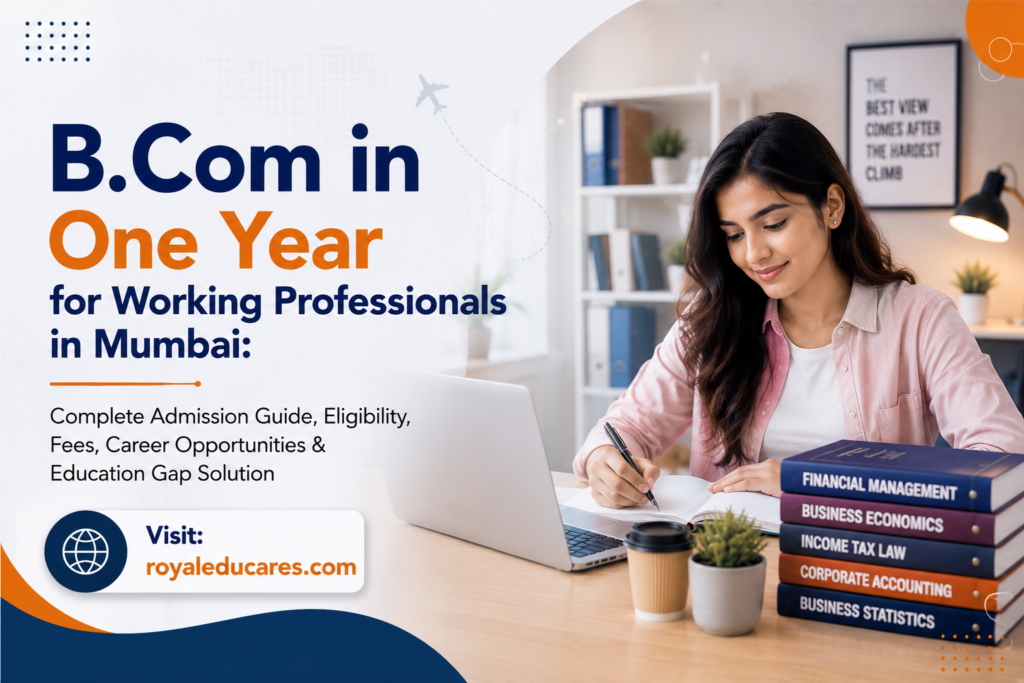
B.Com in One Year for Working Professionals in Mumbai: Complete Admission Guide, Eligibility, Fees, Career Opportunities & Education Gap Solution
Introduction
Complete your B.Com in one year with the right guidance. This guide explains eligibility, admission, fees, career opportunities, and solutions for working professionals and students with education gaps.
Accreditation & Approvals
UGC-DEB APPROVED
AICTE APPROVED
AIU APPROVED
NAAC +++ ACCREDITED

COBSE BOARDS
PHARMACY COUNCIL OF INDIA
BAR COUNCIL OF INDIA

WORLD EDUCATION SERVICES
MHRD

Get Free Career Counseling
Students looking for a Graduation in One Year in Mumbai can explore the available programs and guidance at https://royaleducares.com/graduation-in-one-year-in-mumbai/
If your goal is specifically to complete B.Com in One Year, you can also learn more about the admission process through https://royaleducares.com/b-com-admission-in-mumbai/.
For complete educational guidance, admission assistance, and other available programs, visit the official website at https://royaleducares.com/.
B.Com in One Year in Mumbai: A Smart Choice for Working Professionals
Completing graduation has become one of the biggest priorities for students and working professionals across India. Whether you are planning to apply for a government job, looking for a better private-sector opportunity, preparing for higher education, or simply want to complete your unfinished degree, a bachelor’s degree plays an important role in your career.
Among all commerce degrees, Bachelor of Commerce (B.Com) remains one of the most popular choices because it opens doors to banking, finance, accounting, taxation, insurance, business management, government jobs, and higher education.
However, many students discontinue their education due to financial problems, family responsibilities, health issues, relocation, employment, or personal reasons. Years later, they realize that not having a graduation degree limits career growth.
This is where guidance regarding B.Com in One Year in Mumbai becomes valuable for eligible candidates seeking the right academic pathway.
Why Is “B.Com in One Year” Becoming So Popular?
Thousands of people search online every month using queries such as:
- B.Com in One Year
- One Year Graduation in Mumbai
- Graduation After Long Gap
- B.Com Admission Mumbai
- Complete Graduation Fast
- Graduation for Working Professionals
- Graduation After 5 Years Gap
- Graduation After 10 Years Gap
- Fast Track Graduation
- Degree for Working Professionals
The increasing demand is mainly because today’s job market values educational qualifications more than ever before.
Many employers now make graduation the minimum eligibility requirement for recruitment, promotions, and salary increments.
Similarly, competitive examinations conducted by government departments, banks, railways, insurance companies, public sector organizations, and state recruitment boards often require candidates to possess a recognized bachelor’s degree.
Because of these requirements, thousands of students actively look for solutions that help them understand their available academic options according to their educational background.
Who Should Read This Guide?
This guide is designed for people who are searching for reliable information before making an admission decision.
It is especially useful for:
- Working professionals
- Business owners
- Students with education gaps
- Commerce students
- Diploma holders exploring graduation pathways
- Job seekers
- Banking aspirants
- Government exam candidates
- Private company employees
- Students planning MBA, M.Com, CA, CS, CMA, or other higher education
Whether your education gap is two years or several years, understanding the available academic options is the first step toward completing your educational journey.
Why Students Leave B.Com Before Completing Graduation
Education gaps are more common than many people think.
Some of the most common reasons include:
Financial Challenges
Many students begin working immediately after Class 12 to support their families, making it difficult to continue regular college education.
Full-Time Employment
Working professionals often struggle to balance office timings with regular classroom attendance.
Family Responsibilities
Marriage, family commitments, caregiving responsibilities, or relocation frequently interrupt higher education.
Medical Reasons
Health-related issues sometimes force students to discontinue their studies for extended periods.
Career Changes
Some individuals focus on developing skills or running businesses and later decide that completing graduation is essential for future growth.
Whatever the reason, an education gap does not always mean your learning journey has ended. Understanding the available educational pathways can help eligible candidates move forward confidently.
Why B.Com Remains One of India’s Most Popular Degrees
Commerce continues to be one of the strongest academic streams because it provides knowledge that is useful across almost every industry.
A B.Com degree builds understanding in areas such as:
- Financial Accounting
- Business Economics
- Income Tax
- Cost Accounting
- Auditing
- Banking
- Insurance
- Business Law
- Corporate Accounting
- Marketing
- Human Resource Management
- Business Statistics
- Entrepreneurship
- Financial Management
These subjects form the foundation for numerous career opportunities in both government and private sectors.
Advantages of Completing B.Com
Completing your graduation can positively impact your professional journey in several ways.
Better Job Opportunities
Many organizations shortlist only graduate candidates during recruitment.
Higher Salary Potential
Graduates often become eligible for better-paying roles compared to candidates with only higher secondary qualifications.
Promotion Opportunities
Several companies require graduation for internal promotions.
Eligibility for Competitive Exams
A bachelor’s degree is commonly required for various competitive examinations.
Higher Education
Graduation allows students to pursue courses such as:
- MBA
- M.Com
- PGDM
- LLB
- CA
- CS
- CMA
- Professional certification programs
Why Working Professionals Prefer Flexible Graduation Options
Balancing work and education can be difficult.
A regular college schedule may not always fit around office hours, business commitments, or family responsibilities.
Because of this, many working professionals search online using keywords such as:
- Graduation for Working Professionals
- One Year Degree
- B.Com Admission for Working Professionals
- Flexible Graduation Program
- Graduation After Job
- Continue Graduation After Gap
Understanding the available options helps candidates choose a suitable academic path based on their personal circumstances and eligibility.
Common Questions Students Search Before Taking Admission
Before applying, students usually want answers to practical questions, including:
- Can I complete B.Com after a long education gap?
- Is B.Com still valuable in 2026?
- What documents are required?
- What is the admission process?
- How much are the fees?
- Can working professionals continue graduation?
- Which career options are available after B.Com?
- Can I pursue MBA after B.Com?
- Is B.Com useful for banking jobs?
- Is graduation necessary for government jobs?
These are important questions that every applicant should understand before making an admission decision.
The following sections of this guide will explain these topics in detail, helping students make informed choices based on their educational background and career goals.
Eligibility for B.Com in One Year in Mumbai
Before applying for any academic program, understanding the eligibility criteria is one of the most important steps. Every student’s educational background is different, and the admission process may vary depending on previous qualifications, university norms, and applicable academic guidelines.
If you are searching for B.Com in One Year in Mumbai, Graduation in One Year, or B.Com Admission for Working Professionals, it is essential to first evaluate your eligibility through proper educational guidance.
Who Can Apply for B.Com in One Year?
Many students believe that a long education gap automatically disqualifies them from completing graduation. In reality, eligibility depends on several academic factors rather than only the number of years since you last studied.
Generally, guidance for B.Com-related admissions is sought by:
Working professionals
Students with an education gap
Business owners
Self-employed individuals
Professionals seeking career growth
Candidates preparing for government jobs
Private sector employees
Students planning higher education
Individuals looking to complete an unfinished graduation
Each applicant’s academic history should be reviewed carefully before selecting the appropriate admission pathway.
Is an Education Gap a Problem?
One of the most searched questions on Google is:
“Can I complete B.Com after an education gap?”
The answer depends on your educational background, previous academic records, and the admission pathway available for your situation.
Many students discontinue their education because of:
Financial difficulties
Family responsibilities
Medical emergencies
Full-time employment
Relocation
Business commitments
Competitive exam preparation
Personal circumstances
An education gap does not necessarily mean the end of your academic journey. Many learners return to higher education after several years to improve their qualifications and career opportunities.
Why Working Professionals Choose B.Com
A B.Com degree is highly valued because it supports career growth across multiple industries.
Working professionals often pursue graduation to:
Become eligible for promotions
Apply for better-paying jobs
Switch careers
Meet graduation requirements for recruitment
Qualify for government examinations
Prepare for MBA or M.Com
Improve professional credibility
Expand business knowledge
Many employers now consider graduation a basic qualification, making it an important milestone for long-term career development.
Documents Commonly Required During Admission
Although document requirements may vary depending on the institution and admission process, applicants are generally advised to keep the following records ready:
Academic Documents
Class 10 Marksheet
Class 12 Marksheet
Previous college documents (if applicable)
Transfer Certificate (where required)
Migration Certificate (if applicable)
Identity Documents
Aadhaar Card
PAN Card (if required)
Passport-size photographs
Address Proof
Aadhaar Card
Voter ID
Driving Licence
Passport (where applicable)
Applicants should always verify the exact document requirements before beginning the admission process.
Step-by-Step Admission Process
Students frequently search for:
How to apply for B.Com in One Year?
B.Com Admission Process in Mumbai
Graduation Admission Guide
One Year Graduation Admission
While procedures may differ depending on individual cases, the admission journey generally includes the following stages.
Step 1: Educational Background Assessment
The first step is evaluating the student’s previous educational qualifications.
This helps determine:
Previous academic status
Commerce background
Existing qualifications
Eligibility for available academic pathways
A proper assessment ensures that applicants receive guidance suitable for their educational profile.
Step 2: Eligibility Verification
Once academic records are reviewed, eligibility is verified according to applicable academic guidelines.
This stage helps students understand:
Available admission options
Academic requirements
Necessary documentation
Next admission steps
Step 3: Document Submission
Applicants usually submit the required educational and identity documents for verification.
Providing complete and accurate information helps avoid unnecessary delays during the admission process.
Step 4: Admission Guidance
After document verification, students receive guidance regarding the available admission process based on their educational history.
Proper counselling helps applicants understand:
Academic structure
Important timelines
Required documentation
Examination-related information
Future academic planning
Step 5: Complete the Admission Formalities
After completing all required formalities, eligible students can proceed with the admission process according to the applicable academic guidelines.
Why Proper Guidance Matters Before Admission
Many students make admission decisions based only on advertisements or incomplete information found online.
Instead, it is always better to understand:
Eligibility
Academic requirements
Documentation
Career objectives
Future education plans
Suitable academic pathway
Taking informed decisions can help students avoid confusion later in their educational journey.
Benefits of Completing Your Graduation
Graduation is not just a certificate—it often becomes the foundation for future academic and professional growth.
Some major advantages include:
Better Career Opportunities
Graduates become eligible for a wider range of positions across industries.
Professional Growth
Graduation can strengthen your profile for promotions and career advancement.
Higher Education Opportunities
After completing B.Com, students may explore programs such as:
MBA
M.Com
PGDM
LLB
Professional certifications
Finance and accounting courses
Competitive Examination Eligibility
Many government and public sector recruitment processes require candidates to possess a bachelor’s degree as part of the eligibility criteria.
Skills Developed During B.Com
Apart from academic knowledge, B.Com also helps students build practical skills that are valuable in today’s job market.
These include:
Financial analysis
Accounting fundamentals
Business communication
Problem-solving
Decision-making
Business mathematics
Taxation basics
Banking knowledge
Corporate awareness
Computer applications
Analytical thinking
Professional ethics
These skills are useful across finance, banking, insurance, retail, taxation, consulting, and business management.
Career Goals Students Commonly Have
People searching for B.Com in One Year often have clear career objectives.
Popular goals include:
Government Jobs
Banking Careers
Accounting Jobs
Finance Executive Roles
Tax Consultant
GST Executive
Business Development
Insurance Sector
Private Company Jobs
MBA Admission
M.Com Admission
Entrepreneurship
Family Business Management
A completed graduation can support these aspirations by meeting educational requirements for many roles and further studies.
Mistakes to Avoid Before Taking Admission
Students should avoid making decisions without proper research.
Some common mistakes include:
Not checking eligibility first
Ignoring document requirements
Depending on unofficial information
Applying without understanding the admission process
Overlooking future career goals
Failing to verify academic guidance
Careful planning before admission can save both time and effort.
What You Will Learn in the Next Section
Now that you understand the eligibility requirements, admission process, and commonly required documents, the next section will explain important topics such as course fees, duration, syllabus, core B.Com subjects, specialization options, examinations, and how students can choose the right academic path according to their career goals.
B.Com in One Year Course Fees, Duration, Syllabus & Career Scope in Mumbai
Choosing the right graduation pathway is not only about eligibility—it is equally important to understand the course structure, duration, subjects, fees, and the career opportunities available after completing B.Com. Students who research these aspects beforehand are better prepared to make informed academic and professional decisions.
B.Com in One Year Course Duration
One of the most common questions students search online is:
How long does B.Com in One Year take?
Can I complete graduation in one year?
What is the duration of B.Com in One Year?
One Year Graduation Duration in Mumbai
The course duration depends on the student’s academic background, previous qualifications, eligibility, and the applicable academic pathway. Instead of assuming that every applicant follows the same process, students should first receive proper educational guidance to understand the most suitable option available for them.
Understanding the duration in advance also helps working professionals plan their studies alongside their job responsibilities.
Understanding the B.Com Curriculum
A Bachelor of Commerce program is designed to provide students with a strong foundation in commerce, finance, accounting, business, and management. It develops analytical thinking, financial knowledge, and practical business understanding that can be applied across various industries.
Although the exact syllabus may vary depending on the university or academic framework, the curriculum generally focuses on building both theoretical knowledge and practical skills.
Core Subjects Covered in B.Com
Students pursuing B.Com usually study a wide range of commerce-related subjects. These subjects help build a solid understanding of business operations and financial management.
Common subjects include:
Financial Accounting
Financial Accounting teaches students how businesses record financial transactions, prepare balance sheets, profit and loss accounts, and maintain financial records.
Students also learn the importance of transparency, reporting standards, and accounting principles.
Business Economics
Business Economics helps students understand how economic principles influence businesses, consumers, markets, and industries.
Topics generally include:
Demand and supply
Market structures
Pricing strategies
Inflation
Economic growth
Business decision-making
Corporate Accounting
Corporate Accounting focuses on financial reporting for companies.
Students learn about:
Company accounts
Share capital
Debentures
Financial statements
Corporate financial reporting
Cost Accounting
Cost Accounting helps businesses understand production costs and improve profitability.
Key concepts include:
Cost analysis
Budgeting
Cost control
Inventory costing
Cost estimation
Auditing
Auditing introduces students to the process of examining financial records to ensure accuracy and compliance.
Important topics include:
Internal audit
External audit
Audit planning
Verification
Financial compliance
Business Law
Every commerce student should understand the legal framework governing businesses.
Business Law commonly covers:
Contracts
Partnership laws
Company regulations
Consumer protection
Commercial laws
Income Tax
Income Tax is one of the most searched commerce subjects because taxation knowledge is valuable in many professions.
Students learn about:
Tax basics
Tax computation
Individual taxation
Business taxation
Tax planning
Financial Management
Financial Management teaches students how organizations manage money effectively.
Major topics include:
Capital budgeting
Investment decisions
Financial planning
Working capital management
Risk analysis
Banking and Insurance
The banking and insurance sector offers numerous employment opportunities for commerce graduates.
This subject introduces:
Banking operations
Financial institutions
Insurance principles
Risk management
Digital banking
Business Statistics
Business Statistics helps students analyze data for better decision-making.
Topics generally include:
Data analysis
Probability
Statistical methods
Business forecasting
Research interpretation
Practical Skills Students Develop During B.Com
Apart from academic subjects, students also develop valuable professional skills.
These include:
Financial reporting
Analytical thinking
Communication skills
Business presentation
Teamwork
Time management
Decision-making
Data interpretation
Problem-solving
Professional ethics
Computer proficiency
Business documentation
These skills remain valuable across industries and support long-term career growth.
Is Mathematics Compulsory in B.Com?
Another frequently searched question is:
“Is Maths compulsory for B.Com?”
The answer depends on the admission requirements and academic structure of the institution or university. Some programs may include business mathematics or statistics as part of the curriculum, while eligibility criteria can differ. Students should always confirm the specific academic requirements before applying.
What Makes B.Com a Valuable Degree?
B.Com continues to be one of India’s most preferred undergraduate degrees because it provides flexibility across multiple career paths.
Commerce graduates can explore opportunities in:
Accounting
Banking
Finance
Taxation
Insurance
Retail
Sales
Marketing
Human Resources
Business Operations
Customer Relationship Management
Entrepreneurship
The broad applicability of commerce knowledge makes B.Com relevant for both private and public sector careers.
Career Opportunities After B.Com
Many students search:
Jobs after B.Com
Highest salary after B.Com
Government jobs after B.Com
Private jobs after B.Com
Career after graduation
Best career options after B.Com
A commerce degree opens the door to a variety of professional roles depending on skills, experience, and further education.
Popular career options include:
Accountant
Accountants manage financial records, prepare statements, maintain accounts, and ensure financial accuracy.
Accounts Executive
Accounts Executives handle daily accounting operations, invoices, payments, reconciliations, and financial reporting.
Tax Consultant
Professionals with taxation knowledge can assist individuals and businesses with tax planning and compliance.
Banking Professional
Commerce graduates often pursue careers in:
Private Banks
Public Sector Banks
Cooperative Banks
Financial Institutions
Financial Analyst
Financial Analysts evaluate business performance, investment opportunities, and financial data to support organizational decision-making.
Insurance Advisor
Insurance professionals help clients understand financial protection products and risk management solutions.
Business Development Executive
Business Development Executives focus on client acquisition, sales growth, and market expansion.
GST Executive
GST professionals assist businesses in maintaining tax compliance and filing GST-related documentation.
Entrepreneur
Many commerce graduates use their business knowledge to start their own ventures or expand family businesses.
Government Job Opportunities After B.Com
Graduation is often a basic eligibility requirement for various government recruitment examinations.
Commerce graduates commonly prepare for careers in:
Banking
Public Sector Undertakings
Railways
State Government Departments
Central Government Recruitment
Insurance Organizations
Staff Selection Exams
Administrative Services
Specific eligibility depends on the recruitment notification issued by the respective authority.
Higher Education After B.Com
Many students continue their education after graduation to improve career prospects.
Popular options include:
MBA
M.Com
PGDM
LLB
CA
CS
CMA
CFA
Digital Marketing
Financial Modeling
Data Analytics
Business Analytics
Investment Banking Courses
Higher education allows graduates to specialize in their chosen field and enhance their employment opportunities.
How to Choose the Right Career After B.Com
There is no single “best” career for every student. The right choice depends on:
Personal interests
Career goals
Skills
Industry demand
Future study plans
Work experience
Long-term aspirations
Students should evaluate these factors carefully before selecting a career path.
Frequently Searched Keywords Related to B.Com
Students often search using terms such as:
Best B.Com College in Mumbai
B.Com Admission Mumbai
B.Com Fees
B.Com Subjects
B.Com Syllabus
Commerce Graduation
One Year Graduation
Graduation for Working Professionals
Graduation After Education Gap
Fast Track Graduation
B.Com Career Options
Jobs After B.Com
Government Jobs After Graduation
MBA After B.Com
M.Com Admission
Banking Career After B.Com
Understanding these topics helps students make informed decisions about both education and future career planning.
What’s Next?
In the next section, we will explore career growth for working professionals, salary expectations, industry demand, advantages of completing B.Com after an education gap, common myths, mistakes to avoid, and practical tips to maximize career opportunities after graduation.
Career Opportunities After B.Com in One Year: Jobs, Salary, Government Exams & Future Growth
Completing a B.Com degree is more than earning an academic qualification—it can become a stepping stone toward better career opportunities, higher education, and long-term professional growth. Whether you are a working professional, a student with an education gap, or someone looking to improve your qualifications, understanding the career scope after B.Com can help you plan your future with confidence.
Why Employers Prefer Graduates
In today’s competitive job market, many companies list graduation as a minimum educational qualification for recruitment. A bachelor’s degree demonstrates that a candidate has developed analytical thinking, communication skills, business knowledge, and the ability to complete a structured academic program.
Graduation may also increase eligibility for:
Better job roles
Internal promotions
Leadership positions
Corporate training programs
Professional certification courses
Campus and off-campus recruitment opportunities
Although skills and experience remain important, having a graduation degree often strengthens your overall profile.
Career Scope After B.Com
One of the biggest advantages of a B.Com degree is its versatility. Commerce graduates can explore careers in multiple industries because businesses of every size require professionals with knowledge of accounting, finance, taxation, operations, and administration.
Some of the major sectors that recruit B.Com graduates include:
Banking
Finance
Accounting
Taxation
Insurance
Retail
E-commerce
Logistics
Manufacturing
Healthcare
Education
Information Technology
Consulting
Hospitality
Real Estate
Business Process Outsourcing (BPO)
Financial Services
This wide industry acceptance makes B.Com one of the most flexible undergraduate degrees in India.
Private Sector Jobs After B.Com
Commerce graduates are eligible to apply for a variety of entry-level and experienced roles depending on their skills and work experience.
Popular job profiles include:
Accountant
Accountants maintain financial records, prepare reports, manage bookkeeping, and ensure compliance with accounting standards.
Accounts Executive
Accounts Executives handle invoices, payments, reconciliations, expense tracking, and financial documentation.
Finance Executive
Finance Executives assist organizations in budgeting, financial planning, forecasting, and reporting.
Banking Associate
Banks recruit graduates for customer service, operations, relationship management, loan processing, and sales-related roles.
Tax Executive
Tax Executives work on GST, income tax documentation, tax calculations, compliance, and filing procedures.
Audit Assistant
Audit Assistants help review financial statements, verify records, and support internal or external audit teams.
Business Development Executive
Business Development professionals identify new customers, build relationships, and contribute to revenue growth.
Sales Executive
Many commerce graduates build successful careers in sales because they already possess a basic understanding of business operations and customer interactions.
Customer Relationship Executive
CRM professionals maintain client relationships, resolve queries, and improve customer satisfaction.
Operations Executive
Operations teams coordinate daily business activities to ensure efficient workflow across departments.
Government Job Opportunities After B.Com
A bachelor’s degree is a common eligibility requirement for many government recruitment examinations. After completing graduation, students can prepare for opportunities in various departments and organizations.
Popular career areas include:
Banking recruitment
Staff Selection examinations
Railway recruitment
State government departments
Central government vacancies
Public sector organizations
Insurance sector recruitment
Administrative services (subject to eligibility and examination requirements)
Applicants should always refer to the official notification of the respective recruiting authority for detailed eligibility criteria.
Banking Careers After B.Com
Many commerce students aim for careers in the banking sector because it offers structured career growth, professional work environments, and opportunities for specialization.
Roles may include:
Probationary Officer (subject to recruitment eligibility)
Clerk
Relationship Manager
Customer Service Executive
Credit Processing Executive
Loan Officer
Branch Operations Executive
Sales Officer
Knowledge of finance, accounting, and business communication gained during B.Com can be beneficial in banking careers.
Is B.Com Helpful for MBA?
Yes. A B.Com degree provides a strong academic foundation for students planning to pursue an MBA.
Commerce graduates often have prior exposure to subjects such as:
Accounting
Economics
Business Law
Marketing
Finance
Management Principles
This background can make the transition to management studies smoother.
MBA specializations commonly chosen by B.Com graduates include:
Finance
Marketing
Human Resources
Business Analytics
Operations Management
International Business
Digital Marketing
Supply Chain Management
Professional Courses After B.Com
Students who wish to develop specialized expertise can consider professional certification programs after graduation.
Popular options include:
Chartered Accountancy (CA)
Company Secretary (CS)
Cost and Management Accountancy (CMA)
Financial Modeling
Investment Banking
Data Analytics
Business Analytics
Digital Marketing
GST Certification
Tally with GST
SAP Finance
Advanced Excel
Power BI
Financial Planning
Choosing a course should depend on your career interests and long-term goals.
Entrepreneurship After B.Com
Not every graduate aims for a job. Many commerce students aspire to start their own business or manage an existing family enterprise.
Knowledge gained during B.Com can support entrepreneurs in areas such as:
Financial planning
Business accounting
Budget management
Tax compliance
Business operations
Cost control
Cash flow management
Marketing fundamentals
Understanding these concepts can help entrepreneurs make informed business decisions.
Skills Employers Value After B.Com
In addition to academic qualifications, employers look for candidates who possess practical workplace skills.
Some of the most valued skills include:
Communication
Problem-solving
Time management
Teamwork
Leadership
Financial analysis
MS Excel proficiency
Accounting software knowledge
Business writing
Presentation skills
Customer relationship management
Decision-making
Adaptability
Analytical thinking
Developing these skills alongside graduation can improve employability.
Common Mistakes Students Make After Graduation
Many students complete graduation but delay career planning. Avoid these common mistakes:
Waiting Too Long to Apply for Jobs
Practical experience gained early in your career can contribute significantly to long-term growth.
Ignoring Skill Development
Employers increasingly value practical skills in addition to academic qualifications.
Not Building a Professional Resume
A well-structured resume highlights your education, skills, internships, certifications, and work experience effectively.
Skipping Professional Certifications
Short-term certifications in accounting, finance, taxation, analytics, or digital tools can strengthen your profile.
Lack of Career Planning
Setting clear short-term and long-term goals helps students choose the right opportunities.
How Working Professionals Benefit from Completing Graduation
Many working professionals decide to complete graduation after realizing that it can support career advancement.
Potential benefits include:
Eligibility for promotions
Access to managerial roles
Better salary prospects
Improved confidence
Higher education opportunities
Expanded professional network
Greater job mobility
Enhanced resume value
For many professionals, completing graduation is an investment in long-term career development.
High-Demand Industries for Commerce Graduates
Commerce graduates continue to find opportunities in sectors experiencing steady growth.
These include:
FinTech
Banking
Insurance
E-commerce
Logistics
Healthcare Administration
Retail
Consulting
Information Technology Services
Financial Services
Accounting Firms
Tax Advisory
Corporate Finance
Business Consulting
As industries continue to evolve, graduates with strong analytical and business skills remain in demand.
Career Planning Tips for B.Com Students
To maximize the value of your graduation, consider the following strategies:
Build strong communication skills.
Learn advanced MS Excel and financial tools.
Stay updated with industry trends.
Gain practical experience through internships or work.
Improve computer proficiency.
Pursue relevant certifications.
Develop networking skills.
Prepare for interviews and aptitude tests.
Continue learning through workshops and online courses.
Create a long-term career roadmap.
Consistent learning and skill development can significantly enhance career opportunities over time.
What’s Coming Next?
In the next section, we will compare B.Com in One Year with regular B.Com, discuss common myths and misconceptions, explain how to choose the right academic pathway, provide practical admission tips for students and working professionals, and answer many frequently searched questions before moving to the final comprehensive FAQ section.
B.Com in One Year vs Regular B.Com: Complete Comparison, Common Myths & Admission Tips
Choosing the right graduation pathway is an important decision that can influence your academic journey and future career. Many students searching for B.Com in One Year in Mumbai, Graduation in One Year, or B.Com Admission for Working Professionals often compare different study options before making a decision.
Understanding the differences, clearing common misconceptions, and planning your admission carefully can help you make an informed choice based on your educational background and career goals.
B.Com in One Year vs Regular B.Com
One of the most searched questions is:
Which is better: B.Com in One Year or Regular B.Com?
What is the difference between regular B.Com and one-year graduation guidance?
Which option is suitable for working professionals?
The answer depends entirely on your academic history, eligibility, and personal circumstances.
A regular B.Com program is generally chosen by students who continue their education immediately after completing Class 12 and can attend classes according to the academic schedule.
On the other hand, individuals searching for B.Com in One Year are often working professionals or students with an education gap who want to understand the academic options available to complete their graduation, subject to eligibility and applicable university guidelines.
Instead of comparing both as better or worse, students should focus on selecting the pathway that aligns with their educational background and future goals.
Who Should Consider B.Com Guidance?
Educational guidance can be valuable for many types of learners, including:
Working professionals with full-time jobs
Students returning after an education gap
Business owners
Self-employed individuals
Homemakers planning to restart education
Individuals seeking promotion opportunities
Candidates preparing for competitive examinations
Students aiming for higher education
Every applicant has unique academic circumstances, making proper counselling an essential first step.
Common Myths About B.Com in One Year
Many misconceptions circulate online regarding fast-track graduation pathways. Understanding the facts helps students avoid confusion.
Myth 1: Anyone Can Complete B.Com in One Year
Reality: Eligibility depends on the student’s educational background, previous qualifications, and applicable academic guidelines. Every applicant should undergo proper eligibility assessment before proceeding.
Myth 2: An Education Gap Means Graduation Is Impossible
Reality: A gap in education does not automatically prevent someone from continuing their studies. The appropriate academic pathway depends on individual eligibility and documentation.
Myth 3: Working Professionals Cannot Continue Graduation
Reality: Many professionals explore educational options while continuing their careers. Proper planning and guidance help them balance work and studies.
Myth 4: Graduation Is Useful Only for Government Jobs
Reality: A graduation degree is valuable across both private and public sectors. It may also support career growth, promotions, and higher education opportunities.
Myth 5: Commerce Offers Limited Career Options
Reality: Commerce graduates work across accounting, finance, banking, taxation, insurance, consulting, e-commerce, retail, business operations, entrepreneurship, and many other industries.
How to Choose the Right Academic Path
Before applying, students should evaluate several important factors.
Review Your Educational History
Understand your previous qualifications and academic records before making any decision.
Define Your Career Goals
Ask yourself questions such as:
Do I want a private-sector job?
Am I preparing for government exams?
Do I plan to pursue an MBA or M.Com?
Am I seeking career advancement in my current organization?
Clear goals make academic planning easier.
Verify Eligibility
Always confirm eligibility requirements based on your educational background before proceeding with admission.
Understand the Admission Process
Knowing the required documents, timelines, and academic procedures helps avoid unnecessary delays.
Tips for Working Professionals
Managing both work and education requires discipline and planning.
Some practical suggestions include:
Create a weekly study schedule.
Allocate dedicated learning hours.
Set realistic academic goals.
Organize important documents in advance.
Track important admission dates.
Stay consistent with your study routine.
Seek guidance whenever required.
Even small daily efforts can contribute to long-term academic success.
Time Management Strategies
One of the biggest challenges for working professionals is balancing multiple responsibilities.
Useful strategies include:
Prioritize important tasks.
Avoid unnecessary distractions.
Use digital calendars and reminders.
Break larger goals into smaller milestones.
Maintain a healthy work-life-study balance.
Effective time management improves productivity and reduces stress.
Digital Skills That Complement a B.Com Degree
In today’s job market, combining commerce knowledge with digital skills can improve employability.
Students may consider learning:
Advanced Microsoft Excel
Tally
GST software
Accounting software
Power BI
Data Analytics
Financial Modeling
Google Workspace
Business Communication Tools
Basic AI productivity tools
These skills are increasingly valued across industries.
Soft Skills Every Commerce Graduate Should Develop
Academic qualifications are important, but employers also look for interpersonal and professional abilities.
Key soft skills include:
Communication
Leadership
Teamwork
Critical thinking
Adaptability
Customer service
Negotiation
Professional ethics
Presentation skills
Emotional intelligence
Developing these competencies can support long-term career success.
Preparing for Interviews After Graduation
Whether applying for a first job or seeking career growth, interview preparation is essential.
Students should focus on:
Building a professional resume.
Practicing common interview questions.
Improving communication skills.
Understanding the basics of commerce and finance.
Learning about the company before attending interviews.
Demonstrating confidence and professionalism.
Good preparation often creates a positive first impression.
Industries Expected to Continue Hiring Commerce Graduates
Commerce graduates remain relevant across multiple sectors due to their understanding of business and finance.
Growing industries include:
Banking and Financial Services
Insurance
FinTech
Accounting Firms
Tax Consultancy
E-commerce
Retail
Logistics
Healthcare Administration
Corporate Finance
Business Process Management
Consulting Services
Technology Companies
Startups
Manufacturing
As businesses continue to expand, professionals with commerce knowledge are expected to remain in demand.
Long-Term Career Growth After B.Com
Graduation is often the beginning of a larger professional journey rather than the final destination.
After gaining experience, many professionals move into roles such as:
Senior Accountant
Finance Manager
Business Analyst
Operations Manager
Relationship Manager
Tax Consultant
Financial Consultant
Team Leader
Department Manager
Entrepreneur
Career progression depends on continuous learning, practical experience, and skill development.
Practical Admission Checklist
Before beginning the admission process, ensure that you have:
Reviewed your educational history.
Collected academic documents.
Kept identity proof ready.
Verified eligibility requirements.
Defined your career objectives.
Understood the admission procedure.
Planned your study schedule.
Sought proper educational guidance where necessary.
A well-prepared approach can make the admission journey smoother and more organized.
What’s Next?
The next section will bring together everything covered in this guide with expert tips, a complete student roadmap, final admission guidance, and a comprehensive conclusion before moving to the 50+ SEO-focused Frequently Asked Questions (FAQs) designed to answer the most common queries students search online.
Expert Tips for Students Planning B.Com in One Year in Mumbai
Choosing to complete your graduation is an important milestone that can positively influence your education, career, and future opportunities. Whether you are a working professional, a student returning after an education gap, or someone planning to improve your qualifications, making informed decisions is essential.
This section brings together practical advice, career planning strategies, and expert recommendations to help you approach your B.Com journey with confidence.
Why Completing Graduation Still Matters
Many students ask:
Is graduation still important?
Does B.Com have value in today’s job market?
Can graduation help me get a better job?
The answer depends on your career goals, but graduation continues to be a significant qualification for many employment opportunities, higher education programs, and competitive examinations.
A bachelor’s degree demonstrates commitment, discipline, and the ability to complete a structured academic program—qualities that employers and educational institutions often value.
A Step-by-Step Roadmap for Students
Planning your educational journey becomes easier when you follow a structured approach.
Step 1: Identify Your Career Goal
Ask yourself:
Do I want a private-sector job?
Am I preparing for government examinations?
Do I plan to pursue an MBA or M.Com?
Do I want career growth in my current company?
Am I planning to start my own business?
Your long-term objective should guide your academic decisions.
Step 2: Review Your Academic Background
Before applying, gather and review your previous educational documents. Understanding your academic history helps determine the most appropriate admission pathway.
Step 3: Verify Eligibility
Every applicant’s educational journey is different. Confirm your eligibility based on your previous qualifications and applicable academic requirements before proceeding further.
Step 4: Collect Required Documents
Keeping all necessary documents ready in advance can help make the admission process smoother and reduce delays.
Step 5: Seek Professional Educational Guidance
If you have an education gap, discontinued studies, or are unsure about the available options, proper educational counselling can help you understand the admission process and available academic pathways.
How to Balance Work and Studies
Working professionals often worry about managing both employment and education. With effective planning, it becomes easier to stay organized.
Helpful practices include:
Set a weekly study timetable.
Reserve fixed learning hours.
Prioritize important tasks.
Avoid unnecessary distractions.
Review topics regularly.
Stay consistent with your schedule.
Even one to two focused hours each day can make learning more manageable.
Building a Strong Professional Profile
Graduation is only one part of career development. Students can further strengthen their profiles by developing additional competencies.
Consider focusing on:
Business communication
MS Excel
Tally
GST basics
Financial analysis
PowerPoint presentations
Computer literacy
Email writing
Professional etiquette
Interview preparation
Combining academic knowledge with practical skills improves employability.
Resume Tips for Commerce Students
A well-prepared resume can make a positive impression during the recruitment process.
Include sections such as:
Personal details
Educational qualifications
Technical skills
Professional experience
Certifications
Achievements
Languages known
Career objective
Keep your resume concise, accurate, and updated.
Interview Preparation Tips
Many graduates attend interviews without adequate preparation. Improving your interview skills can increase confidence and performance.
Before attending an interview:
Research the company.
Revise basic commerce concepts.
Practice introducing yourself.
Prepare answers to common HR questions.
Dress professionally.
Arrive on time.
Carry required documents.
Confidence grows through preparation and practice.
Skills That Can Increase Career Opportunities
Employers appreciate candidates who continue learning beyond graduation.
Some useful skills include:
Technical Skills
Advanced Excel
Tally Prime
GST
Accounting software
Financial Modeling
Power BI
Business Analytics
Soft Skills
Leadership
Communication
Problem-solving
Teamwork
Negotiation
Adaptability
Critical thinking
Time management
Developing both technical and interpersonal skills can support long-term career growth.
Career Planning After Graduation
Graduation opens the door to several possibilities. Planning ahead helps students choose the most suitable path.
Potential directions include:
Employment
Apply for roles in accounting, finance, banking, taxation, insurance, sales, operations, and business administration.
Higher Education
Continue studies through programs such as:
MBA
M.Com
PGDM
LLB
Professional certifications
Government Examinations
Many government recruitment processes require graduation as part of the eligibility criteria.
Entrepreneurship
Students interested in business can apply commerce knowledge to launch or expand entrepreneurial ventures.
Frequently Searched Questions Students Should Consider
Before applying, many students ask:
Which career is best after B.Com?
Is B.Com good for banking?
Can I pursue an MBA after B.Com?
What skills should I learn with B.Com?
How can I improve my salary after graduation?
Is accounting a good career?
Which certification should I pursue after B.Com?
The answers often depend on individual interests, career goals, experience, and continuous skill development.
Common Mistakes to Avoid
Avoiding these mistakes can help students make informed academic and career decisions.
Applying without checking eligibility.
Ignoring document verification.
Delaying career planning.
Depending on unofficial information.
Neglecting practical skill development.
Not updating resumes regularly.
Avoiding interview preparation.
Focusing only on degrees without learning new skills.
A balanced approach combining education and practical learning generally leads to better career outcomes.
Final Thoughts
Completing a B.Com degree is an important achievement that can contribute to personal and professional growth. Whether your goal is employment, higher education, entrepreneurship, or career advancement, planning carefully and understanding the admission process can help you make informed decisions.
Every student’s journey is unique. By evaluating your educational background, verifying eligibility, organizing your documents, and continuously improving your skills, you can prepare yourself for future opportunities with greater confidence.
Graduation is not only about earning a qualification—it is about creating a stronger foundation for lifelong learning and career development.
Frequently Asked Questions (FAQs) About B.Com in One Year in Mumbai
1. What is B.Com in One Year?
B.Com in One Year is a guidance-based academic pathway for eligible students who want to understand the available options to complete their Bachelor of Commerce based on their educational background and applicable academic guidelines.
2. Who can apply for B.Com in One Year in Mumbai?
Working professionals, students with an education gap, business owners, self-employed individuals, and eligible candidates seeking graduation guidance may explore the available admission options after eligibility verification.
3. Can I complete B.Com after a long education gap?
Yes. Eligibility depends on your previous educational qualifications, documentation, and applicable academic guidelines. An education gap alone does not automatically prevent you from continuing your graduation.
4. Is B.Com in One Year suitable for working professionals?
Many working professionals look for flexible academic guidance to complete their graduation while continuing their careers. The suitable pathway depends on individual eligibility.
5. What documents are generally required for admission?
Students are commonly asked to provide Class 10 and Class 12 mark sheets, previous academic records (if applicable), identity proof, address proof, passport-size photographs, and other documents depending on the admission process.
6. How do I apply for B.Com in One Year in Mumbai?
The process generally begins with educational counselling, eligibility assessment, document verification, and admission guidance based on your academic background.
7. Can I pursue higher education after completing B.Com?
Yes. After graduation, students may become eligible to apply for higher education programs such as MBA, M.Com, PGDM, LLB, and other professional courses, subject to the eligibility criteria of the respective institution.
8. Is B.Com useful for government jobs?
A bachelor’s degree is one of the common educational requirements for many government recruitment examinations. Candidates should always verify the official eligibility criteria of the respective recruitment authority.
9. Is B.Com a good option for banking careers?
Yes. B.Com provides knowledge of accounting, finance, economics, banking, and business, making it a popular choice among students interested in banking careers.
10. What are the major subjects in B.Com?
Common subjects include Financial Accounting, Business Economics, Corporate Accounting, Cost Accounting, Business Law, Income Tax, Financial Management, Banking, Insurance, Auditing, and Business Statistics.
11. Is Mathematics compulsory in B.Com?
The requirement varies depending on the institution and academic structure. Students should verify the specific curriculum and eligibility requirements before admission.
12. What career options are available after B.Com?
Commerce graduates can explore careers in accounting, banking, finance, taxation, insurance, business development, operations, auditing, retail, consulting, and entrepreneurship.
13. Can I pursue MBA after B.Com?
Yes. Many students choose MBA after completing B.Com to develop advanced management skills and improve career opportunities.
14. Is B.Com better than other commerce degrees?
The right course depends on your interests, career goals, and future plans. B.Com remains one of the most versatile undergraduate commerce degrees in India.
15. What skills should I learn with B.Com?
Students can improve their career prospects by learning Advanced Excel, Tally, GST, Power BI, Financial Modeling, communication skills, business writing, and analytical thinking.
16. Is B.Com valuable for private jobs?
Yes. Many private companies recruit commerce graduates for accounting, finance, banking, taxation, sales, operations, customer service, and business administration roles.
17. Can I become an accountant after B.Com?
A B.Com degree provides a strong academic foundation for accounting careers. Additional certifications and practical experience can further improve career opportunities.
18. Can commerce graduates start their own business?
Yes. Commerce education develops knowledge of accounting, finance, taxation, budgeting, and business operations, which can support entrepreneurship.
19. Is B.Com useful for family businesses?
Yes. Understanding finance, accounting, taxation, and business management can help individuals manage and grow family businesses more effectively.
20. Does B.Com improve career growth?
Graduation can support career development by improving eligibility for jobs, promotions, higher education, and professional certifications.
21. Can I study while working full-time?
Many working professionals continue their education while managing their careers. Proper planning and time management are important.
22. Is there an age limit for B.Com in One Year?
Eligibility requirements may vary depending on the academic pathway and institutional guidelines. Students should verify the latest admission criteria.
23. Which industries hire B.Com graduates?
Commerce graduates work in banking, finance, accounting, taxation, insurance, retail, logistics, e-commerce, healthcare, consulting, education, and corporate sectors.
24. Can I prepare for competitive exams after B.Com?
Yes. Graduation may make students eligible for many competitive examinations, depending on the specific recruitment notification.
25. Why is B.Com one of the most popular graduation courses?
Its wide career scope, business relevance, flexibility, and strong foundation in commerce make B.Com a preferred choice for many students.
26. Is B.Com good for accounting jobs?
Yes, accounting is one of the most common career paths for B.Com graduates.
27. Can I work in finance after B.Com?
Yes. Finance is one of the major industries where commerce graduates build successful careers.
28. Is communication skill important after graduation?
Absolutely. Strong communication skills improve interview performance, workplace collaboration, and career growth.
29. Should I learn computer skills with B.Com?
Yes. Skills such as MS Excel, accounting software, and business applications are valuable in today’s job market.
30. Is B.Com suitable for entrepreneurs?
Yes. Commerce education helps develop business understanding, financial planning, taxation knowledge, and management skills useful for entrepreneurs.
31. Can I pursue M.Com after B.Com?
Yes, subject to the eligibility requirements of the institution.
32. Is B.Com useful for the insurance sector?
Yes. Many insurance companies recruit commerce graduates for sales, operations, customer support, and administrative roles.
33. Can B.Com graduates work in multinational companies?
Yes. Many multinational companies hire commerce graduates for finance, operations, customer service, and business support functions.
34. Is practical experience important after graduation?
Yes. Combining academic qualifications with practical experience can improve employability.
35. Should I build a professional resume after graduation?
Yes. A well-structured resume helps employers understand your qualifications, skills, and experience.
36. What certifications can I pursue after B.Com?
Students often choose certifications in GST, Tally, Advanced Excel, Financial Modeling, Data Analytics, and Power BI.
37. Can B.Com graduates work in the GST field?
Yes. Knowledge of taxation and GST can support careers related to tax compliance and accounting.
38. Is networking important for career growth?
Yes. Professional networking can help students discover learning opportunities and job openings.
39. Can I switch careers after B.Com?
Yes. Many graduates transition into management, marketing, finance, HR, analytics, and entrepreneurship through additional learning and experience.
40. Does graduation increase confidence?
For many students, completing graduation improves self-confidence and creates new educational and professional opportunities.
41. Which is better after B.Com: MBA or M.Com?
The choice depends on your career goals. MBA is generally preferred for management careers, while M.Com focuses on advanced commerce studies.
42. Can I get a promotion after completing graduation?
Many organizations consider graduation for promotions, although company policies vary.
43. What soft skills should commerce students develop?
Communication, teamwork, leadership, adaptability, time management, problem-solving, and critical thinking are valuable skills.
44. Is B.Com useful for digital businesses?
Yes. Commerce knowledge supports financial planning, budgeting, taxation, and business management in digital businesses.
45. Can I prepare for banking exams after B.Com?
Yes. Many students pursue banking recruitment examinations after graduation.
46. Why should I verify eligibility before applying?
Eligibility verification helps ensure that students understand the admission process and available academic pathways based on their educational background.
47. Is career counselling important before admission?
Yes. Professional guidance helps students choose the most suitable academic path according to their qualifications and future goals.
48. What is the biggest advantage of completing graduation?
Graduation can improve eligibility for employment, higher education, professional certifications, and long-term career growth.
49. Where can I get guidance for B.Com in One Year in Mumbai?
Students looking for B.Com in One Year in Mumbai and Graduation in One Year can explore the available guidance, admission process, and eligibility information through Royal EduCares.
50. How can I start my B.Com admission process?
The first step is to review your educational background, verify your eligibility, prepare the necessary documents, and seek professional admission guidance before proceeding with the application process.
Conclusion
Completing a B.Com in One Year in Mumbai can be a valuable opportunity for eligible students, working professionals, and individuals with an education gap who wish to continue their educational journey. Before applying, it is important to understand the eligibility criteria, admission process, required documents, career opportunities, and future academic options.
With the right guidance and proper planning, students can make informed decisions that align with their career goals. Whether you aim to pursue higher education, prepare for competitive examinations, advance in your current profession, or explore new career opportunities, a B.Com degree can serve as a strong foundation for future growth. For personalized admission assistance and the latest information, students are encouraged to seek guidance from Royal EduCares before beginning the admission process.
Contact Royal Educares
Royal Educares
Education Guidance & Admission Support Across India
 Website:
https://royaleducares.com/
 Email:
info@royaleducares.com
 Phone:
+91 9819649369
 Address:
9/D-1, Office No. 005, Sangharsh Nagar, Chandivali, Powai, Mumbai, Maharashtra 400072, India
 GET DIRECTION
Google Map
Start your Admission Today!
Let Us Help You Choose the Right Course for Your Future.