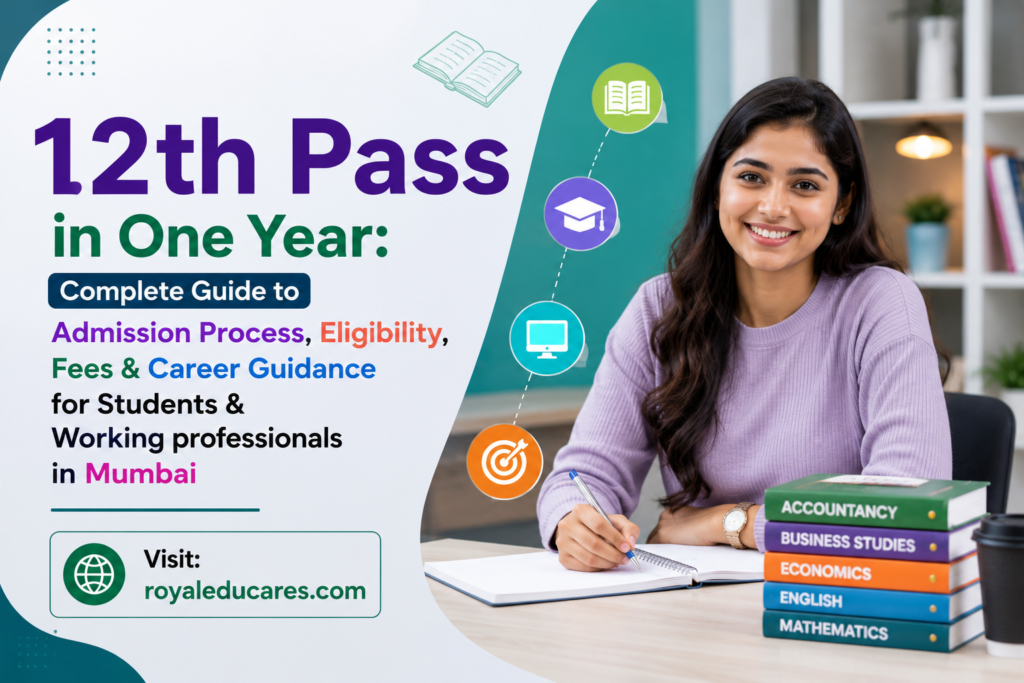
12th Pass in One Year: Complete Guide to Admission Process, Eligibility, Fees & Career Guidance for Students & Working Professionals in Mumbai
Introduction
Completing 12th education is a crucial milestone for students and working professionals seeking better career opportunities, higher education options, skill development, and long-term professional growth.
Accreditation & Approvals
UGC-DEB APPROVED
AICTE APPROVED
AIU APPROVED
NAAC +++ ACCREDITED

COBSE BOARDS
PHARMACY COUNCIL OF INDIA
BAR COUNCIL OF INDIA

WORLD EDUCATION SERVICES
MHRD

Get Free Career Counseling
Students looking for detailed information regarding 12th Pass in One Year can explore the One Year 12th Completion Guidance in Mumbai page at https://royaleducares.com/one-year-12th-completion-guidance-in-mumbai/
for admission guidance, eligibility support, and educational counseling.
For complete educational guidance, career counseling, distance education support, and higher education opportunities, students can also visit https://royaleducares.com/
to explore various academic pathways and professional assistance.
What Is 12th Pass in One Year?
The 12th standard is one of the most important educational qualifications in India. It serves as the gateway to higher education, professional courses, competitive examinations, and numerous employment opportunities.
Unfortunately, many students are unable to complete their higher secondary education due to financial difficulties, family responsibilities, employment commitments, health concerns, relocation, or personal circumstances.
As a result, they often face challenges when applying for jobs, professional certifications, diploma programs, undergraduate degrees, and career advancement opportunities.
A One Year 12th Completion pathway helps eligible students explore opportunities to complete their higher secondary education and continue their academic journey.
This option is frequently explored by:
- School dropouts
- Working professionals
- Business owners
- Homemakers
- Students with educational gaps
- Individuals seeking career growth
- Learners planning higher education
- Professionals requiring educational qualifications
Completing the 12th qualification can significantly improve academic and professional opportunities.
Why Is 12th Qualification Important?
Many students realize the importance of the 12th qualification only after facing difficulties while applying for higher education programs or employment opportunities.
The reality is that the 12th standard is one of the most widely accepted educational requirements across various industries and academic institutions.
Without a 12th qualification, students may face limitations in:
- Undergraduate admissions
- Professional courses
- Diploma programs
- Competitive examinations
- Government recruitment opportunities
- Corporate employment opportunities
- Skill development programs
Completing higher secondary education creates a strong academic foundation for future growth.
Benefits of Completing 12th Education
Access to Graduation Programs
One of the biggest advantages of completing 12th education is eligibility for bachelor’s degree programs.
Students may explore opportunities such as:
- Bachelor of Arts (BA)
- Bachelor of Commerce (B.Com)
- Bachelor of Business Administration (BBA)
- Bachelor of Computer Applications (BCA)
- Bachelor of Science (B.Sc)
- Bachelor of Social Work (BSW)
- Bachelor of Management Studies (BMS)
Graduation often becomes the next step toward professional development and career growth.
Better Career Opportunities
Employers frequently prefer candidates with higher educational qualifications.
Completing 12th education can improve eligibility for:
- Office administration roles
- Customer service positions
- Sales and marketing roles
- Business support functions
- Operations management positions
- Entry-level corporate jobs
Educational qualifications often play an important role in professional advancement.
Eligibility for Professional Courses
Students who complete their 12th qualification may become eligible for various professional and skill-development programs.
Examples include:
- Digital Marketing
- Graphic Designing
- Web Development
- Accounting Courses
- Computer Applications
- Business Management Programs
These courses can help students develop practical skills that support long-term employability.
Improved Confidence and Personal Development
Education is not only about employment opportunities.
Completing the 12th standard often helps students:
- Improve confidence
- Strengthen communication skills
- Enhance decision-making abilities
- Develop analytical thinking
- Build self-esteem
These benefits can positively influence both personal and professional life.
Who Can Apply for 12th Pass in One Year?
Many people incorrectly assume that educational opportunities disappear once they leave school.
This is not true.
Thousands of learners return to education after experiencing interruptions and successfully continue their academic journey.
Common categories of learners include:
Students With Educational Gaps
Students who left school because of family, financial, personal, or health-related reasons often seek opportunities to continue their education later.
Working Professionals
Many working professionals begin employment at a young age and later realize that educational qualifications can support promotions, career growth, and better job opportunities.
For these individuals, completing 12th education becomes a valuable investment.
Homemakers
Many homemakers decide to continue their education after fulfilling family responsibilities.
Completing the 12th standard can become the first step toward higher education and personal development.
Business Owners
Entrepreneurs and small business owners often pursue education to improve communication skills, business knowledge, and professional credibility.
Learners Planning Graduation
Many students understand that graduation opportunities generally begin after completing higher secondary education.
As a result, they seek guidance regarding 12th completion and future academic planning.
Common Reasons Students Leave School Before Completing 12th
Understanding why students discontinue education helps explain why flexible educational pathways remain important.
Financial Challenges
Many students begin working to support themselves or their families.
As a result, education is often postponed.
Family Responsibilities
Family obligations frequently force students to prioritize responsibilities over education.
Health Concerns
Physical or personal challenges can interrupt educational progress.
Relocation
Moving to a different city or region can disrupt academic continuity.
Employment Commitments
Many individuals start working before completing their higher secondary education.
Years later, they seek opportunities to continue their studies.
Lack of Educational Guidance
Some students discontinue education simply because they are unaware of available academic pathways.
Can Students Continue Education After a Long Gap?
One of the most searched questions online is:
“Can I complete my 12th after many years?”
Many students experience educational interruptions that last several years.
Some learners leave school after the 10th standard and later decide to continue their studies.
Others complete a portion of their higher secondary education but cannot finish due to unavoidable circumstances.
A long educational gap does not automatically mean the end of academic opportunities.
Every student’s situation is unique and depends on factors such as:
- Academic history
- Available documents
- Educational objectives
- Eligibility requirements
- Future career plans
Proper educational counseling helps students understand available pathways and make informed decisions.
Long Educational Gap? Your Academic Journey May Still Continue
Many students believe that once several years have passed, they can no longer continue their education.
This misconception often prevents individuals from exploring opportunities that may still be available.
Students with long educational gaps frequently seek guidance regarding:
- Completing 12th education
- Higher education opportunities
- Professional certifications
- Career advancement options
- Graduation pathways
The most important step is obtaining accurate information and professional guidance.
Can Students Plan Graduation After Completing 12th?
Yes.
One of the primary reasons students complete their 12th qualification is to become eligible for graduation opportunities.
A bachelor’s degree can significantly improve:
- Employment opportunities
- Professional growth
- Career advancement
- Business development
- Long-term earning potential
This is why many students view the 12th qualification as a bridge between school education and higher education.
Educational Gap and Future Academic Planning
Many students ask whether a long educational gap permanently affects their academic future.
In reality, educational journeys are often different for different individuals.
Some students complete education without interruptions.
Others face circumstances that delay their academic progress.
What matters most is taking the next step toward achieving educational goals.
Students who seek proper guidance and create realistic plans often find opportunities to continue their education and improve their future prospects.
Why More Students Are Searching for 12th Pass in One Year
The demand for educational flexibility continues to grow.
Common searches include:
- 12th pass in one year
- Complete 12th after dropout
- Education after long gap
- HSC completion guidance
- 12th admission guidance
- Career options after 12th
- Higher education after 12th
- Graduation after 12th
- Working professionals education
- 12th qualification for jobs
These searches reflect a growing awareness that education remains one of the most valuable investments a person can make.
Completing higher secondary education creates opportunities for academic progression, professional development, skill enhancement, and long-term career growth.
Students and working professionals who take the initiative to complete their education often position themselves for greater success in the future.
Eligibility Criteria for 12th Pass in One Year
Before exploring admission opportunities, students should understand that eligibility plays an important role in determining suitable educational pathways.
Many students assume they cannot continue their studies because they have experienced a long educational gap. However, eligibility depends on multiple factors rather than the gap alone.
Educational counselors generally assess:
Previous academic qualifications
10th pass status
Available educational documents
Age criteria
Gap duration
Career objectives
Future education plans
Understanding eligibility helps students make informed decisions and avoid unnecessary confusion.
Who Is Generally Eligible to Explore 12th Completion Opportunities?
Many categories of learners seek guidance regarding higher secondary education.
Students Who Completed 10th But Could Not Continue
This is one of the most common situations.
Students often complete their 10th qualification but are unable to continue further because of:
Financial difficulties
Family responsibilities
Health concerns
Employment commitments
Relocation
Years later, they decide to continue their education and improve their future opportunities.
Students With Long Educational Gaps
A long educational gap is often a major concern for students.
Many learners believe that once several years have passed, education is no longer possible.
However, educational counseling frequently helps students understand available pathways based on their individual circumstances.
The most important step is evaluating eligibility and documentation.
Working Professionals
Many working professionals begin employment immediately after completing 10th or partially completing higher secondary education.
As career responsibilities increase, they often realize that educational qualifications can support:
Promotions
Better job opportunities
Career advancement
Professional growth
For these individuals, completing 12th education becomes an important career decision.
Homemakers Returning to Education
Many homemakers choose to continue their education after managing family responsibilities.
Completing 12th education often becomes the first step toward:
Personal growth
Skill development
Higher education
Career opportunities
Business Owners and Entrepreneurs
Business owners frequently seek educational qualifications to improve communication skills, business understanding, and professional credibility.
Education can contribute positively to both personal and professional development.
Documents Commonly Required
Students often search:
Documents required for 12th admission
Admission documents for educational gap students
Higher secondary admission requirements
While documentation requirements may vary depending on the educational pathway, students are generally advised to keep their records organized.
Commonly requested documents may include:
Academic Documents
10th Marksheet
School Leaving Certificate
Transfer Certificate (if available)
Previous academic records
Educational proof documents
Identity Proof
Aadhaar Card
PAN Card
Passport
Driving License
Address Proof
Aadhaar Card
Electricity Bill
Voter ID
Passport
Passport Size Photographs
Recent photographs are commonly required during documentation procedures.
Students who are missing certain documents should seek professional guidance regarding alternative documentation options.
Step-by-Step Admission Process
One of the most searched queries is:
“How can I complete 12th after a gap?”
Although procedures may vary depending on individual circumstances, the admission journey generally involves several important stages.
Step 1: Educational Counseling
The first step is professional educational counseling.
During counseling, students discuss:
Academic history
Career goals
Educational gap details
Available documents
Future education plans
This helps identify suitable educational pathways.
Step 2: Eligibility Assessment
Once academic details are reviewed, eligibility is evaluated.
Factors commonly considered include:
Previous education
Documentation
Age criteria
Educational objectives
Proper assessment helps students understand their available options.
Step 3: Documentation Review
Documentation is reviewed to ensure smooth academic processing.
Students are advised to provide complete and accurate records whenever possible.
Step 4: Admission Guidance
Students receive guidance regarding:
Educational procedures
Academic planning
Future opportunities
Study preparation
This stage helps learners move forward with confidence.
Step 5: Study Preparation
After completing admission-related formalities, students can begin preparing for their educational journey.
A structured study plan significantly improves learning outcomes.
Why Professional Educational Guidance Matters
Students often make mistakes because they depend on:
Social media rumors
Incomplete information
Unverified online sources
Advice from non-experts
Professional guidance helps students:
Understand eligibility
Avoid mistakes
Plan future education
Identify career opportunities
Build long-term academic roadmaps
Proper information can save both time and effort.
Understanding Educational Gaps
Educational gaps are more common than many people realize.
Students may experience interruptions because of:
Financial Challenges
Many students begin working to support themselves or their families.
Family Responsibilities
Family obligations often require students to postpone education temporarily.
Health Concerns
Physical and personal challenges sometimes interrupt academic progress.
Employment Commitments
Work responsibilities frequently delay educational plans.
Personal Circumstances
Every student’s journey is unique.
Personal situations may affect educational timelines differently.
Long Gap After 10th? What Students Should Know
A large number of students search:
Can I complete 12th after many years?
Education after a long gap
Higher secondary after a gap
Continue studies after several years
The most important thing to understand is that educational gaps affect individuals differently.
Students should avoid assuming that their educational journey has ended.
Instead, they should seek professional counseling and understand the options available based on their specific circumstances.
Many successful learners return to education after long gaps and continue progressing toward higher qualifications.
Can Students Pursue Graduation After Completing 12th?
One of the biggest reasons students seek 12th completion guidance is because they want to continue toward graduation.
A bachelor’s degree often improves:
Employment opportunities
Professional credibility
Career advancement
Business growth
Personal development
After completing 12th, students may explore undergraduate programs such as:
BA
B.Com
BBA
BCA
B.Sc
BSW
BMS
The appropriate choice depends on individual interests and career goals.
Long Educational Gap and Graduation Planning
Many students ask whether higher education remains possible after experiencing significant educational interruptions.
Students with long gaps frequently explore opportunities related to:
Higher Secondary Education
Graduation
Degree Completion
Professional Certifications
Career Development
Educational counseling helps students understand potential pathways based on eligibility and academic history.
Because every case is unique, obtaining proper guidance remains essential.
Common Mistakes Students Should Avoid
Students often make avoidable mistakes while planning their educational comeback.
Delaying Decisions
Many learners postpone education for years because they feel uncertain.
Every year of delay can postpone future opportunities.
Depending on Rumors
Educational decisions should always be based on verified information.
Ignoring Documentation
Organizing documents early can prevent future complications.
Lack of Career Planning
Students should think beyond completing 12th and develop a long-term educational roadmap.
Study Preparation Tips for Students Returning After a Gap
Many students worry about restarting studies after several years.
The following strategies can help:
Create a Study Schedule
A structured timetable improves consistency.
Focus on Concepts
Understanding topics is more effective than memorization.
Practice Regularly
Regular revision improves retention and confidence.
Set Realistic Goals
Small achievements often lead to significant progress over time.
Stay Consistent
Consistency is usually more important than studying for extremely long hours.
Why Completing 12th Can Transform Future Opportunities
The 12th qualification is more than an academic milestone.
It can help students:
Continue higher education
Improve employability
Build professional skills
Increase confidence
Explore career opportunities
Create long-term growth pathways
For many learners, completing 12th becomes the turning point that allows them to move toward graduation, professional certifications, and better career opportunities.
Educational success often begins with one important decision:
The decision to continue learning and invest in your future.
Career Opportunities After Completing 12th
One of the most common questions students ask after completing their higher secondary education is:
“What can I do after 12th?”
The answer depends on a student’s interests, career goals, educational background, and future aspirations.
The good news is that completing the 12th standard opens the door to numerous academic, professional, technical, and skill-based opportunities.
Whether a student wants to pursue higher education, enter the workforce, learn practical skills, or start a business, the 12th qualification provides a strong foundation for future growth.
Why 12th Qualification Is Important for Career Growth
The 12th standard is often considered one of the most important educational milestones because it serves as the bridge between school education and higher education.
Many opportunities become available only after completing higher secondary education.
These opportunities include:
Graduation Programs
Professional Certifications
Competitive Examinations
Government Recruitment Opportunities
Corporate Careers
Technical Education
Skill Development Programs
Completing 12th significantly expands career possibilities.
Career Benefits of Completing 12th
Students who complete their 12th qualification often gain advantages such as:
Better Employment Opportunities
Many organizations prefer candidates who have completed higher secondary education.
The 12th qualification may improve eligibility for various entry-level professional roles.
Access to Higher Education
One of the biggest benefits of completing 12th is eligibility for graduation programs.
This qualification serves as the foundation for future academic advancement.
Increased Confidence
Educational achievement often improves self-confidence and motivation.
Students frequently feel more prepared to pursue professional and personal goals.
Professional Development
Higher educational qualifications often support career advancement and long-term growth.
Government Job Opportunities After 12th
Many students search:
Government jobs after 12th
Sarkari jobs after 12th
Best government careers after 12th
Public sector opportunities after 12th
The 12th qualification may make candidates eligible for various recruitment opportunities depending on official notification requirements.
Potential opportunities can be available within:
Railway Departments
Postal Services
Public Sector Organizations
State Government Departments
Municipal Departments
Administrative Support Services
Defense-Related Recruitment Programs
Students should always verify eligibility requirements through official recruitment notifications.
Private Sector Career Opportunities After 12th
The private sector provides a wide range of employment opportunities for individuals who have completed higher secondary education.
Common industries include:
Customer Service Industry
Customer service roles often involve:
Customer interaction
Problem solving
Communication
Service support
These positions help individuals gain valuable workplace experience.
Sales and Marketing
Sales and marketing remain among the largest employment sectors.
Common roles include:
Sales Executive
Customer Relationship Executive
Marketing Assistant
Business Development Support
Retail Industry
Retail businesses regularly recruit candidates for:
Store Operations
Customer Assistance
Sales Support
Inventory Management
Logistics and Supply Chain
The growing logistics industry offers opportunities related to:
Warehousing
Inventory Control
Distribution Support
Operations Assistance
Hospitality Industry
Hotels, restaurants, travel companies, and service organizations often hire candidates with higher secondary qualifications.
Best Skill Development Courses After 12th
Modern employers increasingly value practical skills alongside academic qualifications.
Students who develop professional skills often improve their career prospects significantly.
Digital Marketing
Digital Marketing is one of the fastest-growing career fields.
Key areas include:
Search Engine Optimization (SEO)
Social Media Marketing
Content Marketing
Google Advertising
Online Branding
Digital skills are increasingly important across industries.
Graphic Designing
Graphic design combines creativity and technology.
Professionals create:
Marketing Materials
Social Media Graphics
Advertisements
Branding Assets
Video Editing
Video content continues to grow across digital platforms.
Video editing skills are becoming highly valuable in modern business environments.
Website Development
Web development remains a sought-after skill in today’s digital economy.
Students can learn:
Website Design
Web Development Basics
Content Management Systems
Website Management
Computer Applications
Computer literacy is valuable in almost every profession.
Popular areas include:
Office Applications
Data Management
Business Software
Digital Communication Tools
Entrepreneurship Opportunities After 12th
Not every student wants a traditional job.
Many individuals choose entrepreneurship and self-employment.
Completing 12th education can support business growth by improving:
Communication
Planning
Financial understanding
Professional credibility
Examples of entrepreneurial opportunities include:
Retail Businesses
Online Businesses
Service-Based Ventures
Consulting Services
Freelancing
Education often helps entrepreneurs make informed business decisions.
Professional Courses After 12th
Students frequently search:
Best professional courses after 12th
Job-oriented courses after 12th
Career-focused courses after 12th
Popular professional programs include:
Accounting Courses
Suitable for students interested in finance and business operations.
Computer-Based Programs
Ideal for learners interested in technology and digital careers.
Business Management Courses
These programs help students develop organizational and leadership skills.
Communication and Soft Skill Programs
Strong communication skills remain valuable across all industries.
Why Students Should Continue Learning After 12th
Although completing 12th is a major achievement, students should continue investing in education and skills.
Continuous learning helps individuals:
Remain competitive
Improve employability
Build professional expertise
Increase career opportunities
Adapt to changing industries
Learning should be viewed as a lifelong process.
Common Career Planning Mistakes After 12th
Students often make mistakes that affect long-term growth.
Choosing a Course Without Research
Students should evaluate:
Career prospects
Personal interests
Industry demand
Future growth opportunities
before making decisions.
Following Friends Instead of Goals
Educational and career decisions should be based on individual objectives rather than peer influence.
Ignoring Skill Development
Practical skills are becoming increasingly important alongside academic qualifications.
Lack of Long-Term Planning
Students should think beyond immediate goals and create a structured career roadmap.
Can Working Professionals Benefit From Completing 12th?
Absolutely.
Many working professionals pursue higher secondary education because they want:
Better job opportunities
Promotions
Career advancement
Higher education eligibility
Professional development
Completing 12th can become the foundation for future academic and career growth.
The Importance of Building a Long-Term Career Roadmap
Students should not view the 12th qualification as the final destination.
Instead, it should be considered a stepping stone toward larger goals.
A practical roadmap may include:
12th Completion → Skill Development → Graduation → Professional Growth → Career Advancement
This approach helps students build sustainable long-term success.
Success Starts With Educational Growth
Every successful career begins with a commitment to learning.
Whether a student wants to pursue higher education, secure better employment, develop professional skills, or start a business, completing 12th education can create valuable opportunities.
The decision to continue education today can become the foundation for future success, confidence, professional growth, and lifelong achievement.
Best Courses After 12th: Complete Higher Education Guide
Completing the 12th standard is one of the most important academic milestones because it opens the door to a wide range of educational and career opportunities.
One of the most common questions students ask is:
“Which course is best after 12th?”
The answer depends on several factors, including:
Career goals
Personal interests
Academic background
Future plans
Industry demand
Choosing the right course can help students build a strong foundation for long-term career success.
Understanding Higher Education After 12th
After completing higher secondary education, students generally have three major pathways:
Graduation Programs
Students who want long-term career growth often pursue bachelor’s degree programs.
Professional Courses
Students interested in practical and industry-oriented learning may choose professional certifications and specialized programs.
Skill Development Programs
Students can also focus on developing job-oriented skills that improve employability.
Each pathway offers unique advantages depending on individual goals.
Best Courses After 12th Arts
Students from the Arts stream have access to a wide variety of educational opportunities.
Contrary to popular misconceptions, Arts offers excellent career potential across multiple industries.
Bachelor of Arts (BA)
BA remains one of the most popular undergraduate programs.
Popular specializations include:
History
Political Science
Sociology
Psychology
Economics
English Literature
Career opportunities may include:
Education
Administration
Journalism
Public Relations
Government Services
Bachelor of Social Work (BSW)
BSW is suitable for students interested in community development and social services.
Career opportunities include:
NGOs
Community Organizations
Social Development Projects
Welfare Programs
Journalism and Mass Communication
Students interested in media and communication can explore this field.
Potential career areas include:
News Media
Content Creation
Broadcasting
Public Relations
Best Courses After 12th Commerce
Commerce remains one of the most popular streams because of its connection to business, finance, and management careers.
Bachelor of Commerce (B.Com)
B.Com provides strong knowledge in:
Accounting
Finance
Taxation
Economics
Business Operations
Career opportunities include:
Accounting
Banking
Finance
Tax Consulting
Business Administration
Bachelor of Business Administration (BBA)
BBA focuses on management and business development.
Students learn:
Marketing
Human Resources
Business Management
Entrepreneurship
BBA often serves as a strong foundation for leadership careers.
Bachelor of Management Studies (BMS)
BMS is another popular management-oriented program.
Students develop knowledge related to:
Business Strategy
Organizational Management
Leadership
Corporate Operations
Best Courses After 12th Science
Science students often have access to diverse educational opportunities.
Bachelor of Science (B.Sc)
B.Sc programs are available across numerous disciplines.
Popular fields include:
Physics
Chemistry
Mathematics
Biotechnology
Environmental Science
B.Sc can lead to both professional and research-oriented careers.
Computer Science Programs
Technology-related education continues to grow rapidly.
Students interested in computers often explore programs related to:
Software Development
Programming
Data Analysis
Information Technology
Healthcare and Allied Fields
Students interested in healthcare may explore opportunities based on eligibility and career interests.
Healthcare remains one of the largest employment sectors globally.
Most Popular Professional Courses After 12th
Many students prefer practical, career-oriented programs.
Popular professional options include:
Digital Marketing
Digital Marketing is one of the fastest-growing industries.
Key areas include:
SEO
Content Marketing
Social Media Marketing
Online Advertising
Brand Promotion
Businesses across all industries increasingly require digital marketing professionals.
Graphic Designing
Graphic design combines creativity and technology.
Career opportunities exist in:
Advertising
Branding
Marketing
Social Media Management
Web Development
Web development skills remain highly valuable in the digital economy.
Students can learn:
Website Design
Website Management
Front-End Development
Content Management Systems
Computer Applications
Computer-based skills are useful across almost every profession.
Students often pursue:
Office Productivity Tools
Data Management
Business Software Training
Digital Communication Platforms
Diploma Courses After 12th
Diploma programs remain popular among students seeking practical and career-oriented education.
Advantages include:
Industry-relevant learning
Practical skill development
Faster career preparation
Professional exposure
Diploma programs are available across numerous fields depending on student interests.
Skill Development Programs After 12th
The modern job market increasingly values practical skills.
Students can improve employability by learning:
Communication Skills
Strong communication supports professional success.
Computer Literacy
Computer skills are valuable across industries.
Business Skills
Business knowledge supports both employment and entrepreneurship.
Digital Skills
Digital literacy continues to become increasingly important.
Leadership Skills
Leadership abilities contribute to long-term career growth.
Which Course Has Better Career Scope?
Students frequently ask:
“Which course has the best future?”
There is no single answer.
The best course depends on:
Interests
Career goals
Strengths
Industry demand
Long-term aspirations
Students should choose educational pathways that align with both personal interests and future opportunities.
Higher Education Planning After 12th
Educational planning should be viewed as a long-term process.
Students should create a roadmap that includes:
Step 1
Complete 12th Education
↓
Step 2
Choose a Suitable Graduation Program
↓
Step 3
Develop Professional Skills
↓
Step 4
Gain Practical Experience
↓
Step 5
Continue Professional Development
This structured approach often produces better career outcomes.
Common Mistakes Students Make After 12th
Many students make avoidable mistakes during educational planning.
Choosing Courses Based Only on Popularity
A course should match career goals and interests.
Ignoring Industry Trends
Students should understand emerging opportunities before making decisions.
Following Peer Pressure
Educational decisions should be based on personal objectives rather than social influence.
Ignoring Skill Development
Skills and qualifications work best when developed together.
Why Educational Guidance Is Important
Students often receive conflicting advice from different sources.
Professional educational counseling can help students:
Understand options
Select suitable programs
Create career roadmaps
Avoid common mistakes
Make informed decisions
Proper guidance often saves time and improves decision-making.
Building a Strong Future After 12th
The completion of higher secondary education creates opportunities for continuous academic and professional growth.
Students who carefully plan their next steps often gain advantages in:
Higher Education
Employment
Business
Professional Development
Personal Growth
The key is to view education as a journey rather than a single milestone.
Every educational decision made today can influence future opportunities and long-term success.
Graduation After 12th: Complete Guide for Students and Working Professionals
For most students, completing the 12th standard is not the final educational goal.
Instead, it becomes the foundation for higher education, professional development, and long-term career growth.
One of the most searched questions online is:
“What should I do after completing 12th?”
The answer often begins with graduation.
A bachelor’s degree remains one of the most valuable educational qualifications because it can improve:
Employment opportunities
Professional credibility
Career advancement
Business opportunities
Higher education eligibility
Long-term earning potential
Students who complete their 12th education often explore graduation programs to strengthen their future prospects.
Why Graduation Is Important After 12th
Graduation serves as the next major academic milestone after higher secondary education.
Many organizations prefer graduates for:
Administrative roles
Corporate positions
Management opportunities
Leadership roles
Professional careers
A bachelor’s degree can also become the gateway to postgraduate education and specialized professional programs.
Popular Graduation Courses After 12th
Students can choose from various undergraduate programs depending on their interests and career objectives.
Bachelor of Arts (BA)
BA is one of the most popular graduation programs in India.
The course focuses on:
Humanities
Social Sciences
Communication
Research Skills
Critical Thinking
Popular subjects include:
History
Political Science
Sociology
Psychology
Economics
English
Career opportunities may include:
Education
Journalism
Public Relations
Government Services
Content Development
Social Sector Careers
Bachelor of Commerce (B.Com)
B.Com is widely chosen by students interested in business and finance.
Key areas of study include:
Accounting
Economics
Taxation
Business Operations
Financial Management
Career opportunities include:
Accounting
Banking
Finance
Tax Consulting
Business Administration
B.Com remains one of the most sought-after graduation programs.
Bachelor of Business Administration (BBA)
BBA focuses on management and business development.
Students learn:
Marketing
Human Resources
Business Strategy
Entrepreneurship
Organizational Management
This course is suitable for students who wish to pursue management careers.
Bachelor of Computer Applications (BCA)
Technology continues to create significant career opportunities.
BCA helps students build knowledge related to:
Computer Applications
Programming Concepts
Software Development
Information Technology
Students interested in digital and technology-related careers often consider BCA.
Bachelor of Science (B.Sc)
B.Sc programs provide opportunities in scientific and technical fields.
Popular areas include:
Mathematics
Physics
Chemistry
Environmental Science
Biotechnology
Graduates may pursue professional, research, or higher education opportunities.
Bachelor of Social Work (BSW)
BSW focuses on community development and social welfare.
Career opportunities may include:
Social Organizations
NGOs
Community Projects
Welfare Programs
Students interested in social impact careers often choose this pathway.
Bachelor of Management Studies (BMS)
BMS focuses on management, leadership, and organizational development.
Students develop knowledge related to:
Business Operations
Corporate Management
Leadership
Strategic Planning
The course supports careers in corporate and business environments.
How to Choose the Right Graduation Course
Students often become confused because of the large number of available options.
The right course depends on:
Career Goals
Students should identify where they want to be professionally in the future.
Personal Interests
Interest plays a major role in long-term academic success.
Strengths and Skills
Educational choices should align with natural abilities and talents.
Industry Demand
Understanding future employment trends can help students make informed decisions.
Graduation Opportunities for Working Professionals
Working professionals often seek graduation opportunities because they want:
Career advancement
Better salaries
Promotion opportunities
Professional growth
Leadership positions
Many professionals understand that higher qualifications can support long-term career development.
Educational Gap and Graduation Planning
Many students worry about educational interruptions.
Common concerns include:
Long academic gaps
Delayed education
Career interruptions
Family responsibilities
Educational gaps do not necessarily prevent future academic progress.
Many learners successfully continue their education after several years.
The most important factor is proper planning and guidance.
One Year Graduation Opportunities for Eligible Candidates
A growing number of students and working professionals search for:
Graduation in One Year
Degree Completion Programs
Fast Track Graduation
One Sitting Degree Guidance
Graduation After Long Gap
These searches are particularly common among individuals who:
Experienced educational interruptions
Started working early
Could not complete their degree
Want to improve career opportunities
Depending on academic history, documentation, eligibility requirements, and educational background, learners often explore available pathways that may help them achieve their graduation goals.
Because every case is different, students should always seek professional educational counseling before making decisions regarding degree completion.
Why Many Students Plan Graduation Immediately After 12th
Students who continue directly into graduation often experience several advantages.
These include:
Continuous Academic Momentum
Learning becomes easier when students continue their education without major interruptions.
Faster Career Progression
Graduates often become eligible for broader career opportunities.
Better Higher Education Opportunities
Graduation provides eligibility for postgraduate programs and advanced certifications.
Stronger Professional Profile
Educational qualifications contribute positively to professional credibility.
Higher Education After Graduation
Students frequently ask:
“What comes after graduation?”
Higher education opportunities may include:
MBA
M.Com
MA
MCA
M.Sc
Professional Certifications
Industry-Specific Programs
Higher qualifications can help students specialize in their chosen fields.
Building a Long-Term Educational Roadmap
Students should think beyond immediate academic goals.
A practical roadmap may look like:
12th Completion
↓
Graduation
↓
Professional Skills
↓
Work Experience
↓
Higher Education
↓
Career Advancement
This approach supports sustainable long-term growth.
Skills That Increase Career Opportunities After Graduation
Educational qualifications become even more valuable when combined with practical skills.
Students should focus on:
Communication Skills
Strong communication supports professional success.
Digital Skills
Digital literacy is increasingly important across industries.
Leadership Skills
Leadership abilities contribute to career advancement.
Problem-Solving Skills
Organizations value individuals who can solve challenges effectively.
Adaptability
The ability to learn continuously is becoming one of the most important professional strengths.
Future Scope After Graduation
Graduation can help students pursue opportunities in:
Corporate Careers
Government Opportunities
Entrepreneurship
Professional Services
Higher Education
Specialized Industries
The specific opportunities depend on the chosen field and individual career goals.
Why Educational Growth Should Never Stop
One of the biggest mistakes students make is assuming that education ends after receiving a certificate.
The modern professional world rewards continuous learning.
Students who continue developing:
Knowledge
Skills
Experience
Professional expertise
often position themselves for stronger long-term success.
Education as a Long-Term Investment
Education is one of the few investments that can continue providing benefits throughout a person’s life.
Completing 12th education and planning graduation thoughtfully can help students:
Improve employability
Build confidence
Expand career options
Increase earning potential
Create professional growth opportunities
Every educational milestone contributes toward building a stronger future.
For many students and working professionals, graduation becomes the next important step after completing 12th and moving toward long-term academic and career success.
Frequently Asked Questions About 12th Pass in One Year
Students and working professionals often have numerous questions before continuing their education. The following frequently asked questions address many of the concerns commonly raised during educational counseling.
Is Completing 12th Important?
Yes.
The 12th qualification is one of the most important educational milestones because it provides access to higher education, professional courses, skill development programs, and various career opportunities.
Can I Continue Education After a Long Gap?
Many students return to education after long academic interruptions.
Available opportunities depend on educational background, documentation, eligibility requirements, and future academic goals.
Can Working Professionals Complete Their 12th Education?
Many working professionals successfully continue their education while maintaining their employment responsibilities.
Proper planning and consistency are often the key factors.
Can Homemakers Continue Their Education?
Yes.
Many homemakers restart their educational journey after managing family responsibilities and later continue toward higher education and professional development.
Why Do Students Return to Education After Several Years?
Common reasons include:
Career growth
Better job opportunities
Higher education goals
Personal development
Increased confidence
Professional advancement
Is Educational Counseling Important?
Professional guidance helps students:
Understand options
Assess eligibility
Plan future education
Avoid common mistakes
Proper information often leads to better decisions.
What Can Students Do After Completing 12th?
Students may explore:
Graduation Programs
Professional Certifications
Diploma Courses
Skill Development Programs
Career-Oriented Training
The best option depends on individual goals.
Why Is Graduation Important After 12th?
Graduation often improves:
Employment opportunities
Career growth
Professional credibility
Higher education eligibility
It remains one of the most valuable educational milestones.
Can Education Improve Career Growth?
Educational qualifications frequently contribute to professional advancement, better opportunities, and long-term career development.
Is It Too Late to Continue Education?
Learning is not limited by age.
Many students and professionals continue their education at different stages of life.
Common Mistakes Students Should Avoid
Students often make mistakes that delay educational progress and career growth.
Avoiding these mistakes can significantly improve outcomes.
Waiting for the Perfect Time
Many students postpone education for years because they believe the perfect opportunity will arrive later.
In reality, progress usually begins when students take action.
Lack of Career Planning
Some learners focus only on obtaining qualifications without creating long-term educational goals.
Students should always think beyond immediate milestones.
Ignoring Skill Development
Modern employers value both qualifications and practical skills.
Students should continuously develop:
Communication Skills
Computer Skills
Digital Skills
Problem-Solving Abilities
Depending on Unverified Information
Educational decisions should always be based on reliable information and professional guidance.
Underestimating Their Potential
Many students believe they cannot succeed because of educational gaps.
This belief often becomes the biggest obstacle.
Confidence grows through action and consistency.
Student Success Strategies
Students who successfully achieve educational goals often follow similar habits.
Set Clear Goals
Students should identify:
Educational objectives
Career aspirations
Long-term plans
Clear goals provide direction and motivation.
Create a Study Schedule
Consistency often matters more than studying for long hours.
A structured timetable improves focus and productivity.
Stay Disciplined
Discipline helps students maintain momentum during their educational journey.
Continue Learning
Continuous learning supports both academic and professional growth.
Seek Guidance When Needed
Professional counseling can help students make informed decisions and avoid unnecessary confusion.
Career Planning Tips After Completing 12th
Educational success becomes more meaningful when combined with effective career planning.
Students should consider:
Long-Term Goals
Think about where you want to be professionally in the future.
Industry Demand
Research industries with strong growth potential.
Skill Development
Practical skills often complement academic qualifications.
Professional Experience
Experience plays an important role in career development.
Continuous Improvement
The most successful professionals continue learning throughout their careers.
Why Skills Matter Alongside Education
Educational qualifications provide a foundation, but practical skills help students succeed in the real world.
Important skills include:
Communication Skills
Strong communication improves professional interactions.
Computer Literacy
Computer knowledge remains essential across industries.
Digital Skills
Digital transformation continues to create new opportunities.
Leadership Skills
Leadership abilities contribute to professional advancement.
Adaptability
Adaptability helps individuals succeed in changing environments.
Future Scope After Completing 12th
The future opportunities available after completing 12th education are extensive.
Students may choose to pursue:
Graduation
Popular options include:
BA
B.Com
BBA
BCA
B.Sc
BSW
BMS
Professional Courses
Students may develop practical skills through career-oriented programs.
Competitive Examinations
Many students prepare for examinations that support government and professional careers.
Entrepreneurship
Education can also support business development and self-employment opportunities.
Higher Education
Students may eventually continue toward postgraduate education and advanced professional qualifications.
Long Educational Gap? Don’t Stop Planning Your Future
Many individuals believe that educational interruptions permanently affect future opportunities.
However, thousands of learners successfully return to education after several years.
Students who experienced:
Financial difficulties
Family responsibilities
Health challenges
Employment commitments
Personal circumstances
often discover that educational growth remains possible when supported by proper planning and guidance.
The key is to focus on future opportunities rather than past interruptions.
Education and Career Growth: The Bigger Picture
Education is not simply about obtaining certificates.
It contributes to:
Knowledge Development
Professional Growth
Career Opportunities
Confidence Building
Personal Development
Lifelong Learning
Educational achievements often create opportunities that extend far beyond employment alone.
Final Thoughts
Completing the 12th standard is one of the most important decisions students and working professionals can make when planning their future.
Whether someone left school because of financial challenges, family responsibilities, employment commitments, health concerns, or personal circumstances, continuing education can create valuable opportunities for growth and advancement.
A recognized 12th qualification helps build a foundation for:
Graduation
Professional Certifications
Skill Development
Career Advancement
Entrepreneurship
Higher Education
Students who continue investing in education often gain access to broader opportunities and stronger long-term prospects.
The most important lesson is simple:
An educational gap does not have to define your future.
With determination, proper guidance, consistent effort, and a commitment to learning, students and working professionals can continue building their qualifications, developing their skills, and creating better opportunities for themselves.
Every educational milestone achieved today can become the foundation for future success, professional growth, and lifelong achievement.
Education remains one of the most valuable investments a person can make, and the decision to continue learning can positively influence opportunities for years to come.
Conclusion
For students and working professionals seeking better career opportunities, higher education options, and long-term professional growth, completing 12th education remains a significant milestone.
It opens doors to graduation programs, professional courses, skill development opportunities, and various career pathways.
Those who take the initiative to continue their education often position themselves for greater confidence, stronger career prospects, and improved personal development.
The journey may begin with completing 12th, but the opportunities that follow can shape an individual’s future for years to come.
Contact Royal Educares
Royal Educares
Education Guidance & Admission Support Across India
 Website:
https://royaleducares.com/
 Email:
info@royaleducares.com
 Phone:
+91 9819649369
 Address:
9/D-1, Office No. 005, Sangharsh Nagar, Chandivali, Powai, Mumbai, Maharashtra 400072, India
 GET DIRECTION
Google Map
Start your Admission Today!
Let Us Help You Choose the Right Course for Your Future.