
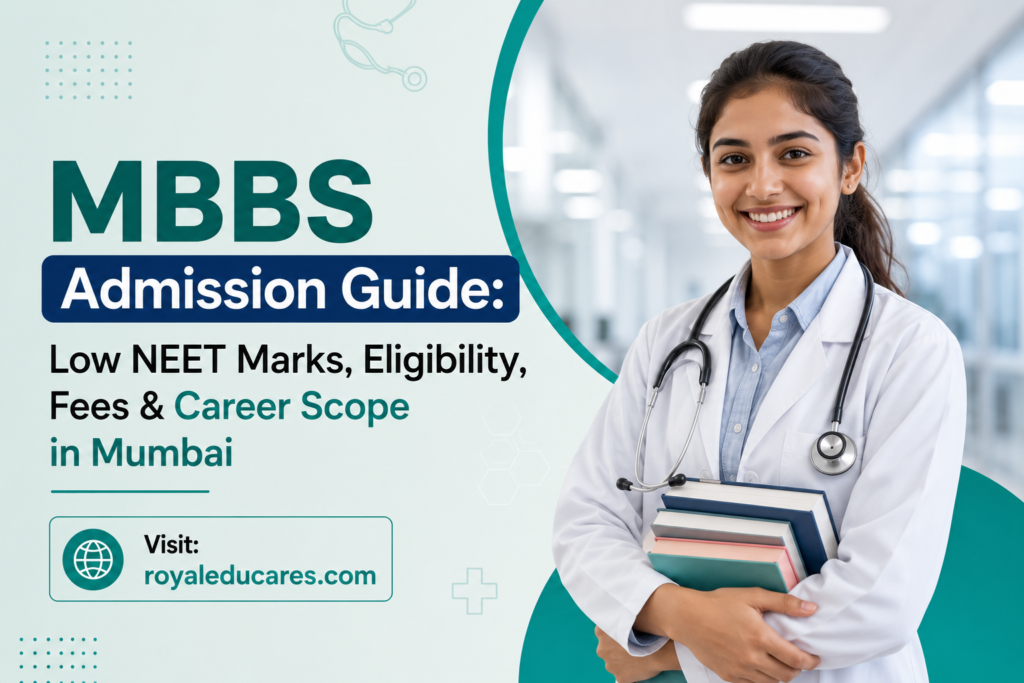
MBBS Admission Guide: Low NEET Marks, Eligibility, Fees & Carrer Guidance in Mumbai
Introduction
MBBS remains one of India’s most sought-after medical courses. Understanding admission requirements, NEET eligibility, fees, and career opportunities helps students make informed decisions for a successful medical career.
Accreditation & Approvals
UGC-DEB APPROVED
AICTE APPROVED
AIU APPROVED
NAAC +++ ACCREDITED

COBSE BOARDS
PHARMACY COUNCIL OF INDIA
BAR COUNCIL OF INDIA

WORLD EDUCATION SERVICES

MHRD

Get Free Career Counseling
Students looking for detailed information about medical admissions can explore BDS, BHMS, BAMS, BNYS, B.SC Nursing Regular Medical Courses Admission in Mumbai at https://royaleducares.com/regular-medical-courses-admission-in-mumbai/ to understand available options.
For complete admission assistance and guidance regarding various healthcare programs, students can also visit https://royaleducares.com/.
MBBS Admission in Mumbai: Everything Students Need to Know
Every year, thousands of students dream of wearing a white coat and becoming a doctor. Among all medical courses available after Class 12, MBBS continues to be the most sought-after option. The combination of career stability, social respect, diverse specialization opportunities, and long-term professional growth makes MBBS the first choice for most medical aspirants.
Students frequently search for:
- MBBS admission in Mumbai
- MBBS admission with low NEET marks
- MBBS eligibility criteria
- MBBS fees in Mumbai
- Private MBBS admission
- Government medical colleges in Mumbai
- Career after MBBS
- Medical courses after 12th PCB
- MBBS admission process
- NEET counseling guide
Understanding the complete admission process is essential for making informed decisions and avoiding costly mistakes during counseling and college selection.
What is MBBS?
MBBS stands for Bachelor of Medicine and Bachelor of Surgery. It is the primary undergraduate medical degree required for students who wish to become doctors.
The course combines theoretical medical education, practical training, clinical exposure, and internship experience. Students learn how to diagnose diseases, understand human anatomy, prescribe treatments, and provide patient care.
MBBS serves as the foundation for nearly every advanced medical specialization. Whether a student wishes to become a cardiologist, neurologist, surgeon, dermatologist, pediatrician, or physician, the journey begins with MBBS.
Why MBBS is the Most Popular Medical Course in India
Several healthcare programs are available after Class 12, including:
- BDS
- BAMS
- BHMS
- BNYS
- B.Sc Nursing
However, MBBS consistently remains the most preferred option.
Broad Career Opportunities
One major reason is the wide range of career paths available after graduation.
MBBS graduates can work in:
- Hospitals
- Clinics
- Government healthcare departments
- Research organizations
- Medical education institutions
- Healthcare startups
- Public health organizations
This flexibility attracts students who want long-term career security.
Strong Professional Recognition
Doctors are among the most respected professionals in society. Their contribution to healthcare and patient well-being creates a high level of trust and recognition.
Growing Healthcare Industry
India’s healthcare sector continues to expand rapidly. New hospitals, diagnostic centers, specialty clinics, and healthcare facilities are increasing the demand for qualified medical professionals. Admission guidance for MBBS and other medical programs is among the services highlighted by Royal Educares.
Global Opportunities
Medical graduates can also explore international opportunities after meeting country-specific licensing requirements.
Why Students Prefer Mumbai for MBBS Admission
Mumbai is considered one of India’s leading educational and healthcare hubs.
Students from different states choose Mumbai because it offers:
- Advanced healthcare infrastructure
- Extensive clinical exposure
- Large patient inflow
- Experienced faculty
- Modern medical facilities
- Better networking opportunities
- Diverse learning environment
The city provides exposure to a wide variety of medical cases, helping students develop strong practical skills during their education.
Eligibility Criteria for MBBS Admission
Before applying for MBBS admission, students must understand the eligibility requirements.
Educational Qualification
Candidates should complete their 10+2 education from a recognized board.
Required Subjects
Students must have studied:
- Physics
- Chemistry
- Biology
- English
These subjects form the academic foundation for medical education.
Minimum Qualification Requirements
Admission eligibility depends on prevailing admission regulations, counseling requirements, and institutional criteria.
Students should always verify current requirements before applying.
Age Criteria
Candidates must satisfy the applicable age requirements prescribed under current admission guidelines.
NEET Qualification
NEET is the primary entrance examination for MBBS admissions in India.
Qualifying NEET is an essential step in the admission process.
Understanding NEET for MBBS Admission
The National Eligibility cum Entrance Test (NEET) is one of the most competitive entrance examinations in India.
Every year, lakhs of students appear for the examination to secure seats in medical programs.
Why NEET is Important
NEET provides:
- Standardized evaluation
- Merit-based admissions
- Nationwide acceptance
- Transparent selection process
Because of its importance, students begin preparation months or even years before the examination.
Can Students Get MBBS Admission with Low NEET Marks?
This is one of the most searched questions among medical aspirants.
Many students assume that a lower-than-expected NEET score automatically ends their dream of becoming a doctor. However, admission opportunities depend on multiple factors.
These factors may include:
- Counseling rounds
- Seat availability
- Category criteria
- Institutional policies
- Cutoff trends
- Competition levels
Students should avoid making decisions based solely on assumptions.
Instead, they should:
- Participate in counseling
- Explore all available options
- Seek professional guidance
- Monitor admission updates
- Stay informed about counseling schedules
Proper planning often helps students identify opportunities that they might otherwise overlook.
MBBS Course Duration
One of the most common questions asked by students is:
“How many years is MBBS?”
The MBBS program includes academic learning, practical training, clinical exposure, and compulsory internship components according to applicable regulations.
The curriculum is designed to prepare students for real-world healthcare responsibilities and patient care.
MBBS Course Structure
The MBBS curriculum is divided into different academic stages.
Each stage focuses on developing specific medical competencies.
Foundation Phase
Students build a strong understanding of:
- Human anatomy
- Physiology
- Biochemistry
These subjects form the basis of medical science.
Pre-Clinical Education
Students learn about the structure and functioning of the human body.
This phase creates the scientific foundation needed for future clinical training.
Para-Clinical Education
Key subjects include:
- Pathology
- Pharmacology
- Microbiology
- Community Medicine
Students begin understanding disease mechanisms and treatment principles.
Clinical Education
Clinical training introduces students to patient care and hospital environments.
Major clinical disciplines include:
- Medicine
- Surgery
- Pediatrics
- Orthopedics
- Dermatology
- Psychiatry
- Obstetrics and Gynecology
This stage develops practical medical skills essential for professional practice.
Major Subjects Studied in MBBS
The MBBS curriculum covers a wide range of medical disciplines.
Anatomy
Anatomy focuses on the structure of the human body.
Students study:
- Bones
- Muscles
- Organs
- Nervous System
- Blood Vessels
A strong understanding of anatomy is essential for clinical medicine.
Physiology
Physiology explains how different body systems function.
Topics include:
- Cardiovascular System
- Respiratory System
- Digestive System
- Nervous System
- Endocrine System
Understanding normal body function helps students recognize disease conditions.
Biochemistry
Biochemistry examines the chemical processes occurring within the body.
Students learn about:
- Proteins
- Enzymes
- Hormones
- Metabolism
- Cellular Functions
This subject connects biology with medicine.
Pathology
Pathology studies diseases and their effects on tissues and organs.
Students understand:
- Disease mechanisms
- Tissue changes
- Diagnostic principles
- Laboratory investigations
Pharmacology
Pharmacology focuses on medicines and their effects.
Students learn:
- Drug actions
- Therapeutic applications
- Side effects
- Drug interactions
Medical professionals rely heavily on pharmacological knowledge throughout their careers.
Why MBBS Continues to Have High Demand
The demand for doctors remains strong due to several factors:
- Population growth
- Expanding healthcare infrastructure
- Rising healthcare awareness
- Growth of specialty hospitals
- Increasing focus on preventive healthcare
- Technological advancements in medicine
Healthcare remains an essential sector, ensuring consistent demand for qualified professionals.
Conclusion
MBBS continues to be one of the most respected and rewarding professional courses after Class 12. Understanding eligibility, NEET requirements, course structure, and admission pathways helps students prepare strategically for a successful medical career.
MBBS Admission Process in Mumbai, NEET Counseling, Fees & College Selection Guide
Understanding the MBBS Admission Process
Securing admission into an MBBS program requires more than simply appearing for NEET. Students must understand every stage of the admission journey, from examination preparation to counseling, seat allotment, document verification, and final enrollment.
Many students lose valuable opportunities because they are unaware of the complete admission process. Understanding each step helps candidates make informed decisions and improve their chances during counseling.
Step-by-Step MBBS Admission Process
Step 1: Complete Class 12 with PCB
The first requirement for MBBS admission is completing higher secondary education with:
Physics
Chemistry
Biology
English
A strong academic foundation in these subjects helps students perform better in NEET and later medical studies.
Step 2: Appear for NEET
NEET is the gateway to undergraduate medical education in India.
Students preparing for NEET typically focus on:
Physics
Physics develops analytical thinking and problem-solving abilities.
Important areas often include:
Mechanics
Modern Physics
Electricity
Optics
Chemistry
Chemistry forms a significant portion of the examination.
Students focus on:
Organic Chemistry
Inorganic Chemistry
Physical Chemistry
Biology
Biology carries substantial weightage and is considered the most important subject for medical aspirants.
Topics include:
Human Physiology
Genetics
Ecology
Cell Biology
Biotechnology
Consistent preparation and regular practice are essential for achieving competitive scores.
Step 3: Analyze NEET Results
After results are announced, students should carefully evaluate:
NEET Score
All India Rank
Category Rank
Previous Cutoff Trends
Counseling Opportunities
Proper analysis helps students build a realistic admission strategy.
Step 4: Participate in Counseling
Counseling is one of the most important stages in the admission process.
During counseling, students:
Register themselves
Fill college preferences
Submit required information
Participate in seat allotment rounds
Students should complete every step carefully to avoid complications later.
Step 5: Seat Allotment
Seat allotment depends on multiple factors including:
NEET performance
Seat availability
Category criteria
Counseling preferences
Applicable admission regulations
Students should regularly monitor official updates throughout the counseling process.
Step 6: Document Verification
Document verification is necessary before admission confirmation.
Candidates must ensure that all submitted documents are accurate and complete.
Step 7: Final Admission Confirmation
After successful verification and completion of admission formalities, students can proceed with enrollment.
This marks the beginning of their medical education journey.
NEET Counseling Explained
Many students search for:
NEET counseling process
MBBS counseling guide
How medical counseling works
MBBS seat allotment process
Understanding counseling is critical because even students with good scores can make mistakes that affect admission outcomes.
Why Counseling is Important
Counseling determines:
College allocation
Seat distribution
Admission opportunities
Final enrollment status
Students should approach counseling with proper planning rather than making rushed decisions.
Common Counseling Mistakes Students Should Avoid
Choosing Too Few Colleges
Limiting college choices may reduce available opportunities.
Students should create balanced preference lists.
Ignoring Research
Many candidates choose colleges without understanding important factors such as:
Infrastructure
Faculty
Clinical exposure
Academic environment
Research helps students make better decisions.
Missing Deadlines
Admission schedules are strict.
Missing deadlines can affect participation in counseling rounds.
Incomplete Documentation
Incorrect or incomplete documentation may create delays during verification.
Students should prepare documents well in advance.
Documents Required for MBBS Admission
Students frequently search:
Documents needed for MBBS admission
NEET counseling documents
Medical admission document checklist
Typical documents may include:
Class 10 Marksheet
Class 10 Certificate
Class 12 Marksheet
Class 12 Passing Certificate
NEET Admit Card
NEET Scorecard
Identity Proof
Passport Size Photographs
Category Certificate (if applicable)
Domicile Certificate (where applicable)
Students should always verify the latest requirements before submission.
MBBS Fees in Mumbai
One of the most searched queries is:
“What are the MBBS fees in Mumbai?”
MBBS fees vary significantly depending on multiple factors.
These may include:
Type of institution
Infrastructure
Clinical facilities
Academic resources
Hospital affiliations
Regulatory guidelines
Students should verify current fee structures directly from official sources before making decisions.
Factors Affecting MBBS Fees
Institution Type
Fee structures often vary between different categories of institutions.
Infrastructure
Modern laboratories, simulation facilities, libraries, and advanced learning resources may influence educational costs.
Clinical Exposure
Institutions with extensive hospital networks often provide broader clinical learning opportunities.
Academic Resources
Research facilities, digital learning tools, and educational support systems also contribute to the overall learning environment.
Government vs Private Medical Colleges
Students often compare government and private medical colleges before making admission decisions.
Both options have unique advantages.
Government Medical Colleges
Government institutions are often known for:
Strong academic reputation
Competitive learning environment
Extensive patient exposure
Established healthcare systems
Because of limited seats and high demand, competition is generally intense.
Private Medical Colleges
Private institutions often offer:
Modern infrastructure
Advanced learning facilities
Diverse educational resources
Wider seat availability
Students should evaluate each institution individually rather than relying solely on general perceptions.
How to Choose the Right MBBS College
Choosing a medical college is one of the most important decisions in a student’s academic journey.
Several factors should be considered.
Academic Reputation
A college’s academic track record can influence learning opportunities and future prospects.
Faculty Quality
Experienced faculty members contribute significantly to student development.
Clinical Exposure
Clinical training remains one of the most important aspects of medical education.
Students should evaluate hospital exposure opportunities carefully.
Infrastructure
Important facilities include:
Laboratories
Libraries
Lecture Halls
Research Facilities
Clinical Training Resources
Hospital Attachments
Hospitals associated with medical institutions play a crucial role in practical learning.
A strong patient inflow often provides valuable exposure.
Location and Accessibility
Students should also consider:
Connectivity
Living arrangements
Transportation
Convenience
These factors can affect the overall educational experience.
Why Students Search for MBBS Admission with Low NEET Marks
Every year, thousands of students look for information regarding admission opportunities with lower-than-expected NEET scores.
Common searches include:
MBBS admission with low NEET marks
Medical admission guidance
Private MBBS admission
MBBS counseling support
Students should understand that admission possibilities depend on multiple variables and counseling outcomes rather than assumptions alone.
Professional guidance often helps candidates explore available options more effectively.
Skills Every Future Doctor Should Develop
Medical education requires more than academic excellence.
Successful doctors typically develop:
Communication Skills
Effective communication improves patient interaction and healthcare outcomes.
Critical Thinking
Medical professionals regularly analyze complex situations.
Problem Solving
Clinical decision-making requires strong reasoning abilities.
Professional Ethics
Ethical conduct remains fundamental in healthcare.
Continuous Learning
Medicine evolves constantly, making lifelong learning essential.
Conclusion
Understanding the MBBS admission process, counseling procedures, fee considerations, documentation requirements, and college selection factors can help students make informed decisions. Proper planning and awareness significantly improve the admission experience and help aspirants move closer to their dream of becoming a doctor.
Career Scope After MBBS, Salary, PG Medical Courses & Future Opportunities
Career Opportunities After MBBS
One of the biggest reasons students choose MBBS is the vast range of career opportunities available after graduation. Unlike many professional courses that offer limited career pathways, MBBS opens doors to multiple healthcare sectors, clinical specialties, research fields, government services, and international opportunities.
Students frequently search for:
Career after MBBS
What to do after MBBS
Best career options after MBBS
MBBS salary in India
Government jobs after MBBS
PG courses after MBBS
MD after MBBS
MS after MBBS
Scope of MBBS in India
Future after MBBS
Understanding these opportunities helps students make informed decisions about their long-term professional goals.
What Happens After MBBS?
After completing MBBS and the required internship training, graduates can choose from several career pathways depending on their interests and professional objectives.
The most common options include:
Clinical Practice
Postgraduate Medical Education
Government Healthcare Services
Private Hospital Careers
Medical Research
Healthcare Administration
Public Health
Medical Education
International Medical Careers
Each pathway offers unique growth opportunities and professional experiences.
Clinical Practice After MBBS
Many graduates begin their careers by entering clinical practice.
Clinical practice allows doctors to apply their medical knowledge in real-world healthcare settings while gaining valuable experience.
Responsibilities may include:
Patient consultations
Medical diagnosis
Treatment planning
Disease prevention guidance
Follow-up care
Emergency healthcare support
Clinical experience is often considered one of the most valuable aspects of early medical careers.
Benefits of Clinical Practice
Practical Experience
Doctors gain hands-on exposure to patient care and disease management.
Professional Development
Continuous interaction with patients improves diagnostic and decision-making skills.
Career Growth
Clinical practice often serves as a strong foundation for future specialization.
Community Impact
Doctors directly contribute to improving public health and patient well-being.
Government Jobs After MBBS
Government healthcare services remain a popular career option for many MBBS graduates.
Students frequently search:
Government doctor jobs
Medical officer jobs
Government jobs after MBBS
Public health careers
Government healthcare opportunities
Government healthcare systems continue expanding healthcare access across urban and rural regions, creating ongoing demand for qualified doctors.
Medical Officer
Medical Officers play a critical role in delivering healthcare services.
Responsibilities may include:
Patient examination
Treatment planning
Community healthcare services
Preventive healthcare initiatives
Public health program implementation
Medical Officer positions are among the most common government healthcare roles.
Public Health Careers
Public health professionals focus on improving healthcare outcomes at the population level.
Areas of work may include:
Disease prevention
Community health programs
Health education initiatives
Epidemiological studies
Healthcare policy implementation
Public health has become increasingly important as healthcare systems focus on preventive care and disease management.
Healthcare Program Management
Government healthcare departments often require professionals to manage large-scale health initiatives.
These roles may involve:
Healthcare planning
Program coordination
Resource management
Policy implementation
Community outreach
Such positions combine medical knowledge with administrative responsibilities.
Private Hospital Careers After MBBS
Private healthcare institutions represent another major employment sector for MBBS graduates.
India’s private healthcare industry continues to expand due to increasing healthcare demand and technological advancements.
Many graduates begin their careers in:
Multi-specialty hospitals
Specialty hospitals
Healthcare networks
Diagnostic centers
Emergency care facilities
Advantages of Working in Private Hospitals
Exposure to Advanced Technology
Modern healthcare facilities often utilize advanced diagnostic and treatment equipment.
Diverse Patient Cases
Doctors gain experience treating a wide range of medical conditions.
Professional Development
Hospitals frequently provide opportunities for continuous learning and skill enhancement.
Collaborative Environment
Doctors often work alongside specialists from various medical disciplines.
Can You Open Your Own Clinic After MBBS?
Many students ask:
“Can I start my own clinic after MBBS?”
Independent medical practice is one of the long-term goals for many doctors.
After gaining experience and fulfilling applicable professional requirements, some doctors choose to establish their own healthcare practices.
Benefits may include:
Professional independence
Flexible work environment
Long-term career growth
Strong patient relationships
Personal brand development
However, practical experience and clinical competence remain essential before considering independent practice.
Postgraduate Medical Education After MBBS
A large percentage of MBBS graduates pursue higher education to develop expertise in specific medical disciplines.
Students frequently search:
Best PG courses after MBBS
MD admission
MS admission
Medical specialization options
Postgraduate medical courses
Specialization often provides advanced clinical knowledge and additional career opportunities.
MD After MBBS
MD (Doctor of Medicine) is one of the most popular postgraduate pathways.
MD programs focus primarily on medical specialties and non-surgical disciplines.
Popular MD Specializations
MD General Medicine
General Medicine remains one of the most preferred specializations.
Areas include:
Internal medicine
Chronic disease management
Adult healthcare
Diagnostic medicine
Because of its broad scope, General Medicine often serves as the foundation for further super-specialization.
MD Pediatrics
Pediatrics focuses on healthcare for infants, children, and adolescents.
Key areas include:
Child development
Pediatric diseases
Preventive healthcare
Growth monitoring
Pediatric specialists play an important role in improving child health outcomes.
MD Dermatology
Dermatology focuses on:
Skin disorders
Hair conditions
Nail diseases
Cosmetic dermatology
The growing interest in skin health has increased demand for dermatology professionals.
MD Psychiatry
Mental health awareness continues to increase globally.
Psychiatry specialists diagnose and manage:
Anxiety disorders
Depression
Behavioral conditions
Mental health disorders
The demand for mental healthcare professionals continues to grow.
MD Radiology
Radiology specialists use diagnostic imaging techniques to support disease diagnosis and treatment planning.
Common imaging technologies include:
X-rays
CT scans
MRI scans
Ultrasound imaging
Radiology remains one of the most sought-after medical specialties.
MD Anesthesiology
Anesthesiologists play a critical role during surgical procedures and critical care management.
Responsibilities may include:
Patient monitoring
Pain management
Surgical support
Intensive care services
MS After MBBS
MS (Master of Surgery) is a postgraduate pathway focused on surgical disciplines.
Students interested in operative procedures often choose MS programs.
Popular MS Specializations
MS General Surgery
General Surgery provides broad surgical training.
Areas include:
Abdominal surgery
Trauma management
Emergency surgical care
Surgical procedures
General Surgery serves as a foundation for many advanced surgical specialties.
MS Orthopedics
Orthopedics focuses on:
Bones
Joints
Muscles
Ligaments
Musculoskeletal disorders
The increasing incidence of sports injuries and orthopedic conditions contributes to demand in this field.
MS ENT
ENT specialists manage conditions related to:
Ear
Nose
Throat
This specialization combines medical and surgical treatment approaches.
MS Ophthalmology
Ophthalmology focuses on:
Eye health
Vision disorders
Eye surgery
Preventive eye care
Advancements in vision correction technologies have expanded opportunities in this specialty.
MS Obstetrics and Gynecology
This specialty focuses on women’s healthcare.
Areas include:
Pregnancy care
Reproductive health
Maternal healthcare
Gynecological disorders
It remains one of the most respected and essential medical specialties.
High-Demand Medical Specializations
Students frequently search:
Best specialization after MBBS
Highest demand medical specialty
Future medical specializations
Several fields continue to experience strong demand due to changing healthcare needs.
Cardiology
Cardiology focuses on heart-related conditions.
Increasing cardiovascular disease prevalence contributes to ongoing demand for specialists.
Neurology
Neurologists diagnose and manage disorders affecting:
Brain
Spinal cord
Nervous system
Advances in neuroscience continue creating new opportunities.
Oncology
Oncology focuses on cancer diagnosis and treatment.
As cancer awareness and screening improve, oncology remains a critical healthcare specialty.
Gastroenterology
Gastroenterologists manage digestive system disorders and related diseases.
Pulmonology
Pulmonology focuses on respiratory health and lung diseases.
Nephrology
Nephrologists specialize in kidney-related healthcare and disease management.
Critical Care Medicine
Critical care specialists manage patients with severe and life-threatening conditions.
The demand for intensive care expertise continues to increase worldwide.
Salary After MBBS
One of the most searched questions among students is:
“What is the salary after MBBS?”
The answer depends on several factors, including:
Experience
Location
Skills
Specialization
Healthcare sector
Professional qualifications
Because career progression varies significantly among individuals, salary growth often increases with experience and specialization.
Factors That Influence Salary
Experience
Professional experience remains one of the most important factors influencing career growth.
Specialization
Specialized medical expertise often creates additional professional opportunities.
Location
Healthcare demand and employment opportunities may vary by region.
Healthcare Sector
Government institutions, private hospitals, research organizations, and healthcare startups may offer different career pathways.
Clinical Competence
Strong clinical skills contribute significantly to professional development.
Is MBBS a Good Career Choice?
Students often search:
Is MBBS worth it?
Future scope of MBBS
Benefits of becoming a doctor
MBBS offers several advantages.
Strong Career Stability
Healthcare remains an essential service regardless of economic conditions.
Professional Respect
Doctors continue to be among the most respected professionals globally.
Continuous Learning
Medicine offers lifelong opportunities for intellectual and professional growth.
Diverse Career Options
Graduates can explore clinical, academic, research, administrative, and public health careers.
Opportunity to Make a Difference
Doctors have a direct impact on people’s lives and community well-being.
These factors contribute to the enduring popularity of MBBS among students.
Research Opportunities After MBBS
Medical research is an important component of healthcare advancement.
Graduates interested in scientific discovery may explore:
Clinical research
Drug development studies
Healthcare innovation projects
Medical technology research
Public health research
Research careers allow doctors to contribute to future medical advancements.
Medical Education and Teaching Careers
Some doctors choose careers in medical education.
Teaching opportunities may include:
Medical colleges
Academic institutions
Clinical training programs
Healthcare education initiatives
Educators play an essential role in training future healthcare professionals.
Healthcare Management Careers
Healthcare organizations increasingly require professionals with medical knowledge and leadership abilities.
Potential areas include:
Hospital Administration
Healthcare Operations
Medical Management
Quality Improvement Programs
Healthcare Consulting
These careers combine clinical understanding with organizational management skills.
Conclusion
MBBS offers one of the broadest career landscapes in the healthcare sector. From clinical practice and postgraduate specialization to research, public health, teaching, healthcare administration, and international opportunities, graduates can choose from numerous professional pathways. The growing demand for healthcare services continues to make MBBS one of the most valuable and future-focused career options for aspiring medical professionals.
MBBS vs BDS, BAMS, BHMS, BNYS & B.Sc Nursing: Which Medical Course Should You Choose?
Choosing the right medical course after Class 12 is one of the most important decisions in a student’s academic journey. While MBBS remains the most preferred medical course in India, several other healthcare programs also offer excellent career opportunities.
Students often search:
MBBS vs BDS
MBBS vs BAMS
MBBS vs BHMS
MBBS vs B.Sc Nursing
Best medical course after 12th
Which medical course has the highest scope?
Medical courses without MBBS
Career options after PCB
Understanding the differences between these courses can help students select the pathway that aligns with their interests, career goals, and long-term aspirations.
MBBS vs BDS
This is one of the most searched comparisons among medical aspirants.
Both MBBS and BDS are professional healthcare degrees, but they focus on different areas of medicine.
What is BDS?
BDS stands for Bachelor of Dental Surgery.
The course focuses on:
Oral Healthcare
Dental Surgery
Orthodontics
Prosthodontics
Periodontology
Oral Pathology
Dental professionals diagnose and treat conditions affecting teeth, gums, jaws, and oral structures.
Difference Between MBBS and BDS
MBBS
MBBS focuses on the diagnosis and treatment of diseases affecting the entire human body.
Students study:
General Medicine
Surgery
Pediatrics
Emergency Medicine
Obstetrics and Gynecology
Community Health
BDS
BDS focuses specifically on dental and oral healthcare.
Students study:
Dental Anatomy
Oral Surgery
Orthodontics
Prosthodontics
Oral Medicine
Both professions play important roles within the healthcare ecosystem.
Career Scope of BDS
BDS graduates may explore opportunities in:
Dental Clinics
Dental Hospitals
Healthcare Centers
Cosmetic Dentistry
Academic Institutions
Research Organizations
The growing awareness of oral health continues to create opportunities in dentistry.
MBBS vs BAMS
Another frequently searched comparison is MBBS vs BAMS.
What is BAMS?
BAMS stands for Bachelor of Ayurvedic Medicine and Surgery.
The course is based on Ayurvedic principles and traditional healthcare systems.
Students study:
Ayurvedic Medicine
Herbal Therapeutics
Human Anatomy
Physiology
Pathology
Preventive Healthcare
Ayurveda has gained significant popularity among individuals seeking holistic wellness approaches.
Difference Between MBBS and BAMS
MBBS
Focuses on modern medical science, clinical diagnosis, and evidence-based treatment approaches.
BAMS
Focuses on Ayurvedic healthcare systems, natural healing principles, and traditional therapeutic practices.
Both pathways provide professional healthcare education but differ in treatment philosophy and clinical approaches.
Career Scope After BAMS
Graduates may work in:
Ayurvedic Clinics
Wellness Centers
Holistic Healthcare Facilities
Healthcare Consultancies
Academic Institutions
Research Projects
The increasing global interest in wellness and alternative healthcare has strengthened the visibility of Ayurvedic professionals.
MBBS vs BHMS
Students also frequently compare MBBS and BHMS while evaluating medical career options.
What is BHMS?
BHMS stands for Bachelor of Homeopathic Medicine and Surgery.
The course focuses on homeopathic healthcare principles and treatment methodologies.
Subjects include:
Homeopathic Materia Medica
Organon of Medicine
Repertory
Anatomy
Physiology
Pathology
Difference Between MBBS and BHMS
MBBS
Provides education in modern medicine and clinical healthcare.
BHMS
Focuses on homeopathic systems of treatment and patient management.
Students should choose based on their preferred healthcare philosophy and long-term career goals.
Career Scope After BHMS
BHMS graduates may pursue careers in:
Homeopathic Clinics
Community Healthcare Services
Healthcare Consultation
Research Activities
Medical Education
Homeopathy continues to maintain a dedicated patient base in many regions.
MBBS vs BNYS
Awareness regarding BNYS has increased significantly in recent years.
What is BNYS?
BNYS stands for Bachelor of Naturopathy and Yogic Sciences.
The course focuses on:
Natural Healing
Lifestyle Management
Yoga Therapy
Preventive Healthcare
Wellness Sciences
The growing popularity of wellness and lifestyle medicine has increased interest in BNYS programs.
Difference Between MBBS and BNYS
MBBS
Focuses on medical diagnosis, treatment, and clinical healthcare.
BNYS
Focuses on holistic wellness, naturopathy, yoga therapy, and preventive healthcare.
Both fields contribute to healthcare, but their educational approaches differ substantially.
Career Opportunities After BNYS
Graduates may work in:
Wellness Centers
Yoga Institutes
Lifestyle Management Facilities
Naturopathy Clinics
Holistic Healthcare Organizations
The wellness industry continues to expand globally, creating opportunities for trained professionals.
MBBS vs B.Sc Nursing
B.Sc Nursing remains one of the most respected healthcare programs available after Class 12.
What is B.Sc Nursing?
B.Sc Nursing is a professional healthcare course focused on patient care and clinical support.
Students study:
Nursing Foundations
Community Health Nursing
Medical-Surgical Nursing
Pediatric Nursing
Mental Health Nursing
Critical Care Nursing
Nurses play a vital role in healthcare delivery systems worldwide.
Difference Between MBBS and B.Sc Nursing
MBBS
Focuses on diagnosis, treatment planning, and medical management.
B.Sc Nursing
Focuses on patient care, healthcare support, and nursing management.
Both professions are essential to effective healthcare systems.
Career Scope After B.Sc Nursing
Graduates may explore opportunities in:
Hospitals
Nursing Homes
Community Healthcare Programs
Healthcare Centers
Critical Care Units
Educational Institutions
Healthcare systems continue to depend heavily on qualified nursing professionals.
Which Medical Course Has the Best Scope?
Students frequently search:
Which medical course is best after 12th?
Highest scope medical course
Best healthcare career option
The answer depends on individual interests and professional goals.
Choose MBBS If You Want:
Broad medical education
Clinical diagnosis experience
Diverse specialization options
Opportunities in multiple healthcare sectors
Choose BDS If You Are Interested In:
Dental healthcare
Oral surgery
Cosmetic dentistry
Choose BAMS If You Prefer:
Ayurveda
Traditional medicine
Holistic healthcare
Choose BHMS If You Prefer:
Homeopathic treatment systems
Alternative healthcare approaches
Choose BNYS If You Prefer:
Wellness
Lifestyle medicine
Natural healing
Choose B.Sc Nursing If You Prefer:
Patient care
Clinical support
Nursing leadership
Every healthcare profession contributes significantly to patient well-being and healthcare delivery.
Best Medical Courses After 12th PCB
Students with Physics, Chemistry, and Biology commonly explore the following programs:
MBBS
BDS
BAMS
BHMS
BNYS
B.Sc Nursing
These programs represent some of the most popular healthcare education pathways in India.
Frequently Asked Questions About MBBS Admission
Is MBBS the Most Preferred Medical Course After 12th?
Yes, MBBS continues to be one of the most sought-after medical programs due to its broad career opportunities and specialization pathways.
Can I Get MBBS Admission with Low NEET Marks?
Admission opportunities depend on various factors including counseling participation, seat availability, category criteria, and applicable regulations.
Is NEET Required for MBBS Admission?
NEET remains the primary entrance pathway for undergraduate medical admissions in India under current regulations.
How Long Does MBBS Take to Complete?
The program includes academic education, practical training, clinical exposure, and internship components according to applicable guidelines.
What Subjects Are Included in MBBS?
Major subjects include:
Anatomy
Physiology
Biochemistry
Pathology
Pharmacology
Microbiology
Community Medicine
Medicine
Surgery
What Can I Do After MBBS?
Graduates may pursue:
Clinical Practice
Postgraduate Medical Education
Research
Government Healthcare Services
Healthcare Management
Medical Education
Can I Pursue MD After MBBS?
Yes, eligible graduates may pursue postgraduate medical specializations through MD programs.
Can I Pursue MS After MBBS?
Students interested in surgical specialties may pursue MS programs.
Is MBBS a Good Career Option?
MBBS offers strong career stability, professional recognition, diverse opportunities, and long-term growth potential.
Can MBBS Graduates Work Abroad?
Many countries provide opportunities for medical professionals after fulfillment of licensing and regulatory requirements.
Is MBBS Difficult?
Medical education is academically demanding, but dedication, discipline, and consistent effort help students succeed.
Which Has Better Scope: MBBS or BDS?
Both offer rewarding healthcare careers, but the scope depends on individual interests and career goals.
Which Has Better Scope: MBBS or BAMS?
Both pathways offer professional healthcare careers, though they differ in healthcare philosophy and clinical practice approaches.
Which Has Better Scope: MBBS or BHMS?
Students should evaluate their interests, preferred treatment systems, and career objectives before deciding.
Why Is MBBS So Popular?
Its popularity comes from:
Broad career opportunities
Strong professional reputation
Diverse specialization options
Healthcare sector demand
Why Do Students Prefer Mumbai for Medical Education?
Mumbai offers:
Advanced healthcare infrastructure
Diverse patient exposure
Strong academic environment
Extensive clinical learning opportunities
What Skills Are Important for Future Doctors?
Key skills include:
Communication
Critical Thinking
Problem Solving
Professional Ethics
Lifelong Learning
Is Healthcare a Good Industry for Long-Term Careers?
Healthcare continues to be one of the fastest-growing and most essential sectors globally.
Can MBBS Lead to Research Careers?
Yes, many graduates contribute to medical innovation, clinical research, and healthcare advancements.
Can Doctors Work in Healthcare Management?
Yes, medical professionals can pursue leadership and administrative roles within healthcare organizations.
How Can Students Improve Their Chances of Medical Admission?
Students should focus on:
Strong academic preparation
Effective NEET preparation
Timely counseling participation
Professional admission guidance
Final Thoughts
MBBS remains one of the most respected and career-focused medical courses available after Class 12. Its combination of clinical exposure, specialization opportunities, professional recognition, and long-term career growth continues to attract medical aspirants across India.
At the same time, BDS, BAMS, BHMS, BNYS, and B.Sc Nursing also offer meaningful and rewarding healthcare careers. The right choice depends on a student’s interests, strengths, and professional aspirations.
A well-informed decision today can become the foundation of a successful healthcare career tomorrow.
Contact Royal Educares
Royal Educares
Education Guidance & Admission Support Across India
 Website:
https://royaleducares.com/
 Email:
info@royaleducares.com
 Phone:
+91 9819649369
 Address:
9/D-1, Office No. 005, Sangharsh Nagar, Chandivali, Powai, Mumbai, Maharashtra 400072, India
 GET DIRECTION
Google Map
Start your Admission Today!
Let Us Help You Choose the Right Course for Your Future.