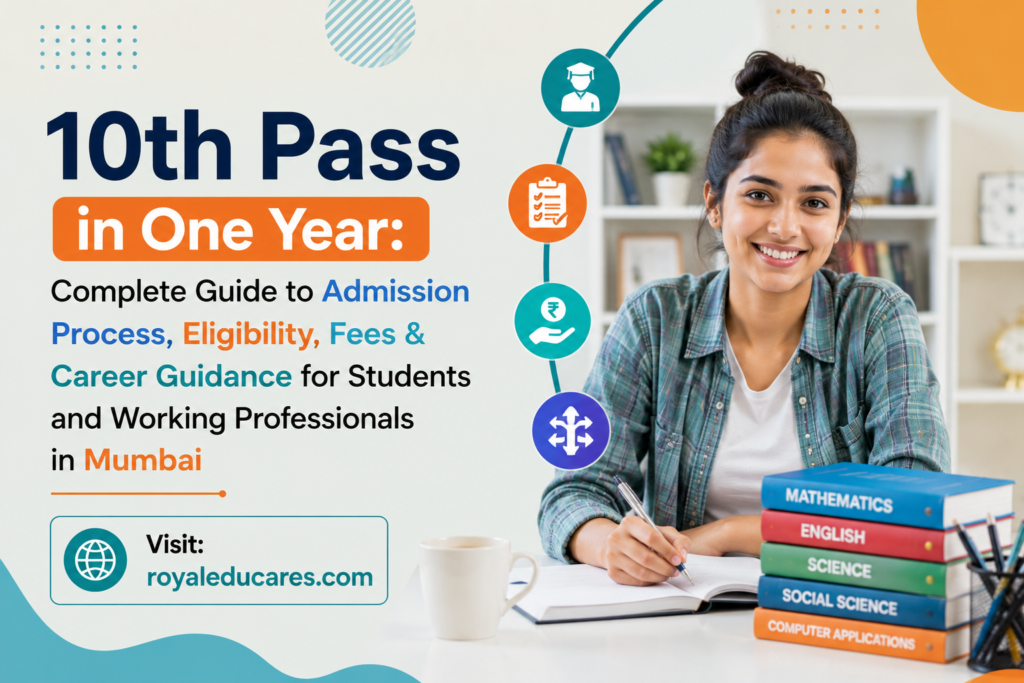
10th Pass in One Year: Complete Guide to Admission Process, Eligibility, Fees & Career Guidance for Students and Working Professionals in Mumbai
Introduction
Completing 10th education is an important milestone for students and working professionals seeking better career opportunities, higher education options, and personal growth through recognized educational pathways.
Accreditation & Approvals
UGC-DEB APPROVED
AICTE APPROVED
AIU APPROVED
NAAC +++ ACCREDITED

COBSE BOARDS
PHARMACY COUNCIL OF INDIA
BAR COUNCIL OF INDIA

WORLD EDUCATION SERVICES
MHRD
Get Free Career Counseling
Students looking for guidance regarding 10th Pass in One Year can explore detailed information through One Year 10th Completion Guidance in Mumbai at https://royaleducares.com/one-year-10th-completion-guidance-in-mumbai/
for eligibility, admission support, and educational counseling.
For complete education guidance, career counseling, distance education support, and higher education opportunities, students can also visit https://royaleducares.com/
to explore available academic pathways and professional assistance.
What Is 10th Pass in One Year?
The concept of completing the 10th standard in one year has become increasingly popular among students who could not continue their education due to personal, financial, family, health, or professional reasons.
Many students leave school after completing the 8th or 9th standard and later realize the importance of obtaining a secondary school qualification. Without a 10th qualification, opportunities for higher education, government jobs, vocational courses, diploma programs, and many private-sector careers become limited.
A One Year 10th Completion pathway provides eligible students with an opportunity to complete their secondary education and continue their academic journey without permanently losing valuable years.
This educational pathway is particularly beneficial for:
- School dropouts
- Working professionals
- Housewives
- Small business owners
- Students with family responsibilities
- Individuals seeking career growth
- Students who could not appear for board examinations
- Learners returning to education after a long gap
Today, educational flexibility has made it possible for many individuals to restart their academic journey and build a stronger future.
Why Is 10th Qualification Important?
Many students underestimate the importance of a 10th qualification until they begin searching for employment opportunities or higher education programs.
The reality is that the 10th standard serves as the foundation of almost every academic and professional pathway.
Without a 10th qualification, students may face challenges in:
- Applying for higher secondary education
- Pursuing diploma programs
- Enrolling in vocational training
- Applying for many government jobs
- Entering professional skill-development courses
- Building long-term career opportunities
A recognized 10th qualification creates opportunities that can significantly improve educational and professional prospects.
Benefits of Completing 10th Education
Access to Higher Education
After completing the 10th standard, students become eligible to pursue:
- 11th and 12th education
- Arts stream
- Commerce stream
- Science stream
- Diploma programs
- ITI courses
- Vocational education
- Technical certifications
Better Employment Opportunities
Many employers require at least a 10th qualification for entry-level positions.
Common opportunities include:
- Office Assistant
- Data Entry Operator
- Retail Executive
- Customer Support Executive
- Delivery Operations Staff
- Warehouse Assistant
- Security Staff
- Store Executive
Government Job Eligibility
Several government recruitment opportunities require candidates to possess a minimum educational qualification of 10th pass.
Completing secondary education can open the door to future government employment opportunities.
Improved Confidence
Many students who return to education after a gap often report improved confidence and self-esteem.
Completing the 10th standard demonstrates determination, commitment, and the ability to overcome challenges.
Who Can Apply for 10th Pass in One Year?
One of the biggest misconceptions among students is that educational opportunities end once they leave school.
This is not true.
Many students successfully complete their education after years of interruption.
The following categories of learners commonly seek admission guidance:
Students Who Left School After 8th or 9th
Students who could not continue their education due to financial difficulties, relocation, family circumstances, or personal reasons often look for opportunities to complete their 10th qualification.
Educational pathways may be available depending on eligibility requirements and academic background.
Students With a Long Educational Gap
A long gap in education does not necessarily mean the end of academic opportunities.
Many individuals return to education after several years and successfully complete their secondary qualifications.
The key requirement is proper guidance, eligibility assessment, and selecting the appropriate educational pathway.
Working Professionals
Many working professionals begin employment at a young age and later realize the importance of formal education.
A 10th qualification can help them:
- Apply for promotions
- Improve employment prospects
- Pursue higher studies
- Build long-term career growth
Housewives
Many homemakers choose to continue their education after managing family responsibilities.
Completing the 10th standard often becomes the first step toward personal and professional development.
Small Business Owners
Business owners frequently seek educational qualifications to improve communication skills, business management knowledge, and eligibility for future academic programs.
Common Reasons Students Leave School
Understanding why students leave school helps explain why one-year completion opportunities are important.
Financial Challenges
Many families face economic difficulties that force students to prioritize work over education.
Family Responsibilities
Students sometimes leave school to support family members or care for younger siblings.
Health Issues
Physical or personal health challenges may interrupt education temporarily or permanently.
Relocation
Frequent relocation due to family or employment circumstances can disrupt academic continuity.
Lack of Guidance
Many students discontinue education simply because they are unaware of available educational pathways.
Early Employment
Some students start working at a young age and postpone their education for several years.
Can Students Continue Education After a Long Gap?
This is one of the most searched questions among students.
The answer depends on educational history, documentation, eligibility, and the pathway selected.
In many cases, students who completed the 9th standard but could not continue further may still find educational opportunities to complete their secondary education.
Similarly, individuals who have experienced a long educational break often discover that restarting education is possible with proper counseling and guidance.
The most important factor is obtaining accurate information and understanding available options.
Many successful professionals today returned to education after several years and eventually completed their academic qualifications.
Is It Possible to Continue 12th and Graduation After Completing 10th?
A large number of students ask whether higher education becomes possible after completing the 10th qualification.
The answer is yes.
Once a student completes secondary education through an appropriate educational pathway, they may explore further studies based on eligibility requirements.
Future educational options can include:
- 12th Education
- Senior Secondary Programs
- Diploma Courses
- Skill Development Programs
- Professional Certifications
- Undergraduate Education
- Career-Oriented Courses
Higher education opportunities continue to expand as students progress academically.
Educational Gap? Don’t Assume Your Academic Journey Has Ended
One of the biggest mistakes students make is believing that a long educational gap permanently ends their future.
Education systems today recognize that learners come from different backgrounds and life situations.
Students may have left school because of:
- Financial problems
- Family commitments
- Employment responsibilities
- Health concerns
- Personal circumstances
Returning to education later in life is becoming increasingly common.
With proper guidance, many students successfully continue their studies and work toward better educational and career opportunities.
Individuals who completed the 9th standard and experienced a long gap often seek guidance regarding pathways that may help them complete their educational goals.
Similarly, students with significant academic interruptions frequently explore opportunities related to secondary education, senior secondary education, and graduation pathways based on their eligibility and documentation.
The most important step is consulting educational experts who can assess individual circumstances and recommend appropriate options.
Why More Students Are Searching for 10th Pass in One Year
Search trends show that more students than ever are looking for flexible educational solutions.
Common searches include:
- How to complete 10th after dropout
- 10th pass in one year
- SSC completion guidance
- Education after long gap
- Secondary education for working professionals
- School dropout education options
- Career opportunities after 10th
- 10th pass admission guidance
- 10th board completion
- 10th qualification for jobs
The growing demand reflects a simple reality:
People want a second chance to complete their education and improve their future.
A 10th qualification remains one of the most valuable educational milestones because it creates the foundation for future academic growth, employment opportunities, professional development, and lifelong learning.
Eligibility Criteria for 10th Pass in One Year
Before exploring admission opportunities, students should understand the importance of eligibility requirements. Educational pathways may differ depending on age, academic history, previous schooling, available documents, and individual circumstances.
Many students assume that they are no longer eligible to continue their education because they left school years ago. However, eligibility assessment often depends on multiple factors rather than educational gaps alone.
Educational counselors typically evaluate:
- Previous academic qualifications
- Last class successfully completed
- Available educational documents
- Age criteria
- Gap duration
- Individual educational goals
This is why proper guidance becomes essential before selecting any educational pathway.
Documents Commonly Required
Documentation plays an important role in the admission process. While requirements may vary depending on the educational route chosen, students are generally advised to keep their educational and identity documents ready.
Commonly required documents may include:
Academic Documents
- Previous school records
- School leaving certificate (if available)
- Bonafide certificate (if available)
- Last attended class proof
- Progress reports or mark sheets
Identity Documents
- Aadhaar Card
- PAN Card (if available)
- Driving License (if available)
- Passport (if available)
Address Proof
- Aadhaar Card
- Electricity Bill
- Voter ID
- Passport
Passport Size Photographs
Recent photographs are usually required for documentation and application purposes.
Students who are missing certain documents should seek professional guidance regarding alternative documentation possibilities and available options.
Step-by-Step Admission Process
Many students search online for:
- How to apply for 10th pass in one year
- Admission process for school dropouts
- 10th completion admission guidance
- SSC completion admission process
Understanding the admission journey can help reduce confusion and improve confidence.
Step 1: Educational Counseling
The first step is educational counseling.
During counseling, students discuss:
- Academic background
- Educational gaps
- Career goals
- Future study plans
- Available documents
This helps determine the most suitable educational route.
Step 2: Eligibility Assessment
After counseling, eligibility is evaluated based on:
- Previous schooling
- Age
- Documentation
- Educational objectives
This assessment helps students understand available opportunities and requirements.
Step 3: Documentation Verification
Documents are reviewed to ensure that the admission process proceeds smoothly.
Proper documentation can significantly reduce delays and complications.
Step 4: Admission Guidance
Students receive guidance regarding:
- Educational procedures
- Application formalities
- Academic planning
- Study strategy
This stage is particularly important for learners returning after a long educational break.
Step 5: Academic Preparation
After admission-related formalities are completed, students can begin preparing for their studies.
A structured study plan often improves performance and confidence.
Why Professional Guidance Matters
Students often make mistakes because they rely on incomplete or inaccurate information from social media, forums, or unofficial sources.
Professional guidance helps students:
- Understand eligibility
- Avoid documentation errors
- Select suitable pathways
- Create realistic study plans
- Continue higher education successfully
A small mistake at the beginning can sometimes create challenges later.
Therefore, obtaining proper educational guidance can save time and effort.
Understanding the Cost of Educational Completion
One of the most searched queries is:
“What are the fees for 10th completion?”
The answer depends on multiple factors including:
- Educational pathway selected
- Documentation requirements
- Academic support services
- Counseling assistance
- Examination-related requirements
Students should avoid selecting options based solely on cost.
Instead, they should focus on:
- Proper guidance
- Academic support
- Future educational opportunities
- Long-term career goals
Education should always be viewed as an investment in personal and professional growth.
How to Prepare for 10th Successfully
Many students worry about returning to studies after several years.
The good news is that success becomes much easier when preparation is systematic.
Create a Study Schedule
A structured study plan helps students remain consistent.
A practical schedule may include:
- Daily study sessions
- Weekly revision
- Subject-wise planning
- Mock tests
- Progress tracking
Consistency often matters more than studying for long hours.
Focus on Core Subjects
Students should prioritize important subjects and build strong conceptual understanding.
Instead of memorizing everything, learners should focus on understanding topics and practicing regularly.
Use Simple Learning Methods
Effective learning techniques include:
- Note-making
- Mind maps
- Question banks
- Practice papers
- Revision charts
Simple methods often produce better results than complicated study systems.
Practice Previous Questions
Question practice improves:
- Confidence
- Time management
- Accuracy
- Examination readiness
Regular practice can significantly reduce examination anxiety.
Study Tips for Working Professionals
Working professionals often believe they cannot continue education because of time constraints.
In reality, thousands of professionals successfully manage work and studies simultaneously.
Study Early Morning
Morning study sessions often provide better concentration and fewer distractions.
Use Small Time Blocks
Even 30–45 minutes of focused study daily can produce meaningful progress.
Weekend Revision
Weekends can be used for:
- Subject revision
- Practice questions
- Mock tests
- Doubt clearing
Stay Consistent
Consistency is more valuable than occasional long study sessions.
Common Mistakes Students Should Avoid
Many students unintentionally create obstacles during their educational journey.
Avoid these common mistakes:
Delaying Admission Decisions
Some students spend years thinking about returning to education without taking action.
Every year of delay postpones future opportunities.
Depending on Unverified Information
Educational decisions should not be based solely on:
- Social media posts
- WhatsApp messages
- Online rumors
Always seek reliable guidance before making decisions.
Ignoring Documentation
Documentation issues become more difficult to resolve later.
Students should organize all available records early.
Lack of Study Planning
Without a study plan, students often lose motivation and direction.
A structured schedule improves learning outcomes.
Can Working Professionals Complete Their Education?
This question is extremely common among individuals employed in:
- Retail
- Sales
- Customer service
- Manufacturing
- Logistics
- Hospitality
- Family businesses
The answer is that many working professionals successfully continue their education while maintaining employment.
Education often helps professionals:
- Improve career growth
- Increase earning potential
- Gain promotions
- Access better opportunities
- Build long-term security
Educational qualifications continue to play an important role in professional development.
Career Advantages of Completing 10th
Many people view 10th education merely as a certificate.
In reality, it represents much more.
Completing secondary education can help individuals:
Build Academic Foundations
The 10th qualification serves as a gateway to future studies.
Improve Employability
Many employers prefer candidates who have completed secondary education.
Access Skill Development Programs
Numerous skill-based courses require a minimum educational qualification.
Strengthen Communication Skills
The learning process itself improves reading, writing, analytical thinking, and communication.
Increase Self-Confidence
Educational achievement often improves personal confidence and motivation.
Popular Courses After 10th
Students frequently search:
- Best courses after 10th
- Career options after SSC
- Diploma courses after 10th
- Skill courses after 10th
Popular options include:
ITI Courses
Industrial Training Institute programs provide practical skill development in various trades.
Polytechnic Diploma Programs
These programs focus on technical and engineering-related education.
Computer Courses
Students often pursue:
- Basic computer training
- Advanced computer skills
- Office productivity software
- Digital skills
Vocational Courses
Vocational programs focus on job-oriented training and practical employability skills.
Language and Communication Courses
These courses help improve workplace communication and professional confidence.
Building a Long-Term Educational Roadmap
Students should view 10th completion as the beginning of a larger journey rather than the final destination.
A practical roadmap may include:
10th Completion → 12th Education → Professional Course → Graduation → Career Growth
This step-by-step approach helps students create sustainable academic and professional development.
Many successful professionals started with a simple decision:
“I want to complete my education.”
That single decision often transformed their future opportunities and career trajectory.
The key is to start, remain consistent, and continue progressing one educational milestone at a time.
Career Opportunities After Completing 10th
One of the most common questions students ask is:
“What can I do after completing 10th?”
The answer depends on individual interests, career goals, financial circumstances, and long-term educational plans.
Completing 10th opens the door to numerous academic and professional opportunities. Whether a student wants to continue higher education, pursue technical training, learn job-oriented skills, or start working, the 10th qualification serves as the first major milestone.
Students who complete their secondary education gain access to pathways that are generally unavailable without a recognized 10th qualification.
Why Completing 10th Can Change Your Career Direction
Many employers, training institutes, and educational organizations consider the 10th qualification as a minimum academic benchmark.
As a result, students who complete their 10th often experience:
- Better job opportunities
- Increased confidence
- Access to higher education
- Professional skill development
- Improved earning potential
- Eligibility for various training programs
Even if a student does not immediately pursue higher studies, having a 10th qualification creates flexibility for future career growth.
Best Educational Options After 10th
Students often search:
- What to do after 10th?
- Best course after 10th
- Career after SSC
- Higher education after 10th
- Diploma courses after 10th
Several educational routes become available after completing secondary education.
Option 1: Continue with 11th and 12th Education
For students planning long-term academic growth, continuing with higher secondary education is often the most common choice.
Students may choose from:
Arts Stream
Subjects commonly include:
- History
- Geography
- Political Science
- Sociology
- Psychology
- Economics
Arts can lead to careers in:
- Education
- Civil Services
- Journalism
- Social Work
- Public Administration
- Law
Commerce Stream
Commerce is popular among students interested in business and finance.
Subjects may include:
- Accountancy
- Economics
- Business Studies
- Mathematics
- Financial Management
Commerce can lead to careers in:
- Accounting
- Banking
- Finance
- Taxation
- Business Management
- Entrepreneurship
Science Stream
Science is suitable for students interested in technical, healthcare, and research-related fields.
Science can eventually lead to:
- Engineering
- Medical Education
- Pharmacy
- Biotechnology
- Research
- Computer Science
Option 2: Diploma Courses After 10th
Many students prefer practical and technical education through diploma programs.
Diploma courses are designed to provide industry-oriented knowledge and skills.
Popular diploma areas include:
- Mechanical Engineering
- Civil Engineering
- Electrical Engineering
- Computer Engineering
- Automobile Engineering
- Electronics Engineering
Diploma education can provide a faster route into technical careers.
Option 3: ITI Courses After 10th
Industrial Training Institute (ITI) programs remain highly popular among students seeking skill-based careers.
ITI courses emphasize practical learning and employability.
Popular trades include:
- Electrician
- Fitter
- Welder
- Mechanic
- Wireman
- Plumber
- Turner
- Refrigeration Technician
ITI programs often help students develop job-ready skills in a shorter duration.
Option 4: Skill Development Courses
The modern job market increasingly values practical skills.
Students can explore skill-development programs such as:
- Computer Applications
- Digital Marketing
- Graphic Designing
- Video Editing
- Web Designing
- Data Entry Skills
- Office Administration
- Communication Skills
These skills can support both employment and self-employment opportunities.
Government Job Opportunities After 10th
Many students search for:
- Government jobs after 10th
- SSC jobs after 10th
- Sarkari jobs for 10th pass
- Government vacancy for 10th pass students
A 10th qualification can make candidates eligible for various entry-level opportunities depending on recruitment rules and official eligibility criteria.
Potential opportunities may include roles related to:
- Railways
- Postal Services
- Public Sector Units
- State Government Departments
- Municipal Departments
- Security Services
- Support Staff Positions
Recruitment requirements vary from one notification to another, so students should always verify official eligibility conditions before applying.
Private Sector Opportunities After 10th
The private sector offers a wide range of opportunities for candidates with secondary education qualifications.
Common fields include:
Retail Industry
Retail organizations frequently hire candidates for:
- Store Operations
- Customer Assistance
- Sales Support
- Inventory Management
Customer Service
Customer service roles often involve:
- Communication
- Problem Solving
- Customer Support
These positions help individuals gain valuable professional experience.
Logistics and Warehousing
With the growth of e-commerce, logistics opportunities continue to increase.
Possible roles include:
- Warehouse Operations
- Inventory Support
- Dispatch Assistance
- Logistics Coordination
Hospitality Industry
Hotels, restaurants, and service organizations regularly recruit candidates for various operational roles.
Self-Employment Opportunities After 10th
Not every student wants to pursue a traditional job.
Many individuals prefer entrepreneurship and self-employment.
Completing 10th can help build confidence and provide the educational foundation needed for business growth.
Examples include:
- Retail Business
- Online Selling
- Service-Based Businesses
- Freelancing
- Local Trading
- Digital Services
Educational qualifications often improve business communication, documentation, and management skills.
Digital Careers After 10th
The digital economy has created opportunities that did not exist a few years ago.
Students interested in technology can learn skills such as:
Digital Marketing
Digital marketing remains one of the fastest-growing skill areas.
Students can learn:
- Search Engine Optimization (SEO)
- Social Media Marketing
- Content Marketing
- Google Ads
- Online Branding
Graphic Design
Graphic designers create visual content for:
- Businesses
- Websites
- Advertisements
- Social Media Platforms
Video Editing
Video content continues to grow rapidly across industries.
Video editing skills are increasingly valuable in the digital marketplace.
Website Development
Basic web development skills can help students build websites and support online businesses.
Career Planning for Working Professionals
Working professionals who complete their 10th education often have different goals compared to younger students.
Common objectives include:
- Career advancement
- Promotion opportunities
- Better salaries
- Higher education eligibility
- Professional development
For working professionals, completing 10th is often the first step toward a larger educational roadmap.
The Importance of Continuing Beyond 10th
While completing 10th is a significant achievement, students should ideally continue their education whenever possible.
Long-term educational growth can create better opportunities in:
- Employment
- Business
- Professional careers
- Government services
- Entrepreneurship
Higher educational qualifications often increase career flexibility and earning potential.
Can Students Pursue 12th After Completing 10th?
Yes.
Many students continue their educational journey after completing secondary education.
The 12th qualification can further improve opportunities related to:
- Undergraduate education
- Professional courses
- Diploma programs
- Competitive examinations
- Career advancement
For this reason, many educational counselors encourage students to plan beyond the 10th level.
What Happens After 12th?
A common concern among students is:
“If I complete 10th and later complete 12th, what comes next?”
After 12th, students may explore various higher education opportunities depending on eligibility and career goals.
Popular undergraduate pathways include:
- Bachelor of Arts (BA)
- Bachelor of Commerce (B.Com)
- Bachelor of Business Administration (BBA)
- Bachelor of Computer Applications (BCA)
- Bachelor of Science (B.Sc)
- Bachelor of Social Work (BSW)
- Bachelor of Management Studies (BMS)
The choice depends on the student’s interests and future objectives.
One-Year Graduation Opportunities for Eligible Candidates
Many students and working professionals eventually search for:
- Graduation in one year
- Degree completion programs
- Fast-track graduation pathways
- Educational solutions for long academic gaps
Individuals who have experienced educational interruptions often explore pathways that may help them complete their academic goals more efficiently, subject to eligibility requirements, academic records, and documentation.
Because every case is unique, professional educational counseling becomes extremely important before making decisions regarding higher education.
Students should always obtain proper guidance regarding available opportunities, eligibility criteria, and future academic planning.
Success Begins with One Educational Decision
Every year, countless students believe that their educational journey has ended because of:
- School dropout situations
- Financial difficulties
- Family responsibilities
- Employment commitments
- Long academic gaps
However, many successful individuals have proven that education can be restarted.
The first step is often the most important:
Completing the 10th qualification and rebuilding academic confidence.
Once this milestone is achieved, students can continue progressing toward:
- 12th Education
- Professional Certifications
- Diploma Programs
- Skill Development Courses
- Undergraduate Degrees
- Career Advancement
Education is not simply about obtaining certificates.
It is about creating opportunities, improving confidence, developing skills, and building a stronger future.
The decision to complete your 10th education today can become the foundation for everything you achieve tomorrow.
Future Scope After Completing 10th
Completing the 10th standard is not the end of an educational journey—it is the beginning of numerous opportunities that can influence a student’s academic, professional, and personal growth.
Many students who once believed they had lost valuable years later discovered that completing their 10th qualification allowed them to restart their educational journey with confidence.
Whether the goal is higher education, a better job, skill development, entrepreneurship, or long-term career growth, the 10th qualification serves as the foundation upon which future success can be built.
A Complete Educational Roadmap After 10th
One of the most important aspects of career planning is understanding the path ahead.
Students often focus only on the immediate goal of completing the 10th standard without considering the opportunities that follow.
A structured roadmap can help students make informed decisions.
Stage 1: Complete 10th Education
The first milestone is obtaining a recognized secondary education qualification.
This qualification helps students:
- Continue higher studies
- Improve employability
- Access technical courses
- Explore vocational education
- Build academic confidence
Stage 2: Pursue 12th Education
After completing the 10th standard, students can continue toward higher secondary education.
Depending on interests and future plans, students may choose:
- Arts
- Commerce
- Science
The 12th qualification significantly expands higher education opportunities.
Stage 3: Professional Courses and Skill Development
Students may choose to strengthen their skills through professional certifications and practical training programs.
Examples include:
- Computer Applications
- Digital Marketing
- Graphic Designing
- Accounting
- Office Administration
- Data Analytics
- Web Development
- Communication Skills
- Business Management
Modern employers increasingly value practical skills alongside educational qualifications.
Stage 4: Graduation
Graduation remains one of the most important educational milestones for career growth.
Popular bachelor’s degree options include:
- BA
- B.Com
- BBA
- BCA
- B.Sc
- BSW
- BMS
Graduation can improve career opportunities across both government and private sectors.
Stage 5: Higher Education and Specialization
After graduation, students may continue with:
- MBA
- M.Com
- MA
- MCA
- M.Sc
- Professional Certifications
- Industry-Specific Training Programs
Higher qualifications often support leadership roles and specialized career opportunities.
Educational Gap Does Not Define Your Future
One of the biggest misconceptions among students is that a long educational gap permanently damages their future.
In reality, many successful professionals, entrepreneurs, and skilled workers returned to education after several years.
Students may experience educational interruptions because of:
- Financial difficulties
- Family responsibilities
- Employment commitments
- Health-related issues
- Personal circumstances
These challenges do not necessarily prevent future academic success.
What matters most is taking the next step toward completing educational goals.
Long Gap After 9th? Educational Guidance May Still Be Available
A common question students ask is:
“I completed 9th many years ago. Can I still continue my education?”
Many students who discontinued studies after the 9th standard seek educational guidance after long gaps.
Every student’s situation is unique and depends on factors such as:
- Academic history
- Age
- Available documents
- Educational objectives
- Eligibility requirements
Proper counseling helps students understand available pathways and identify suitable options based on their individual circumstances.
This is why educational guidance is often the first and most important step.
Long Academic Gap and Future Education Planning
Students who have experienced extended educational interruptions often worry about whether they can continue toward higher studies.
In many situations, learners explore pathways related to:
- Secondary Education
- Senior Secondary Education
- Diploma Programs
- Undergraduate Education
Depending on eligibility and documentation, educational counselors can help students understand potential opportunities and future planning options.
The most important lesson is simple:
A gap in education does not always mean the end of education.
Importance of Career Counseling
Career decisions should never be based solely on assumptions or incomplete information.
Professional career counseling helps students:
- Understand educational options
- Identify strengths and interests
- Plan future studies
- Explore career opportunities
- Avoid common mistakes
- Build realistic academic goals
Students who receive proper guidance often make better long-term decisions.
Why Students Should Avoid Educational Myths
Many students delay important decisions because they believe common myths.
Myth 1: “I Am Too Old to Continue Education”
Reality:
People continue education at various stages of life.
Learning is not restricted by age.
Myth 2: “A Long Gap Means I Cannot Study Again”
Reality:
Many learners return to education after significant gaps and continue successfully.
Myth 3: “Only Full-Time Students Can Succeed”
Reality:
Working professionals, homemakers, business owners, and part-time learners also complete educational milestones successfully.
Myth 4: “Education Is Only for Jobs”
Reality:
Education improves:
- Knowledge
- Confidence
- Communication
- Decision-making
- Personal development
Its value extends beyond employment opportunities.
Skills Students Should Develop Alongside Education
Educational qualifications are important, but skills also play a major role in career growth.
Students should continuously improve:
Communication Skills
Strong communication helps in interviews, workplaces, businesses, and professional networking.
Computer Skills
Basic computer knowledge is increasingly essential in modern workplaces.
Problem-Solving Skills
Employers value individuals who can identify and solve challenges effectively.
Time Management
Managing time efficiently improves both academic and professional performance.
Digital Literacy
Understanding digital tools can create new opportunities in education and employment.
Frequently Asked Questions
Is Completing 10th Important for Career Growth?
Yes.
The 10th qualification serves as the foundation for higher education, skill development, and various employment opportunities.
Can Working Professionals Continue Their Education?
Many working professionals successfully continue their education while maintaining their careers.
Proper planning and consistency are often the key factors.
What Can Students Do After Completing 10th?
Students can explore:
- 11th and 12th Education
- Diploma Programs
- ITI Courses
- Skill Development Courses
- Professional Certifications
- Career-Oriented Training
Does a Long Educational Gap Mean the End of Academic Opportunities?
Not necessarily.
Many students return to education after long interruptions and continue building their academic qualifications.
Why Is Career Counseling Important?
Career counseling helps students understand available opportunities and make informed educational decisions.
Can Education Improve Employment Opportunities?
Educational qualifications often improve eligibility for a wider range of career opportunities and professional growth.
Final Thoughts
Completing the 10th standard is one of the most important educational achievements for students and working professionals seeking a better future.
Whether someone left school because of financial challenges, family responsibilities, health concerns, employment commitments, or personal circumstances, restarting education can open new possibilities.
A recognized 10th qualification creates opportunities for:
- Higher Education
- Professional Development
- Skill Enhancement
- Better Employment Prospects
- Personal Growth
- Long-Term Career Advancement
Students should remember that educational success is not determined by how quickly a journey is completed but by the decision to continue moving forward.
Many individuals who once believed their educational journey had ended later completed their studies, improved their careers, and transformed their lives.
The first step is often the most important.
By completing the 10th standard and planning future educational goals carefully, students and working professionals can create a strong foundation for lifelong learning, career growth, and personal success.
Education remains one of the most valuable investments a person can make, and every milestone achieved today can create opportunities for a brighter tomorrow.
Detailed Admission Guidance for Students Seeking 10th Completion
Many students spend months searching for answers online before taking the first step toward completing their education. Common searches include:
- How to complete 10th after a long gap
- 10th admission guidance
- School dropout education options
- Can I complete 10th after leaving school?
- Education after 9th dropout
- 10th pass opportunities for working professionals
The truth is that every student’s situation is different. Educational background, available documents, age, career goals, and future plans all play a role in determining the most suitable educational pathway.
This is why students should focus on obtaining proper guidance rather than relying on assumptions.
Why Students Delay Their Educational Comeback
A large number of students genuinely want to continue their education but delay taking action because of uncertainty.
Some common reasons include:
Fear of Failure
Many students worry that they have forgotten what they studied years ago.
In reality, most learners regain confidence once they restart their studies and follow a structured learning plan.
Fear of Age Difference
Students often think:
“I am older now. Is it too late?”
Education is not restricted by age.
Many individuals continue their education while working, managing businesses, or supporting families.
Lack of Information
Sometimes students simply do not know what options are available.
As a result, they postpone decisions that could positively impact their future.
Lack of Confidence
Long educational gaps can reduce confidence.
However, confidence usually returns once students begin progressing toward their academic goals.
Academic Gap Case Studies: Common Student Situations
The following examples represent situations frequently discussed during educational counseling.
Situation 1: Left School After 9th Standard
Many students complete 9th and then discontinue their education because of family circumstances, relocation, employment, or financial difficulties.
Years later, they decide to continue their studies.
Such students often seek guidance regarding available educational pathways and future academic planning.
Situation 2: Working Professional Without 10th Qualification
Some individuals begin working at a young age and spend several years in employment.
Eventually, they realize that educational qualifications can improve career growth and promotion opportunities.
For these learners, completing 10th becomes a valuable career investment.
Situation 3: Homemaker Returning to Education
Many homemakers choose to restart their education after managing family responsibilities.
Completing 10th often becomes the first milestone toward personal development and future educational advancement.
Situation 4: Business Owner Seeking Educational Growth
Entrepreneurs and small business owners sometimes return to education because they want to improve communication, management, and professional skills.
Educational qualifications can contribute positively to business development and confidence.
How Educational Counseling Helps Students
Professional counseling is important because it helps students avoid confusion and misinformation.
A counseling session typically focuses on:
- Educational background assessment
- Academic goals
- Career planning
- Documentation review
- Future education roadmap
- Long-term development strategy
The purpose is to provide clarity and direction.
Many students feel significantly more confident after understanding their available options.
Building an Effective Study Strategy
Success in education is rarely about intelligence alone.
In most cases, success comes from consistency and planning.
Students returning after a long gap should focus on developing a realistic study strategy.
Set Clear Goals
Students should define their objectives clearly.
Examples:
- Complete 10th qualification
- Continue toward 12th education
- Improve career opportunities
- Prepare for future graduation
- Pursue professional certifications
Clear goals help maintain motivation.
Create a Weekly Study Plan
Rather than studying irregularly, students should establish a weekly routine.
A balanced schedule might include:
- Daily learning sessions
- Weekly revisions
- Practice exercises
- Self-assessment activities
Consistency creates long-term results.
Focus on Understanding Concepts
Memorization alone is not enough.
Students should focus on:
- Understanding topics
- Applying knowledge
- Practicing questions
- Revising regularly
Conceptual learning improves retention and confidence.
Time Management Tips for Working Professionals
Working professionals often struggle to balance employment and education.
The following strategies can help.
Morning Study Sessions
Many learners find that early mornings provide the best concentration.
Short Daily Sessions
Studying for 45–60 minutes consistently is often more effective than studying for several hours occasionally.
Weekend Preparation
Weekends can be used for:
- Revision
- Practice
- Planning
- Progress evaluation
Avoid Procrastination
Small daily efforts eventually produce significant results.
How Completing 10th Improves Future Opportunities
The benefits of completing 10th extend beyond obtaining a certificate.
A recognized secondary qualification can support:
- Academic progression
- Professional growth
- Skill development
- Career advancement
- Personal confidence
Education often creates opportunities that would otherwise remain unavailable.
Understanding the Importance of 12th Education
Students frequently ask:
“Should I stop after 10th?”
While completing 10th is a major achievement, continuing toward 12th can provide additional benefits.
The 12th qualification often serves as the gateway to:
- Undergraduate education
- Professional courses
- Competitive examinations
- Specialized training programs
Students who plan long-term educational growth should consider future academic progression.
Graduation and Career Development
After completing higher secondary education, many students explore graduation opportunities.
A bachelor’s degree can improve:
- Employment opportunities
- Professional credibility
- Career growth
- Leadership potential
Popular graduation pathways include:
- BA
- B.Com
- BBA
- BCA
- B.Sc
- BSW
- BMS
The appropriate choice depends on individual interests and goals.
Education and Career Success: The Real Connection
Many people believe educational qualifications alone guarantee success.
In reality, success results from a combination of:
- Education
- Skills
- Consistency
- Communication
- Professionalism
- Continuous learning
Education provides the foundation, while skills and experience help individuals build successful careers.
Importance of Skill Development Alongside Education
Students should continuously improve practical skills while pursuing academic qualifications.
Valuable skills include:
Computer Literacy
Computer knowledge is useful in almost every industry.
Communication Skills
Strong communication improves interviews, workplace performance, and business interactions.
Digital Skills
Modern employers increasingly value digital literacy.
Problem-Solving Ability
Organizations appreciate employees who can identify and solve challenges effectively.
Adaptability
The ability to learn and adapt is becoming one of the most valuable professional skills.
Frequently Asked Questions About Educational Gaps
Can I Continue Education After Many Years?
Many students return to education after significant interruptions. Individual eligibility depends on academic history, documentation, and educational objectives.
Is Age a Barrier to Education?
Learning can continue throughout life. Students of different age groups regularly pursue educational goals.
Can Working Professionals Continue Studying?
Many working professionals successfully balance education and employment through proper planning and consistency.
Why Should I Complete My Education?
Education can improve confidence, knowledge, employability, and access to future opportunities.
Is Educational Counseling Helpful?
Professional guidance often helps students make informed decisions and avoid unnecessary confusion.
The Biggest Mistake Students Make
The biggest mistake is waiting for the “perfect time.”
Many students spend years thinking about continuing their education but never take action.
The perfect time rarely arrives.
Progress begins when students make a decision and start moving forward.
Even a small step today can create significant opportunities tomorrow.
Final Career Guidance for Students and Working Professionals
Whether you are:
- A school dropout
- A working professional
- A homemaker
- A business owner
- A learner returning after a long educational gap
The most important thing to remember is that educational growth remains possible when supported by proper planning and guidance.
Completing 10th can become the first step toward:
- 12th Education
- Professional Certifications
- Diploma Programs
- Skill Development
- Graduation
- Career Advancement
Many successful individuals began their comeback by making one simple decision:
To continue their education and invest in their future.
That decision often became the turning point that helped them unlock new opportunities, achieve professional growth, and build greater confidence in themselves and their abilities.
Top 50 Frequently Asked Questions About 10th Pass in One Year
1. What is a One Year 10th Completion Program?
It is an educational pathway that helps eligible students continue their secondary education and work toward obtaining a recognized 10th qualification based on applicable rules and eligibility criteria.
2. Who can apply for 10th completion guidance?
Students, working professionals, homemakers, business owners, and individuals with educational gaps often seek guidance regarding available educational opportunities.
3. Is 10th qualification important?
Yes. The 10th qualification serves as the foundation for higher education, skill development programs, vocational training, and various employment opportunities.
4. Can I continue my studies after a long educational gap?
Many students return to education after long gaps. Available opportunities depend on academic background, documentation, and eligibility.
5. Can working professionals continue education?
Yes. Many working professionals pursue education while continuing their jobs.
6. What documents are generally required?
Requirements may vary, but students are often asked to provide identity proof, educational records, photographs, and supporting documents.
7. Can homemakers continue their education?
Many homemakers successfully return to education and continue their academic journey.
8. Why should I complete my 10th qualification?
Completing 10th can improve access to higher education, professional courses, and career opportunities.
9. Can education improve career growth?
Educational qualifications often support long-term professional development.
10. Is educational counseling necessary?
Proper guidance can help students understand options and make informed decisions.
Diploma vs 12th vs Skill Courses After 10th
One of the most searched questions online is:
“What should I do after completing 10th?”
The answer depends on career goals.
Option 1: Continue With 12th Education
Best For:
- Students planning graduation
- Competitive exam aspirants
- Long-term academic growth
Advantages:
- Strong academic foundation
- Access to bachelor’s degree programs
- Better higher education opportunities
Option 2: Diploma Programs
Best For:
- Technical careers
- Engineering-related fields
- Practical learning
Advantages:
- Industry-focused learning
- Technical knowledge
- Job-oriented education
Option 3: Skill Development Courses
Best For:
- Fast skill acquisition
- Career-oriented training
- Employment-focused learning
Examples:
- Digital Marketing
- Graphic Designing
- Web Development
- Computer Applications
- Data Entry Skills
High-Demand Skills Students Can Learn After 10th
Modern employers increasingly prioritize skills.
Popular skill areas include:
Computer Skills
Basic computer knowledge is valuable in nearly every industry.
Digital Marketing
A rapidly growing field involving:
- SEO
- Social Media Marketing
- Content Marketing
- Online Advertising
Graphic Designing
Graphic design skills are useful across multiple industries.
Video Editing
Video content continues to expand across business and media sectors.
Website Development
Website creation and management skills remain highly valuable.
Communication Skills
Strong communication improves employability and professional growth.
Educational Planning for Long-Term Success
Students should not focus only on obtaining a certificate.
Instead, they should develop a complete educational roadmap.
A practical roadmap could look like:
Step 1
Complete 10th Education
↓
Step 2
Continue Toward 12th Education
↓
Step 3
Develop Professional Skills
↓
Step 4
Pursue Graduation
↓
Step 5
Build a Professional Career
This structured approach can help students achieve sustainable long-term growth.
Why Employers Value Educational Qualifications
Employers often look for candidates who demonstrate:
- Commitment
- Discipline
- Learning ability
- Communication skills
- Professional development
Completing educational milestones shows dedication toward personal growth.
Common Challenges Faced by Students Returning to Education
Many students experience concerns such as:
Fear of Studies
Students worry they have forgotten subjects.
Regular practice usually helps rebuild confidence.
Lack of Time
Working professionals often struggle with scheduling.
A structured study plan can help.
Self-Doubt
Many learners underestimate their capabilities.
Consistent effort often produces significant improvement.
Information Overload
Students frequently receive conflicting advice from different sources.
Professional guidance helps reduce confusion.
Success Habits of Students Who Complete Their Education
Students who successfully achieve their educational goals often share similar habits.
Consistency
They study regularly.
Discipline
They follow a schedule.
Goal Setting
They maintain clear objectives.
Continuous Learning
They seek new knowledge and skills.
Positive Mindset
They focus on solutions rather than obstacles.
Career Growth After Completing Education
Educational qualifications often contribute to:
- Better employment opportunities
- Career advancement
- Professional development
- Skill enhancement
- Personal confidence
The more students invest in learning, the greater their future opportunities can become.
Building Confidence Through Education
Education does more than improve employability.
It also strengthens:
- Confidence
- Communication
- Decision-making
- Problem-solving
- Personal development
Many students report increased self-esteem after completing important educational milestones.
Long-Term Benefits of Completing 10th
A recognized 10th qualification can help students:
Continue Higher Education
Providing access to future academic opportunities.
Learn Professional Skills
Supporting employability and career growth.
Improve Career Prospects
Opening doors to new opportunities.
Build Personal Confidence
Helping individuals achieve personal goals.
Strengthen Future Planning
Creating a foundation for lifelong learning.
Conclusion
Completing the 10th standard is one of the most important steps a student or working professional can take toward building a stronger future.
Whether someone left school because of financial challenges, family responsibilities, health concerns, work commitments, or personal circumstances, educational growth can still remain an achievable goal with the right guidance and planning.
A 10th qualification is not merely a certificate. It is a gateway to:
- Higher Education
- Skill Development
- Professional Growth
- Career Opportunities
- Personal Confidence
- Long-Term Success
Students who complete their secondary education often gain access to a wider range of academic and professional pathways, allowing them to continue progressing toward their goals.
The most important lesson is simple:
Your educational journey does not have to end because of a gap, setback, or delay.
With determination, proper guidance, and a commitment to learning, students and working professionals can continue building their qualifications, developing their skills, and creating new opportunities for the future.
Every educational milestone achieved today can become the foundation for greater success tomorrow.
Contact Royal Educares
Royal Educares
Education Guidance & Admission Support Across India
 Website:
https://royaleducares.com/
 Email:
info@royaleducares.com
 Phone:
+91 9819649369
 Address:
9/D-1, Office No. 005, Sangharsh Nagar, Chandivali, Powai, Mumbai, Maharashtra 400072, India
 GET DIRECTION
Google Map
Start your Admission Today!
Let Us Help You Choose the Right Course for Your Future.